Key Takeaways
- A workable MOQ for custom silicone drinkware is usually 500-3,000 pcs, with tooling from USD 180-800 depending on mold complexity.
- A serious silicone water bottles manufacturer should show REACH, LFGB, FDA, and ISO 9001 documentation, plus batch traceability by lot.
- Lead time is usually 20-35 days after sample approval; shipping to Europe or North America adds 18-35 days by sea.
- For a retail-ready canteen customized program, budget USD 2.20-6.80 FOB depending on size, structure, and decoration method.
If you are sourcing from a silicone water bottles manufacturer, the first mistake is treating it like a color-and-logo job. It is not. A silicone bottle can be a full silicone body, a silicone sleeve on a stainless core, or a hybrid canteen build with a different seal stack and print method. Those choices move unit price, leak rate, freight weight, and the margin your buyer still has after duty.
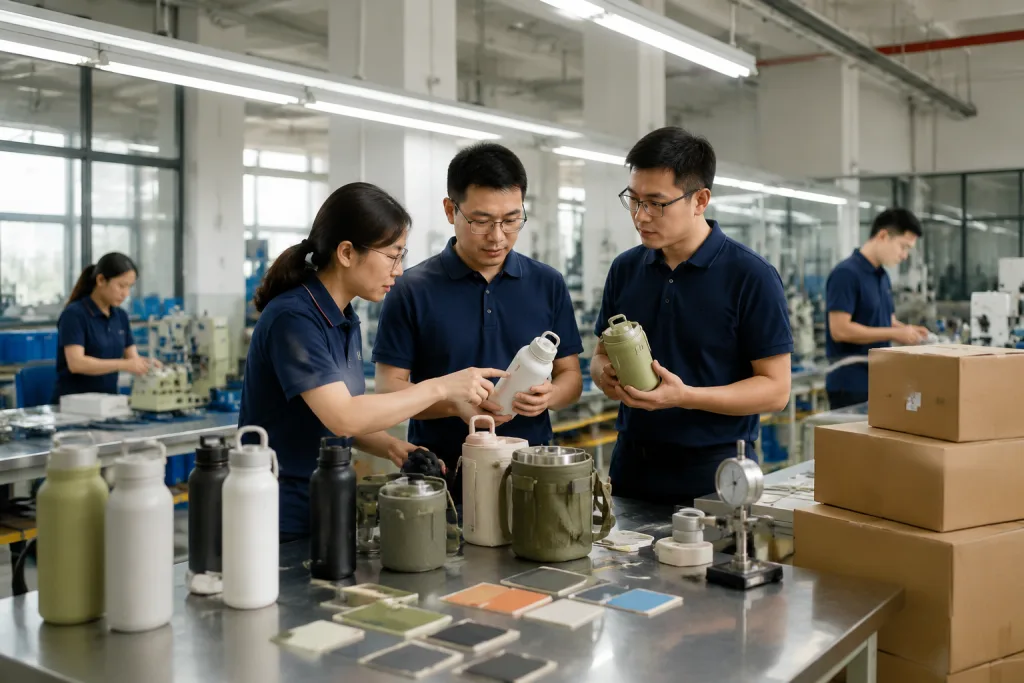
For B2B drinkware buyers, the job is picking the drinkware you can actually sell, not the sample that photographs well. We run this every week in Zhejiang. Factories will send a quote in 24 hours, but you still need to check food-contact compliance, tooling cost, MOQ, and whether the canteen manufacturer can hold wall thickness, hardness, and odor control at scale. QC pulled a sample at 2.1 mm last month, and the buyer flagged a faint rubber note. The math doesn't work if you skip that step.
Start With the Bottle Structure
The first decision is not logo placement. It is structure. A silicone water bottles manufacturer will usually quote three builds: full silicone collapsible bottles, stainless-and-silicone hybrids, and rigid canteen customized designs with a silicone sleeve or lid part. They run differently on the line, in cartons, and at the end user’s desk. Full silicone saves space and ships light, but if the wall is too soft, it folds crooked and feels cheap in hand. Hybrid bottles hold shape better and look cleaner for premium custom drinkware, but they add parts, extra QC, and one more place for the buyer to flag a leak. We’ve seen that go sideways.
Ask for wall thickness in millimeters, not just volume. For one 500 ml sample we ran, 1.8-2.2 mm worked on the collapsible body; sleeve parts at 2.0-3.0 mm stayed stable after compression testing with a caliper on the bench. If the vendor dodges numbers, stop there. A proper canteen factory in Zhejiang should also state whether the silicone is platinum-cured or peroxide-cured, because odor, clarity, and cure residue do not behave the same. The math doesn’t work if the PO only says “soft feel” and leaves the spec loose. QC pulled the sample again after 18 days in storage, and the buyer flagged the smell, not the color.
- Full silicone: lowest pack size, easiest to ship, and a strong fit for tight cartons
- Hybrid build: better shelf presence, tighter cap sealing, and less body collapse in transit
- Silicone sleeve: a safer entry point for distributor drinkware programs with lower MOQ risk
Match Capacity To Channel
Capacity looks simple. It is not. A gym distributor sat on a 750 ml line while a 550 ml bottle cleared in 18 days because the shelf slot and hand feel were wrong for that channel. On our line, 500-600 ml fits daily carry, 750 ml works for commuting and training, and 1,000 ml suits promo packs or hiking bundles. For canteen promotional items, the bigger size still moves, but freight cube and shelf width climb fast. We run the tape check at 240 mm every time.
The real question is where the bottle sits in the channel. On an Amazon-style listing, a compact shape with packed height under 240 mm usually wins because carton math and storage stay clean. For brick-and-mortar, a canteen custom line with strong color blocking and a rigid base reads better on the shelf. We ran a 3-color sample last month with one lid system and two sizes, and the buyer flagged the 280 mm pack height before we booked foam inserts. Fair call. The caliper does not lie.
Do not let a canteen supplier push too many capacities at launch. Three SKUs is enough for most first orders. We have seen this go sideways when a buyer added four sizes, then QC pulled the sample and the PO had one typo on the lid code. The math does not work after that. MOQ jumps, and the line starts chasing parts instead of shipping.
Check Compliance Before Sampling
Compliance burns time fast. Before you sign off a sample from a silicone water bottles manufacturer, ask for current test reports, not screenshots from last year’s PDF. For Europe, we want food-contact papers that line up with LFGB and REACH. For North America, ask for FDA food-contact declarations, and if the bottle has a metal hook or cap ring, check the coating too. One buyer once sent us a PO with “silicon bottle” typed three times; QC still had to stop the line because the file trail did not match the carton mark.
A practical check list helps:
- Material confirmation: food-grade silicone, not generic rubber language
- Odor test: low smell after 24 hours at room temperature
- Leak test: inverted hold for 24 hours, then pressure and drop checks
- Heat tolerance: verify the lid and seal at 100 C if the bottle is meant for hot fill
- Traceability: batch code, production date, and packing lot
We treat compliance as a gate, not a file folder. The math does not work any other way. A Zhejiang canteen manufacturer that runs lot-based records can show the test report, the 18 mm seal spec, and the batch code in one shot, which saves you from customs questions and retailer forms later. QC pulled the sample, checked the odor again, and signed off only after the labels matched the packing lot.
Decide Your Branding Method
Branding can move margin fast on customizable drinkware. On silicone, we run silkscreen, pad print, laser on metal parts, and debossing or embossing on the body. A clean logo on a soft wall usually points to debossing. The finish lasts better than print, but it means a mold change and the MOQ gets tighter. Silkscreen costs less on a 1,000-piece short run. It also scratches once the bottle goes through a dishwasher or gets flexed on the line.
Do not pick decoration by taste. That is the wrong question. Pick it by use case, then by cost. For a custom growler or customized growler style bottle sold in premium retail, laser on a stainless cap or ring gives the product a sharper read at shelf distance. For a canteen promotional item, one-color silkscreen is usually the fastest route we ship. On canteen customizable programs, ask for artwork limits in mm, Pantone tolerance, and print life after 50 dishwasher cycles. We had a buyer flag a PO once because the logo width was written as 38 cm instead of 38 mm; QC pulled the sample and caught it before mass production.
Do not approve decoration from a mockup alone. Ask for a physical sample with the exact substrate, exact color, and exact finishing method you will buy. The math does not work any other way.
Budget Around Real FOB Costs
Price talk goes nowhere until you split the cost drivers. We run this every week on the line. A silicone water bottles manufacturer will quote on material grade, mold count, print method, packaging, and MOQ. For a plain 500 ml custom drinkware bottle, FOB China usually sits around USD 2.20-3.40 at 1,000 pcs. A hybrid build with a custom lid and premium box can move to USD 4.50-6.80. New mold? That is a one-time USD 180-800, and cavity count changes the bill fast.
Buyers need a full cost sheet. This is the right question, not the glossy unit price. Split tooling from the piece price. Split the bottle from the insert card, polybag, and master carton. QC pulled a sample last month and found a PO typo on the carton count; the buyer flagged it before we ship, and it saved a mess. A canteen vendor that gives one lump quote is hiding the math. For China sourcing into retail or corporate channels, the gap between FOB Ningbo, FOB Shanghai, and a truck rate inside Zhejiang can beat a small unit discount.
Packing matters too. We ship 24 or 48 pcs per carton only when the silicone wall can stay under compression without deformation. On a 390 x 320 x 280 mm outer carton, the freight math can improve by 5-12 percent if the shape holds. That is not a side note. It is margin.
Ask For Factory Proof, Not Promises
You are not buying an Instagram sample. You are choosing a canteen factory that has to repeat the same result 10,000 times without drama. Ask for monthly capacity, current line count, and whether they run in-house molding, assembly, and packing. On our Zhejiang line, the press list sits on a whiteboard by the molding room, and a real plant should give hard numbers: 250,000-400,000 units per month across drinkware lines, with 20-35 day lead time after sample sign-off for standard builds. If they dodge that, the math does not work.
For B2B drinkware, factory proof should include BSCI or other social audit records if your channel needs them, plus QA methods like AQL 2.5 for critical defects and AQL 4.0 for minor visual issues. Ask how they test seals, lid torque, and drop resistance. QC pulled the sample on a torque wrench last week and found one lid at 0.8 N·m instead of the target. That is the kind of miss that turns into a buyer complaint later. Ask whether their canteen supplier team can keep spare parts for repeat orders. A custom canteen program only matters if the second and third orders match the first one.
One more practical point: if a factory in China has no clear sample room, no line photos, and no inspection routine, it is not a manufacturing partner. It is a quote source. We have seen that go sideways fast when a buyer flagged a PO typo on a 5,000 pcs order and the plant had no traceable sample record to check against.
Choose The Right Buyer Profile
Not every silicone bottle order belongs with the same supplier. A brand owner needs a canteen manufacturer that can handle packaging, compliance, and repeat color matching on a Pantone chip. A distributor needs flexible MOQ, stable lead time, and easy replenishment. A corporate gift buyer cares more about print sharpness and ship date than premium hardware. Same bottle. Different channel.
Buying direct and buying through a canteen vendor network are different jobs. Direct factory sourcing from China gives better pricing and tighter control, but only if you can handle sampling, revisions, and inspection. We run into buyers who want factory price and zero back-and-forth; the math does not work. If you need a fast-moving distributor drinkware line with mixed SKUs, a supplier that stocks semi-finished parts may fit better. QC pulled the sample with a 1.5 mm lid gap, and the buyer flagged it before we shipped.
Use the buyer profile to lock the spec. A retail line should not carry the same structure as a promotional handout. The use case decides the build, not the other way around. We saw one PO with a 500 ml bottle typed as 5000 ml, and the line caught it before tooling moved.
Send Your Spec, Get a Real Factory Quote
Share capacity, decoration, and target market. We will quote from Zhejiang with clear MOQ, tooling, lead time, and compliance documents.
Frequently asked questions
What MOQ should I expect from a silicone water bottles manufacturer?
For a standard silicone bottle or hybrid canteen custom project, MOQ usually starts at 500-1,000 pcs for existing molds and 1,000-3,000 pcs for new colors or custom tooling. If you need a fully customized canteen with a new lid or body shape, budget for tooling plus a higher first order. In Zhejiang, many factories will quote lower MOQ on paper, but the real constraint is color matching, assembly time, and packaging. For a distributor drinkware program, I would rather see a clean 1,000 pcs MOQ with stable repeatability than a fake 300 pcs number that collapses at production.
How do I verify food-contact compliance for Europe and the US?
Ask for current LFGB and REACH test reports for Europe, and FDA food-contact documentation for the US. Do not accept old PDF screenshots without lot numbers. If the bottle includes steel parts, check coating and migration coverage too. A serious silicone water bottles manufacturer should also provide material declarations and batch traceability. For retail and marketplace channels, I would ask for one test set per material lot and keep records for at least 12 months. In China, the better canteen manufacturer will already know which papers your buyer team or customs broker needs.
What is a realistic FOB price for custom drinkware made in China?
For a simple 500 ml silicone bottle, FOB China often sits around USD 2.20-3.40 at 1,000 pcs. A premium hybrid or custom growler style build can reach USD 4.50-6.80 depending on molding, cap complexity, and packaging. Tooling is usually separate and can range from USD 180-800 for a new mold. If your project includes a custom logo, insert card, and retail carton, add another USD 0.20-0.80 per unit. The cheapest quote is rarely the best landed cost once freight, packing, and rework are included.
What lead time should I plan for samples and production?
For standard items, sample time is often 7-12 days if the factory already has the tooling or a close match. Production after sample approval is commonly 20-35 days, depending on order size and color changes. If you are doing a canteen customized shape or a new lid, add tooling time of 12-20 days before sampling. Sea freight from China to Europe or North America usually adds 18-35 days, depending on the route. A good canteen supplier will give you a schedule by stage, not one vague date.
Which decoration method lasts longest on silicone?
Debossing and embossing generally last longer than surface print because the mark is built into the material. For a printed custom canteen or promotional bottle, silkscreen is usually fine for short-term campaigns, but it can fade faster under repeated washing and abrasion. Laser works well on stainless or coated metal parts, not on silicone itself. If you want customized drinkware for retail, ask for a wear test, ideally after 50 dishwasher cycles and a rub test. A proper canteen manufacturer will tell you the limits before you approve artwork.