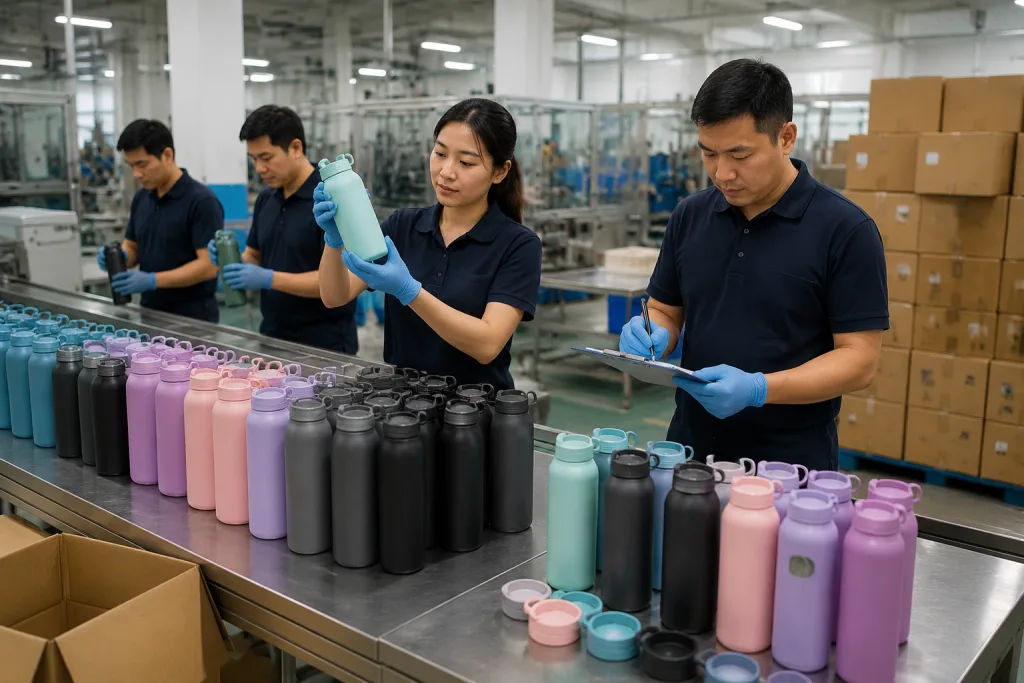
Key Takeaways
- A workable MOQ for a silicone water bottles factory is usually 500-1,000 pcs per SKU, with 35-45 days lead time after sample approval.
- Food-grade silicone should be specified at 40-60 Shore A hardness, with wall thickness around 1.2-2.0 mm depending on the bottle geometry.
- For Europe, ask for REACH and LFGB; for North America, request FDA food-contact compliance plus basic migration documentation.
- A factory running 300,000+ units/month can support canteen custom, canteen promotional, and distributor drinkware programs without compressing quality control.
Price is not the first risk when you source from a silicone water bottles factory. The gap between the spec sheet and what lands in your warehouse is where orders go sideways. Silicone looks simple. It is not. Wall thickness, durometer, fold design, lid sealing, and migration testing all change how the bottle runs on retail shelves, promo drops, or distributor programs. On one job, QC pulled the sample at 2.2 mm while the PO called for 2.5 mm, and the buyer flagged it before we packed the cartons. If you buy custom drinkware for Europe or North America, you need numbers you can audit.
At our Zhejiang factory, the questions stay the same: is the silicone food-grade and LFGB-safe, what is the MOQ, how many days to ship, and how much decoration survives repeated use? We run those checks on the line every week, and this is the wrong question to ask if the factory answers with slogans. A serious canteen manufacturer in China should give you tolerance, drop test limits, and AQL sampling without a script. We shipped one PO that listed "12,000 pcs" in the notes and "1,200 pcs" in the line item, and the buyer caught the typo fast. If the factory cannot explain that kind of mismatch, you are buying headaches. That goes for a custom canteen, customizable drinkware, or a distributor canteen program built for repeat orders.
Start With the Silicone Grade
The first line on your spec sheet should be the silicone grade. Everything else hangs off it. At our silicone water bottles factory, we run food-grade silicone with a clear hardness window, usually 40-60 Shore A for collapsible or flexible bodies. Softer than that and the bottle goes floppy in hand; harder than that and it stops folding cleanly on the line. We had a buyer flag a 35 Shore A sample once, and QC pulled the sample after the first squeeze test.
Do not accept “eco silicone” as a spec. That is not a standard. Ask for something you can verify: FDA food-contact compliance for the United States, LFGB for Germany and wider EU retail, and REACH documents for chemical control. A good canteen factory will also tell you whether the silicone is platinum-cured or peroxide-cured. Platinum-cured usually gives cleaner odor control and a better look on the shelf. The math does not work if the compound is vague. We saw this go sideways on a PO with “silicone bottle, green” and no grade callout.
- Hardness: 40-60 Shore A
- Wall thickness: 1.2-2.0 mm
- Compliance: FDA, LFGB, REACH
- Factory output: 300,000 units/month is a realistic benchmark for a stable export plant
Body Shape Changes the Use Case
Silicone bottles are not one product. Body shape drives the use case. We run 600 ml collapsible samples for airline retail, then 750 ml straight-wall bottles for outdoor accounts, and they land as different parts on the line. A buyer once flagged a PO typo on the cap thread callout, and QC pulled the sample before tooling moved. Ask for net weight, folded height, open height, mouth diameter, and cap thread size before you sign off.
If you are a canteen distributor or drinkware buyer, watch the height-to-base ratio. A tall, narrow bottle looks clean in a photo, then it tips on conveyor belts and on a 450 mm retail shelf. That is the wrong question to ask if the base is too small. For a 500-600 ml body, we like 65-75 mm at the base; it gives better stability and enough flat area for print. For a custom growler-style bottle, the lid and pressure handling matter more than foldability, so do not push a silicone body into a beer-style spec unless the factory has already run pressure checks. We’ve seen that go sideways.
Practical rule: if the factory cannot show a dimensioned drawing with tolerance on every critical point, treat the sample as a concept, not a production part.
Lid, Seal, and Leak Risk
Most complaints on custom drinkware start at the lid, not the bottle body. We see it on the line all the time. For silicone water bottles, define the lid by material, seal type, and torque. A PP lid is common and low cost; an aluminum cap fits a premium canteen promo only when the liner and thread match. Ask for the gasket material, usually silicone or TPE, plus the closing torque in N·cm. If the factory cannot give that number, they are guessing. QC pulled the sample at 1.2 mm thread depth, and the buyer flagged the cap after the third hand-tighten test.
Leak testing needs a number, not a "watertight" claim. Require inverted leak testing for 2 hours at room temperature, then add a hot-fill and cold-shock check if the bottle will ride in luggage. A proper canteen supplier should also state whether the lid survives 3,000-5,000 open-close cycles without cracking or losing compression. That cycle count matters more than a pretty render. We have seen this go sideways on a 500 pcs MOQ order when the PO typo said "silionce" and the wrong gasket went to the line. ISO-style process control is the right baseline here, because the seal has to hold batch after batch.
Decoration Without Weakening the Part
Decoration is where a lot of custom canteen jobs get overpromised. Silicone moves under pressure, so the same logo method does different things from part to part. On a smooth panel, screen print can hold up, but we ask for ink adhesion, abrasion resistance, and wash-cycle data before we run it. QC pulled a sample after 500 rubs on the line, and the buyer flagged edge wear. That is the real question. Not the catalog photo.
If you need a customizable growler or customized drinkware for retail, embossing or debossing on the silicone body usually gives a cleaner result over time than print. The tooling bill is higher up front. One mold add-on can land at MOQ 3,000, and the first setup takes about 12 days versus 18 days for a second revision. For canteen customizable promotional orders, print is cheaper, often by USD 0.15-0.40 per piece depending on color count and artwork size. A serious canteen vendor should show setup and running cost on separate lines, because the math does not work any other way. We once saw a PO typo turn "deboss" into "emboss"; that kind of slip changes the whole visual.
- Screen print: lower setup cost, moderate abrasion resistance
- Emboss/deboss: higher tooling, best for long-term branding
- Laser marking: generally for metal parts, not silicone bodies
Testing You Should Actually Request
Do not take a certificate pack at face value just because it looks thick. In a silicone water bottles factory, the tests worth paying for are migration for food contact, odor after heat, leak checks, drop tests, and colorfastness when the print or sleeve matters. We run these on the line with a simple torque wrench and a 1.2 meter drop board. The buyer flagged weak paperwork before, and the math does not work without real data. For Europe, LFGB is usually the harder bench; for North America, FDA food-contact compliance is expected, but a supplier declaration alone will not move a carton through customs. Ask for third-party reports, then check whether the unit label and outer carton carry batch numbers that match the lot code.
Write the drop test in plain numbers: 1.0 meter or 1.2 meter onto hard tile, with the pass rule tied to your channel. QC pulled the sample after a lid popped on the second drop, and that is the kind of miss a pretty PDF will never catch. If the bottle is sold as a custom growler or customized growler, seal retention and pressure release matter more than marketing copy. Ask for AQL numbers on incoming and final inspection too; AQL 2.5 for critical defects and 4.0 for major defects is common on export orders, but we have seen premium distributor canteen jobs tighten that to 1.5 when the buyer wants less risk.
MOQ, Pricing, and Lead Time
Procurement mistakes start when buyers fixate on unit price and skip the rest. On a silicone water bottles factory quote, we split tooling, sample charge, packaging, logo setup, and freight terms. For a standard custom drinkware program, MOQ is usually 500-1,000 pcs per color or per artwork, and unit pricing often sits around USD 2.30-4.80 FOB China depending on size, lid complexity, and decoration. We had a buyer flag a quote that looked cheap; the carton spec was missing, and the math did not work. A 3-layer corrugated carton with 5 mm edge crush test changes the landed number fast.
Lead time needs a clean answer. Sample development usually takes 7-12 days if the mold is already close to your target, and we run a test pull on the first silicone shot before QC signs off. Production is often 25-35 days for a stable SKU, then 7-18 days for sea freight depending on destination. If you need canteen distributors support or distributor drinkware replenishment, ask whether the factory can hold safety stock for repeat orders. We have seen that go sideways when the buyer assumed we could store 3,000 pcs without a plan. A Zhejiang line with the right balance can handle OEM and repeat-stock runs, but only if the forecast and reorder point are set early. That is the practical split between a canteen supplier and a long-term canteen manufacturer partner.
Packaging and Channel Fit
Packaging is not cosmetic. It decides whether the bottle survives warehouse handling, fits a retail shelf, or clears an Amazon-style intake. We had a buyer flag a 1.2 mm carton spec because the line crushed it on a 6-drop test. For a custom canteen program, a plain kraft box works. For a distributor canteen channel, master carton strength and barcode placement matter as much as the bottle, and that is the part people miss.
For Europe and North America, keep the pack honest. If the order goes to supermarkets or e-commerce, the barcode needs to scan on the first pass, the inner tray has to protect the lid threads, and the outer carton should hold up in a basic ISTA-style handling sequence if the customer asks for it. On one PO, QC pulled the sample and found the FNSKU printed 3 mm too low; that turns into a chargeback fast. For promotional canteen orders, display packaging can add USD 0.20-0.70 per unit, and at 20,000 pieces the math gets loud fast. A good vendor will tell you where to trim cost without making the box look cheap. This is the right question to ask.
Send your spec sheet, get a real factory quote
We can price silicone bottles by size, lid, logo method, and packaging, with clear MOQ and lead time from our Zhejiang team.
Frequently asked questions
What MOQ should I expect from a silicone water bottles factory?
For a standard export model, expect 500-1,000 pcs per SKU, sometimes 300 pcs if the factory already has the mold and packaging. Custom logo or special color usually raises the practical MOQ. If you need multiple colors or artwork versions, many canteen manufacturers will treat each version as a separate SKU. For better pricing, keep one body shape, one lid, and one decoration plan.
How do I know the silicone is safe for food contact?
Ask for FDA food-contact compliance for the US and LFGB plus REACH for Europe. Then request third-party test reports, not only a supplier statement. A good factory should also state hardness, usually 40-60 Shore A, and confirm whether the silicone is platinum-cured or peroxide-cured. If the canteen factory cannot explain odor, migration, and colorant control, keep looking.
Can I order a custom canteen with my logo on silicone?
Yes. The best method depends on how you want the product to age. Screen print is fine for lower-cost canteen promotional orders, but molded embossing or debossing lasts better on silicone bodies. For a canteen customizable program, expect setup charges and a production MOQ. Typical pricing for logo work adds USD 0.15-0.40 per piece for print, more for tooling-based branding.
What lead time is normal for custom drinkware from China?
For a mature SKU, 25-35 days production after sample approval is normal, plus 7-18 days freight depending on mode and destination. Sample development can take 7-12 days if the design is straightforward. In Zhejiang, factories with stable output can support repeat distributor canteen orders faster, but you still need to lock artwork and packaging early to avoid delays.
How do I compare canteen suppliers without getting lost in samples?
Compare them line by line: material grade, wall thickness, seal design, test reports, MOQ, and packaging spec. Then ask for AQL inspection standards, usually 2.5 for critical defects and 4.0 for majors. If one canteen supplier gives you only photos and a price, that is not enough. A real canteen manufacturer should send dimension drawings, compliance files, and a production timeline.