Key Takeaways
- A 0.5 mm to 0.7 mm SUS304 inner wall is the practical range for most bulk thermos programs; thinner walls save cost, but performance drops.
- For logo work, laser engraving is cleaner on a 2-color promotional thermos, while silkscreen is better if you need a large, low-cost brand mark.
- A silicone sleeve adds grip and dent protection, but expect a 6%-12% unit cost increase and slightly longer assembly time.
- For export orders, ask for AQL 2.5 on major defects and 4.0 on minor defects, plus REACH, LFGB, and carton drop-test evidence.
If you are buying a custom stainless thermos for outdoor retail or a promotion program, the hard part is not finding a supplier. It is picking the build before you spend on tooling, decoration, and freight. A silicone vacuum flask factory in Zhejiang will quote brushed, powder coat, or silicone wrap, and each one shifts unit cost, cycle time, and scrap rate. We run this every day. A 7-day slip on decoration is normal when the line changes from spray to wrap, and the buyer usually feels it first on the packing table.
For most buyers, the real choice is between a thermos that looks cheap on a quote sheet and one that survives daily use, passes REACH and FDA-style market checks, and still lands at a workable FOB China price. At BottleForge Industrial in Hangzhou, Zhejiang, our monthly capacity runs to 500,000 units, with standard MOQ from 3,000 pcs and lead times around 25-35 days after sample approval. QC pulled the sample last week and found a 0.3 mm gap on the lid lip. This is the wrong question to ask if you only look at unit price; the math does not work once a loose lid turns into returns.
Start with the use case
The first mistake buyers make is asking for a quote before they pin down how the bottle will be used. A ski-shop distributor thermos has a different job from a promo thermos for a trade show giveaway. Outdoor retail buyers ask about heat retention, glove grip, and whether the finish will take rack abrasion after 200 hang cycles. Brand owners running a campaign care about logo size, unit price, and a clean pack-out for FNSKU or retail sticker application. We had one PO where the sticker side was typed as “left label” by mistake. That typo cost us 2 days.
That is why the best silicone vacuum flask factory is not the one with the longest catalog. It is the one that can split a factory thermos for daily carry from a thermos promotional item that only needs to look sharp for one season. Decide the job first, then the specs fall into place. Simple. On our line, QC pulled the sample and checked the lid gap at 0.8 mm before we even talked artwork.
- Retail outdoor use: SUS304 or SUS316 inner, double-wall vacuum, powder coat, silicone base or sleeve, 12-24 hour thermal claim depending on volume. We run a 0.8 mm lid-gap check on the sample bench because that is where heat loss starts.
- Promotional use: lower decoration cost, 18/8 stainless, simpler lid, carton pack with 25 or 50 pcs per master carton. The buyer asked for “cheap but premium,” and that math does not work.
- Premium brand program: tighter tolerance on lid fit, better coating adhesion, and more controlled surface defects. We hold a 1.2 mm rim check here, because that is where complaints start.
In Zhejiang, too many buyers still chase unit price alone. Fine until the first complaint about sweating lids, weak straps, or a warped silicone sleeve. A supplier thermos program starts with use case, not with color selection. We've seen this go sideways on a 5,000 pcs MOQ order when the buyer skipped the use case and asked for samples after the price was locked.
Pick the right steel and wall build
Most buyers ask for stainless steel and stop there. That is too vague. For a custom thermos, we run SUS304 on the inner and outer walls for most jobs. If the buyer needs tighter food-contact paperwork for a stricter market, SUS316 on the inner wall is the better call. Wall build beats catalog copy. On a 500 ml bottle, we usually see the inner wall at 0.5 mm to 0.7 mm and the outer wall at 0.4 mm to 0.6 mm, and QC pulled the sample with a micrometer before the line moved on.
Thicker is not always better. The math does not work. A heavier bottle can feel solid, but once the tube wall gets too thick, vacuum performance and unit cost both take a hit. For 500 ml, 280 g to 340 g is a sane range for most buyers. We had one buyer flag a 365 g sample as "premium" on the PO, then push back when freight and shelf price both climbed. Go too light and the bottle dents in transit. Go too heavy and your retail customer asks why it costs more but drinks the same.
For a bulk thermos order, ask the factory to confirm the grade in writing, not just on a product page. You want the material declaration, magnet test results where they apply, and a clean split between stainless parts and PP, silicone, or Tritan pieces. We once caught a PO typo that listed "SUS304" in the title and "201" in the notes; that kind of mismatch is how orders go sideways. If the seller cannot state this cleanly, they are acting like a trader, not a factory you can trust.
Choose silicone only where it helps
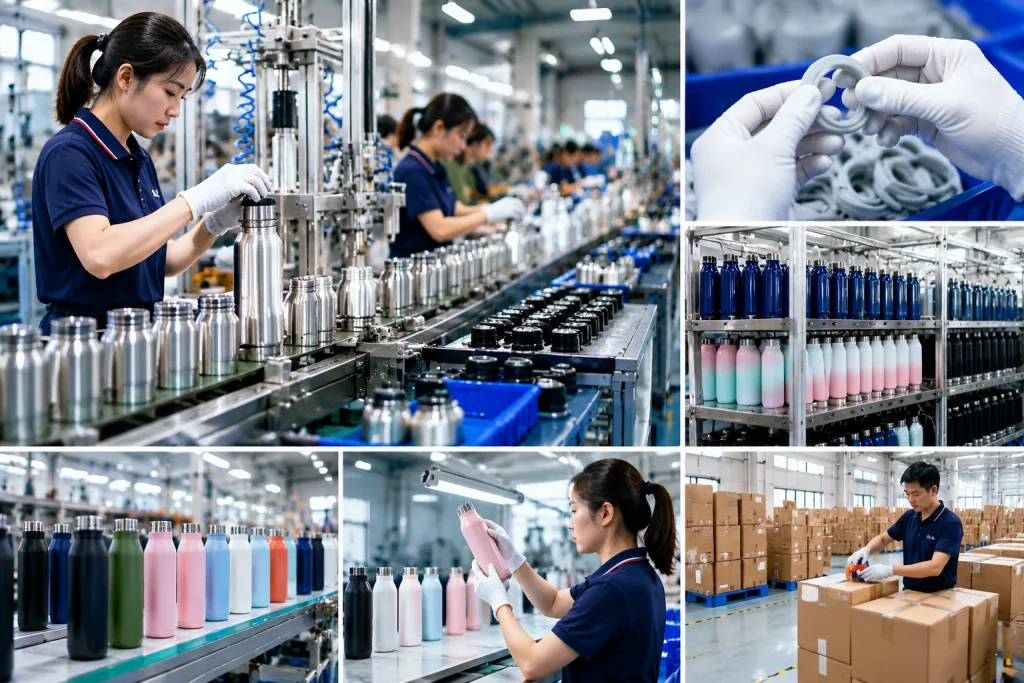
A silicone vacuum flask factory has one clear advantage: we keep the steel body and the silicone parts under one roof, or inside a supplier chain we can actually check. That matters on the line. Silicone solves specific problems, not every problem. A 1.5 mm sleeve on the lower body adds grip, hides small dents, and helps when hands are cold. A base ring cuts table noise and takes light knocks. A strap lid works for hiking, but it adds 2 assembly steps, and we have seen weak snap fits loosen after 24 hours on the line.
For an outdoor retailer, silicone usually pays back. For a giveaway run, it burns cash fast, and the math does not work. We quote a 6% to 12% cost increase once you add a custom-molded sleeve or a more complex lid gasket set. QC pulled the sample on a 3,000 pcs promo order last month and found the silicone trim added 2 extra minutes per unit at assembly; on 10,000 pcs, that still clears, but on a thin-margin run it hurts. Simple as that.
My rule is simple: use silicone for grip, sealing, or impact protection. Use it there. Do not add it just because it looks more engineered.
Ask your supplier thermos team to show pull-force and fit tests for the silicone parts. If the sleeve slips after a heat cycle or the lid ring distorts, that bottle comes back through retailers, and we ship the headache, not the factory. One buyer flagged a PO typo on the sleeve OD as 68 mm instead of 58 mm, and the sample would not seat. This is the wrong question to ask if the dimensions are still loose.
Decoration should match the channel
Decoration is where a lot of custom thermos orders pick up cost for the wrong reason. We had one buyer push for full-color print on a 500 ml bottle, then complain when it scuffed after 2 weeks on a retail shelf. For outdoor retailers, a clean laser mark usually wins on a 304 stainless body because it stays put and the line keeps a sharp edge. For promo campaigns, silkscreen makes sense when the logo is large, flat, and the MOQ is tight. The real question is simple: what survives the channel.
On stainless surfaces, laser engraving is the safest call. QC pulled the sample with a loupe, and the mark stayed clean on matte powder coat, raw steel accents, and plain one-color branding. Silkscreen works when you need a bold logo and the artwork stays within 1 or 2 colors. Heat transfer and water transfer can pass on some runs, but we do not put them first for a distributor thermos that will move through 3 warehouses and 1 truck route. The math does not work, and we have seen that go sideways.
- Laser engraving: durable, low-maintenance, and a good fit for premium branding on matte powder coat.
- Silkscreen: lower cost, works for larger logos, and wears sooner on hard-use stock.
- Full wrap print: good for campaign art, but it needs tighter color control and cleaner artwork.
If you are comparing thermos customizable options, ask for logo placement mockups on the exact body diameter and curve. A layout that looks fine on a 65 mm bottle can break on a 73 mm bottle. We had a PO typo once where the buyer wrote 67 mm, the sample came back off-center, and the buyer flagged it before we shipped. That is a sourcing problem, not a design problem.
Temperature claims need evidence
Every thermos supplier says the bottle keeps drinks hot for hours. That means nothing until the test sheet shows the setup. Ask for start water temperature, room temperature, fill volume, lid torque, and the check points. We run this on the line with a probe thermometer, and a claim like 6 hours above 70 C and 12 hours above 60 C for a 500 ml stainless vacuum bottle only holds up if the method matches the sample.
Look for a factory that can show an internal test procedure with repeatable numbers. Fill ratio matters. So does cap design. A narrow neck cuts heat loss better than a wide mouth, and a pretty lid will not rescue a weak vacuum layer. We have seen a buyer push back on a 24-hour claim after QC pulled the sample and found the core dropped fast once the cap was swapped to a loose fit.
For Europe and North America, compliance is not a side note. Ask for REACH, LFGB where relevant, and the right material declaration and migration records for the channel you sell into. A serious thermos factory in China should send those files without drama. If they stall, the paperwork is late on more than one job. On one PO, the buyer flagged a typo on the item code, and the document set had to be rebuilt before we could ship.
When you compare custom thermos options, insist on the test report for the exact SKU. A report from a different model is useless for your purchase order. This is the wrong question to ask if you only look at the headline hours; the math does not work. We tie the report to the same 500 ml body, same lid, same vacuum line, then keep the data with the lot card.
MOQ, pricing, and margin math
Buyers usually push for a lower unit price first. That is the wrong question to ask. On the line, order structure moves cost faster than the steel spec. For a silicone vacuum flask factory in Zhejiang, 3,000 pcs is a normal MOQ for a branded stainless thermos with custom logo, custom color, and silicone parts. If the buyer adds two lid types, a second body color, or retail packaging, we usually move to 5,000 pcs per variant. QC pulled a sample last month with a 0.8 mm print shift, and the buyer still wanted the same price. The math does not work.
FOB China pricing for a 500 ml custom thermos usually lands around USD 2.80 to USD 6.50 per unit before freight. Steel grade, finish, decoration, and silicone complexity drive that spread. A plain powder-coated bottle with one-color print sits near the low end. A premium customized thermos with silicone sleeve, gift box, and laser mark sits near the top. We ship enough of these to know the gap is real. The buyer flagged a PO typo once, “5000 ml” instead of “500 ml,” and the quote looked absurd until we caught it at the ERP screen.
Do not let the quote hide the extras. Ask for separate lines for bottle, lid, silicone part, packaging, and testing. You want to know whether the supplier thermos price includes:
- Individual polybag or paper wrap
- Gift box or color box
- Drop test or carton reinforcement
- Barcode, FNSKU, or retail label application
On a large distributor thermos program, a packaging swap from paper wrap to color box changed landed cost by 3% to 8%. We saw it on a carton scale in QC, 18.4 kg per case versus 16.9 kg before the change. That is where margin gets eaten if you only stare at the unit quote. We have seen this go sideways fast.
Audit the factory, not the brochure
Brochure claims are cheap. The line tells the truth. The real test is whether a factory can repeat the same bottle 50,000 times without color drift, loose cap fit, or a spray finish that flakes on the third carton. A proper thermos maker should pull out incoming inspection sheets, in-process checks, and final AQL records on the spot. For export orders, AQL 2.5 for major defects and 4.0 for minor defects is a common starting point, and brand accounts often tighten that. We saw one buyer accept the sample, then reject the first bulk lot because the lid gap moved by 0.4 mm.
Ask how they handle vacuum sealing, leak testing, and packing. Ask whether QC pulls temperature retention checks on every lot or only on samples. Ask where the silicone parts come from, because an in-house molding press and a bought-in gasket are not the same setup. The answers tell you plenty. A factory that can explain the process in plain words usually runs it. One that stays buried in sales talk usually does not. This is the wrong question to ask: “Do you have a brochure?” Ask to see the vacuum gauge, the leak tank, and the test log.
Capacity needs a hard look. If a Zhejiang plant says 500,000 units per month but cannot name the daily output of the decoration line, the number is decoration too. A real shop knows its line balance, sample turnaround, and where the bottleneck sits. On one audit, the buyer flagged a PO typo on the cap color code, and the order sat 6 days because the pre-production sample sheet did not match the artwork. That is how jobs slip. We run into this when the factory talks big and the pad printer is still waiting for a Pantone card.
Direct sourcing gives you more control over spec, but only if the seller is a factory and not a broker with a showroom. Check the VAT invoice, the molding machine list, and who signs the QC report. Otherwise the math does not work. You think you are buying from the source; you are buying through one more hand.
Build for distribution, not just samples
Sample approval is the easy part. Getting 1,000 pieces through warehousing, palletizing, and retail handling is where the dents show up. We had one 500 ml run where the buyer flagged a 3 mm carton crush after cold storage, so the line moved from 5-layer to 7-layer board. The edge crush test was the clue. For outdoor retailers, carton strength is the first fight because bottles move through mixed freight and freezing docks. For promo brands, packing repeatability matters more. One mixed-SKU case can kill a launch. The carton comes first.
For export, we run drop tests, carton count checks, and label position before mass production starts. If the order goes to Amazon or a similar channel, we need the FNSKU location, master carton mark, and whether each unit goes in a bag one by one. We once caught a PO typo that changed the case pack from 24 to 42, and QC pulled the sample before it reached packing. This is the wrong question to ask after goods are loaded. Basic handling. No heroics.
This is where a solid thermos supplier setup pays off. The right factory moves from prototype to mass production without changing the packing method every week. On our floor, the strip-seal machine and the carton jig stay fixed unless the buyer gives a hard reason to move them. We run a 2 mm carton gap check before the first shift. In Zhejiang, the good plants do not just make the bottle; they make the ship-ready pattern work on the line. The math does not work any other way. That is the gap between a one-off maker and a factory you can reorder from twice a year without reopening the same file.
When the carton spec, label, and pallet plan are fixed early, your custom thermos order lands like a product line, not a loose bulk lot. We ship better that way. A 1200 mm pallet stack with a clean barcode scan saves headaches at the warehouse door.
Request a factory quote with real specs
Send your target volume, lid style, decoration method, and market. We will quote a custom thermos built for retail, promotion, or distributor resale.
Frequently asked questions
What is a realistic MOQ for a custom stainless thermos order?
For a silicone vacuum flask factory, 3,000 pcs is a practical MOQ for one SKU with custom logo and standard packaging. If you add custom silicone sleeves, multiple print colors, or gift boxes, 5,000 pcs per variant is more realistic. Some suppliers will quote 1,000 pcs, but the unit cost usually rises by 12% to 25% and your color consistency becomes harder to control. For outdoor retail programs, it is better to commit to one clean specification and repeat it than to split into too many low-volume variants.
How much should I budget for a custom thermos from China?
For a 500 ml custom thermos made in China, FOB pricing often falls between USD 2.80 and USD 6.50 per unit. The lower end is usually a simple SUS304 bottle with basic print and standard packaging. The upper end is a customized thermos with silicone sleeve, premium lid, laser engraving, and retail box. Freight, duties, and local fulfillment are extra. If you need your bottle to compete in retail, budget another 8% to 18% for packaging, carton reinforcement, and labeling work.
Which decoration method is best for a promotional thermos?
For a promotional thermos, silkscreen is usually the cheapest way to put a large logo on the bottle, especially when you only need one or two colors. If the item needs to look more premium or survive abrasion, laser engraving is the better long-term choice. On powder-coated stainless steel, laser is very durable but more limited in color. On glossy finishes, silkscreen can look stronger at the start but may wear faster. The right method depends on whether your campaign is short-term visibility or retail resale.
Do silicone parts affect insulation performance?
Silicone itself does not improve vacuum insulation. The vacuum layer and lid structure do the thermal work. Silicone parts mainly add grip, sealing support, shock resistance, and a better user feel. A sleeve or base ring can slightly increase weight and cost, usually by 6% to 12%, but it does not meaningfully raise hot or cold retention. In practice, the insulation performance depends on stainless wall design, neck geometry, and the quality of the lid seal. A poor lid will hurt performance far more than a silicone sleeve will help it.
What compliance documents should I ask for from a thermos manufacturer?
Ask for REACH, LFGB if relevant to your market, a material declaration for stainless steel and silicone, and a test report tied to the exact SKU. For quality control, request AQL inspection criteria, leak testing records, and carton drop-test evidence. If you are selling through retail or e-commerce channels, confirm labeling support such as barcode or FNSKU application. A serious thermos manufacturer in Zhejiang or elsewhere in China should provide these without drama. If the seller cannot document materials and test methods, treat that as a sourcing risk, not a paperwork delay.