Key Takeaways
- Most silicone vacuum flask bulk programs start at 500 to 1,000 pcs per SKU, with 25 to 35 days for bulk production after sample approval.
- A practical stainless thermos for promotion usually lands at USD 3.20 to 6.80 FOB China depending on capacity, wall structure, and decoration.
- For export orders, ask for AQL 2.5 major / 4.0 minor, REACH-compliant coatings, and carton testing before you approve the PO.
- A Zhejiang factory with 300,000 units/month can usually support mixed thermos custom programs if you lock artwork, lid style, and packaging early.
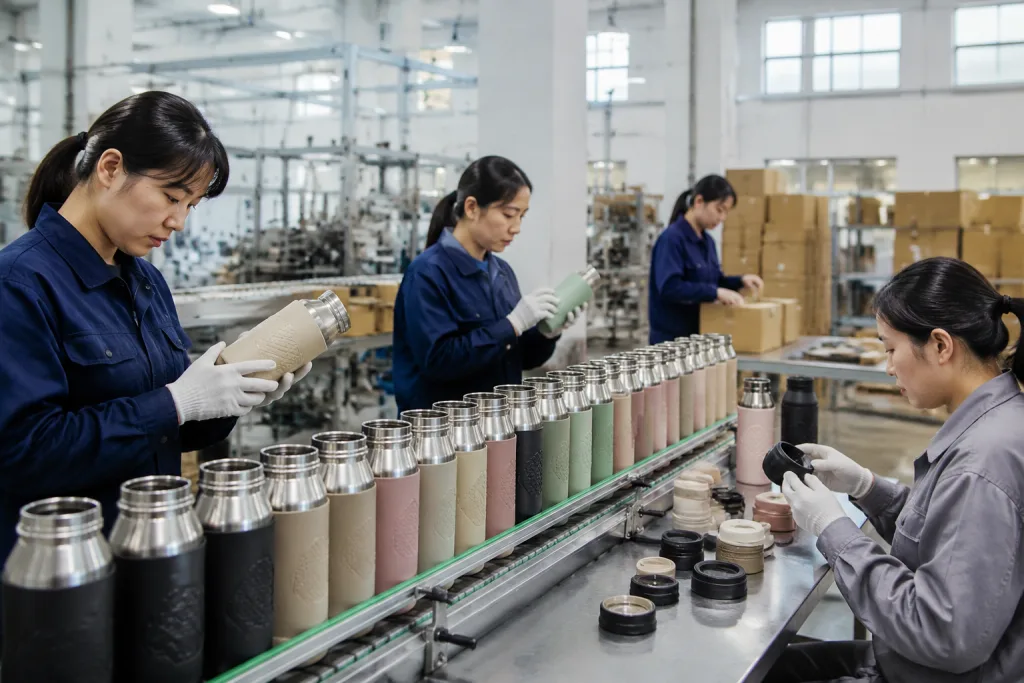
Buying silicone vacuum flask bulk is not about pulling a stainless thermos from a shelf. You need the right bottle: one that survives daily use, prints clean, passes REACH, and lands at your warehouse without preventable headaches. We run this on the line every week, and a 1.0 mm wall or a loose cap gasket shows up in QC fast. Outdoor buyers ask for grip, leak resistance, and cold-weather hold. Promo buyers count decoration area, freight, and carton math to the cent.
We build thermos bulk programs in Zhejiang, China, and the same pattern shows up every season. Buyers who send a tight RFQ get usable samples faster, cleaner FOB quotes, and fewer PO changes. Last month the buyer flagged a 24 oz spec typo on the PO, and that one line saved a remake. Buyers who leave out lid style, coating, or carton count usually pay for it later. This is the wrong question to ask if you want a custom thermos or customized thermos program that scales. Treat it like sourcing, not a catalog order.
Start with the use case
Start with the use case before you ask for a quote. A silicone vacuum flask bulk order for hiking retail is one job; a thermos promo run for a bank giveaway is another. One needs grip, 6-hour heat retention, and a cap the buyer can wash in 30 seconds. The other needs a lower unit cost, a wide print panel, and carton packing that stacks cleanly. The line here is simple. Miss that split, and the quotes all look usable. They are not.
Give the factory four facts: target capacity, retail channel, color direction, and decoration method. We price faster when the brief says 500 ml double-wall 304 stainless body, silicone ring at the base, powder coat, one-color logo, retail box, FOB Ningbo. Last week, QC pulled the sample with a 1.5 mm ring spec after the buyer flagged a lid sketch on a messy PO, and that killed two days of back-and-forth. If you need a distributor line, add master carton count and pallet height. The math does not work on guesswork, and we've seen that go sideways on the packing table.
Useful buyer shorthand: thermos bulk for volume price, thermos custom for brand identity, thermos customizable for flexible colors and lids, thermos customized for final artwork and packaging.
Write an RFQ that gets answers
A weak RFQ gets weak quotes. A clean RFQ gets the supplier pricing the exact bottle you want. Put capacity, body material, inner and outer wall thickness, lid type, silicone parts, surface finish, logo method, drop-test target, and order quantity in one line. For a custom thermos run, say 304 or 316 stainless steel up front. The price gap is real. So is the corrosion result. We had one buyer leave it vague, then flag the quote later because the line priced 304 while they wanted 316. The math does not work, and we ship fewer surprises when the spec is pinned down on day one.
For bulk thermos sourcing, the useful items are the ones we can check on the line, not soft words. Ask for:
- Product spec: 500 ml, 304 inner wall, 0.4 mm outer wall, food-grade PP lid, silicone base ring
- Decoration: laser engraving, 1 color silkscreen, or 4-color heat transfer
- Packaging: individual box, 25 pcs per carton, carton dimensions, gross weight
- Compliance: REACH, LFGB if needed, ISO 9001, BSCI audit status
- Trade term: FOB China or EXW, with sample freight excluded
Do not accept “same as picture.” That is the wrong question to ask. Ask the thermos supplier to name the mold number, lid family, and decoration process. QC pulled the sample with a 0.8 mm gap on the cap thread last month, and that kind of miss shows up fast if the RFQ is loose. A serious manufacturer will send a data sheet in 24 to 48 hours. A vague quote usually turns into change fees later.
Check the sample before pricing
The sample stage is where we save money. It is not where we burn it. For a custom thermos order, we run a white sample first if the mold is standard, then a decorated pre-production sample after the logo position is locked. If the job needs a new silicone sleeve, a new lid color, or special embossing, the first round in China usually takes 7 to 12 days and the sampling fee lands at USD 50 to 150. We had a buyer flag a 0.8 mm sleeve gap once; that one went straight back to the line.
Check the sample like a buyer, not like a gift recipient. Measure wall thickness, check the fit between the silicone base and the steel body, verify cap torque, and run the upside-down leak test for 24 hours. If the flask is for outdoor retail, drop it from 80 cm onto plywood. QC pulled the sample on a powder-coat job last month because of pinholes near the seam. This is the wrong question to ask: “Does it look fine?” The real question is whether the sample matches the claim and the use case.
Do not approve bulk based on appearance alone. Ask for boiling-water retention data at 6 hours and 12 hours, then line it up with your target market. If the claim is 24 hours hot and 24 hours cold, test it under your own conditions. We have seen that go sideways when the buyer took the catalog figure at face value.
For a promotional thermos, the sample has to match the final packaging too. A bottle that looks clean in hand but ships in a loose carton is not a finished product. Check the carton size, inner tray fit, and print position before you sign off. We once caught a PO typo on the master carton spec, 12 pcs wrote as 120 pcs, and that would have broken the whole shipment.
Price the bulk order correctly
FOB price starts with capacity, decoration, packaging, and how many custom parts sit on the spec sheet. On our Zhejiang line, a plain 500 ml stainless thermos with a silicone base ring, one-color logo, and a simple box usually lands at USD 3.20 to 4.60 at 1,000 pcs. Add powder coating, a laser logo, an upgraded lid, and a retail insert, and the quote moves into the USD 4.80 to 6.80 band. A 316 stainless build or a lid with extra parts pushes it up again. The buyer asks for a lower number. The math does not work. We run this split on the packing table every week, and the tape measure does not lie.
Check what sits inside the quote. QC pulled the sample on a Tuesday and found one quote had left out carton upgrade, test reports, and the second logo color. Ask straight whether the price covers the silicone parts, gift box, barcode label, and master carton marks. If the factory quote excludes those items, the landed cost is fiction. We have seen that go sideways on a PO with a typo in the carton mark, and the reprint bill was not small.
For outdoor retailers, I tell buyers to build around sellable options, not open-ended customization. One body color, two lid colors, one decoration method, one carton spec. That keeps the MOQ under control and makes replenishment easier. For distributor programs, consistency beats novelty. A clean FOB China quote from a steady thermos factory is better than a cheap number that changes after sample approval. We ship that way because a 12-day repeat order beats an 18-day scramble, and the buyer who pushed for six lid colors ended up back at two.
Lock the PO line items
Once the sample is signed, the PO should read like a control sheet. Not a reminder. We see custom thermos orders slip here all the time. The buyer sends a loose PO, the line fills in blanks, and the math blows up. For silicone vacuum flask bulk, the PO needs the product code, capacity, material grade, finish, logo file name, carton spec, QC standard, and delivery window. We had one PO last quarter that listed “silver” for a matte powder coat. The buyer flagged it on the first pass.
At minimum, your PO should state:
- Item: stainless vacuum flask with silicone base ring
- Quantity: 2,000 pcs, with 3% overrun allowed if agreed
- Material: 304 inner and outer, food-grade silicone, BPA-free PP lid
- Artwork: final AI file, Pantone reference, logo placement drawing
- Inspection: AQL 2.5 major, 4.0 minor, 100% leak test
- Delivery: 30 to 35 days after deposit and sample sign-off
If you are a thermos distributor or promotional brand, add the carton label format, barcode type, and whether you need FNSKU or Amazon-ready labeling. QC pulled the sample on a 38 mm carton print and found one barcode typo before we shipped. That is the kind of miss that costs a day on the line and one angry email. A factory that runs bulk thermos export well will ask for these details anyway. If they do not, ask first. The math does not work without them.
Inspect the batch before shipment
Bulk QC is not paperwork. It is the gate before the cartons leave China. On a 1,000 pcs thermos order, we check sealing, heat-retention sampling, surface scratches, logo position, and carton drop test results. QC pulled the sample with a caliper, then flagged one cap that sat 0.6 mm off-center. If you are running a promo order with a fixed event date, a third-party inspection at AQL 2.5 major and 4.0 minor costs less than a missed launch. The math does not work any other way.
A proper quality plan from a China supplier starts at incoming material checks, then moves through in-process welding control, vacuum leak testing, and final random inspection. Ask for photos from the line, not just the finished goods. We run laser-welded seams, vacuum sealing equipment, and carton compression test records on the same job sheet; if the factory cannot show those, the buyer flagged it for a reason. That is the wrong question to ask only after shipment.
Packaging moisture matters too. If your shipment passes through humid ports, specify a plastic inner bag or desiccant. We ship that on plenty of North America and Northern Europe orders, and the cost is usually under USD 0.08 per unit. One PO typo we see all the time is the buyer writing "dry packing" and forgetting the desiccant line. Then the cartons land with a damp smell. Ugly and avoidable.
Plan replenishment like a buyer
A buyer who knows the line treats a thermos custom order as a rolling plan, not a one-off buy. We run the second PO while the first 5,000 units are still on the water. If your outdoor season peaks in 60 to 90 days, ask for reorder lead time, color match repeatability, and spare lid stock. A Zhejiang line pushing 300,000 units a month can repeat SKUs fast, but only if the first PO is clean and the carton spec says 12 pcs, not 10.
For a distributor thermos program, the sequence is simple: sample approval, first PO, shipment inspection, then a reorder forecast 30 days before stock runs thin. QC pulled the sample on a 58 mm lid last week, and the buyer flagged a loose gasket. Fair point. We’ve seen that issue turn into a return claim. If the same bottle structure goes to three markets, keep the body and lid fixed, then change only print, hangtag, or carton language.
China sourcing works best when you think in part numbers, not adjectives. A stable thermos supplier can repeat a bottle made in Zhejiang in six months with the same lid torque, the same powder coat, and the same carton count. We checked a repeat run on the torque meter at 0.8 N·m, and the numbers held. That is the part that matters, not the sales pitch. The math doesn’t work any other way.
Send your spec, get a real quote
We can price your thermos custom order from a clear RFQ, confirm sample timing, and keep the bulk build aligned with your channel needs.
Frequently asked questions
What MOQ should I expect for silicone vacuum flask bulk orders?
For a standard stainless body with one logo color, MOQ is usually 500 to 1,000 pcs per SKU in China. If you need a new lid, special silicone ring, or custom box, the MOQ can move to 2,000 pcs. For very simple thermos promotional runs, some Zhejiang factories can mix colors within one body mold, but you should still expect one decoration setup per artwork. If the quote is lower than 300 pcs, check whether the supplier is adding hidden tooling or packaging charges later.
How long does custom thermos sampling take?
A standard sample usually takes 7 to 12 days if the mold already exists and the logo is straightforward. If you need a new lid color, a molded silicone part, or a special finish, allow 15 to 20 days. Pre-production samples should be approved before bulk starts. For outdoor retailers, I recommend testing the sample for 24-hour leak resistance and at least one heat-retention check at 6 hours and 12 hours.
What is a realistic FOB China price for bulk thermos units?
For a 500 ml stainless thermos with silicone base ring and simple packaging, a realistic FOB China price is often USD 3.20 to 4.60 at 1,000 pcs. With powder coating, laser engraving, and retail box packaging, expect USD 4.80 to 6.80. 316 stainless, complex lids, or premium gift packaging can go higher. Prices from a China supplier should always be checked against exact spec, because a 0.1 mm wall change or upgraded lid can shift the cost.
Which compliance documents should I ask for?
For Europe, ask for REACH-related material declarations, and if the market requires it, LFGB testing for food contact. For broader quality control, request ISO 9001 certification and a recent BSCI audit if social compliance matters to your retail partners. For the United States or Canada, confirm food-contact materials and any retailer-specific lab reports. If your order is for Amazon, ask about FNSKU labeling, carton barcodes, and polybag requirements before production starts.
How should I inspect a thermos bulk shipment?
Use AQL 2.5 for major defects and 4.0 for minor defects as a practical baseline. Check leak resistance, lid fit, print accuracy, coating scratches, and carton condition. For a 2,000 pcs order, a third-party inspector will usually pull a sample across cartons and verify random units from different pallets. Ask for photo evidence of the test setup and a final report before you release the balance payment. That is the simplest way to keep a distributor thermos order from turning into a claims problem.