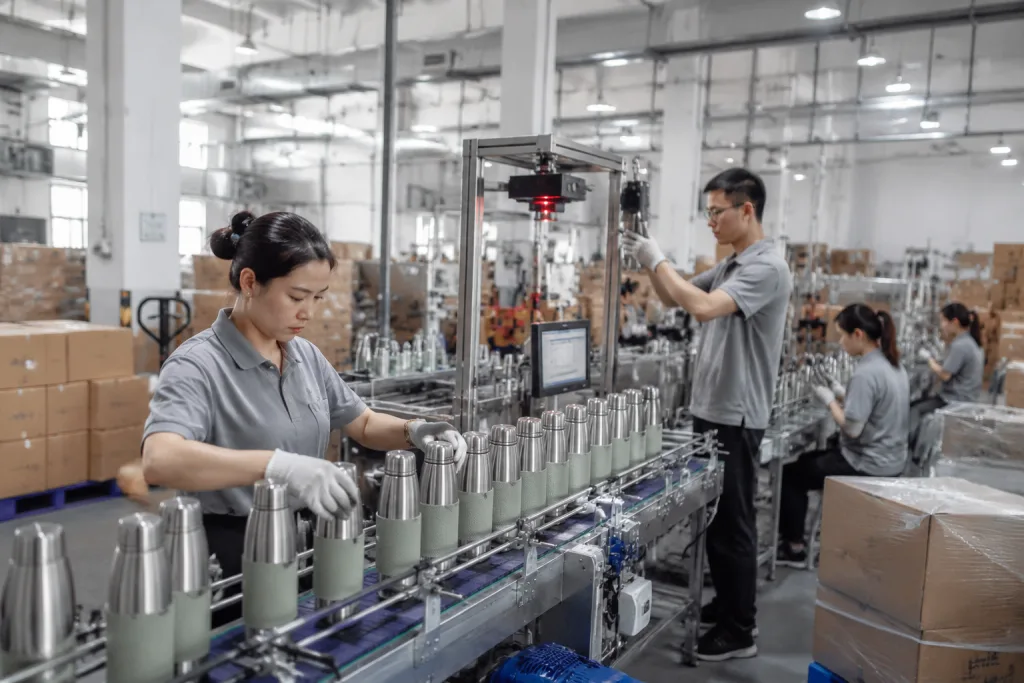
Key Takeaways
- For silicone vacuum bottle wholesale, set a 304 stainless body at 0.4 mm minimum and a vacuum hold target of 48-72 hours.
- Typical MOQ is 3,000-5,000 units per SKU, with 25-35 days lead time after sample approval at a capable China factory.
- A silicone sleeve should stay bonded after 1,000 abrasion cycles and 10 wash cycles at 60°C, or it is not retail-safe.
- Use AQL 2.5 for critical leaks and AQL 4.0 for appearance defects if you want distributor thermos shipments to stay consistent.
You can buy a good-looking stainless thermos in China and still lose money on it. We see it on the line all the time. The failure is usually small: a loose cap, a weak vacuum, a silicone sleeve that lifts at 60C, or a finish that marks up before the cartons leave Zhejiang. If you are sourcing silicone vacuum bottle wholesale for outdoor retail or promotion, this is not a catalog-pick job. Lock the weak points before we run the first batch.
That is the gap between a normal thermos custom order and one that survives retail handling, distributor storage, and North American or European compliance checks. QC pulled the sample and checked the wall gauge at 0.35-0.45 mm inside and 0.4-0.5 mm outside; the math does not work unless the factory holds it from the start. A serious thermos program should sit on measurable specs: 304 or 316 stainless, 48-72 hour vacuum retention, and AQL 2.5/4.0 inspection. We ship cleanly when the factory expects trouble, not when it hopes for a lucky run.
Why good samples fail later
The first mistake is treating one hand sample as proof of a production thermos. It is not. One piece may come from a senior tech, hand-trimmed, wiped twice, and signed off before it leaves the floor. Then we run 5,000 pcs on standard tooling, the carton stack goes to 8 layers, and the weak point shows up fast. A sample can look clean and still fail on the line.
The pattern is simple. The bottle passes the first vacuum test, then sweats after three thermal cycles. One cap closes cleanly, the next cross-threads by 1.5 mm. The silicone sleeve looks good in photos, then twists under torque because the mold draft angle is too steep. QC pulled the sample and found a 0.3 mm gap at the mouth ring. We’ve seen this go sideways when buyers approve only pre-production units. Ask for line-pulled samples from the actual shift.
For outdoor retailers and promo brands, lock the process first and chase finish second. This is the wrong question to ask if the test plan is weak. Ask for:
- vacuum leak test on 100% of units or at least every 30 minutes on line
- torque test for cap closure
- drop test at 1.0 m on packed samples
- visual reference panel for paint, print, and sleeve alignment
Vacuum loss is the real killer
If a bottle cannot hold vacuum, the rest is decoration. In silicone vacuum bottle wholesale, the weak point is usually a bad vacuum weld or a neck seal that walks on the line. A buyer flagged one batch after 14 days: dry on day 1, then condensation showed up in warm-cold cycling. That is a failure, not a finish issue. The leak detector does not lie.
A proper stainless thermos spec should name the build, not just the metal. Say 18/8 stainless inner and outer, double-wall vacuum, copper plating optional, neck seam fully welded, and silicone sleeve installed only after vacuum verification. If a factory sends “food grade stainless” and leaves the gauge vague, push back. We run 0.35-0.45 mm for the inner wall, 0.4-0.5 mm for the outer wall, and at least 0.6 mm bottom thickness after forming. That is standard bulk production in Zhejiang. A spec sheet with no numbers is a problem.
For testing, ask for 6-8 hours above 60°C and 12-24 hours below 10°C at a 95% fill ratio. The math does not work if the supplier talks in slogans. We ask for 5 thermal cycles, then a 1 m drop, then QC pulled the sample again to check sweat marks around the neck. A PO typo on one run swapped 1.0 mm for 10 mm, and the buyer caught it before the line started. If the supplier cannot describe the method, you are buying a story, not a thermos. This is the wrong question to skip.
Silicone sleeve fit gets sloppy
The silicone sleeve is where a custom thermos starts looking tired. If hardness, wall thickness, or mold tolerance drifts, the sleeve shrinks, twists, or lifts at the base. We saw it on a 500-piece run last month: QC pulled the sample, the buyer flagged the loose edge, and the line stopped for a shim fix. That went sideways fast when someone pushed a soft-touch promo bottle, Pantone color matching, and a 12-day ship date at the same time.
Call the sleeve a part, not an add-on. Use 50-60 Shore A silicone for a grip sleeve unless there is a hard reason to go softer. Ask for 1.8-2.2 mm wall thickness and confirm whether the sleeve is overmolded or mechanically retained. If it is just stretched on, it will walk. This is the wrong question to ask after packing starts. A customized thermos for retail should pass 1,000 rub cycles and 10 dishwashing cycles at 60°C with edge lift under 1 mm.
Color is where the math gets ugly. Silicone takes pigment differently from painted steel, and we have seen a buyer reject a batch because the sleeve looked fine under showroom lights but failed under D65. Approve a physical Pantone chip under D65 lighting and accept that +/- 5 delta E is a more honest target than sample-room perfection. A thermos customizable program should also state whether the sleeve sits flush with the bottle base or hangs over by 1-2 mm for impact protection; we had one PO with a typo that left out the 1 mm note, and the buyer caught it before mold steel was cut.
Printing, engraving, and peeling
Most promo thermos orders miss on decoration, not on the bottle body. Screen print looks clean on day one, then edge lift shows up after 3 weeks in a tote bag. Laser engraving stays sharp, but it needs a stable powder coat or bare steel. A bad cure still shows. For a retail run or corporate gift order, the print method has to match how the buyer uses the flask.
For a silicone vacuum bottle wholesale order, we run three options: silk screen on the steel body, laser engraving on powder coat, or debossed branding on the silicone sleeve. Each one has a cost and a failure mode. Silk screen is the low-cost move, usually USD 0.15-0.40 per color per unit at volume. Laser engraving costs more, but there is no ink layer to wear off. Sleeve debossing works better on a distributor thermos line because the mark stays after hand washing and carton rubbing. One buyer flagged a PO typo on the sleeve color code, and QC pulled the sample before the line started. That mistake cost us 40 minutes.
Ask the supplier thermos team for adhesion and abrasion tests. For print, a 3M tape test and 50-rub alcohol test are the baseline. For laser, check contrast depth and oxidation consistency under a loupe. If the artwork has gradients or fine lines, hold the minimum line width at 0.3 mm. Anything smaller turns into a production gamble at 5,000 units. The math does not work. We saw it go sideways when a buyer wanted 0.2 mm text on a curved body and the first 200 pieces came back fuzzy.
Lids leak more than bottles
Caps decide whether a custom thermos order feels tight or sloppy. The bottle body can pass, then the lid blows the deal because the gasket groove is 0.3 mm shallow, the threads come off rough, or the flip top was built for light duty only. We see this on bulk runs every week. Retail returns hit the bottle name, not the lid.
State the sealing system up front. A screw cap should run a food-grade silicone gasket with compression set below 25% after heat aging. A flip lid needs a hinge target, and 5,000 open-close cycles is the floor if the buyer wants repeat use. For outdoor accounts, we run a 45-degree tilt test and a 1 m drop check. QC pulled the sample last month and the buyer flagged a slow drip at the spout; the math doesn't work if the lid only passes on paper. This is the first thing we check on the line.
Watch the threads. Coarse threads close fast, but if the cut is dirty, they cross-thread during packing. Fine threads feel cleaner, yet a worn mold makes them bind. Ask for a go/no-go gauge on the cap neck and set a torque target around 0.8-1.2 N·m for manual screw lids. We had a PO with a typo on the neck size, 48 mm written as 58 mm, and that order went straight back to the line. This is the wrong question to ask: "Does it look premium?" Ask whether it seals after 200 hand opens.
Packaging breaks retail margins
Packaging is not a side note when you ship thermos bulk. A 500 ml bottle can pass the line test and still land with crushed corners, sleeve rub marks, or moisture stains if the pallet wrap is loose. The bottle was fine. The carton spec was not. On a Zhejiang to Los Angeles run, we see that in 12 days, not 18.
For distributor thermos shipments, treat the inner box and master carton as part of the product. A standard pack for a 500 ml insulated bottle is one bottle per white box, 24 or 36 pieces per master carton depending on bottle diameter, with 5-layer corrugated board and a carton compression target above 250 lbs. We had a buyer flag a PO typo on FNSKU placement once, and QC pulled the sample before print; that saved a full rework on the line. The math doesn't work if you only stare at bottle cost.
Ask for carton drop test, vibration simulation, and pallet pattern photos. We want gross weight, net weight, and carton size in millimeters before production starts, because the freight forwarder checks those numbers anyway. One failed edge crush test at 250 lbs can turn a clean FOB quote into a margin loss. We've seen that go sideways.
QC rules that prevent chargebacks
Most chargebacks start with defects you can catch on the line. We write the inspection plan before the first pre-production sample leaves the bench. If you wait until cartons are packed, the buyer flags it and the math stops working fast. The clean setup is simple: define critical, major, and minor defects, then tie them to AQL and field use.
For silicone vacuum bottle wholesale, we treat leakage, vacuum loss, sharp edges, and missing parts as critical defects. Print shift, dust, and light scuffing sit in major or minor, depending on the channel. QC pulled the sample on a 500-piece run and found one cap with a 0.8 mm burr; that is the kind of miss that turns into a claim. We usually set AQL 2.5 for critical and major functional issues, with 4.0 for appearance, and for retail chains we add 100% cap function checks plus random destructive vacuum tests. Asking whether the carton looked fine is the wrong question.
Use the standards that fit the market. REACH matters for Europe. LFGB may be needed for some food-contact routes. For North America, buyers often ask for FDA declarations and material traceability back to the resin lot. That is normal. On our Zhejiang line, we keep batch records by date, machine, and operator, and the vacuum press logs sit next to the torque gauge. If a vendor cannot tell you which shift molded the sleeves, you will spend the next 60 days arguing over a complaint you should have killed at source.
How to buy without overpaying
The cleanest way to buy a customizable thermos is to price the job as a system: body, sleeve, lid, decoration, packing, and inspection. Buyers ask for one FOB number, then the sample room sends a second page of setup charges. We have seen that go sideways. On a normal China OEM run, a 500 ml silicone sleeve insulated bottle lands around USD 3.20-5.80 FOB depending on steel grade, lid build, and print count, with tooling billed separate if the mold is new.
For most promotional thermos and retail distributor thermos orders, MOQ sits around 3,000 units per color or design, and 5,000 units if you want full customization with new mold elements. Lead time is usually 25-35 days after sample approval, and a busy Zhejiang line can stretch to 40 days when the artwork needs extra passes on the pad printer. The buyer flagged a magnetic lid once, then dropped it after we ran the math on a 2,000-piece order. A carabiner handle, matte powder coat, and full-color sleeve look neat until they add cost and do nothing for sell-through.
When you negotiate, ask for the price break by 1,000, 3,000, and 5,000 units. That tells you whether the thermos manufacturer is set up for real production or just quoting to fill inboxes. QC pulled the sample on one quote because the lid torque was off by 0.6 N·m, and the unit price only made sense after we fixed it. A good supplier thermos quote shows where the money goes, and where you can trim it without weakening the bottle.
Spec your thermos before the first sample
Send the target size, logo method, carton needs, and compliance market. We can quote a practical China-made thermos program with real QC numbers.
Frequently asked questions
What MOQ should I expect for silicone vacuum bottle wholesale?
For a standard silicone vacuum bottle wholesale order, expect 3,000 to 5,000 units per SKU if you want practical pricing and stable production. If you use an existing mold and one-color print, some China factories can start at 1,000-2,000 units, but unit cost will climb fast. For new sleeve color, custom cap, or special packaging, 5,000 units is more realistic. In Zhejiang, a serious thermos factory will usually quote 25-35 days after sample approval. If someone promises 7 days for a fully customized thermos line, the math is usually wrong.
How do I stop vacuum leakage in production?
Start with the weld and neck seal, not the decoration. Ask for 100% leak testing or a documented sampling plan with AQL 2.5 on critical defects. Specify double-wall 304 or 316 stainless, wall thickness around 0.4 mm, and a defined hot/cold retention target. A proper factory thermos line should report vacuum hold for at least 48 hours, often 72 hours on better models. Also ask for thermal cycling tests, because a bottle can pass a single hot-fill test and still fail after repeated heating and cooling.
Is silicone sleeve branding durable enough for retail?
Yes, if you spec it correctly. For thermos custom orders, use debossed or molded branding in the silicone when durability matters more than color pop. If you need print on the sleeve, ask for rub testing and wash testing at 60°C. A good sleeve should tolerate 1,000 abrasion cycles and 10 wash cycles without edge lift or cracking. The sleeve material should usually be 50-60 Shore A silicone with 1.8-2.2 mm wall thickness. Thin sleeves look cheaper and wear faster in distributor thermos channels.
What certifications do buyers in Europe and North America ask for?
For Europe, REACH is the baseline conversation, and some channels may want LFGB for food-contact confidence. For North America, buyers often ask for FDA-related material declarations, plus general traceability and test reports. If the bottle is promoted as insulated, thermal performance test data is useful too. A Chinese thermos supplier should be able to provide material specs, ink or coating declarations, and batch records. Ask for document dates and lot numbers, not just a PDF with a logo. That is the difference between a real manufacturer thermos file and a sales sheet.
What is a reasonable FOB price for a custom thermos with silicone sleeve?
For a 500 ml customized thermos with a silicone sleeve, one-color logo, and standard lid, a normal FOB China range is about USD 3.20-5.80 at 3,000-5,000 units. Simple promotional thermos versions with fewer decoration steps can come in lower, while upgraded lids, powder coating, or special packaging push price up. Tooling may be separate if the sleeve or cap is new. In Zhejiang, factories that handle real thermos bulk orders will quote based on material grade, print count, and carton spec, not just bottle volume.