Key Takeaways
- A realistic custom thermos MOQ starts at 500 units per SKU, but 3,000+ units usually gives better carton efficiency and lower FOB cost.
- For outdoor retail, 304 stainless with 0.4-0.5 mm inner wall and 18/8 grade steel is the safer default for a bulk thermos program.
- Silicone grip bands add $0.18-$0.45 per unit and improve handling, but they also add one more process step and one more inspection point.
- Typical vacuum insulation for a quality customized thermos holds 6 to 12 hours hot and 12 to 24 hours cold, depending on cap design and fill ratio.
If you are sourcing a silicone vacuum bottle supplier, you are balancing three checks at once: the bottle has to carry your brand cleanly, the insulation needs to hold, and the unit cost still has to work at your target margin. Good samples are the easy part. We had a buyer flag a 0.8 mm cap wall on a PO last month, and that turned into a return risk before first article even cleared the line. The wrong cap, liner gauge, or silicone detail will do that fast.
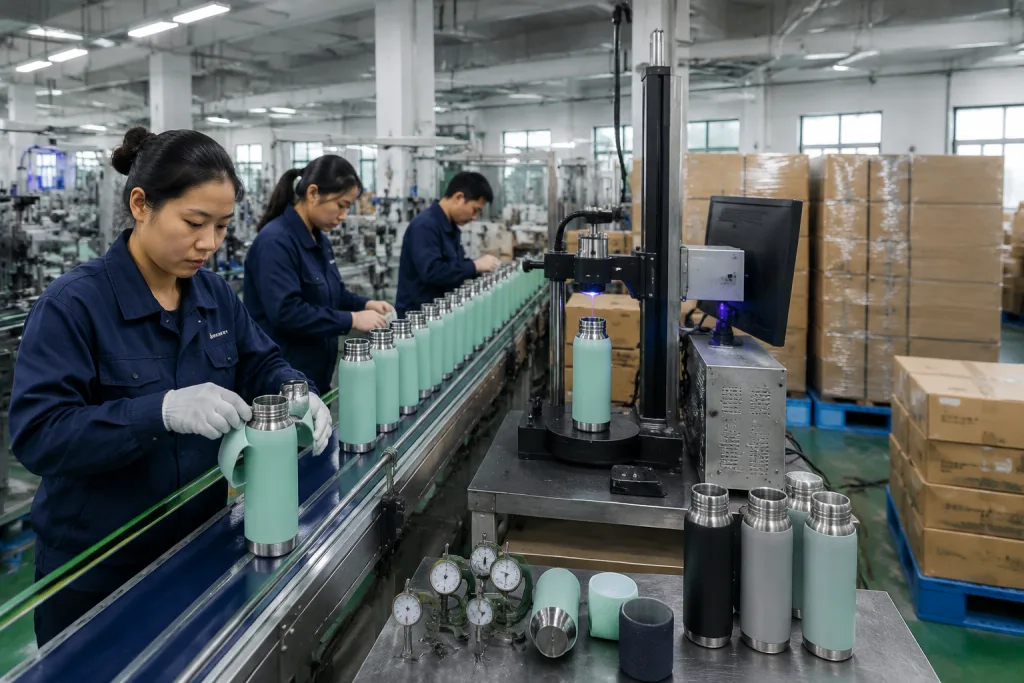
We build and export from Zhejiang, China, so the questions we hear every week are plain: which body style ships best, which cap gets fewer complaints, and what MOQ makes sense at 2,000 to 10,000 units. A serious thermos supplier should answer with numbers, not slogans. Our Hangzhou factory runs about 180,000 units per month, and typical lead time sits at 25 to 35 days after sample approval. QC pulled the sample, checked the silicone sleeve fit against a 1.5 mm tolerance, and that is the level of detail you should expect from any thermos factory in China.
Top five buyer priorities
Before you compare a thermos manufacturer or thermos vendor, sort the bottle by what your channel actually sells. Outdoor retail watches insulation, dent resistance, and whether the finish still looks clean after 8 weeks in a pack pocket. Promo buyers care about logo space, lead time, and whether a promotional thermos fits the campaign budget. Distributors want repeatability. We had one buyer flag a 2 mm lid gap on the line, and that turned into service tickets fast.
For this guide, the order is thermal performance, cap reliability, branding space, MOQ flexibility, and compliance for Europe and North America. That is how a serious silicone vacuum bottle supplier should think. A factory thermos is not just a shell with vacuum insulation. It is stainless grade, wall thickness, silicone placement, powder coating, and packaging working together. QC pulled the sample with a caliper at 0.45 mm, and if one part slips, the numbers stop adding up.
Here is the blunt version: you do not need the fanciest bottle. You need the one that survives packing, shipping, retail handling, and repeated washing without creating claims. If you buy thermos bulk for a seasonal program, the real metric is not the sample on your desk. It is the share of units that pass a random carton pull after 30 days in transit and 90 days in warehouse storage. We ship those cartons every week, and a typo on the PO can still cost a day if the SKU code is off by one digit.
Ranking criteria that matter
- Thermal hold: 6-12 hours hot, 12-24 hours cold
- Structure: 304 stainless, 0.4-0.5 mm inner wall, silicone base or sleeve where needed
- Decoration: screen print, laser engraving, or 360-degree wrap
- Supply: MOQ, 25-35 day lead time, carton efficiency
- Compliance: REACH, LFGB, FDA, and documented AQL inspection
Best overall for outdoor retail
The best all-around custom thermos for outdoor retail is a 500 to 750 ml double-wall stainless bottle with a screw lid, silicone base ring, and a straight body that takes a clean logo. We run this shape on the line because it stacks cleanly in cartons and on pallet racks. Simple sells. A solid manufacturer thermos in this category should give you 304 stainless steel, a 0.4 mm inner wall, and a powder-coated exterior that still looks decent after field scratches and warehouse rub marks. That is the right starting point.
For buyers, the numbers do the talking: 8 to 12 hours hot, 18 to 24 hours cold, depending on ambient temperature and lid type. The buyer flagged the lid torque on one sample, so QC pulled the sample and checked the cap thread with a go/no-go gauge. If you are comparing a customizable thermos program, this is the spec that pays back, not a busy shape with extra parts. You can add laser engraving, one-color silk screen, or a low-relief deboss on the silicone sleeve. On FOB terms, a 1,000-unit order often lands around $3.20 to $5.60 per unit depending on finish and packaging. The math works when the spec stays clean.
What makes this the best choice is low complaint risk, not novelty. Outdoor retailers need a thermos supplier that can keep the same body and cap in production for 6 to 12 months without changing fit. We have seen this go sideways when a supplier swaps the gasket or trims the cap wall by 0.2 mm to save cost. The PO typo on a 3,000-piece run was one line off, and it still took two days to sort. China factories in Zhejiang do this well when the process is locked and the inspection plan is disciplined.
Best for high-impact branding
If your channel is promo-heavy, a straight-wall thermos promotional model with a wide print panel and a removable silicone sleeve is the clean fit. We run this style for roadshows and staff gifts. The sleeve adds grip, gives a solid color block, and hides scuffs after 500 handouts. QC pulled a sample once and the buyer flagged a 1.5 mm print misalign on the sleeve as a hard stop, so this shell is the right call for a custom thermos push.
For logo work, the sleeve earns its keep. We can do 1-color screen print on silicone, laser engraving on the steel body, or both on the same SKU. On the line, a sleeve usually adds $0.18 to $0.45 per unit and 3 to 5 extra days if the incoming color check needs a separate pass at QC; a white sample once came back with a 2 mm shade shift, and that held the lot. A good thermos factory still keeps repeat orders inside 30 to 35 days.
This is the right fit for thermos custom campaigns at 2,000 to 20,000 units when you need the product to look expensive without blowing the budget. We have seen buyers ask for a “premium” finish on a 304 stainless body with a 1,000 pcs MOQ, then push back when the math doesn't work. Reuse the same bottle body, swap the sleeve and carton artwork, and you keep inventory simple. A carton typo on the PO can delay a reprint by 4 days, so this is where a Zhejiang supplier should stay sharp.
Best for premium retail margins
The premium slot usually goes to a slimmer 450 to 500 ml vacuum bottle with a polished or matte body, a precision-fitted cap, and a tighter silicone band near the base or neck. We sold one 480 ml shape into a gift chain last quarter. Buyer pushed back on any heavy-looking wall, so the line held the body at 0.6 mm to protect the finish. Shelf appeal wins here. This is the bottle you pick when display value and perceived quality matter more than raw capacity. For outdoor boutiques, gift shops, and higher-end distributor thermos programs, the extra $0.70 to $1.20 per unit usually pays back at retail. The math does not work any other way.
The premium design still has to work in daily use. Do not chase fragile shapes or lids with too many moving parts. A premium thermos manufacturer should keep the neck opening wide enough for cleaning and use a cap that can pass 5,000 to 10,000 open-close cycles in internal testing; QC pulled one sample last month because a 28 mm gasket seat was too tight after repeated torque checks. If the customer cannot clean it or the seal starts slipping after a few months, the margin is gone. We have seen that go sideways.
For Europe and North America, this is the point to check finish durability under ASTM-style rub testing and a clean chemical file. Ask for REACH and FDA declarations, and confirm that all silicone contact parts are LFGB-compliant if you sell into stricter retail programs. We ship this file before the PO on purpose, because a buyer once flagged a typo on a release note and the whole order sat for 12 days instead of 18; that is a cheap mistake to avoid.
Best for bulk promotions
Price sets the spec. We run a 350 to 500 ml promo thermos with a plain outer shell, insulated inner body, and a basic PP cap or stainless cap, depending on the target quote. Nothing fancy. That is the point. On a March sample, QC pulled the cap with a go/no-go gauge and the buyer still pushed for a lower price; wrong question. The campaign number was already fixed. A thermos supplier earns trust by keeping the sample honest.
On a thermos bulk order, accessories decide the margin. A plain gift box, one-color logo, and standard carton can hold landed cost down by $0.35 to $0.90 per unit. Add FNSKU labeling for Amazon or retail prep, and you are usually looking at another $0.08 to $0.15 per unit plus carton-sorting labor. We had one PO with “ctn qty” typed wrong, and the buyer flagged it before pack-out; that saved a useless reprint. A practical thermos distributor asks for these details up front, not after the line is already running.
The tradeoff is thermal time. We usually see 4 to 8 hours hot and 10 to 16 hours cold, enough for commuter use and low-cost gifting. We have seen this go sideways when a promo buyer expected premium hold from a giveaway bottle. The math does not work. If the brief needs premium insulation, the spec has to move, or the budget has to move. A 350 ml unit with a 1.2 mm wall and a basic cap is a campaign tool, not a flagship flask.
Best for distributor programs
For distributors, the cleanest move is a standard factory thermos platform with swap-in lids, two body sizes, and one repeatable decoration area. We run that setup every week because it holds on reorder. You do not need 15 shapes. Two or three stable bodies, one cap family, cartons that stack the same way. That is how a thermos distributors program stays workable. QC pulled the sample on a 58 mm neck, and the fit stayed tight after 1,000 open-close cycles. Good enough for the line.
Plan for an MOQ of 500 units per color on repeat programs, or 1,000 units if you want better price and less line changeover loss. The math does not work the other way around. We had a buyer flag 300 pieces last month, then ask why the unit cost jumped. On our bench, the gap between 500 and 3,000 units can land at $0.40 to $0.80 per bottle, depending on tooling and packaging. That matters when you ship container loads from China to North America or Europe. One PO even came in with a lid code typo, and the rework cost more than the savings.
Ask about inspection from the start. An honest thermos factory should accept AQL 2.5 for major defects and 4.0 for minor defects on general consumer drinkware, with photo records from pre-shipment sampling. We also check lid leaks on the vacuum line, print alignment, and color tolerance before we release the lot. A caliper, a leak tester, and a label gauge tell the story fast. If a supplier cannot explain those checks, you are not talking to a serious manufacturer. You are dealing with a catalog broker, and we've seen that go sideways fast. One bad valve seat at 0.3 mm will do it.
What customization should cost
Customization is where buyers get billed for guesswork. They load options before the first sample is cut. A sensible customized thermos program starts with body color, logo method, and packaging. That is the base. We run samples in 7 to 12 days when the artwork is clean and the cap stays on our current mold rack; if the buyer asks for a shaped lid on day one, the schedule slips and the math does not work. QC pulled one sample with a 0.6 mm print shift last month. It was a simple fix.
Silk screen printing is the cheapest logo method, laser engraving lasts longest, and full-wrap heat transfer sits in the middle. On a 1,000-unit order, the logo gap is often $0.08 to $0.60 per unit, and the buyer sees it in the PO before they see it on the bench. Silicone parts add cost too. They need separate tooling, extra curing time, and another check at QC. We have seen one flat-price quote hide that until the first inspection, and that is the wrong question to ask. A buyer once pushed for “same price, same look” on a 24 mm cap; the line could not hold it.
Good buyers ask for a written structure: base bottle price, decoration charge, packaging charge, and test charge. That is how you compare a thermos manufacturer in Zhejiang against another factory in China without guessing. It also keeps the next step clean when the MOQ moves from 1,000 to 3,000. One typo on a PO, one missing packaging line, and the price argument gets messy fast. We ship against that every week. The buyer flagged it.
How to audit a supplier
Audit the supplier the same way we audit the line: stainless traceability, process control, inspection records. Ask for mill certs, the vacuum leak test method, and silicone compliance papers. A proper thermos supplier should hand over REACH, FDA, and LFGB reports when the market asks for them. If they ship to North America, ask who prints carton labels, outer case marks, and FNSKU stickers when your warehouse runs a fixed scan rule. One buyer flagged a PO typo on the carton mark, and the shipment sat for 3 days. Catch that before we run mass orders.
Then check the real production numbers. A factory that claims to be a serious thermos manufacturer should show monthly output, lead time, and the route from prototype to mass run. In Hangzhou, Zhejiang, our line runs about 180,000 units per month, and we keep sample development off the main line so buyers do not get a wall thickness jump from 0.8 mm to 1.0 mm. QC pulled the sample, checked the neck finish with a caliper, and sent it back if the fit was off by 0.2 mm. That matters more than a polished sample room. The math does not work any other way.
Finally, ask where products fail. Where do leaks start? Where does the powder coat chip? How does the silicone hold up after dishwasher cycles? A real supplier answers with defect points and corrective action, not slogans. A weak one talks price and stops there. We saw a 12-day vs 18-day repair loop on one order because the buyer pushed for a cheaper gasket, and the leak rate climbed on the pressure test bench. For outdoor retailers and promo brands, cheap usually turns expensive after the first season.
Build your thermos line with real factory numbers
Send your target capacity, logo method, and monthly demand. We will map the right stainless thermos structure, MOQ, and lead time from Zhejiang, China.
Frequently asked questions
What MOQ should I expect for a custom stainless thermos?
For a standard custom thermos, 500 units per SKU is a normal starting point from a Zhejiang factory. If you want custom colors, silicone parts, or multiple logo positions, 1,000 to 3,000 units is more realistic for stable pricing. At 3,000 units, your FOB cost usually improves by 8% to 15% versus a 500-unit trial order. If the supplier offers 100-unit MOQs, check whether they are holding stock or just passing you a weak quote with hidden charges.
How long does a silicone vacuum bottle supplier need for production?
For a repeat order with an existing mold, 25 to 35 days is normal after sample approval and deposit. If you need new silicone tooling or a new finish, add 7 to 12 days. Shipping time is separate: 18 to 30 days to Europe by sea, 15 to 25 days to North America depending on port and service. A serious supplier should state the factory lead time and the freight timeline separately, not mix them into one vague promise.
What compliance documents should I request?
For Europe and North America, ask for REACH, FDA food-contact declarations, and LFGB if your retailer wants a stricter file set. For the factory, ask for ISO 9001 if available, plus an AQL inspection report before shipment. If the thermos uses silicone contact parts, confirm the silicone compound is food-grade and the inks or coatings are suitable for indirect food contact. If you need retail packaging, also request carton drop-test or compression-test data.
Is silicone worth adding to a thermos design?
Usually yes, if you use it for a real purpose. A silicone base ring helps with grip and table stability, and a silicone sleeve improves handling and branding. Cost is usually $0.18 to $0.45 per unit depending on part size and color count. The downside is more process control, because silicone adds one more part to inspect. If you are buying promotional thermos quantities and your price target is very tight, a base ring is often the better compromise than a full sleeve.
Which decoration method is best for outdoor retail?
Laser engraving is the most durable for a custom thermos because it does not wear off in normal use. Silk screen is cheaper and works well for large logo runs, but it can abrade over time if the bottle gets heavy field use. For premium outdoor retail, many buyers combine laser on the metal body with a one-color mark on the silicone part. For a 1,000-unit order, expect logo costs from about $0.08 to $0.60 per unit depending on method and size.