Key Takeaways
- MOQ for most custom stainless thermos programs starts at 3,000 units, with 25-35 day lead time from artwork approval
- Double-wall 304/316 stainless construction usually sits at 0.35-0.5 mm inner wall thickness and 0.4-0.6 mm outer wall thickness
- A practical FOB China price range is USD 2.10-5.80 per unit depending on size, lid, coating, and packaging
- For export retail, ask for REACH, LFGB, and AQL 2.5 inspection terms, plus drop and thermal-retention data
Pick the wrong silicone vacuum bottle manufacturer, and the quote is not the problem. The trouble shows up after tooling opens and the buyer flags a 0.8 mm wall note nobody checked on the spec sheet. A 500 ml bottle can pass three samples, then split on hot-fill, fail a drop test, or miss a 90-day retail run. We have seen that go sideways more than once.
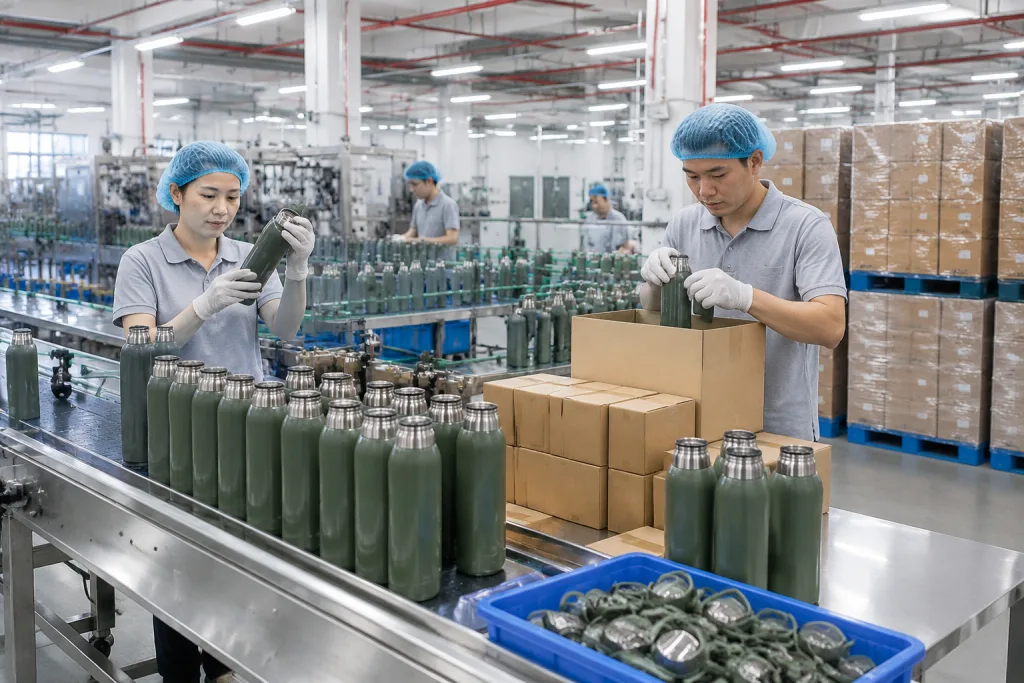
We run stainless thermos programs in Zhejiang, China, for buyers who want a clean custom finish and steady output. At our Hangzhou factory, MOQ starts at 3,000 units for custom thermos orders, monthly capacity is 120,000 units, and lead time is 25-35 days after artwork approval. QC pulled the sample on the bench with a caliper last week; the lip thickness was 0.4 mm off until the line adjusted it. Read the spec line by line. The real offer shows up fast.
Start With the Bottle Core
Before you talk logo placement or gift boxes, check the bottle core. That is where the job starts. We run 500 ml samples on the line with a micrometer, and the first checks are steel grade, wall structure, and vacuum quality. For a standard export build, 304 stainless steel goes inside and outside. Use 316 only when the buyer wants better chloride resistance for coastal shipping or harsher wash cycles. “Food grade stainless” is too loose. We need the exact grade, wall thickness, and whether the inner liner is deep-drawn or welded. The buyer flagged a PO once that only said “stainless body” - that typo turned into two rounds of sample rework at QC.
For outdoor retailers, 0.4 mm inner wall and 0.5 mm outer wall is a sane middle point. Light in the pack. Still holds shape. If a quote looks too cheap, check whether the gauge was cut down. We have seen 0.35 mm slip in to save material, and the math does not work once dent rate climbs and returns start. A thinner body can shave 8-12% off material cost, but it bites back later. Ask for vacuum retention data at 95°C fill, checked after 6 hours and 12 hours, not a brochure line. QC pulled the sample on the bench with a thermometer and timer; a real thermos manufacturer should hand over that data without a song and dance.
- 304 stainless: standard for most bulk thermos programs
- 316 stainless: useful for premium thermos customized projects
- 0.35-0.5 mm wall: normal export range for a durable body
- Vacuum hold: expect 6-12 hours depending on size and lid design
Lid Design Changes Everything
The lid decides whether a custom thermos feels like a retail piece or a complaint generator. Buyers stare at the body print and skip the cap; that is the wrong question to ask. On a promo run or distributor program, the lid controls leak rate, drinking feel, and how many tickets hit customer service in the first 30 days. A screw lid with a silicone ring is cheap and steady. A flip-top or push-button lid costs more, and it adds spring wear, seal wear, and one more part the line has to hold to spec.
For outdoor use, we usually push a wide-mouth lid with a removable silicone gasket. It cleans faster, takes ice without a fight, and does not hold odor like a narrow neck does. If the buyer says hikers are the target, we ask for 48-52 mm opening; if it is office or travel, 36-42 mm keeps heat loss in check. QC pulled the sample and ran a tilt-leak test on the bench, because a bottle can sit upright all day and still drip once it lands in a backpack. That is the part that saves you from a bad review. Decorative cartons do not fix a weak lid.
Rule of thumb: a lid can feel premium in hand and still be a bad lid if the seal slips at the first real use.
We see too many thermos suppliers chase a trendy cap and skip cycle testing. The math does not work. We have seen that go sideways after 800 open-close cycles on the line, with one PO even missing the word "silicone" on the cap spec and the buyer flagging it after sampling. If you want a thermos promotional item people actually keep on desks or in cars, keep the mechanism simple unless the margin pays for the extra engineering.
Silicone Details That Matter
Silicone is not a footnote if you source from a silicone vacuum bottle manufacturer. It sits on the base ring, sleeve, stopper, gasket, and grip zone. Each part changes hand feel. Grade, hardness, and cure method show up later as odor, color shift, and crack resistance. We run this check on the line with a durometer and a 24-hour odor hold, because the buyer will flag it after the first unpacking.
For export work, ask whether the silicone is platinum-cured or peroxide-cured. Platinum-cured material is cleaner and fits premium custom thermos orders, but the price goes up. Peroxide-cured works when the structure is simple and the target MOQ is tight. Hardness matters too. A base ring at 55-65 Shore A gives grip without going floppy. A sleeve at 60-70 Shore A is common, and overmolding adds tooling cost plus 12-18 seconds to cycle time. QC pulled the sample at 62 Shore A last week and the buyer still pushed back on feel. The math doesn't work if you keep calling that “soft enough.”
- Base ring: protects the bottle and reduces table slip
- Gasket hardness: 55-65 Shore A is practical
- Odor control: request low-VOC silicone for food-contact parts
- Color stability: verify after 50 dishwasher cycles
Colored silicone also needs pigment stability at high wash temperatures. If your buyer spec says dishwasher-safe, ask for 50 cycles with no cracking, tackiness, or color migration, and ask for the test sheet, not a promise. We have seen this go sideways on a PO where the carton note said “silcone ring” and the sample arrived with dust in the bag; that typo cost a repack. For a supplier thermos program with silicone parts, the carton needs a clean check too. Lint sticks fast, and a sloppy pack line turns into a retail rejection before the bottle even hits the shelf.
Decoration and Brand Fit
Brand decoration is where a thermos custom program stops looking like a commodity and starts behaving like a SKU. The choice comes down to art file, finish, and MOQ. Silkscreen works for one or two solid colors on powder-coated bottles. Laser engraving gives a clean permanent mark on bare metal or matte-coated surfaces. Heat transfer and sublimation only make sense on certain coated bodies. We ran a 500-unit sample last month, and QC pulled the logo at 60x magnification because a 0.3 mm stroke filled in. Ask for the actual decoration yield. The theoretical limit is not what you ship.
For outdoor retailers, we push powder coating or spray painting with a laser logo, because the mark still reads after abrasion. Soft-touch looks premium on day one, then it starts picking up scratches faster than a standard matte coat. The buyer flagged one PO where the Pantone code was typed as 186 C instead of 186 U, and that one typo would have sent the line the wrong ink. We quoted an extra USD 0.18-0.45 per unit for more complex decoration, depending on color count and setup. Ask for a sample with the exact Pantone code and a 72-hour adhesion test. That is the right question before mass production starts.
When the art is tight and the order is large, a manufacturer thermos program can run full-body wrap printing or UV print, but both need clean files and firmer QC. If the bottle goes into Amazon or a chain store, keep the brand mark readable at 1 meter. That sounds basic. It is. We have seen a 12-day rework turn into 18 days because the logo sat too close to a seam line and the buyer rejected the first carton drop.
Sizing for Use Case
Capacity is not a catalog filler line. It drives weight, heat hold, carton count, and freight. A 350 ml bottle slips into a kid’s lunch bag, a commuter tote, or a gift box with no drama. A 500 ml bottle is the workhorse for office desks and car cup holders. A 750 ml thermos fits hiking and travel, but the bulk shows up fast, and the freight math starts to bite. We usually build distributor programs around 500 ml and 750 ml; the 350 ml sells better in promo and gift channels. Last month QC pulled a 500 ml sample that still fit a 58 mm cup holder. That was the point.
Here is the part buyers check after the first quote: a 500 ml double-wall stainless thermos usually lands at 260-340 g, depending on the lid, while a 750 ml unit often reaches 380-480 g. That extra 120 g changes carton loading and pushes up ocean freight per case. Ask for net weight, gross weight, and carton dimensions before you sign samples. We ship those three numbers on one sheet because the math does not work any other way. A sloppy factory sends a pretty photo and no carton data. We have seen that go sideways on a 12,000-piece PO. The scale never lies.
- 350 ml: promo runs, kids, gift sets
- 500 ml: best all-around custom thermos size
- 750 ml: outdoor and travel-focused custom thermos
Capacity also changes how the shelf price reads. Buyers will take a higher unit price on a larger bottle, but freight can wipe out the gain if the carton count is weak. We had one buyer flag a PO because “500ML” was typed as “500mls” in the artwork notes, and the line had to stop for a recheck. So the spec sheet should show landed cost, not just FOB China. This is the wrong question to ask if you only look at unit price. One 600x400x300 mm carton tells you more than three sales calls.
Test the Claims, Not the Sample
Samples help, but they are not proof. One hand-picked bottle can hide a bad weld, a weak gasket, or a print defect that only shows up after 200 units. We tie the test plan to the PO. For export orders, we normally run AQL 2.5 for major defects and 4.0 for minor defects, then add leak checks, vacuum retention, and decoration adhesion. If the buyer says the sample passed, fine. QC pulled the sample off the line at 9:30 a.m., and the real question was whether the same result held on the full lot.
Ask for material compliance too. For Europe, REACH and LFGB are the usual ask. For North America, buyers often want FDA-style food-contact declarations, and sometimes ASTM or ISO references for thermal testing and coating durability. We had one PO where the carton label missed an FNSKU by two digits, and that typo cost a week at the warehouse. This is the wrong question to ask: not “can you send the report,” but “can you show the report before shipment?” A solid thermos supplier has the file ready, or the buyer flags it at receiving.
For outdoor programs, we run a plain abuse test: 1 meter drop on concrete, 3 times, with no leak and no lid failure. The bottle can come back with scuffs. Function must stay intact. That test costs little and it catches weak hinges, loose gaskets, and bad thread tolerances fast. We saw a 26 mm lid skirt crack on the second drop last season, and the math does not work on a claim rate like that. Good factories pass the same abuse again and again.
Pricing, MOQ, and Lead Time
Numbers close POs. A standard custom thermos with 304 stainless steel, powder coating, and a one-color logo usually lands at USD 2.10-3.60 FOB China for 500 ml at 3,000 units. Add a premium lid, silicone grip, custom box, or laser logo, and the quote moves to USD 3.80-5.80. Last month QC checked a lid insert at 0.3 mm on the vernier caliper, and that one change pushed the price up again. 316 steel, copper-plated vacuum layers, and complex molding cost more. That is material and labor.
MOQ is usually 3,000 units for a real custom run. Some thermos suppliers will say 1,000 units if the mold is already in house and only the decoration changes. Lead time is normally 25-35 days after sample approval and deposit, then 5-12 days for sea freight, depending on destination. We once caught a PO typo that changed “matte black” to “matt black,” and QC pulled the sample before we shipped. For a seasonal launch, work backward from the ship date. The factories that keep their word in Zhejiang usually run 80,000-150,000 units a month, and the production board on the line matters more than sales talk.
For distributor thermos programs, ask for a volume ladder. The gap between 3,000 and 10,000 units can be USD 0.25-0.60 per bottle, depending on packaging and decoration. That is real margin. We’ve seen this go sideways when a buyer chased the first quote and skipped the breakpoints. If your supplier thermos partner cannot show the scale break, the math does not work.
Packaging for Retail and Promo
Packaging is not an afterthought once the bottle goes through retail or a corporate gift channel. We have seen a good thermos look cheap because the box was sloppy. White box, color box, window box, kraft mailer, gift set insert. Those are the usual picks. For e-commerce and distributor thermos orders, the carton has to survive stacking, vibration, and 60 days in a warehouse without crushing at the corners. If you want FNSKU labels, barcodes, or multilingual inserts, say it early, because the buyer will flag the print area on the first proof. We ship samples with a 0.5 mm gap at the tuck flap so the lid does not rub the liner.
A plain white box keeps cost down, but a printed color box usually adds USD 0.12-0.38 per unit. A molded pulp tray or EVA insert costs more, and the math does work when the shelf display is the selling point. We ran a 1.2 mm wall sample with a loose insert once, and QC pulled the sample after the lid scratched the liner in transit. That went sideways fast. If you sell a customizable thermos as a gift, box depth and internal fit matter because rattling bottles come back as complaints. Ask the thermos factory for a drop-tested shipper carton, usually 3-layer or 5-layer corrugated depending on weight and route. For export to Europe and North America, moisture resistance and carton burst strength should be on paper, not guessed.
Retail buyers should also ask for pack-out time per unit. A box with three inserts slows the line and adds labor. On a 120,000 units/month factory line, 20 seconds extra packing time turns into a real scheduling problem by the afternoon shift. We saw a PO once with the word “retial” in the pack spec; the buyer corrected it on day one because the carton art and the packing list did not match. This is the wrong question to ask if the goal is a clean launch. A practical supplier thermos program keeps packaging simple unless the channel truly needs premium presentation.
Request a spec-led thermos quote today
Send your size, lid style, logo method, and target price. We’ll return a factory thermos quote with MOQ, lead time, and test points.
Frequently asked questions
What MOQ should I expect for a custom stainless thermos order?
For most export programs, expect 3,000 units as the working MOQ for a custom thermos with your logo, finish, and packaging. If the factory already has an existing mold and you only change decoration, some thermos suppliers may accept 1,000 units, but pricing will be less efficient. For a true new tool or custom lid, 3,000-5,000 units is more realistic. In Zhejiang, the better factories keep lead time around 25-35 days after sample approval, which is normal for bulk thermos production. Smaller runs usually mean higher per-unit cost and less room for quality control.
How do I judge whether a thermos is really leakproof?
Do not rely on an upright table test alone. Ask for a tilt-and-shake leak test, ideally 45 degrees for 10 minutes and then a full inversion test. A useful spec also includes hot-fill at 95°C, closure after 5 minutes, and no leak after 6-8 hours. For a custom thermos, check the gasket material and thread tolerance because those are the first failure points. If the lid uses silicone, request the hardness rating and cycle count. A serious thermos manufacturer will also show you how the seal performs after repeated opening and closing, not just on a fresh sample.
What is a fair FOB China price for a promotional thermos?
For a simple promotional thermos in 500 ml, FOB China often lands around USD 2.10-3.20 if you are buying 3,000 units or more. Add a powder coat, one-color logo, and standard box, and you can move to USD 2.80-3.80. If you want silicone grip parts, a premium lid, or laser engraving, USD 3.80-5.80 is more realistic. The exact price depends on steel grade, lid complexity, and packaging. A good supplier thermos quote should break out body, lid, decoration, and carton separately so you can see where the cost sits.
Which compliance documents should I ask for when sourcing from China?
For Europe, ask for REACH and LFGB where applicable, plus material declarations for stainless steel and silicone. For North America, many buyers request food-contact compliance statements and test references tied to coating and migration. If your product has packaging or barcode labeling requirements for Amazon, ask for FNSKU readiness and carton mark samples. On the factory side, BSCI or equivalent social compliance may matter for some retailers. A practical thermos supplier in China should also provide AQL inspection terms, usually AQL 2.5 for major defects, and thermal-retention test records tied to your approved spec.
Is 304 stainless enough, or should I specify 316?
For most custom thermos projects, 304 stainless is enough and is the standard choice. It gives good corrosion resistance, stable cost, and broad food-contact acceptance. Use 316 only when the bottle will face harsher conditions, such as coastal humidity, saline exposure, or a premium retail position where the higher material cost is justified. In practice, 316 can add roughly 8-15% to material cost depending on market conditions. If your buyers are outdoor retailers, the more important issue is not the grade alone but wall thickness, vacuum quality, and lid performance. A well-made 304 bottle usually beats a poorly built 316 bottle.