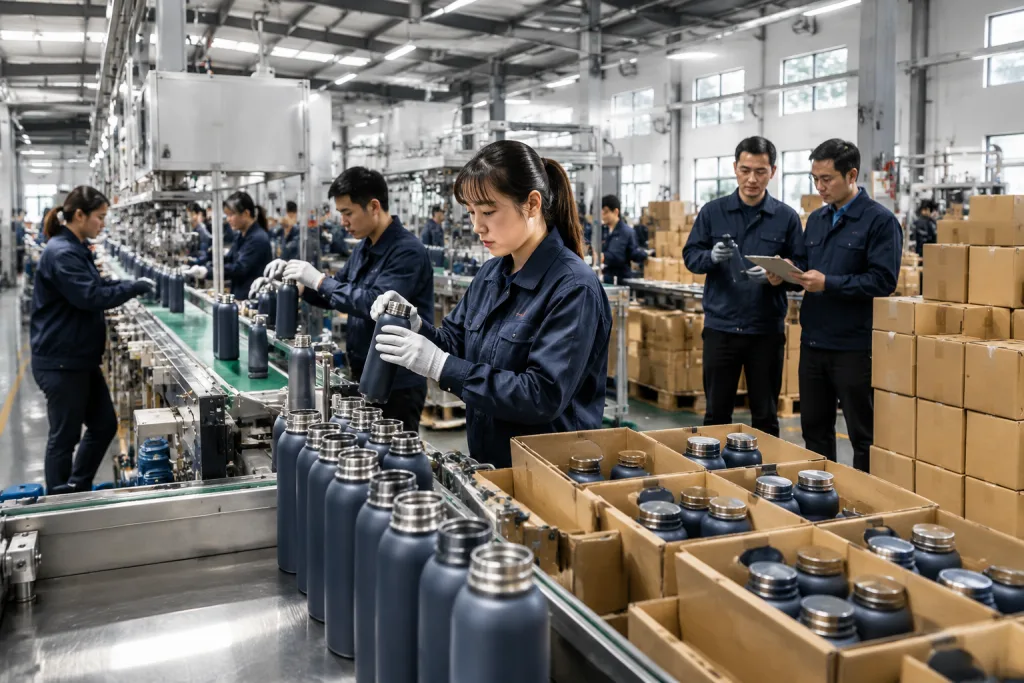
Key Takeaways
- A practical thermos custom order usually starts at 500 pieces and 25-35 days after sample approval
- A 304 stainless body with 0.4-0.5 mm inner wall is the normal baseline for bulk thermos programs
- AQL 2.5 for major defects and 4.0 for minor defects is a common export QC target
- Laser logo on a customized thermos stays cleaner than a 1-color silkscreen after 200+ wash cycles
You are not buying a stainless thermos to sit on a shelf. You are buying a working part that has to survive carton drop tests, logo printing, repeated opening, and one simple check: does it hold temperature the way the spec sheet says? The first talk with a silicone vacuum bottle factory should start with structure, not artwork. We saw a buyer chase a matte finish, then QC pulled the sample and found a slow leak at the cap after 24 hours. Margin gone.
In Zhejiang, and across China, we run this kind of order every week. The useful details sit on the line sheet, not the brochure. You need to know what 304 or 316 means in practice, how a 0.5 mm inner wall behaves against 0.4 mm, what a 500-piece MOQ actually buys, and which tests matter before FOB shipment. For outdoor retailers and promo brands, that is the gap between a clean repeat order and 2,000 units sitting in the warehouse. The math does not work any other way.
Start With the Use Case
Do not start with lid color. Start with the job. A thermos for a campground retail chain is a different build from a promo bottle handed out at a sales meeting. One needs 18-hour heat hold, a grippy finish, and a cap that still closes after a 200 km truck run. The other needs a clean imprint zone, a unit cost that stays inside the quote, and a ship date that lands before the campaign goes live. We saw a buyer lose 7 days chasing cap samples because the use case was never pinned down.
For a silicone vacuum bottle factory, the first questions are plain: hot hold or cold hold target, daily use, capacity, and whether the customer wants a wide mouth or narrow mouth body. A 500 ml custom thermos is easier to merchandise and cheaper to ship. A 750 ml or 1,000 ml bottle gives more print area and stronger shelf presence, but it also adds weight and freight. The math does not work any other way. If you are building a distributor thermos program, this is where the pricing gets set. QC pulled a 500 ml sample with a 1.2 mm wall, and the buyer flagged the hand feel before we even opened the decoration file.
- Outdoor retail: 500-750 ml, powder coat, leakproof lid, 12-24 hour insulation target
- Promotional: 350-500 ml, simple cap, low-color decoration, lower FOB
- Gift/distributor sets: matched carton, sleeve, and barcode-ready packout
A competent thermos factory should quote all three without changing the basic line. In Zhejiang, that usually means one deep-draw body line, one vacuum sealing line, and one print table for thermos custom artwork. We run it that way. A typo on a PO once turned 1,000 pcs into 10,000 pcs on paper, and the buyer caught it before the carton labels were printed.
Choose the Bottle Construction
Buyers often say “stainless thermos” and stop there. Too vague. We run the line by grade, wall thickness, vacuum target, and finish: silicone, powder coat, paint, or bare steel. For a standard thermos program, 304 stainless is the default inside and outside. 316 only makes sense when the buyer has a real corrosion case or a premium shelf slot. It costs more. It will not save a rough build.
Wall thickness is where the cheap-looking problems start. A common build is 0.4 mm inner wall and 0.5 mm outer wall. That gives the forming press enough stability without making the bottle heavy. If the inner wall drops below 0.35 mm, QC pulled the sample and you start seeing more deformation, plus a vacuum line that gives us less room to breathe. We had one buyer push back on price for a 420 ml bottle, and the math still did not work. For an outdoor retail order, we do not take that unless the buyer signs off on the tradeoff. One bad gauge reading, and the whole lot gets noisy.
Silicone matters too, but only as a working part. A silicone base ring cuts slip and table noise. A partial wrap gives better grip with winter gloves. A full body sleeve changes the look more than the insulation. This is the wrong question to ask if someone thinks silicone will carry thermal performance. The vacuum does the heat retention; silicone helps handling and the brand story. On one PO, the buyer flagged a 2 mm sleeve gap, and that tiny miss caused more complaints than the insulation spec. We had the caliper on the bench. That gap shows up fast at the line.
Ask the factory for the exact structure drawing: inner cup material, outer shell material, silicone coverage area, and lid assembly. If they cannot send a clean section view, they are selling you a story, not a thermos. We have seen this go sideways on a 5000 pcs order when the PO typo said “full sleeve” but the sample was only a base ring. We shipped the wrong build once on that kind of mismatch, and the fix cost 12 days.
Price the Order Like a Buyer
Pricing a thermos bulk order starts by splitting the number into product cost, packaging, decoration, and freight. We run 500 ml 304 stainless bottles with a plain PP lid and one-color logo at about USD 2.20-3.20 FOB China for 1,000 pieces, depending on finish and carton spec. Add a silicone sleeve, double-wall structure, or a more complex lid, and the price jumps fast. I’ve seen buyers fixate on the first line item, then get burned on print setup, individual boxes, inserts, or export cartons. The math does not work that way. A vacuum bottle factory in China can quote low, then add those extras later; QC pulled the sample, checked the carton size at 58 x 58 x 240 mm, and the gap showed up immediately.
For promotional thermos programs, I push buyers to ask for two quotes: base spec and upgraded spec. Clean split. If you need a thermos distributor margin of 25-35%, a vague quote with hidden print charges will eat it. We had a buyer flag a PO typo on the lid artwork once, and the reprint cost was more than the margin on 800 pieces. Ask for FOB Ningbo or FOB Shanghai terms, because Zhejiang factories often ship through either port depending on container timing and trucking cost. That is the right question, not a round number with no shipping lane behind it.
MOQ is where buyers waste days. A lot of thermos suppliers will take 500 pieces for a stock structure and 1,000 to 3,000 pieces for custom colors or special lids. If a factory says 300 pieces for everything, check whether they actually control the mold or are only reselling finished goods. A real thermos manufacturer in China can tell you exactly where the MOQ comes from: coating batch size, lid tooling, or print setup. We ship this every week, and the line does not lie.
Lock the Branding Early
Logo choice moves the line more than most buyers expect. Silkscreen is cheap and clean, but on bottles that get washed every day it can scuff off fast. Laser engraving costs more per unit on some runs, yet it stays on stainless steel. We had one buyer flag a 10,000 pcs PO because the logo spec changed after sample sign-off, and that added 4 days to our engraving schedule. For an outdoor retailer, laser reads sharper. For a promo thermos, one-color screen print usually wins.
Do not approve artwork before you lock the decoration area. A tapered 500 ml body may give you only a 40 mm print field on the front panel, and a long wordmark will not fit there. This is the wrong question to ask. We run into this on the measuring jig all the time. If the brand needs more width, the logo can move to the rear panel or wrap toward the shoulder, but that changes the fixture and can move the quote. The cleanest orders come when the buyer sends AI or PDF artwork with the spec sheet, not after.
If you are building a distributor thermos line, ask for one blank white sample and one decorated sample, minimum. QC pulled the sample and checked the logo edge, the coating after curing, and the alignment against the bottle seam. We have seen this go sideways when the print looks fine from 3 feet away and fails under the light box. A factory thermos sample like that does not help anyone in a B2B program.
Test the Sample Before You Approve
Sample approval should be boring and written down. We run it on the bench, not in a sales deck. Check the PO, not the pitch. For a custom thermos, the sequence is fill test, leak test, retention test, drop check, and finish inspection. On retention, we want hot water above 60 C after 6 hours for a 500 ml bottle in normal lab conditions. Wall thickness and lid stack change the result. QC pulled the sample and the lid gap sat at 0.8 mm. Ask for the number, not a promise.
For leakage, invert the bottle for 24 hours with room-temperature water and check the cap, gasket, and thread. At a silicone vacuum bottle factory shipping export goods, I also ask for a 50 cm drop test on the carton corner and bottle body. We saw a buyer flag this on one order: the heat data passed, then the corner crush left a hairline crack at the cap. That is the wrong place to argue. Outdoor buyers care about dents and lid cracks, not just heat hold. If your market is the US or EU, confirm REACH for the coating and ask for MSDS on any silicone or paint system used. For food-contact orders, request FDA-related declarations where relevant, plus ISO 9001 process control and BSCI if the retailer asks for social compliance. The math does not work without the paperwork.
Reject one sample now. It is cheaper than finding a 2% leak rate after 20,000 units are in a warehouse. We have seen this go sideways on a carton stamp typo before, and the batch sat while the buyer sorted claims. That was a bad week. A thermos supplier turns a good price into a bad season that way.
Control the Factory QC Points
A thermos order wins or blows up on QC points. Promises do not ship. We put the checks on the PO: vacuum hold, closure torque, lid fit, logo placement, carton drop, and appearance under 6500K light. For export runs, AQL 2.5 major and AQL 4.0 minor is a solid baseline on a simple SKU. On a retail box, we tighten the cosmetic callouts around seam marks, paint dots, and print ghosting. We have seen a buyer sign off on the sample, then flag 300 cartons on arrival because the lid print sat 2 mm off center.
Ask the factory how they test vacuum, not how they talk about it. Some plants run only a heat-hold test, and that is the wrong question to ask. We want temperature retention plus a leak check after vacuum sealing. For an outdoor spec, we spell out the cap gasket material, usually silicone, and write the torque range down so the lid does not come off the line over-tight. QC pulled one sample at 18 N·m on the torque wrench, and the buyer flagged it because the cap felt stiff in hand.
- Body diameter tolerance: keep within +/- 1.5 mm on finished goods
- Logo position tolerance: 2-3 mm is acceptable for most retail programs
- Carton compression: confirm master carton stackability for sea freight
- Sampling: pre-production sample, first article, and inline audit before packing
We run this way in Zhejiang, and the good thermos factories know the numbers. A supplier who dodges them is not running a disciplined export line. Last month we caught a PO typo on a 500 ml bottle and it would have sent the wrong carton mark to the warehouse, so the math does not work if QC is loose.
Plan Packaging and Freight
Packaging is where a lot of thermos distributors lose margin. A bottle can pass QC in a white box and still get crushed in retail handling if the insert is too soft or the carton is off by 5 mm. We run that check with a tape measure and a drop test. For a bulk thermos order, ask for packed dimensions and gross weight before you confirm. We had a buyer flag a 10 mm carton change on a 40HQ, and the loading math moved right away.
For Amazon or any barcode-driven channel, we run FNSKU labels, suffocation warnings, and carton marks to match the receiving plan. Clean label placement speeds intake at the warehouse, even for offline buyers. Ask the customer whether they want inner cartons of 24, 12, or 6 units. Six per carton cuts damage risk, but carton cost and handwork climb fast. The buyer usually pushes back on that, and they are not wrong. MOQ and labor tell the real story.
Lead time is usually 25-35 days after sample approval for standard production, with custom molds or special silicone sleeves taking 12 days vs 18 days longer in real terms. A good China factory should tell you what is in stock, what needs a new mold, and what can ship from existing tooling. QC pulled the sample on our line last week and found a sleeve thickness drift of 0.3 mm. If the supplier cannot separate those three cases, the plan is not ready. We have seen this go sideways on a PO typo for 6,000 pcs.
What a Good Sample Order Looks Like
For a first-time buyer, this is the sample order flow we trust. Approve the bottle structure. Keep 304 stainless. Lock 500 ml. Pick one logo method and one packing spec. The factory should send a pre-production sample in 7-10 days if the body is standard, and QC pulled the sample with a caliper on the neck finish before it left the line.
Test the sample, then fix the lid feel or print position once, and release the bulk order. That is the right pace for a normal thermos custom program. We have seen buyers push for three rounds on a simple cup; the math does not work when the seasonal window is 12 days out. A clean handoff should name material grade, wall thickness, finish, retention target, logo method, carton spec, AQL level, and delivery terms. One typo on the PO can turn “matte” into “metal,” and the buyer flags it later.
A serious silicone vacuum bottle factory in Zhejiang should work from that level of detail without drama. If they argue against it, walk away. A sample that looks good once is easy. Repeating that sample 5,000 times with the same fit, the same print, and the same thermal performance is the real test. We ship a lot of orders, and this is where weak vendors slip. One lid gasket at 0.8 mm instead of 1.0 mm is enough to show the gap.
Quote your thermos order with real specs
Send the capacity, finish, logo method, and target market. We will price the order with MOQ, lead time, and QC terms that actually hold up.
Frequently asked questions
What MOQ should I expect for a custom stainless thermos?
For a standard 304 stainless custom thermos, a normal MOQ is 500 pieces per color or design. If you want a special silicone sleeve, custom lid tooling, or a new finish, 1,000 pieces is more realistic. A few factory thermos suppliers may quote 300 pieces, but that often means stock body, stock lid, and limited decoration. If you need real custom thermos work, the MOQ follows tooling and coating batch size, not a sales promise. Ask for the MOQ by structure, not just by order total.
How much does a bulk thermos usually cost FOB China?
A simple 500 ml stainless bulk thermos can land around USD 2.20-3.20 FOB China at 1,000 pieces. Add silicone grip, better lid hardware, laser engraving, or retail packaging, and the price rises to USD 3.40-5.20 depending on spec. If a thermos supplier gives you one flat number without separating bottle, logo, box, and carton, the quote is not useful for procurement. In Zhejiang, factories usually quote more cleanly when you send full artwork and packaging requirements up front.
Is laser engraving better than silkscreen for a custom thermos?
It depends on the channel. Laser engraving is the safer choice for a customized thermos that will be washed often or sold in outdoor retail. It stays visible after repeated use and does not depend on ink adhesion. Silkscreen is better when you need a strong one-color logo at lower cost for promotional thermos campaigns. On stainless steel, laser usually costs more per unit but reduces complaints later. If the design is complex, the logo size and print area may decide the method before cost does.
What tests should I request before mass production?
Request leak test, retention test, drop test, and appearance check before you approve the mass order. A practical leak test is 24 hours inverted with water. For retention, ask the factory to report temperature after 6 hours and 12 hours under a stated fill level. For an outdoor-oriented thermos manufacturer, a 50 cm drop test on carton corners is a reasonable start. Also ask for AQL inspection at 2.5 major and 4.0 minor, especially if the order is going to retailers or distributors.
How long does production take in China?
For a standard custom thermos, lead time is usually 25-35 days after sample approval and deposit. If the bottle uses existing tooling and standard packaging, Zhejiang factories can often move faster. New molds, custom silicone parts, or special cartons add time. Shipping from China by sea then adds another 20-35 days to Europe or North America depending on port and season. If your launch date is fixed, build a 60-day window, not a 30-day hope. That gives you room for sampling, production, inspection, and freight.