Key Takeaways
- Silicone sleeve tooling costs range from $800 to $2,500 depending on intricacy, separate from the bottle mold.
- MOQ for custom silicone colors typically starts at 1,000 units per shade to ensure pigment consistency.
- Standard lead time for a custom thermos with silicone sleeve is 40-55 days, including 15 days for mold trials.
- FOB prices for a 500ml silicone vacuum bottle custom unit range from $5.80 to $9.40 based on wall thickness and finish.
- AQL 2.5 inspection standards apply to both the vacuum insulation performance and the silicone fit tightness.
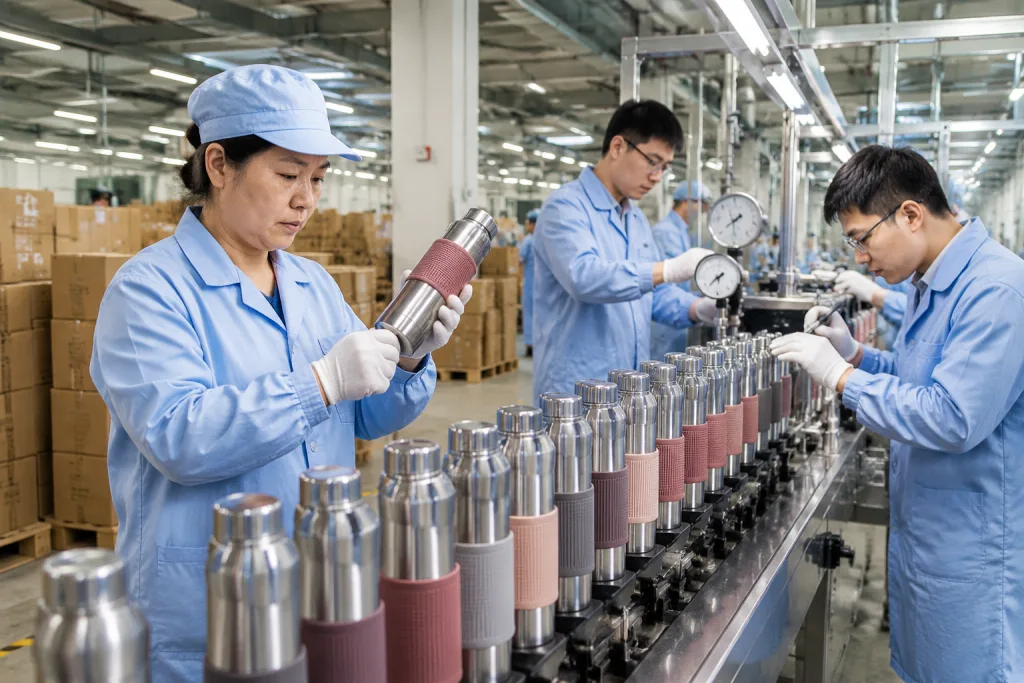
Glossy finishes are out. Matte silicone sleeves are in. But when you quote a silicone vacuum bottle custom project, the price spreads are wild. We see factories quote $4.50 while others quote $7.00 for the exact same spec sheet. The difference comes down to tooling amortization, silicone material grades (LFGB vs. FDA), or MOQs that look fine on paper but trigger penalties once production starts.
For distributors and promotional brands, lock down the cost structure before the contract phase. We break down the real manufacturing costs in Zhejiang, from the per-unit silicone molding charge to the stacking logic that dictates your final FOB price. Concrete ranges only. No estimation.
The Hard Costs of Custom Silicone Tooling
Powder coating gets sprayed on. A silicone vacuum bottle custom design needs a dedicated injection mold for the sleeve. That is separate from standard bottle tooling. You are paying for two mold sets: the stainless steel 拉伸 (deep drawing) mold for the inner and outer vessels, and the compression mold for the silicone jacket.
At our facility in Hangzhou, a standard round-sleeve mold runs $800 to $1,200. If your design needs a tapered shape, textured grip lines, or custom logo debossing, that tooling jumps to $1,800 to $2,500. This is a one-time NRE fee. We see first-time buyers assume the factory absorbs this cost. At lower MOQs—under 3,000 units—the amortization per unit becomes impossible to hide in the unit price.
Amortization Logic
1,000 units means a $1,000 mold adds $1.00 to your unit cost. At 10,000 units, it adds $0.10. Manufacturers push for higher volume commitments because it allows them to bury tooling costs without affecting the quoted FOB price. We have had clients push back on tooling fees, but on a 500-unit run for a custom shaped sleeve, we cannot absorb a $2,500 mold. The math does not work.
Unit Price Drivers: Steel Gauge and Silicone Grade
Quoting custom thermos projects comes down to steel gauge and silicone spec. Our baseline for a standard 500ml vacuum bottle is 0.5mm wall thickness using 18/8 (304) stainless steel. Buyers sometimes ask for 0.4mm to save a few cents. Don't do it. Last March, transit damage hit 15% on a shipment because the thinner walls buckled under compression inside the container. If you're shipping to big-box retailers like Walmart or Target, that dent rate gets the whole PO rejected at the dock.
Silicone is the other variable. Standard REACH-compliant material is fine for basic gaskets, but if the component is a mouthpiece or a carrying handle, we push clients toward LFGB. It costs about $0.40 more per unit on a 500ml bottle, but the tear strength is noticeably higher. Cheap silicone cracks after 6 months of UV exposure; LFGB holds up. For EU buyers, LFGB is practically mandatory anyway, so the upsell is an easy conversation.
Real Cost Impact: Upgrading from 0.4mm steel to 0.5mm and switching to LFGB silicone adds roughly $0.85 to your FOB price. We tracked this exact change with a German client over two containers—their after-sales defect rate dropped from 3.2% to under 0.5%, saving them thousands in credit notes.
MOQ Tiers and Pricing Breaks
MOQ pushes the price tier fast. We run the line that way for a reason. A 500ml silicone vacuum bottle with a one-color sleeve still needs the silicone press reset, the logo jig, and the laser table, and that setup time gets paid for. Here is the split we use with Zhejiang buyers:
- Tier 1 (500-999 units): Premium pricing. The factory quote usually lands at $8.50 - $9.40/unit. Jobs here sit behind repeat orders, and lead time can stretch to 60 days if QC pulls the sample back for sleeve color mismatch. We had one buyer flag a 2 mm color shift on the sleeve, and the order sat for 4 days while the line was checked again.
- Tier 2 (1,000-2,999 units): Standard pricing. $7.20 - $8.00/unit. This is where most promo buyers land when they need custom Pantone colors and can accept a 7-day setup window before the line starts. The math works here because the MOQ covers the press change, and the buyer stops fighting the setup fee once they see the swatch card.
- Tier 3 (3,000-5,000 units): Bulk pricing. $6.10 - $6.90/unit. The math works better here because we buy silicone in larger lots, and one 25 kg drum cuts material waste on the sleeve line. One drum saves more than a half-day of feeding and cleanup, which is why this tier moves faster.
- Tier 4 (10,000+ units): Distributor pricing. $5.80 - $6.50/unit. This fits buyers with steady warehouse flow and repeat forecast, not a one-off trial order. A typo on the PO for 10,000 units once held a shipment for two days, and that was a paperwork problem, not a factory one.
These numbers assume a standard one-color silicone sleeve. Add a second color, a raised 3D logo, or a tight Pantone match, and the unit price goes up by $0.50 to $1.20. We have seen buyers push back on that. Then QC pulled the sample and found a rough edge on the logo cut, and the complaint stopped right there.
Lead Time Phases: From Tooling to FOB
Buyers get burned on lead time when the quote jams tooling, sampling, and freight into one line. Wrong question. On a silicone vacuum bottle custom job with new tooling, we run a 45-55 day schedule, and the line only stays on track when it is split into phases:
Days 1-15: Tooling build and T1 sampling. We cut the steel mold and the silicone compression mold, then QC pulled the first shot off the press. The caliper reads matter here. Photos go out first, then the courier box takes 3-5 days in transit.
Days 16-20: Sample sign-off and material booking. Once the buyer clears the 2 mm logo depth and the neck size, we place the steel tube order and book silicone raw stock. The PO typo we see most is the logo position written twice with two offsets, and that burns a day if nobody catches it at the desk.
Days 21-40: Mass production. Welding, vacuum pumping, polishing, and silicone curing all run here. Curing takes 12-24 hours per batch, so the oven queue becomes the choke point. A 1,000-piece order can sit behind yesterday's run if the line is loaded, and we've seen that go sideways more than once.
Days 41-45: QC and packing. AQL 2.5/4.0 inspection is standard, and we check carton count, cap fit, and leak rate before release. Bulk packing for thermos orders usually goes into individual polybags and master cartons of 40-50 units. The drop test rack sits by the dock.
If you skip new tooling and use an existing bottle mold with only a custom logo, the schedule drops to 30-35 days. We've seen buyers push for 25 days; the math does not work unless the factory already has the tube size, lid tooling, and silicone color on hand. On one rush order, the buyer flagged a missing `mm` callout and we had to hold the line until the revised PO came back.
Logistics: FOB Ningbo vs. Ex-Works
Most thermos suppliers in Zhejiang quote FOB Ningbo. We run that number every week. From Yongkang or Wuyi to Ningbo port, inland trucking usually sits at $150-$200 per container, and the factory has already absorbed it in the FOB price.
Packing is where the math shifts. A 500ml silicone vacuum bottle custom build with a thick sleeve takes more cube than a plain steel bottle, and QC pulled one carton plan at 52 cm because it would not sit clean on the pallet stack. A standard 20ft container holds about 8,000 to 10,000 units. Cut pack size by 10% with compressed packing, or drop individual boxes, and you can load about 1,000 more units. That trims freight by around $0.15 per unit. The buyer usually pushes on pallet count first. That is the wrong question.
EXW only works when the buyer already has a China agent on the ground. The saving is thin, usually about $0.05 per unit, because the factory still has to move the goods to your forwarder's warehouse. We had a buyer flag a PO typo on the pickup address once, and the truck sat for 4 hours while the line waited. We ship FOB unless the buyer has a real local hand on booking. Chasing that tiny EXW gap has burned more deals than it saved.
Quality Control Checkpoints for Silicone
Silicone changes QC. Steel alone does not. One buyer flagged a batch because the sleeve sat 0.8 mm loose at the neck, so we check these points before we ship:
1. Fit and Flash
The sleeve has to lock on without creeping down in use. Flash is the usual mess here: thin silicone left on the mold split line. It feels rough, and the buyer spots it fast. We run a hand-rotate check on 100% of assembled units, then QC pulls the sample and checks the edge under a light table. If the sleeve leaves residue on a white glove, that batch stays on the line.
2. Vacuum Retention
Test the vacuum before the sleeve goes on. Once the silicone covers the shell, you lose sight of the steel wall and bad units hide. Our standard is a 24-hour temperature test on the bare bottle; for hot water, a drop over 5°C in 6 hours means reject. This is the wrong question to ask after assembly, because by then the line has already buried the defect.
3. Odor Test
Cheap silicone smells like solvent when it gets warm. For a custom thermos that holds coffee at 80°C, that is a hard stop. We use an oven test at 100°C for 30 minutes, then check the sleeve right away for odor and off-gassing. If the buyer complains about smell on the first carton, the math does not work for either side.
Choosing the Right Supplier Type
Not every thermos supplier works the same way. You will see trading companies, small workshops, and integrated factories. For a silicone vacuum bottle custom job, the risk changes fast. We ship these pieces every week, and the wrong supplier type shows up on the first 200 pcs.
Trading Companies: They quote low MOQs, often 100-500 units, because they pool orders from different buyers. The math does not always work. They do not run the line, so a 15-day promise can turn into 28 days when the actual workshop slips, and QC has to chase three different people for one defect photo.
Small Workshops: You see a lot of these in Yongkang. Cheap, flexible, and quick to answer on WeChat. The problem is simple. Many do not have LFGB test gear or an automatic vacuum pump, and we have pulled samples where the wall thickness jumped from 0.7 mm to 1.2 mm in the same batch. That is the wrong place to save money.
Integrated Factories: These plants keep molding, welding, and silicone work under one roof. MOQ is usually 1,000+ units, and we run the vacuum check in-house before packing. That control matters. When the buyer flagged a 304 stainless typo on a PO last month, the issue was caught at the artwork stage, not after shipping. For a brand or thermos distributor, this is the safer pick.
Get a Quote for Your Custom Silicone Bottle
Send us your specs. We provide a detailed cost breakdown within 24 hours, including tooling amortization and lead time phases.
Frequently asked questions
Can I get a sample before committing to a bulk order?
Yes, but expect to pay for tooling first. For a silicone vacuum bottle custom design, you cannot get a production-quality sample without making the mold. Some factories offer 3D printed mockups for $50-$100 to check dimensions, but the texture and feel of the silicone will differ from the final compression-molded product. The best approach is to plan for a 'Golden Sample' round after tooling is complete, which takes 15-20 days.
Why is the MOQ for custom silicone colors higher than for the bottle itself?
Mixing silicone pigments is a batch process. To ensure the color is consistent across all 1,000 or 5,000 units, the factory must mix a large quantity of raw silicone at once. If they mix small batches, you risk color variation between the first and last bottle. This is why most manufacturers thermos set the custom color MOQ at 1,000 units, while stock colors may be available at 500 units.
Is debossed or printed logo better for silicone sleeves?
Debossed (indented) logos are more durable and cost-effective for silicone. The logo is part of the mold, so there is no additional per-unit cost. Printing on silicone requires special silicone-based inks and curing, adding $0.15-$0.30 per unit and it can scratch off over time. For a rugged promotional thermos, debossing is superior.
How do I verify the vacuum insulation quality before shipping?
Require a pre-shipment inspection (PSI) based on AQL 2.5. The inspector should randomly select 200-315 units (depending on lot size) and perform a temperature retention test. Pour 95°C water, seal the lid, and measure the temperature after 6 hours. For a quality thermos bulk order, the temperature should remain above 65°C. If the failure rate exceeds 2.5%, the batch should be rejected.
Can I use existing molds to save money?
Yes, if the factory has a 'private mold' or 'open mold' library. Many thermos manufacturers have stock shapes (tumblers, standard cylinders) that you can use for free. You only pay for the silicone sleeve tooling if you need a specific texture or shape, or just pay for the logo mold. This reduces upfront investment from $3,000+ to under $500.