Key Takeaways
- MOQ for a custom silicone Tritan bottle is usually 3,000 units, with 25-35 day production from approved sample
- FOB Zhejiang pricing for standard 600-750 ml models typically starts around USD 1.85-3.20 per unit depending on lid, sleeve, and print
- A practical acceptance plan uses AQL 2.5 for major defects and 4.0 for minor defects on drinking-related checks
- REACH, LFGB, and BPA-free declarations matter more than marketing language when you sell into Europe and North America
You are not buying a water bottle. You are buying a unit economics problem with a lid attached. A 600 ml bottle that saves 38 g over glass looks small on paper. On the line, that gap changes carton count, freight, and breakage claims. We run a drop test from 1.2 m, and the difference shows up fast. When a silicone Tritan bottle runs well, you get a light body, better drop resistance than glass, and a cleaner print area than a soft sports bottle. When it misses, the buyer flags leaks, sleeves warp at 60°C, and the pack that passed here cracks in Rotterdam or New Jersey.
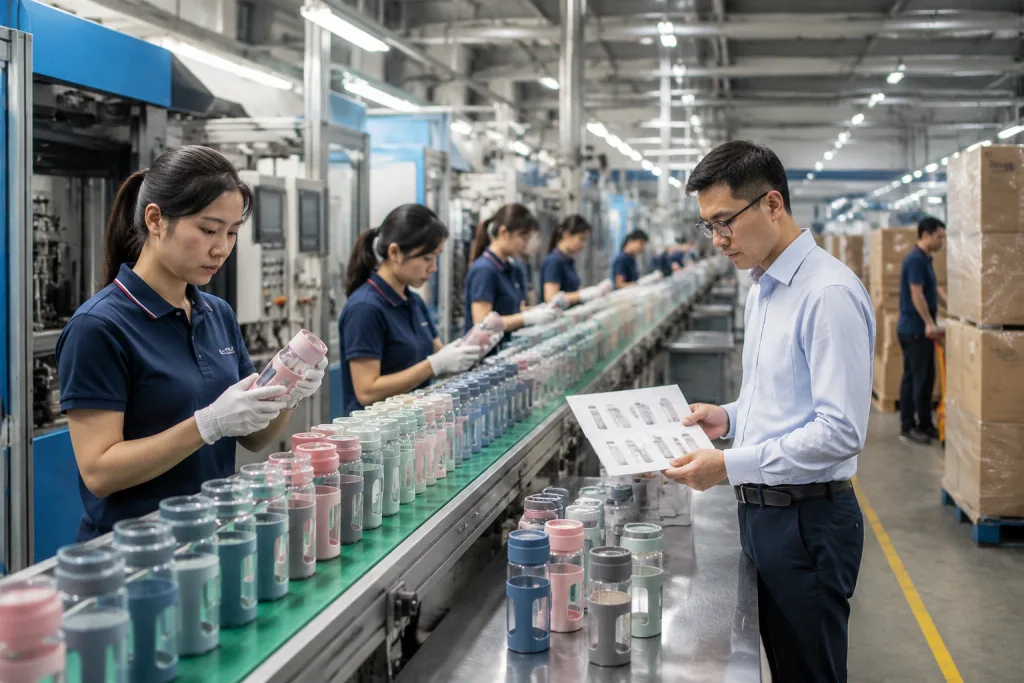
If you are sourcing silicone tritan bottle wholesale, start with the order facts: capacity, cap style, print method, carton count, and how the bottle moves through your channel. A PO typo on our side once changed 24 pcs/carton to 42 pcs/carton, and that kind of mistake wrecks pallet math. At BottleForge in Zhejiang, our normal MOQ for a custom silicone Tritan bottle is 3,000 units, with a 25-35 day production lead time after sample approval. This is the right place to be strict. QC pulled the sample, checked the neck finish at 32.4 mm, and the factory pricing only matters when the numbers hold all the way to your warehouse.
Start with the order, not the bottle
Silicone Tritan is not the first question. Order is. We run the line that way in Hangzhou because a 500 ml promo bottle, a 750 ml gym bottle, and a private label refill pack all need different wall specs, lid tooling, and carton counts. A buyer once pushed back on a 1.2 mm sleeve as “too much material”; QC pulled the sample, weighed it, and the math showed 18 g vs 11 g. The sleeve stayed.
Lock four points before you ask for a quote: capacity, lid type, decoration area, and target market compliance. Skip one and you get a neat price that dies at sampling. One PO typo we see a lot is “flip lid” on the RFQ and “screw cap” on the artwork file. The buyer flagged it. That mistake burns a week and a retool note, and this is the wrong question to ask if the spec is still loose.
- 500-600 ml: works for retail shelves and gym carry
- 700-750 ml: fits outdoor use and office desks
- Silicone sleeve thickness: usually 1.2-1.8 mm
- Tritan body wall thickness: typically 1.0-1.2 mm for good rigidity
A Zhejiang supplier worth using asks about the channel first, then builds the bottle around it. We ship that way because the line has to hold MOQ, print area, and carton fit at the same time. If the buyer says “just send a catalog price,” the math does not work.
Choose materials with evidence
Tritan sells because it stays clear, takes a hit, and does not look cheap the way thin copolyester does. We still ask for the resin code, the masterbatch formula, and whether the sleeve is food-grade platinum-cured or a lower-cost compound. On the line, that is where substitutions hide, not in the bottle body. QC pulled one 500 ml sample last month and the sleeve wall was 1.2 mm thinner than the spec sheet. Buyer noise started right there.
Ask for material declarations on paper, not a sales pitch on WeChat. For Europe, REACH and LFGB are the normal baseline. For North America, BPA-free claims need backup, and for reusable bottle programs, ISO 9001 process control tells you more than a glossy brochure. The buyer flagged a PO typo once, “Tritan” misspelled as “Titran”, and the lab report no longer matched the SKU family. This is the wrong question to ask if you only look at price; the math does not work.
“A silicone sleeve should protect the bottle, not become the bottle’s hidden cost center.”
For a normal wholesale canteen order, Tritan body material usually adds USD 0.20-0.45 over basic PET or PP, while a better silicone sleeve adds another USD 0.18-0.40 depending on thickness and color complexity. We run the same quote stack against 300 pcs MOQ and 3,000 pcs MOQ, and the gap changes fast. If a price lands too low, it usually comes from density, pigment load, or QC time, and we have seen that go sideways after shipment. That is not a saving.
Price the real unit cost
Buyers ask for one price. Wrong question. A silicone Tritan bottle picks up cost from the body, sleeve, lid, print, and packing, and we have seen a PO with 6000 ml typed in place of 600 ml turn a clean quote into a headache at receiving.
For a 600 ml bottle with a silicone sleeve, standard screw lid, one-color silk screen, and kraft box, FOB Zhejiang usually lands around USD 1.85-2.35 at 3,000 pieces, then USD 1.55-1.95 at 10,000 pieces. Add a magnetic lid, stainless insert, or two more print colors and the math moves fast. QC pulled the sample and found the lid tooling alone added 0.18 USD; the buyer flagged it, and that was the right pushback. We have seen that line item sink a deal.
- MOQ: 3,000 pcs for custom color or logo
- Sample time: 7-10 days
- Mass production: 25-35 days after sample sign-off
- Standard carton packing: 24 pcs per carton, export master carton tested for drop resistance
If you are comparing drinkware wholesale offers across several factories, keep the Incoterm the same. FOB Ningbo, FOB Shanghai, and FOB Hangzhou-area routing do not land on the same freight and inland move; we ship that route every week, and the gap can show up before ocean rates even start. The math does not work otherwise.
Treat the lid like a failure point
Most bottle returns start at the lid, not the Tritan body. We see it on the line every week. Gasket seat, thread pitch, vent hole, cap flatness. A body can pass a drop test and still leak because the lid sat 0.3 mm off. That is where a cheap quote turns into a chargeback.
For a screw-cap or flip-top design, ask for torque spec, gasket material, and cycle testing. We run 3,000-5,000 open-close cycles on the lid, then a 24-hour inverted leak test at room temperature. On one 28 mm cap, QC found thread wear after 4,200 cycles, and the buyer pushed back on the whole lot. For hot-fill or insulated use, tighten the spec and ask for cap assembly checks under ASTM-style physical handling expectations for repeated use, not a visual pass. The math does not work any other way.
This matters for canteen wholesale and wholesale canteen programs too, because one bottle platform gets pushed into school, promo, and retail channels. QC pulled a sample with a lid that passed bulk school use but failed on a premium shelf after repeated carry-and-drop handling. Same bottle. Different abuse. A closure that clears one channel can fail in the next. We have seen that go sideways.
When a factory says “no leak,” ask what that means in grams, hours, and pressure. We had a PO last month with “cap leak proof” typed in the notes, and the buyer flagged it because there was no test number behind it. If they cannot answer, they are selling confidence, not product.
QC the sleeve, print, and carton
The silicone sleeve is not decoration. It changes grip, brand color, scent hold, and how the bottle survives a 12-day sea leg versus an 18-day inland transfer. We ran a dark sleeve against a light carton once, and QC pulled the sample after vibration left scuff transfer on the outside. Clean on the eye, wrong in the box. The buyer flagged it fast. That becomes a claim.
For logo work, one-color silk screen is the cleanest call on a silicone Tritan bottle. Laser engraving belongs on metal parts, not on a soft sleeve that flexes on the line. Keep the bottle body clear and put the logo on the sleeve or lid. We ship that way a lot. On one PO, the buyer typed the Pantone code one digit off, and the first sample came back wrong before we caught it. The wrong question is whether the print looks nice in photos. For more detail on print choice, you can pair this with a look at silkscreen vs laser engraving for drinkware.
Carton work needs the same discipline. Use an export-ready inner box if the order goes through Amazon, wholesale clubs, or retail distribution. A carton that passes a local truck test can still crush in ocean freight if the board grade is too low; we have seen 3-layer board fail under pallet load at 18 kg, and the math does not work. For mixed programs like drinkware bulk and seasonal promo orders, I would take 5% more packaging cost over 2% lower unit price. Broken cartons become chargebacks. On the packing bench, we check the flap crease with a 0.2 mm gauge before the line releases the master carton.
- Logo tolerance: check against approved Pantone, not screen appearance
- Scuff test: sleeve-to-carton rub after 1,000 km simulated vibration
- Drop test: at least 1.0 m for packed retail cartons
- Carton compression: verify for stacked pallet loads
Use the right acceptance standard
If you buy from Zhejiang or anywhere else in China, the factory needs a sampling standard it can read without guessing. AQL still does the job. For a normal consumer bottle, we use AQL 2.5 for major defects and 4.0 for minor defects. Major defects cover leakage, cracked body, bad seal, missing parts, and wrong capacity. Minor defects cover surface marks, print shift, and carton scuffing. The buyer often asks for "perfect goods"; that is the wrong question to ask. On the line, we need a pass or fail call that matches the order, not a wish list.
Do not turn inspection into theater. Ask for a pre-shipment inspection with photos of sampled units, not a one-line summary. Send the approved sample and the color standard together if you use a third-party inspector. QC pulled the sample with calipers on one batch, found a 1.2 mm cap gap, and the buyer flagged it before we shipped. A solid Zhejiang factory takes that call. A weak one argues because the sample and the production batch do not match. We have seen that go sideways fast.
For imports into Europe and North America, this is where compliance paperwork gets packed with the order: REACH, LFGB where needed, BPA-free declaration, and test reports tied to the SKU. In our factory, we run around 200,000 units per month across drinkware lines, so inspection is a gate. One typo on a PO can throw the whole file off; last month a buyer wrote the wrong carton count, and the math did not work. We keep the carton spec sheet on the line for that reason. A 3 kg stack of paperwork can stop shipment just as fast as a bad cap.
Match the bottle to your channel
One buyer wants a 650 ml wide-mouth bottle. Another wants a 480 ml gym shape. Same factory, different line setup. A brand going into outdoor retail usually wants quick filling, easy washing, and a shelf face that works as a best wholesale drink bottle; a promo buyer often pushes harder on a 60 x 90 mm print panel than lid hardware. We run that split every week.
That is why terms like bulk canteen, bulk drinkware, canteen bulk, canteen wholesale, wholesale drinkware, and wholesale growler need a hard check before we quote. A growler-style body is a different animal. If the buyer flags bulk growler or growler bulk, we check the neck width, the handle thickness, and carton drop resistance, because a 2 mm wall on the handle area will not survive rough freight. For beer-led retail, beer growler wholesale or beer tumbler wholesale means a different cap, a different seal test, and a different compliance file. The math does not work any other way.
Match the bottle to the channel. Simple. For a premium reusable line, a silicone Tritan bottle sits in the middle: lighter than steel, tougher than glass, and easier to print than a dark opaque body. QC pulled the sample on one run because the sleeve edge was 1.5 mm too tight, and the buyer flagged it before we shipped. That is the kind of miss that turns into a claim later. It sells when the spec matches the shelf, not when the name sounds broad enough for every channel.
Plan the first reorder now
Your first PO should already point to the second run. Keep the same resin family, the same sleeve durometer, the same lid vendor, and the same carton spec, or you will spend the next round requalifying parts we already signed off. For seasonal color work, hold it to one or two sleeve colors and leave the body tooling alone. QC pulled the sample on the caliper at 0.3 mm drift, and the line slowed right there.
For distributors running mixed programs like beer growler bulk, beer growler in bulk, beer growler wholesale bulk, or even alcohol flask bulk and alcohol flask wholesale bulk in separate channels, the buyer mistake stays the same: too many variants, not enough repeatable specs. Every extra colorway adds carton setup, label change, and stock risk. The math does not work. We have seen seven SKUs at 2,000 units each turn into a mess, while three clean SKUs at 5,000 units each ship on time.
If you want the program to stay clean, build the file now: approved sample photos, color standard, test report set, carton spec, and reorder pricing. We run this every week in Hangzhou, and the buyer usually flags the same typo first, a PO that says 5,00 instead of 5,000. Get those papers locked before the first shipment leaves. That is how a Zhejiang supplier keeps the account moving without friction.
Request a quoted sample set from Zhejiang
Send your target capacity, lid style, logo file, and carton spec. We will quote FOB China pricing, confirm MOQ, and prepare sample units for review.
Frequently asked questions
What MOQ should I expect for silicone Tritan bottle wholesale?
For a custom silicone Tritan bottle, 3,000 pieces is the practical MOQ in most Zhejiang factories. If you need a custom sleeve color, logo, and retail carton, 3,000-5,000 units is the normal range. For stock colors with minimal branding, some factories can go lower, but the unit price usually rises by 12-20%. At BottleForge, the usual lead time is 25-35 days after sample approval, which is realistic for export-grade production rather than rushed domestic stock.
How much does a silicone Tritan bottle cost FOB China?
For a 600-750 ml bottle with a silicone sleeve and standard lid, FOB Zhejiang pricing often lands around USD 1.85-3.20 per unit depending on capacity, print, and lid complexity. A one-color logo and kraft box sit near the lower end. Add a premium lid, extra print passes, or special color matching and the price moves up. Always compare quotes on the same packing, same inspection standard, and same Incoterm, or the numbers are not meaningful.
What compliance documents should I ask for?
For Europe, ask for REACH documentation and, where relevant, LFGB food-contact testing. For North America, ask for BPA-free declaration and food-contact related test reports. You should also request ISO 9001 or equivalent process control evidence, plus a batch-linked QC record. If you are selling through retail or e-commerce, keep the test reports aligned to the exact SKU family, not a generic bottle family document. That prevents customs delays and downstream disputes.
How do I inspect a shipment of bulk drinkware?
Use AQL 2.5 for major defects and 4.0 for minor defects on a normal consumer bottle order. Major defects include leaks, cracks, missing parts, wrong capacity, and seal failure. Minor defects include print shift, surface marks, and carton damage. I also recommend checking 100% of the first 10 cartons for visual consistency, then sampling from the rest. For higher-risk programs, add inverted leak testing and lid cycle checks before release.
Can I use one bottle design for canteen, growler, and alcohol flask programs?
Only if the channel requirements are genuinely similar, and usually they are not. A canteen bulk or canteen wholesale program may prioritize lightweight carrying and easy refill. A growler wholesale or beer growler wholesale program usually needs a wider mouth, stronger closure, and more robust packaging. Alcohol flask bulk or alcohol flask wholesale bulk is a different category entirely and often requires a different form factor and compliance review. Reusing one design across all three usually creates compromise, not efficiency.