Key Takeaways
- A workable MOQ for a custom Tritan bottle is usually 1,000-3,000 pcs; complex silicone overmolding often starts at 3,000 pcs.
- Typical FOB China pricing for custom drinkware sits around USD 1.80-4.80 per piece depending on size, lid, and print method.
- A disciplined canteen manufacturer should quote 15-25 days for sample tooling and 30-45 days for mass production.
- For export buyers, REACH, LFGB, FDA food-contact claims, and AQL 2.5 inspection are not optional paperwork; they are the buying floor.
If you are sourcing from a silicone tritan bottle factory, design is not the first issue. Control is. We run this every week in Zhejiang. The sample can look fine on day 7, then the buyer flags a 10,000-piece order because the cap torque drifts, the silk screen smears, or the carton size misses the pallet plan by 8 mm. QC pulled the sample on the torque gauge twice. Same bottle, different result.
The better buy is the one that matches the use case. A plant that handles Tritan resin, silicone overmolding, leak tests, and export docs saves weeks later; a weak canteen factory does not. We’ve seen this go sideways on a 0.5 mm logo shift, so this is the wrong question to ask first. Start with bottle structure, closure, and decoration method, then check the target FOB China price against the MOQ and the QC report. The math does not work any other way.
How to rank the options
For a silicone Tritan bottle factory, the order is simple. Structure first. Compliance next. Decoration after that. Cost and packaging come later. We run it this way on the line because a sample can look clean and still fail if the sleeve traps dust, the cap torque drifts, or the Tritan wall drops below 1.8 mm at the shoulder. That is a production problem, not a design story.
For a canteen custom project, we ask five checks. Does it pass leak testing at 20-30 kPa? Can the plant hold shrinkage on clear Tritan parts? Is the silicone food-grade and heat resistant to 200 C? Will the print survive 50 wash cycles? Can the factory support your channel, whether you buy for a canteen chain, a brand program, or Amazon FBA? The buyer flagged a 0.4 mm fit shift on one PO last month. The math does not work if QC has to sort it later.
- Top criterion: food-contact compliance and traceability
- Second: repeatable manufacturing tolerance, usually within +/- 0.3 mm on key fits
- Third: real landed cost, not just piece price
That is the right lens for any customizable canteen or customizable drinkware program coming out of Zhejiang or wider China. QC pulled the sample on a 12 ml ink rub test and the coating held. We trust that kind of result, not a pretty render.
Best for retail brand launches
For a retail launch, we start with a straight-wall Tritan bottle, a silicone sleeve, and a one-piece PP or Tritan lid. Clean shape. Low risk. The line stays simple, and that matters when the buyer wants 4 SKUs in one carton set and still needs the first run to move. For 500 ml or 750 ml, MOQ usually lands at 1,000-2,000 pcs if the sleeve color is stock and the logo stays one-color silk screen. A custom sleeve color pushes it to 3,000 pcs. The math does not work any other way.
This setup wins when speed beats extra features. We ship these retail programs around USD 2.10-3.40 FOB China, depending on the lid and print area. One buyer pushed for a magnetic cap under USD 2.00; QC pulled the sample, the seal test failed at 0.8 bar, and we dropped it on the spot. If the shelf needs more pull, we switch to a matte sleeve or add laser engraving on a stainless cap insert. Check carton fit before art sign-off. 24 pcs per export carton is one thing, and a bloated pack-out is another.
What to ask the supplier
- Can you provide food-contact declarations for Tritan, silicone, and ink?
- What is the wall thickness on the bottle body, and is it consistent at 1.8-2.2 mm?
- How do you test cap torque and leak resistance?
This is the right pick for a canteen supplier serving retail, corporate gifting, or a distributor program that needs a working SKU, not a vanity sample. We see it go sideways when a buyer chases a weird lid before the first PO is even signed. Last month the buyer flagged a PO typo on the sleeve code, and that one small miss cost us 12 days while the line waited for corrected artwork.
Best for promotional budgets
If the brief is a canteen promo run, do not overbuild the bottle. A straight Tritan body, a basic silicone band or half sleeve, and a flip-top or screw lid is enough. We run this line every week. The buyer wants logo space, not a gadget. Keep the lid plain, keep the print flat, and keep carton packing tight. One buyer pushed for a magnetic cap on a 5,000 pcs event order; the math did not work, and the line slowed for nothing.
For bigger campaigns, a promotional bottle usually lands around USD 1.60-2.60 FOB China at 3,000-10,000 pcs, and the number moves with size and print colors. If the customer wants a custom canteen for events or channel incentives, pad print and one-color silk screen give the best cost-to-result balance. Deep embossing and multi-part closures look neat on a spec sheet. On the shop floor, they add 2-3 extra minutes per unit and more scrap. We had a PO with a typo on the lid color code, and QC pulled the sample twice before the buyer flagged it.
Procurement comes down to repeatability. Ask for an AQL 2.5 inspection plan, with checks on lid seal integrity, logo position, and scratch marks on the bottle wall. A good canteen manufacturers team will also tell you whether the sleeve color is stock or custom dyed, because that changes lead time by 12 days vs 18 days in a real run. For a distributor canteen order, boring wins. We've seen clever go sideways.
Best for premium retail shelves
The strongest premium pick is a double-wall or hybrid canteen with Tritan outer parts and a silicone sleeve. The sleeve gives grip, adds visual weight, and hides small handling marks on the shelf. This is not the cheap route. Buyers choose it when the bottle needs a hard-edged silhouette, clean cap lines, and a matte finish that still looks good under store lights. We run this cap fit with a torque gauge at 0.35 N·m; if the closing feel is loose, QC pulls the sample and the buyer flags it fast.
Pricing usually starts around USD 3.20 and can go to USD 4.80 FOB China once you add better hardware, custom molds, or two-color decoration. That math works only when the structure earns the price. A buyer once pushed back on a 1.5 mm wall change because the PO still called the item “standard retail,” and the line had to stop while we fixed the spec sheet typo. Our better plants in Zhejiang ship about 100,000-200,000 units per month across mixed custom drinkware runs, but only when orders stay grouped by color and lid family. We’ve seen mixed cartons go sideways.
Buy premium only when the structure makes the bottle better to use. Premium for copy alone burns margin.
Ask for ISO-style process controls, spare gasket policy, and carton drop-test results before you approve packaging. A proper drop test at 1.2 m tells you more than a polished sales deck, and the wrong carton spec shows up on the first pallet.
Best for outdoor and gym use
The best pick for outdoor and gym use is a tough Tritan body with a wide mouth, a thick silicone bumper, and a carry lid that seals clean. We ship this style in gym bags, truck cabs, and promo kits that get dragged across concrete. On the line, we run a 1.2 m drop test, then check that one-hand opening still works. For hiking or fitness retail, the wide mouth makes ice loading and brush cleaning faster. This is the right question to ask.
A solid outdoor build usually runs 2.0 mm to 2.4 mm wall thickness in the high-stress zones, plus a silicone base or sleeve that takes the hit. QC pulled the sample after a corner-drop test left a hairline mark near the shoulder. The math does not work if someone wants to shave the structure any further. FOB China is usually USD 2.50-4.20, depending on capacity and cap structure, and the buyer usually pushes back on the lid cost first. We have seen this go sideways when someone tries to turn it into a stainless-steel copy, because the point is lighter carry and easier branding, not extra metal.
For export, check REACH on the silicone and on any sealing parts that use plasticizers. If you ship to North America, ask for FDA food-contact paperwork and confirm the neck diameter matches your packing line. We had one PO where the buyer flagged a typo on the neck spec, and the FNSKU label could not wrap cleanly on the bottle. A 2 mm mismatch sounds small. It is not. Make sure carton packing and label automation are tested before the order releases.
Best for e-commerce scaling
If you sell online, the bottle is not the first problem. Pack-out is. A mid-size Tritan bottle with one lid spec, a snug sleeve, and a carton plan that keeps dimensional weight in check will beat a cheaper unit that lands in a bigger box. We ran this at 38 x 38 x 28 cm, and a USD 0.20 factory saving disappeared on freight. The math does not work.
For Amazon or marketplace channels, build the canteen custom project around stable variants. Keep the same body and lid across 2 colorways, then change only the sleeve or logo. That keeps the MOQ at 1,000 pcs per color with 3,000 pcs total across the line, and it stops stock from splitting into dead piles. One buyer pushed for four lid colors on a 1,500 pcs trial. Bad call.
Ask the factory for the master carton spec, inner-pack count, and a drop-test result after one round of FBA-style handling. QC pulled the sample at 76 cm and checked the corner crush before we shipped the trial carton. Ask whether the line will use custom barcode stickers or direct FNSKU application. A buyer once flagged a PO typo on the label count, and the shipment sat for 12 days. That is the gap between a bottle that looks ready and one that actually moves.
What a real factory should prove
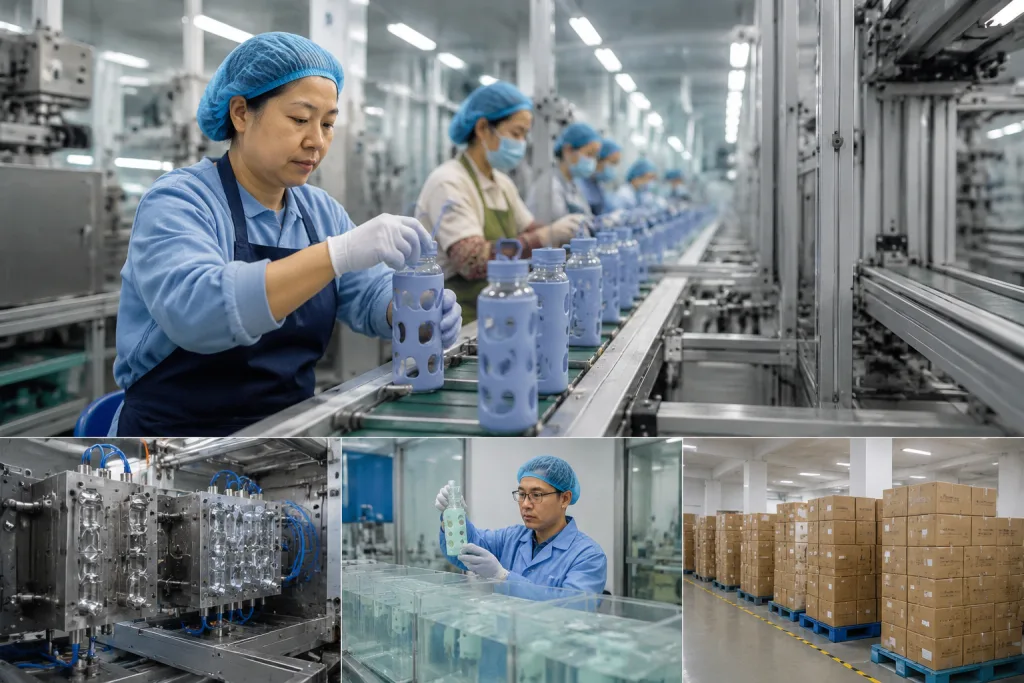
A real silicone tritan bottle factory proves the run, not a showroom sample. We ask for resin lot traceability, incoming silicone checks with a durometer, and final QC that checks odor, seal, and fit on the line. A 1.8 mm cap can pass a hand sample and still fail a 10,000 pcs batch. We want batch records, test reports, and floor photos from the actual run, not a polished deck. If a supplier cannot show that, we do not trust them for distributor drinkware or branded retail jobs.
Look at the basics: BSCI or an equivalent social compliance file if you need audit coverage, LFGB or FDA food-contact support by market, and an inspection plan built around AQL 2.5 for major defects and 4.0 for minor defects. For higher-value orders, we push pre-shipment sampling at 0.5%-1% of the batch, especially when a mold is still settling. The buyer flagged it as "extra work" once; the math did not work after three cartons came back with seal drag. A caliper on the QC table settles the question fast. This is normal in China, and Zhejiang factories see it on mixed custom drinkware jobs every week.
The honest truth is that a lot of canteen manufacturers can make one good sample. Fewer can hold the same quality at 10,000 pcs. Ask how many cavities the mold has, what the cycle time is in seconds, and how many units per month the plant runs in your size range. If they dodge that, you are talking to the wrong vendor. We have seen this go sideways when the PO said 10,000 and the factory was set up for 3,000 MOQ, then QC pulled the sample and found wall thickness wandering by 0.4 mm.
How to write the PO
Your purchase order has to leave no room for guessing. Put capacity, body material, silicone durometer if it matters, lid color, Pantone code, logo method, carton count, and defect limit in black and white. For a custom canteen or other custom drinkware order, say whether we ship spare gaskets, separate inserts, or assembled units only. Packing labor changes the unit cost. It also moves the lead time.
For a standard order, a China factory in Zhejiang usually quotes 15-20 days for tooling adjustment and 30-45 days for mass production after sample approval. If the lid tool is new, add 7-10 days. We run into this on the line all the time. QC pulled a sample last week because the buyer’s PO said “green” and the carton label said “mint,” and that sort of mismatch burns a day fast. If you are buying a canteen custom program for several regions, set the packaging language before production starts, or the artwork gets reopened mid-run. Put the shipping term on the PO too, usually FOB Ningbo or FOB Shanghai, and state whether you need DDP support or export docs only.
Ask for pre-production samples with the final color chip, not the first sample shade. The first one is a reference, not the finish. We’ve seen this go sideways when a buyer signed off on a bright sample and then flagged the bulk as off by 1.5 Delta E. A factory that does this every day will prefer the sharper PO, because it cuts the back-and-forth before the carton tape is even on the bench.
Send your spec and get a real quote
We will review your bottle structure, MOQ, packaging, and compliance needs, then return a practical FOB China quote with lead time and sampling plan.
Frequently asked questions
What MOQ should I expect from a silicone tritan bottle factory?
For a standard custom drinkware order, expect 1,000-2,000 pcs if you use stock colors and a simple lid. For custom color sleeves, new molds, or multi-part caps, 3,000 pcs is more realistic. If you want canteen promotional volume with heavy branding, some factories can quote lower, but the unit price usually becomes inefficient below 1,000 pcs. In Zhejiang, serious export factories prefer order structures that fit one production line run, not a scattered test order.
What is a fair FOB China price for custom canteen orders?
A fair FOB China range for a canteen custom project is usually USD 1.60-4.80 per piece. Simple promotional bottles with one-color print sit near the low end. Premium formats with better caps, thicker silicone, or more complex structures move to the upper end. For a 500 ml or 750 ml bottle, you should ask for price breaks at 3,000 pcs and 5,000 pcs. If the supplier cannot explain what is included, the quote is not ready for procurement.
Which compliance documents should I request?
At minimum, ask for food-contact declarations for Tritan, silicone, and inks or coatings. For Europe, REACH support matters; for Germany or similar markets, LFGB is often requested; for North America, FDA food-contact relevance is the usual baseline. If you are buying from a canteen manufacturer for retail, add BSCI or another social audit if your buyer requires it. Also ask for an inspection plan using AQL 2.5 for major defects and clear leak-test records.
How long does production usually take in China?
For a standard order from a China factory, sample confirmation to mass production often takes 15-25 days if tooling is stable. Mass production is usually 30-45 days for the first batch, sometimes 50 days if the lid is new or the color match is difficult. If you need a custom growler or customized canteen with fresh tooling, budget an extra 7-10 days. Zhejiang factories with higher output can move faster, but only when artwork, packaging, and color chips are locked.
What should I check before choosing a canteen supplier?
Check whether the supplier can explain material grade, wall thickness, gasket material, and the exact leak test method. Ask for finished product photos from the same mold, not random catalog images. A good canteen supplier should also give you carton dimensions, pallet count, and an honest lead time. If you are a canteen distributor or distributor drinkware buyer, confirm whether they can keep the same mold and color stable for repeat orders. Consistency is worth more than a low sample price.