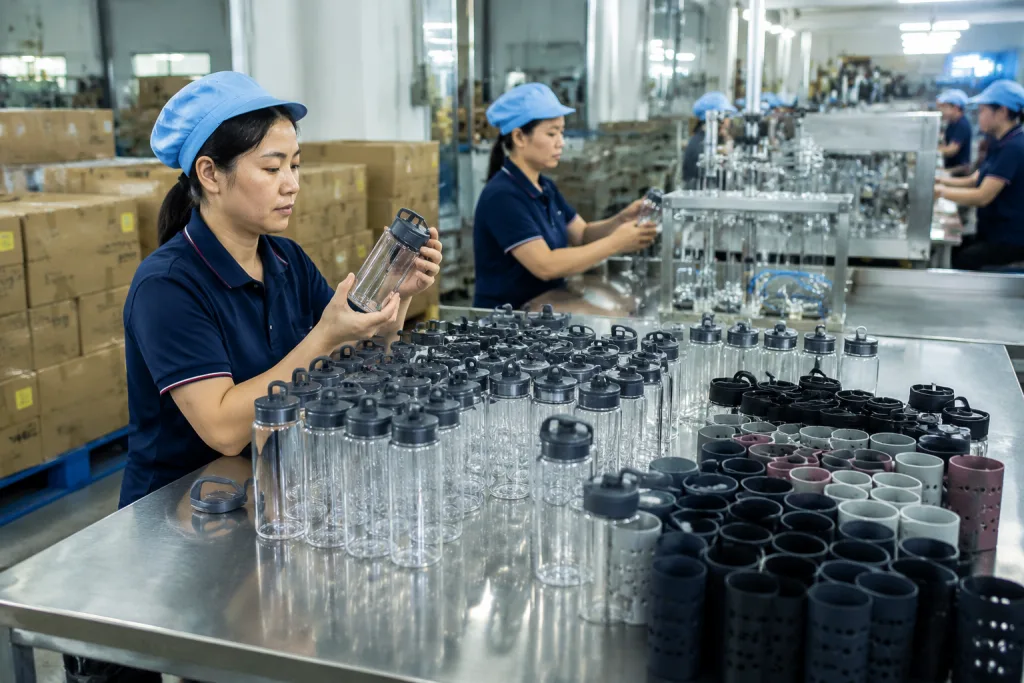
Key Takeaways
- A silicone tritan bottle custom order usually starts at 3,000 units MOQ and 30-45 days lead time after sample approval
- A realistic FOB Zhejiang price is often USD 2.20-4.80 per unit depending on size, print, and packaging
- For leak testing, ask for 100% cap fit checks and AQL 2.5 for critical defects on the final inspection
- Tritan body thickness around 1.2-1.8 mm and silicone sleeve Shore A 50-70 are common working ranges
You are not buying a bottle. You are buying a production spec that has to survive freight, retail handling, and customer abuse. For a silicone tritan bottle custom program, the real question is whether the bottle passes your use case at the right landed cost, not whether it looks good in a mockup. We run into this on the line all the time in Zhejiang and across China: plenty of nice samples, then the cap torque slips, the silicone ring shifts, or print registration walks off by 1.5 mm once the order hits 5,000 or 50,000 units. QC pulled the sample at 32 Ncm last week, and that number matters more than the render.
If you are a procurement manager, brand owner, or canteen distributor, the order usually starts with a vague brief and ends with a surprise charge. That is the wrong question to ask. A clean custom drinkware order should lock down material grade, wall thickness, decoration, carton packing, test standard, and acceptable defect rate before the first deposit moves. We have seen POs with a typo on the sleeve size or a missing MOQ, and the math does not work once tooling starts. The buyer flagged it after we had already cut the sample mold. Too late.
Start With The Use Case
The fastest way to waste money is to start with color. Start with the use case. Gym retail, a school campaign, distributor drinkware, or a corporate gift each pushes the bottle in a different direction. We ran one school-chain promo job, and QC pulled the sample because the lid clip sat 1.5 mm loose. A bottle for outdoor promo work needs a wide mouth, a tethered lid, and a sleeve that still grips after sweat and dust hit the line. Retail stock needs cleaner decoration, stronger shelf presence, and a carton that survives the drop test we run on export packs. Promo work usually stays on simpler tooling. Premium customized drinkware needs tighter finish control, and the carton print must not rub off in transit.
For silicone tritan bottle custom work, I lock four points first: capacity, drinking mode, closure type, and whether the silicone is functional or decorative. A 650 ml bottle with a flip lid and full silicone sleeve is a different cost structure from a 1,000 ml bottle with a partial sleeve and carry loop. On the line, a 2 mm sleeve wall or a 1 mm mold mismatch shows up fast. If your buyer is a canteen distributor in Europe, the retail shelf and the export carton are part of the product. The supplier should quote unit cost and carton loading. If they cannot tell you how many units fit in a 40HQ, the math does not work. We had one PO where the buyer typed “6500 ml” by mistake, and that typo burned a week before we could cut the sample.
- Common capacities: 500 ml, 650 ml, 750 ml, 1,000 ml
- Typical MOQ: 3,000 units per color or 5,000 units mixed by style
- Typical lead time: 7-10 days sample, 30-45 days mass production
Choose Materials That Pass Real Use
Material choice is where a canteen factory earns its margin. Tritan stays clear, takes impact better than cheap copolyesters, and keeps its shape through normal filling and washing. The bottle still fails if the sleeve, seal, or lid is weak. We had one buyer flag a lid that looked fine on the bench, then warped after 85°C filling. That lot stopped before carton packing. For EU or North America, ask for REACH, food-contact papers, and migration test reports when the channel wants them. If the factory only says "food grade" and cannot show the file, the math does not work.
For the body, 1.2-1.8 mm wall thickness is the range we run for most promo and retail orders. Thinner than that, and the bottle feels flimsy and can deform with hot water. Thicker than that, and you pay for resin you do not need. On the sleeve, check Shore A hardness. Shore A 50-70 gives a usable grip and still goes through assembly cleanly. Softer sleeves can walk during packing; QC pulled one sample where the sleeve slipped 6 mm after a 1-meter drop test. For a silicone tritan bottle custom build, state whether the sleeve is overmolded, slipped on, or locked by a retainer. Overmolded sleeves hold position better, but tooling gets harder and MOQ usually goes up.
Do not buy on vague material claims. Ask for the resin brand, silicone hardness, lid gasket material, and lab report numbers before you release production.
What I would put on the spec sheet
- Tritan body: clear, BPA-free, 1.5 mm target wall
- Silicone sleeve: food-grade, Shore A 60 +/- 5
- Seal: platinum silicone or approved equivalent
- Lid: PP or Tritan/PP hybrid with silicone gasket
Price Structure Without Surprises
Buyers ask for unit price too early. The quote looks neat, then grows later. We run this every week on the line. For a custom drinkware order, the bill splits into five parts: product cost, decoration, packaging, testing, and freight. A silicone tritan bottle custom order at 3,000 units can land at USD 2.20-3.40 FOB with one-color print and a standard carton. Add two print positions, metallic ink, a gift box, or a molded lid insert, and the same bottle jumps into the USD 3.80-4.80 range fast. One PO typo, 3000 written as 300, burned more time than the pricing itself. QC pulled the sample twice because the cap spec was off by 1.5 mm.
China pricing looks competitive, but the spread is real. One canteen factory quotes low because they leave out testing or swap in a generic cap. Another comes in higher because it includes a leak test, carton compression standard, and one spare gasket per case. Compare total landed value, not the first line in the email. That is the wrong question to ask. If you are sourcing from Zhejiang, ask whether the factory is quoting FOB Ningbo, FOB Shanghai, or EXW. A 2.5 mm wall on the sleeve can change carton fit, and that changes freight math more than buyers expect. We have seen this go sideways on a 40HQ when the buyer pushed for the cheapest cap and the carton crushed at 18 kg stack load.
- Sample fee: often USD 30-120, refundable on larger orders
- New mold cost: USD 3,000-12,000 depending on lid and sleeve complexity
- Carton loading: a 40HQ often fits 20,000-30,000 units depending on size and packing style
Sample Like A Buyer, Not A Tourist
Samples are where polite talk stops and numbers start. We ask for three pieces: a white blank, a decorated sample, and, if the line is already set, one packed the same way we ship. A silicone Tritan bottle custom order can look clean on screen and still fail in hand because the lid has 0.3 mm of side play or the sleeve buckles near the shoulder. Check torque, smell, print alignment, drop feel, and whether the bottle sits flat on the desk. That hand check beats the catalog photo every time.
Run a simple test matrix. Fill the bottle with room-temperature water, invert it for 5 minutes, shake it 10 times, then check for seepage around the gasket. If the buyer flagged gym use, add a hot-water check too. Ask for the actual dishwasher test condition, not the slogan; we see PO notes that say "dishwasher safe" and nothing else, and that is too thin. Good canteen manufacturers in China will give you the limits. Bad ones dodge the numbers. A distributor canteen project should not move forward until the sample passes basic handling and leakage checks.
For branding, put silkscreen and laser engraving on the same body if the budget allows. Silkscreen costs less and holds bold logos well. Laser on a coated part gives a cleaner read for premium work, but not every Tritan body or cap shape can take it. QC pulled the sample once and found a 1.2 mm logo shift after curing; the buyer spotted it at arm's length. For related decoration choices, see silkscreen vs laser engraving for drinkware.
QC The Order Before Shipment
This is where buyer programs go sideways. Production approval is not shipment approval. We run a separate gate before the pallet gets stretch wrap: incoming resin check, sleeve fit on the assembly jig, print adhesion, cap torque, and a final random pull. On a normal export order, I push AQL 2.5 for major defects and AQL 1.0 for critical defects, plus 100% leak testing on assembled units when the lid design is touchy. That is not overkill. QC pulled a 300-piece sample last month, and it stopped a chargeback before it hit the bank.
Ask for photos and video from three stages: first article, mid-run, and pre-packout. A serious Zhejiang factory should show line checks, not polished sample-room shots. We had a buyer flag a PO typo on the carton count once, and the whole file slipped 12 days because the master carton marks did not match the ASN. Check carton markings too. If you sell on Amazon or through a retail DC, SKU labels, FNSKU or barcode placement, and carton detail all need to line up. “Close enough” is the wrong question to ask.
- Critical checks: leak, cap fit, gasket placement, contamination, odor
- Major checks: print offset, sleeve wrinkle, color mismatch, scratches
- Minor checks: small cosmetic marks below your accepted threshold
Branding That Holds Up In Market
Branding on custom drinkware has to survive use, not sit pretty under showroom lights. A custom canteen sold as a corporate gift can run on one one-color logo and a plain box. A retail customized growler or distributor growler line needs a tougher mark, but durability still wins. We had a buyer flag a mockup that looked clean on paper and fail after 200 rub cycles on the abrasion tester. Pick the decoration method by bottle surface and wear risk, not by what looks fancy. Screen print works for 5,000-piece runs. Laser gives a clean premium mark on metal parts, but on Tritan bodies we usually run pad print or UV print based on the surface treatment. The line tells the truth.
For a canteen promotional order, I keep branding to one logo placement and one clear color palette. Every extra ink or effect adds risk. The math does not work. On the line, QC pulled the sample after the logo shifted 1.2 mm near the shoulder, and that kind of miss shows up fast in retail. If your buyer asks for a customizable growler concept for beverage samplers or cold brew, check the closure and gasket for repeated opening. We ship a lid that loosens after 30 days, and the bottle is dead. That is the wrong question to ask. When you compare custom canteen and custom growler programs, look at user frequency, cleaning method, and spill risk first. A 0.3 mm print drift on a 500 ml Tritan body is enough to trigger a buyer complaint. If you need a broader sourcing brief, review sourcing custom drinkware from China before you lock the artwork.
Work With The Right Factory
A factory should not just send a price. It should ask the questions that protect your margin. Six colors or two? Retail carton or master carton? BSCI support? DC, Amazon prep, or direct to a distributor warehouse? We had one buyer flag a 2 mm cap-print typo on the PO, and that kind of slip turns into rework fast. A serious canteen manufacturer shortlist in China keeps engineering off the sales desk. If the line runs 200,000 units per month, fine, but only if QC holds the same standard on carton drop and cap torque from first box to last box.
Look for a partner that gives stable communication, sample accountability, and a clean change-control process. No poetry. We run the clock on this stuff: quote in 24 hours, samples in 7-10 days, mass production that stays on schedule. That beats a stack of promises. A capable canteen distributor or canteen supplier relationship is built on lead times you can plan around, not hope. On one job, the buyer pushed for a faster first sample, and we cut the cycle from 12 days to 8 by keeping the valve spec frozen. In Zhejiang, the better factories ask for the spec sheet before they ask for the deposit.
- Typical production capacity: 150,000-300,000 units per month
- Common audit support: BSCI, ISO 9001, and buyer QC visits
- Best practice: approve pre-production sample, then lock packing spec
Buyer Checklist Before PO
Before you send the PO, lock five points with no guessing: exact SKU, decoration method, approved packaging build, test standard, defect limit. If one is soft, the order is not ready. We run into this on silicone tritan bottle custom jobs all the time, and the buyer usually finds out after the line is booked. Bad timing. This is the wrong question to ask late.
For execution, I keep the final spec to one page plus artwork. Put capacity, dimensions, material, weight, lid type, sleeve spec, logo size, carton count, and outer carton marks on the same sheet. QC pulled the sample with a caliper at 72.4 mm, and that is the level of detail the line wants before we start. If the product goes to a canteen distributor or a distributor drinkware program, add country-of-origin labeling and warehouse handling notes. For a promo run, add the event date and a ship-by buffer of 10-14 days. We have seen 12 days turn into 18 days when the PO leaves out one line. The buyer flagged it later, and the math does not work.
For next-step planning, compare your bottle SKU with a related format like a custom travel tumbler for retail channels or a custom sports bottle for fitness programs if you need a broader assortment.
Send Your Bottle Spec For A Fast Quote
Share capacity, logo method, carton count, and target market. We can quote a silicone tritan bottle custom program with real MOQ, lead time, and QC terms.
Frequently asked questions
What MOQ should I expect for a silicone tritan bottle custom order?
Most factories in China will quote 3,000 units MOQ for a standard silicone tritan bottle custom order, sometimes 5,000 units if you want multiple colors or a new lid mold. If the design uses an existing lid and only changes print or sleeve color, you may see 1,000-2,000 units. New tooling changes the math fast. A custom sleeve, custom cap, or new carton insert can add USD 3,000-12,000 in one-time cost. For serious retail or distributor drinkware programs, 3,000 units is the normal starting point.
How much does a custom tritan bottle usually cost FOB China?
For a simple silicone tritan bottle custom build, FOB China pricing often sits around USD 2.20-3.40 per unit at 3,000 pieces. Add extra print colors, a premium lid, special packing, or tighter QC and the range can move to USD 3.80-4.80. Prices vary by capacity, sleeve coverage, and decoration method. Zhejiang factories often quote more clearly when you ask for a line-by-line breakdown instead of one lump sum. That lets you compare real unit economics, not just the first number in the email.
What QC tests should I require before shipment?
At minimum, require leak testing, cap torque or fit checks, visual inspection for scratches or print offset, and carton drop or compression verification if the goods are going direct to retail. AQL 2.5 for major defects and AQL 1.0 for critical defects is a normal export standard. If the bottle has a sensitive gasket or a carry lid, I would ask for 100% leak checks on assembled units. For EU and North America, also confirm REACH or food-contact documentation before cargo leaves China.
Can I order a canteen promotional run with custom packaging only?
Yes. Many canteen promotional projects start with stock bottle tooling and custom packaging, which is the cheapest way to test the market. You can often keep the MOQ at 1,000-3,000 units and avoid new mold cost. Expect a lower risk program if the body, lid, and gasket are standard parts. If you need a custom canteen look without heavy tooling, use print, sleeve color, or a gift box. That is a practical route for canteen distributors who want faster launch timing.
How long does a typical order take from sample to shipment?
A normal timeline is 7-10 days for sample production, 3-5 days for buyer review and revisions, then 30-45 days for mass production after deposit and artwork approval. If the order needs new tooling, add 15-25 days depending on complexity. Freight adds another 20-40 days depending on whether you ship by sea or air. A canteen factory in Zhejiang that keeps tooling and assembly in-house can usually move faster than a fragmented supply chain, but only when the spec is frozen early.