Key Takeaways
- Most silicone thermos wholesale orders start at 3,000 units MOQ and land at FOB USD 2.80 to 6.40 depending on 304 steel, vacuum spec, and decoration.
- For outdoor retail, 18/8 stainless with 0.35 mm inner wall and 0.40 mm outer wall is a safer baseline than chasing the lowest unit price.
- Silicone sleeves add grip and impact resistance, but they can raise cost by USD 0.25 to 0.70 per piece and add 2 to 4 days to lead time.
- Ask for AQL 2.5 major and 4.0 minor, plus REACH and food-contact compliance, before you approve a bulk thermos order.
Buying silicone thermos wholesale means signing off on three parts at once: the stainless body, the silicone wrap, and the decoration step. Miss one, and the PO still looks clean while the bottle feels wrong in hand. Outdoor buyers press on grip and dent resistance. Promo buyers ask about logo edge, Pantone match, and whether the finish still holds after 3 months in a bag.
This job is specific. We run stainless thermos orders in our Zhejiang factory from 3,000 units MOQ to 80,000 units a month, with a normal lead time of 25 to 35 days after sample approval. QC pulled the sample at 1.2 mm wall thickness last week, and the buyer flagged it on the spot. That is the wrong question to ask after the line starts. Lock the thickness, silicone finish, lid build, and test standard first, or the math does not work.
Start with the use case
Do not start with color or logo placement. Start with where the thermos gets sold and how we run it on the line. A silicone thermos wholesale order for a hiking shop is a different build from a promotional thermos for a trade show. One needs a grip that still works with gloves and a lid that can take pack abrasion. The other needs fast branding, a steady color match, and a unit cost that still holds after freight and duty.
For outdoor retail, I would push a 500 ml or 750 ml custom stainless thermos with a straight body, powder coat, and a partial silicone band. Full sleeve only makes sense if the grip complaint is real, because it adds cost and slows packing by 3 to 5 seconds per piece. For promotions, a 350 ml or 500 ml customizable thermos with a simpler sleeve usually wins. The sleeve is not decoration. It changes hand feel, heat retention, and how the product wears after 200 washes. We let buyers pick sleeve thickness, usually 1.5 mm to 2.5 mm, instead of forcing one look across every SKU.
Ask one blunt question: is this a retail item or a giveaway? A distributor thermos for retail has to pass shelf inspection and repeat handling. A thermos promotional order can run simpler hardware if the branding is clean and the carton packout is tight. We had a PO last quarter where the buyer flagged a 350 ml item as "3,500 ml" in the notes. The math does not work. That typo changed the spec, the carton test, and the line setup.
Choose the steel spec first
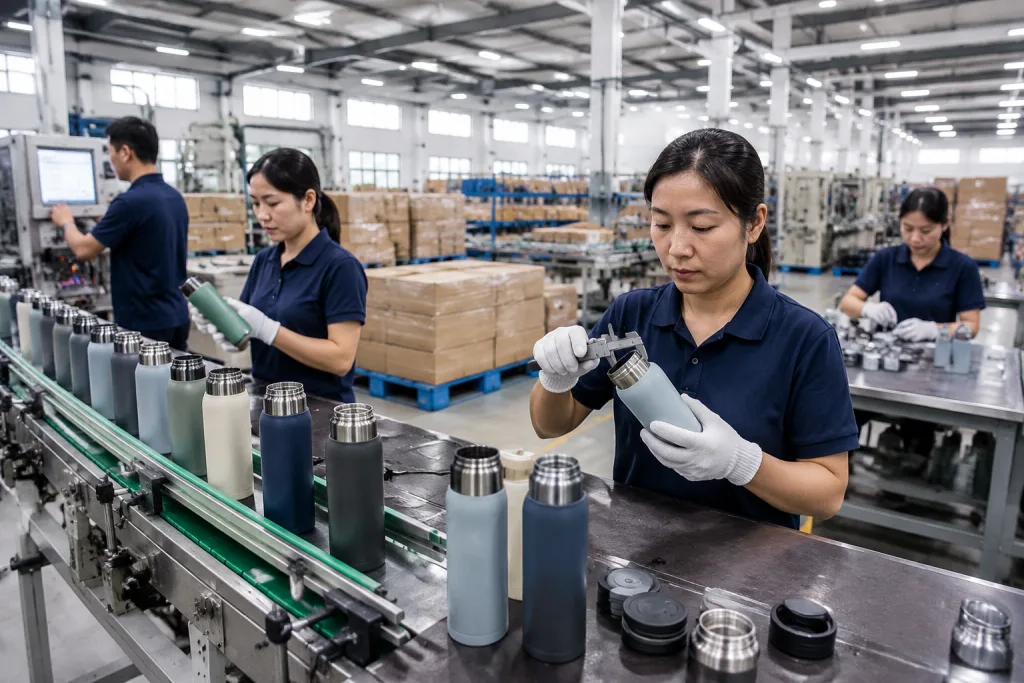
Stainless steel decides whether the spec holds. If the liner is soft, the thermos still looks fine on day one, then returns start after the first 500 cartons. For a serious manufacturer thermos, 304 or 18/8 stainless is the baseline. We run that check with a handheld thickness gauge on the line, and the buyer usually wants the reading before they sign off. Some low-cost thermos bulk orders use 201 on the outer shell to shave price, but we stop that at the line. For Europe and North America, 304 inside is the safe default.
A typical vacuum insulated custom thermos uses a 0.35 mm inner wall and a 0.40 mm outer wall. Go thinner and warehouse dents show up fast; we saw it on a 1.2 m drop test, and the buyer flagged it before packing. Go thicker and the cost climbs with no real gain in retention. A good thermos factory in Zhejiang should show vacuum performance in hours, usually 6 to 12 hours hot holding depending on lid design, fill volume, and ambient conditions. If a thermos supplier throws out a big number without the test condition, that is sales talk. The math does not work.
What to lock before sampling:
- Inner steel grade: 304 or 316 if the use case justifies it
- Outer steel grade: 304 or 201 depending on budget
- Wall thickness: 0.35/0.40 mm or better for retail
- Finish: powder coat, spray paint, or bare brushed steel
Lock those four points early. It saves time when you compare manufacturers thermos quotations across China, and it avoids the classic PO typo where the buyer writes 201 on the inner liner and the whole order gets stuck for a recheck. QC pulled the sample twice on one order like that, using the micrometer and the magnetic test on the same piece. We've seen this go sideways too many times. The spec needs to be tight before sampling starts.
Decide how silicone should work
The silicone on a silicone thermos wholesale order has one job: seal, grip, and ship clean. We check that on the line with a caliper and a sample cup, because a full sleeve, a partial band, a molded base ring, and a soft-touch lid part each change labor, scrap, and pack-out in a different way. A full sleeve looks premium and hides small dents, but it catches dust and adds handwork. A band costs less and comes off the line cleaner. A colored base ring gives grip on wet tables, and outdoor buyers ask for it a lot.
Silicone hardness matters. Most buyer specs land around Shore A 50 to 70. Softer than that and the part gets gummy. Harder than that and the grip drops off fast. The buyer flagged this on a hiking line sample we sent last month, and they were right. For a customized thermos used outdoors, ask for a sleeve texture that wipes clean and does not trap mud in deep grooves. For a promo thermos, smooth or lightly ribbed silicone prints better and keeps the logo area clear. We’ve seen this go sideways with one deep rib at 0.6 mm.
From a factory thermos angle, silicone changes the pass rate in assembly. A sleeve must sit even, or the bottle looks cheap even when the vacuum flask is fine. QC pulled the sample and measured 0.8 mm offset at the seam, and that was enough to reject the lot for rework. We usually run a pilot of 300 to 500 units before a large thermos customized batch. The math does not work the other way around; catching shrinkage mismatch after 5,000 units are packed costs more than a short sample round. One PO even came through with “silicon” on the line item. We fixed it before tooling started.
Match decoration to volume
Match the decoration to the order size and the art file. That is the job. On a silicone thermos run, we do not treat silkscreen, laser engraving, heat transfer, and UV printing as the same tool. Silkscreen gives the best unit cost for simple 1-color or 2-color logos at 3,000 pcs and up. Laser works on bare stainless, but once the sleeve goes on, the logo window often moves to the lid or a narrow metal band. We ran a 24 oz sample last month, and QC pulled the sleeve with a 10 mm smaller opening than the drawing showed.
For a thermos custom project, I split it by use case: 1-color silkscreen for 3,000 units and up, laser for premium metal exposure, and debossed or embossed marks on molded silicone when the brand wants a tactile finish. Small detail work is the wrong question to ask on a promotional bottle. It costs more and fails more. If the line has to hold a logo stroke under 0.3 mm, the print starts to break after packing rub, and the buyer flags it as a quality issue. A PO typo on one job asked for "4pt" text on a 500 ml sleeve. We had to push back.
Use one rule: if the artwork has fine text under 4 pt, simplify it before we quote. A thermos distributor in North America usually cares about repeatability more than a clever layout. We have seen this go sideways when the buyer approves the screen mockup and only finds out after sleeve fitting that the print area is 8 mm narrower. That gap kills the file. We ship cleaner jobs when the logo has 0.3 mm line weight, plain text, and a sleeve size confirmed before production.
Price the real landed cost
The unit price is only half the bill. A silicone thermos wholesale quote that looks 20 cents cheaper can land higher once you add sleeve tooling, logo setup, carton changes, and freight. We ran this on a 500 ml vacuum bottle last month: FOB China sat around USD 2.80 to 6.40, depending on steel grade, lid build, silicone coverage, and packing. Gift box packout, custom inserts, and multi-piece sets added another USD 0.20 to 0.90. QC pulled the sample before we sent the revised sheet.
Ask every thermos supplier for the same split: bottle body, silicone parts, lid, printing, carton, export packing. If they cannot break it out, the margin is buried in the bundle. We see that move a lot across Zhejiang, and it causes trouble when the buyer flags a quote from another line. Freight changes the picture too. A 750 ml bottle can print cheaper at the factory, then eat more cubic volume, push pallet count up, and blow the math. The tape measure on the packing table does not lie.
For distributors running thermos programs, quote landed cost to warehouse, not just FOB. Put carton master count, case dimensions, and CBM on the same sheet. A product that saves USD 0.15 at the factory but adds one more pallet on the truck gives the gain back fast. We've seen it go sideways on PO copies with a wrong carton count. This is the wrong question to ask if you stop at unit price.
Check compliance before sampling
Compliance is not paper for the folder. For Europe or North America, we want the file pack before the first bulk run starts: food-contact declarations, REACH paperwork for silicone and coatings, and factory audit records like BSCI if the retailer or distributor asks for them. For US orders, some buyers also want FDA food-contact support and migration tests from recognized labs. The channel sets the list. We put it in writing before the line runs.
On QC, we use AQL 2.5 for major defects and 4.0 for minor defects as the baseline unless the program calls for tighter limits. QC pulled the sample from a 500-unit lot, and the buyer flagged one lid mark that would have passed on a loose spec. We run leak tests, vacuum retention checks, and carton drop tests. For a stainless thermos, I want 100 percent hot-water leak checks on lid assemblies, then appearance sampling. Same on a promo thermos. Cheap giveaways still come back as claims when they fail in a bag.
One shop-floor detail matters here: silicone grabs dust and lint during packing. That is not a cosmetic footnote; it is what we see on the table. We run final assembly with a tack roller, even when the plant is not a clean room. A PO typo on a 3,000-piece order once sent the wrong inner bag spec, and the math does not work when that mistake lands in export cartons. This is the wrong question to ask after shipment. The complaint rate drops when we catch it before sealing.
Work the factory process
Pick the thermos manufacturer, and you are picking the change-control routine too. A decent factory in Zhejiang locks down mold sign-off, sample approval, pre-production check, inline inspection, and final check before the line runs. If the supplier cannot tell you where the silicone sleeve sits, who checks the logo, and which gate rejects a bad lid, the process is loose. We have seen that go sideways.
At our Hangzhou plant, we usually move from sample to first run in 25 to 35 days, depending on whether the silicone mold is already on the shelf or needs a new set. On repeat work, we ship 80,000 units a month, but only after the buyer signs off artwork, Pantone codes, and lid drawings on time. One PO came in with a typo on the Pantone code, and QC pulled the sample before we packed anything.
A thermos program should spell out spare-part tolerance too. Lids, gaskets, silicone rings, and base pads need a replacement path, with the gasket spec usually held to 1.5 mm or the fit starts drifting. That matters after the first sell-through cycle for distributors and outdoor chains. A thermos vendor that cannot ship spare lids is handing your team extra aftersales work, and the math does not work.
Buy the process as much as the bottle. In China, especially in Zhejiang, the better factories keep the sample and the mass order matching on the same line.
Build the order around channels
Your channel should drive the spec. Outdoor retail wants a tougher custom thermos, so we run a grippy sleeve, a 1.2 mm wall, and a finish that still passes a shelf rub after 200 handlings. Promo buyers usually push for 12-day turnaround, 24 color options, and a logo that reads from 2 meters. That is a different job. For a distributor thermos going into regional resale, we keep the shape neutral so the same SKU can move through 3 or 4 accounts without looking tied to one brand. One die, one body. That keeps the line calm.
If you sell through Amazon or a similar channel, packout and labeling are part of the order, not a side note. FNSKU placement, carton barcode placement, and a 5-layer master carton all change receiving speed and damage rate. QC pulled the sample last week because the barcode sat 8 mm too low, and the buyer flagged it on the first scan. For retail distributors, ask for a clean master carton with clear case counts and no mixed SKUs. A thermos bulk program that ships 6 colors in one carton sounds flexible, but the math does not work once the line starts sorting.
My advice is plain: keep the bottle stable and localize the branding. One bottle. One lid family. Then run multiple logo or color variants off the same base. We ship that way because reorders stay cleaner, inspection is faster, and your distributor thermos partners do not get a carton with three PO lines and one typo on the sleeve code. We have seen that go sideways. Better to fix the spec at the start than argue over a sleeve code after the goods are packed.
Get a quote built on the right spec
Send your volume, target price, logo art, and market. We will quote the bottle, silicone, packing, and lead time as one working plan.
Frequently asked questions
What MOQ should I expect for silicone thermos wholesale?
A realistic MOQ is 3,000 units for a standard silicone thermos wholesale order, especially if the mold already exists. If you need a new silicone sleeve mold, expect 5,000 units or a tooling fee that is usually USD 300 to 1,200 depending on complexity. For repeat thermos bulk orders, some factories can split colors within the same structure, but keep each color above 1,000 units if you want consistent packing efficiency. Below that, your per-unit cost rises fast because setup, inspection, and carton changes do not shrink proportionally.
Is silicone on a stainless thermos worth the extra cost?
Usually yes, if grip and brand feel matter. A silicone sleeve or band often adds USD 0.25 to 0.70 per piece, plus a small amount of labor. That is a reasonable trade if you are selling to outdoor retailers or using the bottle as a premium promotional thermos. The sleeve improves wet-hand grip and can hide light scuffs, which helps on shelf and in field use. If your product is strictly price-driven, a plain powder-coated stainless thermos may be better. The right answer depends on channel, not aesthetics.
What certifications should I ask a thermos supplier for?
Ask for food-contact compliance documents, REACH support for the silicone and coating, and factory audit evidence such as BSCI if your customer requires it. For quality control, request AQL inspection records and leak test data. If you are shipping to the EU or North America, also ask what third-party lab reports are already available for the exact materials you plan to use. Do not accept a generic certificate for a different model. On a custom thermos order, the details matter: lid material, gasket compound, coating, and silicone all need to match the tested configuration.
How do I compare quotes from different thermos manufacturers?
Compare them line by line, not as a single number. Check steel grade, wall thickness, vacuum spec, silicone coverage, printing method, packaging, and carton size. Two thermos manufacturers can both quote USD 3.20, but one may be using 201 outer steel, a thinner liner, and a cheaper lid. Another may include a better gasket and stricter leak test. For a fair comparison, ask for FOB pricing, sample lead time, mass production lead time, and defect standard. In Zhejiang and elsewhere in China, the cheapest quote is often the one with the most missing detail.
Can I reorder a customized thermos without remaking everything?
Yes, if the project was set up properly. Keep the bottle body, lid, and silicone sleeve as a stable platform, then change only logo print, sleeve color, or carton graphics. That is the fastest way to run a thermos customized program without paying for new tooling every time. On repeat orders, the best factories can usually cut sampling time to 5 to 7 days and production to 20 to 30 days, depending on inventory and season. If the original order used a unique mold or special insert, confirm whether that tooling stays with the same thermos factory or is archived for later runs.