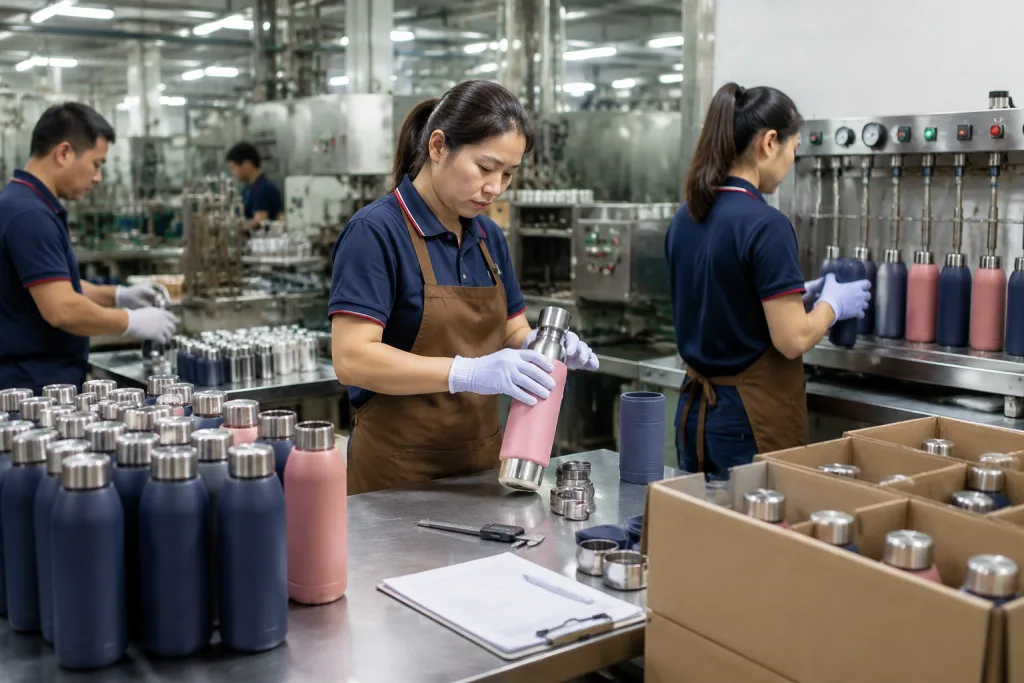
Key Takeaways
- A workable custom thermos order usually starts at MOQ 500 units and 25-35 days lead time after sample approval.
- A 304 stainless inner wall at 0.4-0.5 mm is common for bulk thermos programs; 316 is better when you need stronger corrosion resistance.
- For promotional thermos work, decoration choice changes cost fast: one-color silkscreen is often USD 0.20-0.45 per unit, laser engraving USD 0.35-0.80 per unit.
- QC should be written against ASTM or ISO touchpoints, plus AQL 2.5 for major defects and 4.0 for minor defects on a typical export lot.
You are not buying a generic bottle. You are placing a production order that has to survive freight, logo placement, shelf checks, and daily use. We once had a buyer flag a 1.5 mm cap gap on the first pre-production sample; that stopped the run. The weak point is usually not the vacuum flask. It is the handoff between design, decoration, sealing parts, and inspection. That is where margin gets burned in China.
For outdoor retailers and promo brands, treat this as a factory order, not a branding exercise. A thermos plant in Zhejiang will quote by structure, finish, and pack-out, then lock the spec before the line starts. At BottleForge Industrial in Hangzhou, our standard thermos MOQ starts at 500 units per design, with 20,000 units per month capacity and a normal lead time of 25-35 days after sample approval. Ask for that level of detail from any supplier thermos partner. QC pulled the sample, checked the lid torque, and the math has to work before we ship.
Start With the Actual Use Case
First, pin down the use case. A 500 ml office giveaway, a 750 ml trail bottle, and a 1 L distributor thermos can all look fine in a catalog. On the line, they are three different builds. If you buy for outdoor retailers, choose one-hand drinking, a tea infuser, or a wide-mouth pour shape before you talk decoration. If you buy promotional stock, decide whether price, print area, or leak resistance leads. That is the right question.
A Zhejiang thermos manufacturer should ask about the channel first: retail shelf, Amazon, corporate gifting, or event promotion. That choice changes wall thickness, lid cost, and carton packing. We run 304 stainless with a PP lid and silicone seal on a lot of bulk thermos orders, and QC pulled the sample on one job because the lid thread was off by 0.3 mm. For camping, a powder-coated body and a screw cap with carry handle usually move faster than a polished office flask. For a premium gift set, the bottle can stay the same, but the box, insert, and logo method do the real work. The buyer flagged the carton size, and the math did not work.
Choose the Steel Before the Color
Steel choice is where a serious buyer stops reading the brochure and checks the mill cert. We run most custom stainless thermos orders in 304 stainless for both walls. If the bottle will sit on acidic drinks or spend weeks in humid storage, 316 is the cleaner call, and it usually adds USD 0.30-0.80 per unit depending on body shape and MOQ. The silicone sleeve changes grip and keeps fingerprints down. It does not carry the thermal load.
Look at the numbers on the line. A standard 500 ml vacuum bottle usually runs 0.4 mm on the inner wall, 0.5 mm on the outer wall, and a vacuum gap around 0.25-0.35 mm. We had a buyer flag a PO typo once, “5000 ml” instead of “500 ml,” and the math does not work when the wall gauge is off. The lid should pass a 360-degree leak test, not a quick upside-down shake. If a factory says it can only do a visual check, push back. QC pulled the sample, and the cap failed at the spout after 12 minutes. Stainless quality needs REACH-compliant seals, food-contact safe inks, and traceable heat numbers. That is basic export work, not premium positioning.
Decide What the Silicone Does
Silicone needs a job. If a buyer asks for material first, we push back. Function comes first. On our line, the first question is simple: grip, heat shield, impact buffer, or just a color sleeve that hides a repaint. Kids, gym users, and outdoor accounts pay for that part when the cup stops slipping at 0.3 kg fill weight.
We usually see three setups. A full sleeve on the lower body, 1.5-2.5 mm thick, gives grip and hides scuffs. A base ring cuts the clack on set-down and takes a small knock. A carry loop in the lid works best with a PP or Tritan cap. This is the wrong question to ask: start with the job, then pick the part. The sleeve adds a mold and another assembly step, so it is not free trim. On a 20,000-piece order, the math lands around USD 0.25-0.70 per unit, depending on size and color count. QC pulled the sample on a 2 mm sleeve once and flagged a loose fit after 48 hours in the freezer. For distributor thermos programs, a removable sleeve also makes pack-out cleaner and cuts carton rub in transit.
Lock Decoration Before Production
Decoration can send a custom thermos order back to the line fast if the spec is fuzzy. Lock the method before the first run: silkscreen, pad print, laser engraving, heat transfer, or UV print. For promo work, one-color silkscreen usually lands at USD 0.20-0.45 per bottle and runs clean on our 160 mesh screen. Laser engraving sits around USD 0.35-0.80 per bottle and holds better on bottles that get daily use. Full-wrap print costs more, and Pantone matching on a curved body gets messy fast.
Do not sign off on a flat mockup. That is the wrong question to ask. We run brushed steel, matte powder coat, and silicone through different print tests, and the same press setting does not behave the same on all three. Ask the thermos factory for a proof on the real substrate; QC pulled one sample last month where the logo shifted 2.5 mm after curing, and the buyer flagged it before we shipped. If you need a custom thermos with multiple logos, product line names, or SKU marks for retail, split the files and get the placement tolerance confirmed in millimeters, not by eye. We ship less drama that way.
Practical rule: if the branding can be read from 1.5 meters, it is probably fine for promo. If it has to look premium at 30 cm, you need a physical sample, not just a render.
Sample Like You Mean It
You do not approve a custom thermos from photos. We run a sample order to check fit, finish, cap torque, seal integrity, and coating wear. On a silicone thermos job, QC pulled the sample with the sleeve on the bottle, then checked odor, daylight color match, and the 2 mm sleeve gap. If the bottle is headed to Europe or North America, ask for REACH declarations on silicone and plastic contact parts, and tie the sample label to the final spec sheet. The buyer flagged the mismatch later, and then you are stuck explaining a carton that does not match the approval.
At minimum, the sample needs four checks: no pinholes in vacuum seams, no wobble on a flat table, no ink smear after 24 hours, and no leak after repeated opening and closing. “Does it look good?” is the wrong question to ask. One packed sample tells the truth. Ask for it in the exact carton build, with inserts, barcode, and master carton label. We had a PO once with “barcod” typed wrong, and the line caught it before ship. A distributor buyer learns more from that one carton than from ten loose units. The math does not work any other way.
QC the Mass Production Lot
Once the order hits the line, looks stop driving the job. Repeatability does. Ask the thermos manufacturer for the inspection plan before mass production starts: incoming raw material check, in-line leak test, decoration check, final carton audit. We want the first IQC sheet on 304 stainless, not a口头 promise. For export lots, AQL 2.5 for major defects and 4.0 for minor defects is a workable benchmark. It is not magic. It gives the buyer and the factory one yardstick.
Watch the failure modes that hit the buyer at destination. A bent rim kills lid sealing. A weak vacuum drags down heat retention. A thin coating chips in transit. An over-tightened cap cracks the silicone gasket. We saw this go sideways on a 5000 pcs PO when QC pulled the sample and found three lids with a 0.8 mm rim bend; the buyer flagged it fast. For a thermos promotional order, cosmetic mismatch is the usual complaint. For a retail custom thermos program, leakage or carton crush is the problem. Ask your manufacturer thermos supplier to show leak testing, drop testing, and packaging compression testing. A Zhejiang factory should put those records on the table without drama. If they cannot, you are taking on their process risk.
- Leak test: 100% of units
- Appearance sampling: AQL 2.5 major, 4.0 minor
- Carton drop test: 5 sides, 3 corners
- Heat retention target: 6-12 hours depending on structure and volume
Price the Order Like a Buyer
Do not judge a custom thermos quote by unit price alone. Price it on total landed cost. A 500 ml stainless bottle with one-color print, basic carton, and 500-unit MOQ often lands at USD 3.20-4.80 FOB China, depending on steel grade, lid structure, and decoration method. Add a silicone sleeve, premium box, and barcode labeling, and the quote can move to USD 4.80-6.50 FOB. That spread is normal. The real check is simple: are the numbers backed by actual parts, or did someone pad the sheet with vague allowances? We run into that on the line when a PO shows “packing as discussed” and nothing else.
For distributors and outdoor retailers, freight and packing decide profit more than bottle cost. A factory thermos that nests well can cut carton volume by 8-12%; a bad carton layout wipes out margin fast. Ask for net weight, gross weight, carton count, and master carton dimensions before you confirm. If the program needs Amazon FNSKU labeling, polybagging, or kitting, put it in the quote from day one. QC pulled the sample on a 36 cm master carton last month, and the buyer flagged a 2 mm gap that would have turned into crushed corners in transit. We’ve seen that go sideways. The better China supplier keeps product cost and service cost on separate lines, which makes the next round of pricing cleaner when your order moves from trial to repeat bulk volume.
Work the Factory Relationship Properly
If you source from China, Zhejiang included, the relationship matters as much as the spec. A silicone thermos manufacturer keeps repeat orders moving when you send one final artwork file, one exact color code, one approved sample, and a forecast the line can build against. We had a buyer change the lid Pantone three times in one week; the batch still ran, but the carton reprint pushed shipment from 12 days to 18 days. That is factory math. The wrong question is usually "can you rush it?" The real one is "what changed on your side?"
Use one contact path, one spec sheet, and one approval record. If retail and promo orders are different, write that on the PO instead of burying it in email. Good thermos programs run cleaner when the buyer thinks like operations. QC pulled the sample on a 0.5 mm gap at the cap shoulder, and the buyer flagged it before we packed 2,000 pcs. We see this go sideways when three people answer the same thread. When you know what a leak test is, what silicone hardness means, and why the outer carton finish matters, the factory stops guessing and the second order lands smoother.
Specify your thermos order with real factory data
Send us your volume, target price, decoration method, and pack-out needs. We will build a workable custom thermos quote from our Hangzhou line.
Frequently asked questions
What is the usual MOQ for a custom stainless thermos order?
For a standard custom thermos program, MOQ is often 500 units per design and color when you work with a China thermos factory that already has the body structure in production. If you want a new mold, special silicone sleeve, or multi-part gift set, the MOQ can move to 1,000-3,000 units. For a simple promotional thermos with one-color print, 500-1,000 units is realistic. The point is to separate decoration from tooling. A silicone thermos manufacturer in Zhejiang can usually support a lower trial order if you accept a standard bottle shape and limited color options.
How long does production usually take after sample approval?
A typical lead time is 25-35 days after sample approval for a regular factory thermos order. If the order needs a new sleeve mold, special packaging, or a busy seasonal schedule, expect 40-50 days. Shipping time is separate. Air freight to Europe or North America can be 5-8 days transit, while sea freight is usually 18-35 days depending on port and routing. When buyers miss their sell window, it is often because they counted only production time and ignored print proofing, sample approval, and export booking.
What steel grade should I choose for outdoor retail?
For most outdoor retail and distributor thermos programs, 304 stainless steel is the default because it balances cost, corrosion resistance, and supply stability. If the bottle may hold acidic drinks, or you want a stronger premium story, 316 stainless is worth considering, but it usually adds cost. A practical spec is 0.4 mm inner wall and 0.5 mm outer wall for a 500-750 ml bottle. Ask the thermos supplier for material certificates and make sure the silicone and plastic parts are REACH-compliant if you are selling into Europe.
How do I reduce logo wear on a promotional thermos?
Use the right decoration method for the finish. Laser engraving holds up better on stainless or powder-coated bodies because it is etched, not printed. On a budget promo line, silkscreen can work fine, but it should be protected from abrasion by using a smooth coat and avoiding very large ink blocks. For a custom thermos that will be handled daily, ask for a physical sample and do a simple rub test after 24 hours. A decent production line should be able to show you the difference between a logo that survives 500 cycles and one that starts fading after 50.
What QC documents should I ask for from the factory?
Ask for the final approved sample, material declaration, inspection report, and carton pack-out confirmation. For export, it is also smart to request AQL-based inspection records, leak test records, and any available REACH or food-contact compliance documents for the silicone and plastic parts. If you are selling in North America, you may also want basic compliance support for contact materials and packaging. A real thermos factory in Zhejiang should be able to provide these without long delay. If they cannot produce even a simple inspection record, treat that as a warning sign, not a paperwork issue.