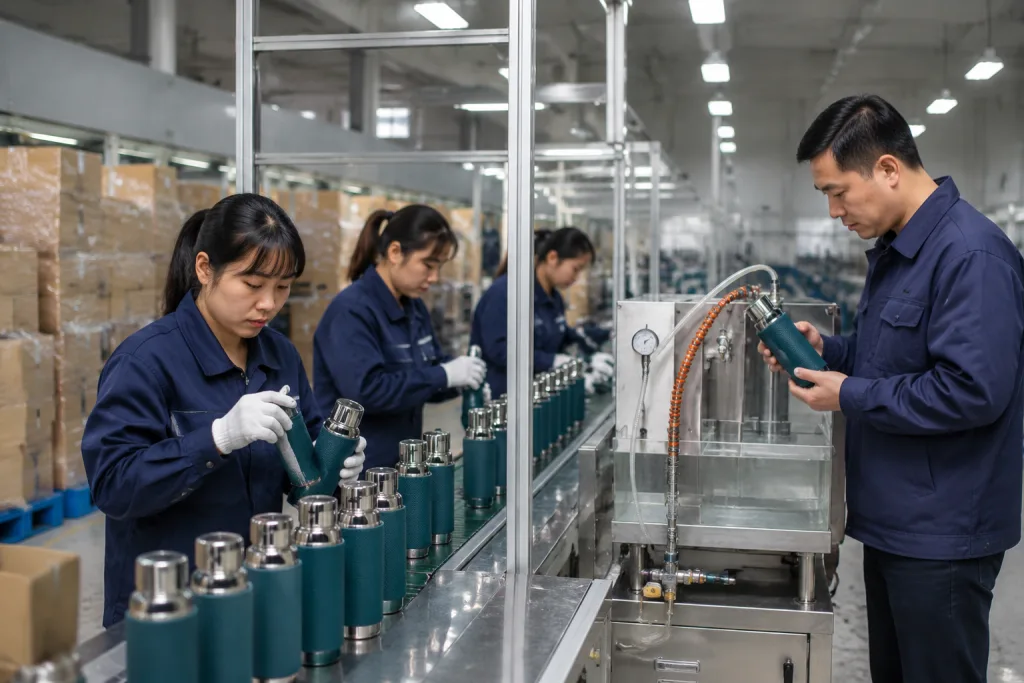
Key Takeaways
- A standard custom stainless thermos in 500 ml often lands at USD 2.20-4.80 FOB China at 3,000-5,000 units, depending on cap and decoration.
- A silicone sleeve adds about 12-25% to unit cost but improves grip and scratch resistance for outdoor use.
- Most Zhejiang factories can support 50,000-200,000 units/month, but MOQ and lead time shift by cap tooling and print method.
- For export, ask for REACH, LFGB, and vacuum leak tests, plus AQL 2.5 for critical defects and 4.0 for minor defects.
Source a silicone thermos flask manufacturer, and you are not buying a bottle. You are buying a spec stack: 304 or 316 steel, single-wall or vacuum, powder coat or silicone sleeve, cap style, print method, and the carton test it has to survive before it lands at the port. The wrong mix looks fine on a quote. Three months later, QC pulls the sample and the buyer flags dents, peeling, or a lid that walks loose.
For outdoor retailers and promo brands, the real question is which spec mix fits the margin, the user, and the MOQ. Last week on our Hangzhou line, one buyer pushed for a 5,000-unit FOB run with a 1.2 mm body and a color lid typo on the PO; another wanted 30,000 units with a silicone sleeve and laser logo. Same factory, different math. Lead time, rejection rate, and landed cost split fast when the spec sheet is loose.
Spec table first, opinions second
Start with the spec table. Skip the brochure talk. We run this check on the line every week: channel first, finish later. A 2-day trade show bottle is one job; a retail flask that sits on a shelf for 18 months is another. Buyers still mix those up. The margin goes sideways fast.
Here is the split we use when quoting thermos custom projects:
- Entry promo: 350-500 ml, 201 outer shell or 304 inner, silk screen logo, MOQ 3,000-5,000 pcs, FOB USD 2.20-3.20
- Main retail: 500-750 ml, 304 inner and outer, powder coat, laser logo, MOQ 2,000-3,000 pcs, FOB USD 3.40-5.80
- Premium outdoor: 500-1000 ml, 304 or 316 inner, silicone grip sleeve, embossed cap detail, MOQ 1,000-2,000 pcs, FOB USD 4.80-8.50
The sleeve is not decoration. It changes grip, scuff resistance, and how the buyer reads the bottle on shelf. Last month QC pulled the sample on a 0.8 mm seam line because the sleeve flashed at the joint, and the buyer flagged it in the first round. Soft-touch custom thermos units usually move faster than bare steel in gifting. That is where the math works.
Use-case rule: if your customer is commuting and gifting, the sleeve helps. If your customer is mostly backpacking and wants dishwasher simplicity, a cleaner stainless shell may sell better. We have seen that tradeoff go sideways when a PO typo called for a 500 ml body but the art file was sized for 750 ml.
Stainless grades change the business
Buyers often check wall thickness and miss the steel grade. That is the wrong question. On the line, we have seen a 0.40 mm body pass and still get rejected after a salt-spray check because the buyer flagged pitting. For a thermos manufacturer, 304 and 316 are different calls. They change corrosion resistance, landed cost, and which shelves the bottle can reach. A supplier quote should state the grade for the inner shell and outer shell. “Food grade stainless steel” is too loose for procurement.
For a standard vacuum insulated bottle, 304 is the workhorse. We run it for tea, coffee, and water, and it keeps the BOM in a range buyers can live with. 316 earns its place when the bottle sees harsher wash cycles, salt air, or a premium shelf price. We had one buyer push for 316 on a mass-market promo run, then the math did not work at their MOQ of 3,000 pcs. Pay for 316 when the channel can support it. Otherwise you are buying a label, not margin.
What you should ask for
- Inner wall: 0.35-0.45 mm thickness for most 500-750 ml bodies; QC pulled the caliper at 0.38 mm on our last run
- Outer wall: 0.30-0.40 mm depending on emboss and print area; a deep emboss needs the extra 0.05 mm or the panel oil-cans
- Vacuum performance: 6-12 hours hot hold, 12-24 hours cold hold, depending on lid and fill volume; we test with a thermometer probe and a 95°C fill
- Standards: REACH for Europe, FDA or LFGB depending on destination, and material traceability by lot; keep the mill certificate with the PO, not buried in email
A thermos bulk program into Europe should not skip documentation. Zhejiang factories can issue material declarations, but you need to ask before the first sample shot. Once the line starts, changing grade or coating burns time and scrap. We have seen this go sideways on a PO with “316L” typed as “316,” and the buyer caught it only after artwork approval. Lock the steel spec first. Then lock the artwork.
Silicone sleeve or bare steel
The silicone sleeve is the fastest way to make a custom thermos look priced up without touching the steel body. We run it on a lot of 500 ml and 750 ml orders. It gives you a wide color panel for retail branding, but the line can go sideways fast. If the mold line is rough, the sleeve traps dust and the cup looks tired. If the durometer is too soft, it feels tacky; too hard, and you lose the grip you paid for. QC pulled one sample with a 0.6 mm parting line, and the buyer spotted it in two minutes.
Use the sleeve when the buyer wants glove-friendly handling, anti-slip grip, or a clear visual break from the shelf next door. Skip it when cleaning speed or the lowest landed cost wins. The math does not work otherwise. On our Hangzhou line, sleeve jobs usually add 12-25% to unit cost versus bare steel, mostly from extra tooling, assembly, and QC pulls. We shipped one batch where the buyer flagged a 0.8 mm flash line at the seam, and that alone ate the margin. Bare steel is the cleaner call for hotel programs and tight MOQ runs.
For outdoor retailers, the sleeve should solve a real problem: grip with gloves, table protection, or hiding small dents from transit. If it is only there to “look custom,” you are paying for decoration.
Ask the thermos supplier for sleeve shrinkage data and color tolerance by Pantone. We check it with a caliper and a pull test, not a sales promise. A solid thermos supplier should hold color drift tight across a 5,000-piece batch, and QC should be able to show the report. If they cannot speak to curing temp, trim rate, and incoming rubber checks, the sleeve line is not ready for your order. The buyer once sent a PO with “Pantone 186 C” typed as “189 C”; we caught it before the line started.
Best use case by channel
The real question is not “which bottle is best.” It is which bottle fits the channel. For a promo thermos run, the buyer watches reach and margin. For outdoor retail, sell-through and complaint rate decide the order. Same mold. Different job. We had one conference PO asking for screen print on a flip lid, then the buyer flagged leak risk after QC pulled the sample at 500 ml. That spec worked for giveaways. It failed on a hiking shelf where abrasion and sealing matter more.
Use this channel map when you set the spec. The 38 mm cap neck on the line keeps the print area clear, and it keeps the quote honest:
- Trade shows and gifting: 350-500 ml, lighter body, lower MOQ, bold print area
- Outdoor retail: 500-750 ml, vacuum performance, silicone grip, powder coat or matte finish
- Corporate programs: 500-1000 ml, custom packaging, laser logo, tighter carton pack control
- Distributor thermos programs: multi-SKU line with one common lid platform and two body sizes
The common mistake is overbuilding promo stock and underbuilding retail stock. We have seen that go sideways. A thermos distributor wants steady replenishment, not a novelty piece that dies after one season. A premium outdoor buyer wants a body that survives repeated drops and still looks clean after 12 days in transit, not 18. The math does not work if you push one mold into every order from a China thermos factory with export work behind it.
For repeat runs, I prefer one body platform and two lid options. That gives thermos customizable breadth without piling up tooling and carton cost. We run 500 pcs on the common body, then split lids by channel. Replenishment stays simple.
Decoration changes the quote fast
Logo method moves the quote fast. A silicone sleeve takes deboss or pad print cleanly, but the same artwork can fail the minute you ask for 0.2 mm hairline strokes or four colors on a curved wall. Bare stainless gives us room for laser engraving, silk screen, and 360-degree wrap graphics. The right quote names the decoration method and the rejection line. “Logo included” is useless.
Here is the cost pattern we run in China, and the math does not lie. We check it on the line with a caliper and a print jig:
- Silk screen: low setup cost, best for 1-2 color logos, works on 3,000+ pcs; QC pulled a 0.3 mm line test and the edge held
- Laser engraving: cleaner look, higher perceived value, fits 500-1,000 pcs, but the buyer flagged a 0.2 mm font on the first sample as too thin
- Heat transfer or wrap print: strong visual impact, tighter artwork control needed, scrap climbs if the print file drifts by 1 mm
If your thermos custom project is for distributors, ask how many reorders the same artwork setup can carry. We keep the screens, laser files, and carton dielines for repeat runs. A 200 pcs MOQ on a new logo can turn into 2,000 pcs of repeat business if the setup is clean. That is how a thermos manufacturer protects margin. In Zhejiang, we price decoration into yield from day one.
Ask for sample photos under neutral light. A black matte custom thermos with a silver laser logo can look clean on screen and turn dull in production if the coating is too rough at the 5-7 um level. The buyer flagged that once after a PO typo changed “matte” to “metallic.” We’ve seen that go sideways. This is a spec control issue, not a design issue.
MOQ, lead time, and factory reality
Ask about capacity before you burn time on color chips. A silicone thermos flask manufacturer running 80,000-150,000 units/month can cover seasonal orders, but only after the spec is frozen. We had one buyer change the cap sketch on sample round 3, and the line slipped 9 days. Simple as that.
A Zhejiang thermos factory usually needs 7-10 days for sample confirmation, 25-35 days for standard production, and 35-50 days once new molds or complex packaging hit the job. MOQ often starts at 1,000-3,000 pcs for standard bodies and 3,000-5,000 pcs for full custom packaging or multi-color sleeve programs. QC pulled a sleeve at 1.8 mm wall thickness, the buyer flagged it, and the 500 pcs promise died on a low FOB price. The math does not work.
For outdoor retailers, match the spec to the reorder plan. If the item is meant to grow into a distributor thermos line, choose a shared cap platform now. That keeps the next order off new tooling. Carton packing, master carton count, and spare parts stay steady for the warehouse team.
Zhejiang factories can move fast, but only when the buyer locks the decision tree early. A PO typo on sleeve color cost us 2 days on the line and pulled yield down with it. Late changes do both. We have seen that go sideways too many times.
Quality checks that prevent damage
QC is not filler in a quote. For a vacuum insulated bottle, the failures stay the same on the line: vacuum leak, lid leak, coating scratch, print rub-off, carton crush. A serious thermos supplier ties each risk to a test list, then puts sample size and acceptance level in plain numbers, not sales talk.
Use these checks as the floor:
- AQL: 2.5 for critical defects, 4.0 for major, 6.5 for minor if your program allows it
- Leak test: 100% inverted or pressure-tested on final assembly line for export orders
- Thermal test: 6-hour and 12-hour retention checks by batch
- Drop test: 1-meter drop on carton and bottle, especially for retail packs
Ask for the inspection report, not a promise. We run batch traceability by date, line, and inspector, and QC pulled the sample with a 0.3 mm lid gap before it left the bench. Buyers skip that step until a carton shows up dented in Chicago. One bad lot can sit in distributor stock for 60 days before anyone flags it, and by then the root cause is a pain to pin down.
For Europe, REACH and LFGB paperwork should be ready before the PO lands. For North America, the carton marks need to survive warehouse handling, which means clean printing and no loose labels. If the order is going to Amazon FBA, sort out the outer carton and FNSKU plan before packing starts; we have seen a 2 mm label shift trigger a buyer complaint and hold up the whole shipment. That is the wrong question to ask after goods ship.
Which version I would buy
If I were buying for an outdoor retail line, I would take the 500 ml or 750 ml vacuum insulated stainless body with a silicone sleeve, matte powder coat, and laser logo. We run that spec a lot. Grip is better, the shelf looks clean, and the repeat order rate is easier to defend when QC pulled the sample and the lid still held after a 1.2 m drop test. It is not the cheapest thermos bulk option, but it cuts embarrassment risk once customers start using it. The math works at FOB USD 4.20-6.20 for 2,000-3,000 pcs, with the lid and carton doing most of the cost swing.
If I were buying for a promotional brand, I would go lighter: 350-500 ml, one-color print, a simpler cap, fewer moving parts. That is the right call. A thermos promotional product should ship cleanly, sit on a desk without drama, and stay inside budget; the buyer flagged a PO once because someone typed 5,000 pcs instead of 5000 pcs and the carton fee was the only line anyone wanted to argue about. A thermos vendor earns trust by saying no to extra decoration when the order does not need it.
The strongest thermos manufacturer relationship comes from cutting the list, not adding to it. A good factory thermos quote should show the price gap between a 304 stainless body, a silicone sleeve, and a cheaper lid, then say plainly when a customized thermos idea will hurt margin without lifting sell-through. We have seen this go sideways when buyers chase ten finish options and then ask why the line slips 12 days versus 18 days. This is the wrong question to ask: the better one is which spec will reorder without drama in China and beyond.
Request a custom thermos spec sheet
Send your target price, capacity, and market. We will map the right steel grade, sleeve option, and MOQ before you commit to tooling.
Frequently asked questions
What is a normal MOQ for a custom stainless thermos?
For standard molds, MOQ is usually 1,000-3,000 pcs. If you add a custom silicone sleeve, special cap, or full-color packaging, 3,000-5,000 pcs is more realistic. A true thermos custom program with new tooling can start higher, especially for premium shapes. In Zhejiang, factories with stable export lines often support 50,000+ units/month, but they still need the order to be rational. A lower MOQ is possible if you accept higher unit cost and fewer customization options.
How much does a silicone sleeve add to the price?
A silicone sleeve usually adds about 12-25% to unit cost versus a bare stainless body. On a 500 ml bottle, that can mean a shift from roughly USD 3.40 FOB to USD 4.10-4.70 FOB, depending on sleeve color, molding complexity, and logo method. If the sleeve is only cosmetic, you may be paying too much. If it improves grip for outdoor use or reduces visible wear in retail, the premium is easier to defend.
Which steel grade should I choose for export orders?
304 is the default for most custom thermos programs and works well for coffee, tea, and water. Choose 316 when you need stronger corrosion resistance or a premium position, especially for harsher environments. Do not let a supplier thermos quote hide the grade under vague wording like food-grade steel. Ask for the inner and outer material spec, thickness, and supporting documentation. For Europe, also confirm REACH or LFGB compliance, depending on the destination market.
What lead time should I plan for?
For a standard customized thermos order, plan 25-35 days after sample approval. If you need new molds, sleeve tooling, or revised packaging, 35-50 days is more realistic. Sampling usually takes 7-10 days if the mold exists. Shipping time is separate. From China to Europe or North America, ocean freight may add 20-40 days depending on route and congestion. Good planning matters because one late artwork change can push the whole schedule.
How do I check quality before shipment?
Ask for a pre-shipment inspection with AQL 2.5 for critical defects, 4.0 for major, and a clear leak test report. For a vacuum bottle, I would also want thermal retention checks, carton drop testing, and photo evidence of print alignment and sleeve fit. If you are selling through distributors or retail chains, ask for batch traceability and spare carton samples. A serious thermos supplier in Zhejiang should be able to provide this without drama.