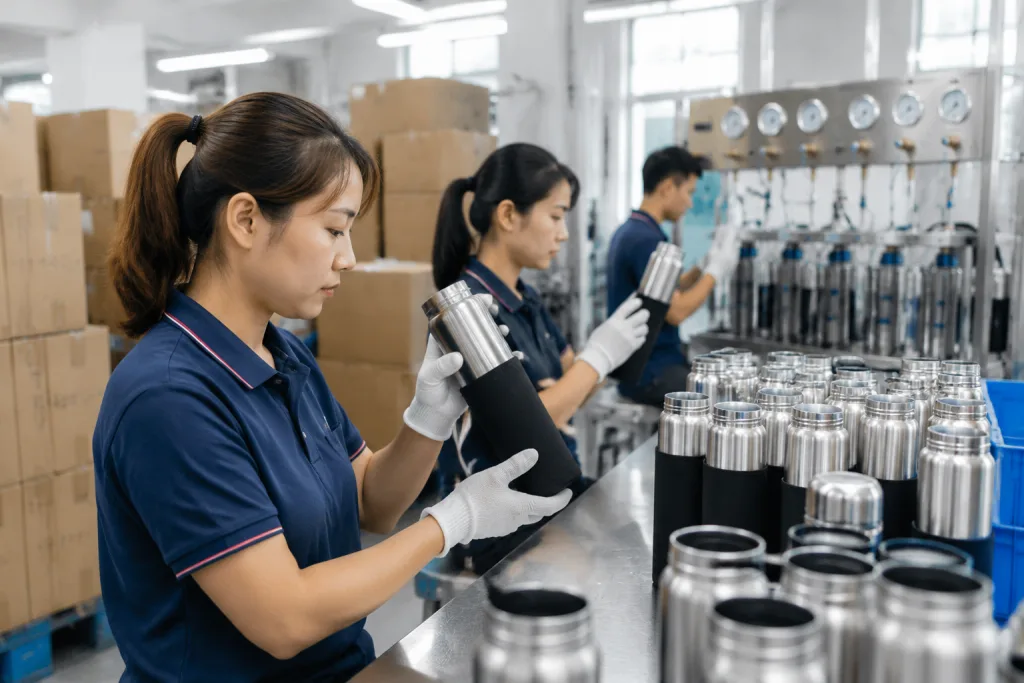
Key Takeaways
- Full silicone sleeves hide dents but increase outer diameter by 6-10mm, affecting packaging density.
- Partial grip bands reduce material cost by approximately 15-20% compared to full wraps.
- Pad printing on silicone requires a specific curing agent; standard ink rubs off within 500 cycles.
- Minimum Order Quantity (MOQ) for custom silicone molds typically starts at 1,000-3,000 units per color.
- REACH and LFGB compliance for silicone is mandatory for EU markets; request test reports upfront.
Outdoor retailers and promo buyers keep running into the same problem: a bare stainless bottle holds up, but it slips when hands are wet and picks up dents fast. We see it on the line every week. A 500 ml bottle can clear packing, then the buyer flags it after a 1 m drop test. A silicone thermos flask custom build closes that gap. Grip goes up. The shell takes less abuse, and there is still space for a clean logo.
Specifying one is not just choosing a Pantone chip. The real calls are silicone thickness, bonding method, and the test set behind the order. QC pulled a sample last week and the wrap lifted at the seam after a hot-water soak; that batch stopped there. If you are sourcing from a Zhejiang factory, the math has to work on landed cost and service life, because humid storage will expose weak glue fast. Color-only buying is the wrong question.
Decision 1: Full Sleeve vs. Partial Grip Configuration
First decision: coverage area. Full sleeve means full wrap, no guesswork. It covers the stainless body, takes the dents, and hides the small marks we see after a 1.2 m drop test. Good for site-use bottles and outdoor kits. The sleeve adds bulk. On one run, 24 units per master carton dropped to 18 when the sleeve OD grew by 6 mm. If the buyer keeps the same freight target, the math does not work.
Partial grip bands keep silicone on the high-touch zones only. The bottle stays slimmer, and the stainless thermos still looks clean on shelf. For a promo thermos going into corporate gifts, that usually sells better. Material cost drops too. We run a 3D rendering before the line starts, because a buyer once flagged a top-heavy feel on a 500 ml sample after the lid cap shifted the center of gravity. Ask for the balance check first; this is the wrong question to ask after tooling.
Thermal Performance Considerations
Silicone slows heat transfer. Full sleeve gives a small lift on cold retention, but it also hides how hot the drink is. You cannot feel scalding coffee through the wall. For a bulk thermos order going to hikers, that safety angle matters. For city commuters, it cuts both ways. Some buyers want the warm-hand feel of bare steel, and we have seen that go sideways in sample approval when QC pulled the bottle after a 78°C fill test.
Decision 2: Bonding Method and Longevity Risks
The bond between silicone and steel decides how long the flask stays on shelf. A friction-fit sleeve is the cheap route. One molded silicone part slides over the bottle, and we run it when the buyer wants fast assembly and a sleeve they can pull off for washing. On a thermos custom order, the issue shows up fast: the logo sits on the bottle body, then the sleeve hides it at retail. We had a buyer flag that in a PO once, with the print callout sitting under a 1.5 mm wall sleeve. Friction-fit sleeves can loosen after repeated squeezing in pack-out. QC pulled one sample after 30 hand squeezes, and the fit was already drifting.
Bonded silicone costs more and holds better. The line applies adhesive to the steel before molding or wrapping the silicone, so the shell stays on and the look stays clean. That also gives you dual-material branding, with laser engraving on the steel showing through a silicone cutout. This is the right route for a premium thermos manufacturers quote, but the math does not work if you expect replaceable parts. Once the silicone tears or the adhesive gives up in high heat, the unit is done. Ask for the adhesive grade up front. We use food-grade epoxy on higher-spec runs, and QC pulled the sample after boiling-water soak because the edge on a bad batch started lifting at 95°C. A buyer once pushed for "easy swap" parts on a bonded cup; we told him straight, that spec fights the process.
Always ask for a dishwasher test sample on bonded silicone flasks. Run 50 cycles and check the seam, the corners, and the logo window before you approve mass production.
Decision 3: Branding Technique Selection
Silicone is hard to brand. The wall moves, so standard silk-screen ink starts to crack after a few bend cycles. For a silicone thermos flask custom run, we usually put two routes on the table: pad printing with silicone ink, or debossing and embossing in the mold. QC pulled the sample after a 30,000-cycle bend test, and the print line showed hairline splits at the edge. That was the answer.
Pad printing works when the buyer needs two colors or three colors and wants a lower opening cost. The ink sits on top of the surface, so it fits a distributor thermos program where price drives the order. We had one buyer push back on the hand feel in a 1,000-piece run; the print came back a bit tacky, and the retail team killed it. Debossing is the cleaner call for outdoor retail. The logo goes into the mold, so it stays put and feels solid in hand. The mold fee is higher, and the lead time usually stretches 10 to 15 days because you cannot swap artwork without remaking the tool. The math does not work.
If you are a thermos supplier handling promotional orders, check the silicone pigment and the UV package before the line starts. Cheap material can yellow after sun exposure. We ask for UV stabilizer on white and pastel blue, then run a 48-hour aging check with the oven at 70°C. The buyer once sent a PO with the color code typed one digit off, and that turned into a full re-sample. Small mistake. Big delay. We ship around that kind of typo all the time, and it still burns a day on the schedule.
Decision 4: Material Compliance and Safety Standards
Silicone is safe only when the grade is right. Food-grade and industrial-grade are not the same thing. If the part touches a mouth or liquid, food-grade is the baseline. We run LFGB for Europe because buyers ask for it in week one, and the lab in Shenzhen will catch a weak batch fast. For dual-market orders, LFGB is the cleaner call for your thermos customizable line.
Ask for the MSDS on the exact silicone batch, not a sample sheet from last quarter. A solid factory thermos supplier sends it without chasing. Check BPA, phthalates, and lead. On the line, we once caught a PO typo that said 201 steel while the sample tag read 304; the math does not work there, because 201 may save $0.80 to $1.50 a unit but it brings rust claims later. Get the MTR and match it to the coil number before you release production. The stainless under the shell should be 304 (18/8), not 201. Buyers who wave that off usually regret it.
For North America, ASTM child-safety rules apply when the bottle is sold for kids. QC pulled the sample and checked cap torque at 1.8 N·m; the silicone boot must not jam the lid, or the closure fails in real use. We've seen this go sideways on a 38 mm neck, and that is a fast way to eat a reorder.
Logistics: Cost Drivers for Bulk Orders
Shipping a thermos bulk order starts with carton math. Silicone sleeves are light, but they eat cube. A 500ml bottle with a full sleeve can sit in the same outer carton as a bare 750ml bottle, and the freight quote changes fast. On one 40HQ, we packed 6,480 pcs after QC measured the carton at 58 x 39 x 34 cm, not the 60 x 40 x 36 cm the buyer had put on the PO. That typo added 11% to the landed cost. When you negotiate FOB with a thermos vendor, ask for carton size, pallet height, and pcs per layer. Price the shipment on volumetric weight. That is the number that pays the bill.
Lead time is where the line gets tight. A standard customized thermos can ship in 25 days, but a custom molded silicone sleeve usually adds 10-15 days for tool cutting and sample approval. We had a buyer flag a Q4 launch in mid-September; the math did not work, and we told them straight. For a distributors thermos program, August is the real cutoff if you want stock on the water before peak season. Rush mold charges can go past $500 per cavity, and one bad first sample can burn another 3 to 5 days while QC pulls the sample again and the line waits.
Modular tooling cuts the bill. We run this on a lot of promotional thermos orders: keep the bottle shape standard, then build the silicone sleeve as the custom part. That skips the steel bottle mold, which usually sits around $3,000-$5,000, and the buyer still gets a clean branded look. On a 1,000 pcs run, that choice saved more than the sleeve logo cost itself. For tight budgets, this is the right question to ask. We have seen the full custom route go sideways when the MOQ is only 500 pcs and the customer wants six colors.
Quality Control Checkpoints for Silicone Wraps
Run AQL 2.5 for cosmetic checks, and keep AQL 0.0 on sharp flash. Last month QC pulled a sleeve with a 1.2 mm seam tail off the mold line and caught it in under 10 seconds with a caliper. Flash is a safety problem, not a styling problem. Small shade drift stays in the cosmetic bucket, but if the wrap cuts a glove at packing, the math does not work and the lot stops.
On the line, we test bonded sleeves with a force gauge and log detachment load in pounds. A clean sample should hold; if it peels early, the adhesive was off or the steel was oily. We once saw a buyer write “sillicone” on the PO and ask why the sleeves failed at 3.5 lbs instead of 8 lbs. That is the wrong question to ask. The surface prep and cure window decide the result, and that is what we ship against. For a 5,000-piece order, bring a third-party inspector in Zhejiang and make them watch the pull-test on-site. capabilities.html">capabilities
The 'Sweat Test'
Check the insulation after the wrap goes on. Heat from bonding can stress the vacuum seam, and we have seen that go sideways on a 500 ml bottle when the oven ran too hot at 78°C. Fill the bottle with ice water, leave it in a 30°C room for 2 hours, then inspect under the silicone edge for condensation. If moisture shows up, the vacuum is already compromised. No debate. QC pulled the sample with a 0.2 mm feeler gauge before we released the lot.
Top 5 Use Cases for Custom Silicone Flasks
We ship this category in five lanes. The line usually starts with a 1.5 mm sleeve sample, and that one spec moves the quote fast:
- Construction Site Hydration: Full sleeves in high-visibility orange or yellow sell here. Tough handling wins the order; glossy graphics do not. Best for: Industrial suppliers.
- Yoga and Fitness Studios: Pastel colors with debossed logos fit this channel. The silicone grip helps when hands are wet, and buyers often ask for a 60 mm waist grip. Best for: Boutique retailers.
- Corporate Onboarding Kits: Dual-tone builds, like matte black silicone on brushed steel, move well in office kits. One buyer flagged a PO typo on the logo line, so we stopped the print screen and fixed it before run-out. Best for: B2B promotional buyers.
- Hiking and Trail Running: Partial grip bands with carabiner points suit this use case. Light in hand. That is the point. Best for: Outdoor gear shops.
- Kids' School Bottles: Bright molded silicone with character shapes sells to school channels. QC pulled the sample after a drop test at 1.2 m left a scuff on the sleeve, so we changed the corner radius. Best for: School suppliers.
Each use case needs its own wall thickness, grip pattern, and print method. One-size pricing looks neat on paper, but the math does not work on the line. We have seen that go sideways before. Specialization keeps margin where it belongs.
Ready to specify your custom silicone thermos?
Submit your artwork and technical specs to our Zhejiang engineering team for a feasibility review and detailed quote within 48 hours.
Frequently asked questions
Does the silicone sleeve affect the insulation retention time?
Yes, but marginally. Silicone adds an extra layer of thermal insulation, potentially extending cold retention by 1-2 hours. However, it primarily serves as a grip and protective layer. The vacuum seal inside the stainless steel wall is responsible for 95% of the insulation performance. If the bottle is dropped and the seal breaks, the silicone will not compensate for the heat loss.
Can I mix different silicone colors in one bulk order?
Most factories allow color mixing within a single shipment, but the MOQ applies per color. For example, if the MOQ is 1,000 units, you could order 500 black sleeves and 500 blue sleeves. However, if you need 50 units of a custom Pantone color, you will likely pay a surcharge or be required to order the full MOQ for that specific color to cover the setup and material changeover time.
Is it possible to remove and replace the silicone sleeve?
It depends on the design. Friction-fit sleeves are removable by design, allowing users to swap colors or clean the bottle thoroughly. Bonded sleeves are permanent. Attempting to remove a bonded sleeve will usually tear the silicone and leave adhesive residue on the steel. For <strong>thermos promotional</strong> items, bonded is standard for a premium look; for retail outdoor gear, friction-fit is preferred for versatility.
How do I clean and maintain custom silicone thermos flasks?
Silicone is dishwasher safe, but the underlying stainless steel vacuum seal may not be. High heat in dishwashers can sometimes expand the air inside the bottle, stressing the seal. Hand washing is recommended. For bonded silicone, ensure water does not get trapped between the steel and the silicone edge during washing, as this can lead to mildew if not dried properly.
What is the typical lead time for a custom silicone mold order?
For a standard order, expect 35-45 days from approved artwork to shipment. The breakdown is roughly 7-10 days for silicone mold tooling, 5 days for sample approval, and 20-25 days for mass production. If you are re-ordering an existing mold, production time drops to 20-25 days. Always add a buffer of 10 days for shipping from China to Western ports.