Key Takeaways
- A silicone thermos custom is usually built around 304 stainless steel, 0.4-0.6 mm inner wall thickness, and a molded or wrapped silicone sleeve.
- Typical MOQ for a factory thermos program is 500-1000 units per color; lead time is usually 25-35 days after sample approval.
- FOB China pricing for a 500 ml customized thermos often lands around USD 4.20-7.80 depending on lid, finish, and print method.
- For distributors and promotional brands, the real decision is not just looks; it is leak test standard, sleeve adhesion, and whether the logo survives abrasion.
If you are buying a silicone thermos custom for outdoor retail or a promo run, the spec usually breaks in three spots: grip, leak performance, and decoration wear. The silicone sleeve looks simple on paper, but it changes unit cost, mold work, and how the bottle holds up in a 1.2 m drop test. We had a buyer flag a PO typo once, and the line still caught the same sleeve-fit issue before packing. This is a build choice. Treat it that way.
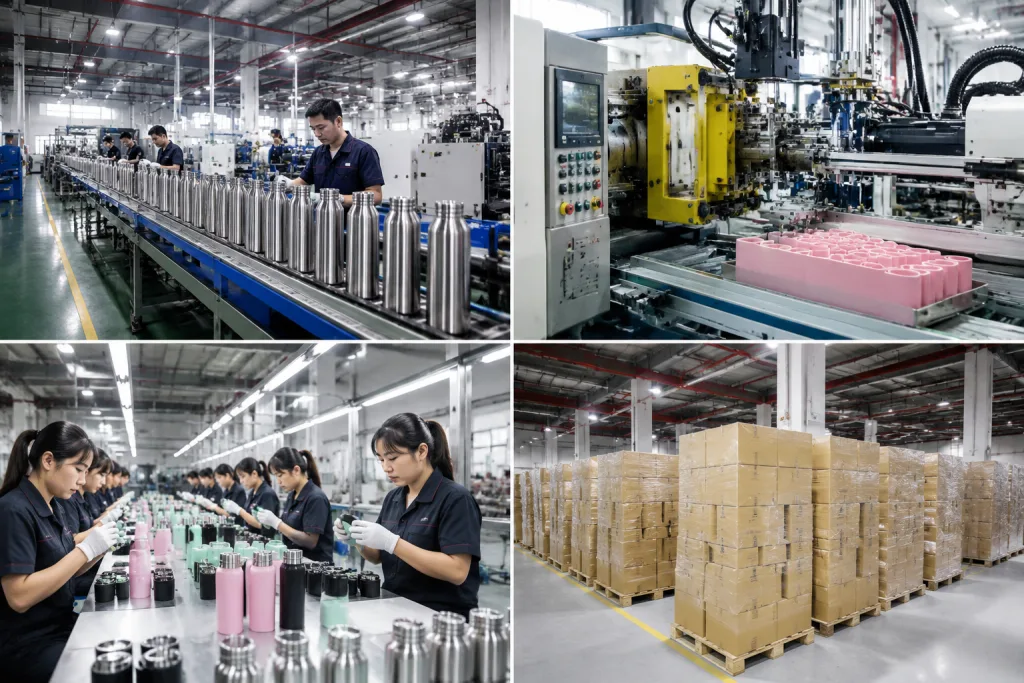
We run this category in Zhejiang and ship a lot of it out of China for bulk thermos programs, so the pattern is old news here. The buyers who get a clean result lock the insulation target, sleeve wall thickness, and logo method before they ask for quotes. That cuts 1-2 sampling rounds, keeps MOQ sane, and avoids paying for print that starts peeling after 50 dishwasher cycles. QC pulled the sample at 78 mm neck fit last week; the math does not work any other way.
Start With The Use Case
Do not start with color. Start with where the thermos lives. A silicone thermos custom for hikers, commuters, and trade-show giveaways is not the same buy, even if the bottle body is identical. Outdoor retail wants a grippier sleeve, less palm chill, and abrasion resistance after 20 trips in a bag. Promo orders care more about logo space, unit cost, and a quick re-order path. Freight bites hard. If you are a distributor thermos buyer, carton count and pack efficiency matter as much as the decoration.
The first split is resale or campaign distribution. Resale programs usually justify a heavier lid assembly, better powder coating, and a sleeve that still looks clean after 6 months on shelf and in use. Promo orders can be simpler, but we still run a leak test and check sleeve finish under the same light box. QC pulled a sample last week with a 0.8 mm sleeve seam shift, and the buyer flagged it before we shipped. That is the wrong question to ask if you start with color. In our Zhejiang factory, the target channel tells us whether we quote a 500 ml or 750 ml body, a straight sleeve or wrapped sleeve, and whether the PO goes to thermos bulk or the higher-spec retail line.
- Retail outdoor: prioritize grip, abrasion resistance, and a sleeve that covers 50-70% of the body.
- Promotional giveaway: prioritize logo visibility and FOB China cost control.
- Distributor replenishment: prioritize carton count, consistent color tolerance, and repeatable sampling.
Pick The Right Steel Build
The steel spec sets the quote. For a custom thermos, 304 stainless is the base call because it keeps cost under control, holds up against corrosion, and fits food-contact checks in Europe and North America. We run a lot of 304 samples on the line, and the math usually works. 201 stainless can shave a few yuan off the unit price, but we have seen that go sideways in humid warehouses; one buyer flagged rust spots after 4 months. 316 shows up on premium jobs. It is a special call, not the default.
Wall thickness is where weak quotes hide. On our line, the inner wall usually sits at 0.4-0.5 mm, with the outer wall at 0.4-0.6 mm, depending on dent resistance and body shape. Too thin, and the flask feels flimsy in hand. Too thick, and you add weight and slow the cooling curve. For a 500 ml insulated stainless thermos, finished weight often lands around 260-340 g before the sleeve, depending on lid parts and the vacuum gap. QC pulled the sample once at 248 g, and the buyer rejected it on first touch. Ask for the cross-section and vacuum test data. That is the right question.
Ask for material declarations, wall thickness targets, and whether the product passed a vacuum retention and thermal retention test. A proper thermos quote should show those numbers without hand-waving.
Silicone Sleeve Choices Matter
The sleeve is the first thing a buyer grabs, so it gets judged before the print or the carton. On a silicone thermos custom job, we usually run three builds: molded sleeve, wrapped sleeve, or a partial grip band. Molded sleeves look clean on shelf and hold shape, but they lock up tooling, and the buyer will push on that in the first call. Wrapped sleeves cost less on a 3,000 pcs promo run and let us swap colors fast. Partial grip bands keep the bottle slimmer and save material. The math is plain.
Silicone hardness decides how the sleeve feels in hand. We sit around 50-60 Shore A for grip sleeves here; soft enough to hold, firm enough not to split at the edge after repeat flex tests. On the line, 1.8-2.5 mm works better than a thick, gummy part that makes a 500 ml bottle look off. Color match is not magic. If Pantone is strict, say it early. We had one PO with the color code typed wrong by one digit, and QC pulled the sample before the second shot. In Zhejiang, we check the sleeve against the steel body because matte 304 stainless and colored silicone can read a full shade apart under store lights. We've seen that go sideways.
- Molded sleeve: best for premium appearance and repeat orders.
- Wrapped sleeve: best for lower MOQ and faster model changes.
- Grip band: best for tight cost targets and lighter packaging.
Decoration Should Match The Surface
A custom thermos is only custom if the mark stays on after daily use. Silicone is rougher than bare steel, so we run a tape pull on each new sleeve and rub the sample 200 times with a dry cloth. QC pulled the sample at 200 cycles. If the print lifts or turns fuzzy, the buyer flagged it for a clean reason. Pad printing fits simple logos. Screen printing works better for larger marks. For a harder mark, we use debossing or embossing in the silicone mold, but that needs tooling upfront and a clean vector file. On the steel body, laser engraving on exposed stainless still gives the cleanest result.
For promotional thermos orders, buyers ask for full-color prints on silicone because the mockup looks sharp. The math does not work every time. On a flexible sleeve, small text blurs faster than on steel, and we have seen 0.3 mm lines close up after one shipment cycle. If the logo has detail below 0.3 mm, simplify it. On a 5,000-piece run, laser engraving on the metal and one-color print on the sleeve usually holds up better than forcing a busy graphic onto a curved, elastic surface. This is the wrong question to ask: the real one is which method survives abrasion. A serious thermos supplier should show abrasion-tested samples from the line, not just a render.
If you also need guidance on method selection, compare the production behavior of [silkscreen versus laser engraving](blog/silkscreen-vs-laser-engraving.html) before you approve artwork.
Price, MOQ, And Lead Time
Most buyers miss what the sleeve does to the quote. Bare stainless looks cheaper on paper, but once we add a molded grip, Pantone matching, and a second print pass, the number moves fast. For a 500 ml silicone thermos custom in China, FOB usually starts around USD 4.20-5.20 for simple promo specs and lands at USD 6.50-7.80 for retail builds with better lids and cleaner finishing. We run 304 steel, a double-wall vacuum body, and a proper silicone sleeve in that band. Plain and simple.
MOQ sits on color count and tooling. On the line, a standard sleeve often starts at 500 units per design, while 1000 units is the normal ask once the buyer wants two colors or a custom molded part. Lead time is usually 25-35 days after sample approval, and the first sample set takes 7-10 days if the structure is already close to an existing body. One PO came through with “silcon” on the sleeve line, and QC pulled the sample until the buyer fixed it. That typo burned a day. If you are launching a distributor thermos program across several SKUs, ask for carton optimization and mixed-color packing at the start. A 500 ml bottle ships fast; a bad carton plan sits in the warehouse. The math does not work any other way.
- Simple promo build: USD 4.20-5.20 FOB.
- Retail-grade build: USD 6.50-7.80 FOB.
- Typical MOQ: 500-1000 units.
- Typical lead time: 25-35 days after sample approval.
Check Compliance Before You Quote
For Europe and North America, compliance has to be in the PO before we run the line, not after carton art is signed off. Stainless parts need food-contact support and migration data for the target market. The silicone sleeve needs the right mark too, food-contact or consumer-contact depending on where it touches the cup. We ask for REACH declarations on the silicone and any coating, plus traceability back to the stainless coil lot. A buyer once typed “silicone cover” instead of “sleeve” on the PO, and the file bounced for 1 day. Small typo. Real delay.
QC needs numbers. We run AQL 2.5 for major defects and 4.0 for minor defects, then leak test every batch on the pressure bench. For thermal claims, sales copy does not count. Ask for the actual protocol: start temperature, room temperature, and test duration. If a supplier says “keeps hot for 12 hours,” ask what the bottle did at hour 12, not what the deck says. The math does not work any other way. We’ve seen it go sideways when the buyer flagged a 3°C gap in the report.
When you compare quality control standards or review factory capabilities, ask for the test sheet, carton spec, and inspection record. A factory that ships export orders should hand over the data without drama. QC pulled the sample, the caliper read 0.8 mm on the sleeve lip, and that was enough to settle the question.
Who Should Buy Which Spec
There is no universal best spec. The channel sets the spec, and margin sets the ceiling. For an outdoor retailer, we usually run a 500-750 ml stainless body, 304 steel, matte finish, and a silicone sleeve with a grip pattern that still bites when gloves are wet on the line. That package supports a higher ticket because the buyer can feel the difference in hand, and the MOQ still stays sane at 3,000 pcs. For a promotional brand, a straight-sided bottle with a large print zone and a sleeve color matched to campaign art works better. You avoid expensive multi-part tooling. For thermos distributors, repeatability beats novelty. One lid family. Two sleeve colors. That is the cleaner setup.
A thermos distributor should also look at storage and replacement rate. If end customers reorder in 12 days instead of 18 days, keep the lid and seal parts simple. If the market is gift-heavy, spend more on sleeve finish and packaging. QC pulled the sample and flagged a 0.8 mm gap at the cap seat once, and that kind of miss turns into returns fast. We have seen that go sideways. A thermos factory can make a sample photo look clean; that is the wrong question to ask. The real check is whether the spec fits sell-through. A customizable thermos earns its keep only when the custom features add margin or cut returns. If neither happens, it is just cost.
For launch planning, pair this buying logic with custom logo options and the basics of MOQ planning before you commit to tooling.
How To Brief The Factory
A tight brief cuts sample loops. Send capacity, 304 stainless steel grade, lid style, sleeve coverage, logo file, color standard, packaging spec, and target FOB range in one note. If the program covers 2 sales channels or 3, say it up front. We run this on the line every week. With that in hand, a supplier thermos team can tell you what stays fixed and what can move, and you avoid paying for 2 sets of molds when 1 platform does the job.
Put the commercial side on the table too: destination market, BSCI or other social audit records, carton loading target, and whether you need FNSKU labels or retail barcode application. One Amazon buyer flagged a 2 mm carton gap, QC pulled the sample, and the master pack count would have blown up on arrival. The quote changed after that. A manufacturer thermos quote without carton count, inner box spec, and master carton dimensions is not ready for approval. The math doesn't work. Good factories in China ask for these details early because that's where the cost sits.
Start from the finished job, not from the design board. A PO typo on sleeve coverage can waste 12 days, and we've seen that go sideways more than once. Build the brief around what you will reorder. That is how a custom thermos program stays profitable when the first reorder comes around.
Build your custom thermos spec with real numbers
Send your capacity, logo, and target FOB. We will map the right stainless body, silicone sleeve, and MOQ before you waste a sampling round.
Frequently asked questions
What is the usual MOQ for a silicone thermos custom order?
For a standard silicone thermos custom program, MOQ is usually 500 units per color and 1000 units if you want multiple sleeve colors or a custom mold. If you use an existing thermos body and only change decoration, some China factories can work from 300 units, but that is less common for export-ready orders. The practical MOQ for a retailer or distributor is usually set by carton efficiency and print setup, not by the sleeve alone.
How much should I budget per unit for a custom thermos?
For FOB China pricing, a basic 500 ml custom thermos with 304 stainless steel and a simple silicone sleeve often lands around USD 4.20-5.20. A stronger retail version with a better lid, cleaner finish, and more durable decoration is often USD 6.50-7.80. The biggest drivers are lid complexity, sleeve tooling, and whether the logo is printed, laser engraved, or molded into the sleeve.
Is 304 stainless enough for outdoor retail?
Yes, 304 is the normal choice for a bulk thermos or distributor thermos program aimed at Europe and North America. It offers a good balance of corrosion resistance, cost, and food-contact acceptance. You only need to step up to a special grade if the use case is unusually aggressive. For most custom thermos orders, 304 on the inner and outer body is the right commercial decision.
How long does sample and production take?
If the structure is based on an existing thermos factory platform, samples often take 7-10 days. Once you approve the sample, mass production usually takes 25-35 days. If you need a new sleeve mold or custom packaging, add time for tooling and color approval. A realistic project timeline for a first-order promotional thermos is often 4-6 weeks from brief to shipment.
What documents should I ask from the thermos supplier?
Ask for material specs, REACH-related declarations for the silicone and coatings, a leak test report, thermal retention test data, and carton dimensions. For quality control, request the inspection standard, usually AQL 2.5 for major defects and 4.0 for minor defects. If your channel needs it, also ask for BSCI audit status, barcode labeling support, and packaging photos before shipment.