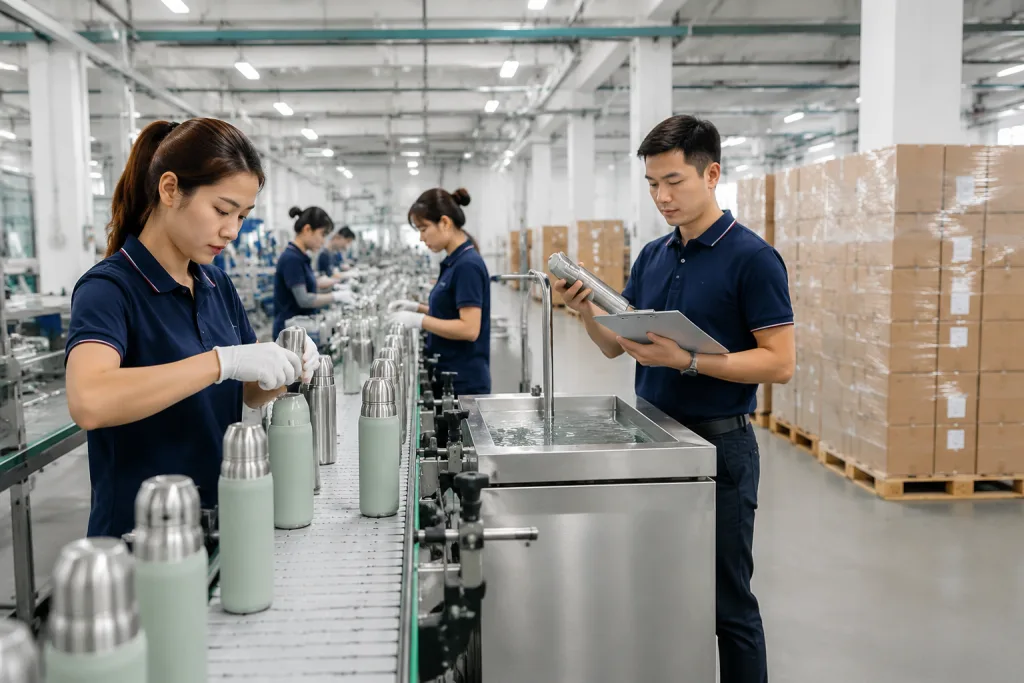
Key Takeaways
- For 500 ml silicone thermos bottle wholesale, FOB China often starts around USD 2.35 to 4.80 per unit at 1,000 to 3,000 pcs, depending on lid, sleeve, and finish.
- A realistic MOQ for a custom thermos with silicone sleeve is usually 500 to 1,000 pcs per color, with 7 to 12 days for samples and 25 to 35 days for mass production.
- Silicone sleeve, powder coat, and lid tooling are the three main cost drivers; they can add 12% to 28% to a standard stainless thermos order.
- A Zhejiang thermos factory that runs 300,000 units per month can usually hold lead times tighter than a trading-only supplier, especially for repeat bulk thermos orders.
If you are sourcing silicone thermos bottle wholesale for an outdoor retail line or a promo run, do not treat every stainless bottle as the same SKU with a new logo. It is not. A plain 500 ml vacuum thermos can leave our Zhejiang line at one cost, while the same body with a silicone sleeve, custom lid, laser mark, and retail carton can push the landed price up 20% to 45% before freight. We run that comparison on the packing bench with a caliper in hand. The buyer asks for “just a logo.” The math does not work.
The right question is not “what is the unit price?” Ask what drives the price, which MOQ tier gets the setup right, and how many days you lose if you change the lid, sleeve hardness, or print method. A decent thermos supplier in China should answer in numbers, not slogans. If they cannot break out tooling, sample time, and packing labor, you are buying blind; QC pulled one sample last week and the buyer flagged a 3 mm lid mismatch before it turned into a claim. We ship faster when the PO is clean, and a typo on the carton spec can cost two days on the line.
What buyers actually pay for
When you ask for thermos bulk pricing, the quotation is only the first line. A stainless thermos with a silicone sleeve has separate cost blocks: shell, vacuum draw, lid set, sleeve compound, print, carton, and the hand work that keeps the finish clean. We run this every day. On one line, a 500 ml bottle picked up a fingerprint mark because the sleeve fit was too tight at the press jig, and QC pulled the sample before packing.
For a standard 500 ml double-wall 304 stainless steel bottle, a plain FOB price from a real factory thermos line sits around USD 1.85 to 2.40 at 3,000 pcs. Add a 1.2 mm to 1.8 mm silicone sleeve, and unit cost usually rises by USD 0.25 to 0.70. A custom flip lid or push-button lid adds another USD 0.18 to 0.65. If you want a matte powder coat, laser logo, and printed carton, the total can move up by 18% to 35%. The buyer once pushed back on a quote because the PO said "sleeve" but never named the thickness. The math doesn't work when the spec is vague.
The right comparison is structure, not headline price. Ask for body grade, wall thickness, lid type, sleeve thickness, and packing spec, then compare line by line. A supplier who throws out one low number without saying whether the silicone sleeve is 1.2 mm or 2.0 mm is skipping the real cost. We've seen that go sideways when the buyer flags the carton count after the sample is already approved.
MOQ tiers that make sense
The right MOQ comes down to two things: how much you change, and how much dead stock you can carry. For customizable thermos programs, we price MOQ by tier, not by hope. One color, one logo, stock packaging? 500 pcs works at a lot of China factories. Add a custom sleeve color, custom lid, and printed gift box, and the floor moves to about 1,000 pcs per SKU. QC pulled a sample on the line last week, and the buyer flagged a box-print typo; one wrong digit on a PO can turn a cheap run into a mess fast.
- 500 pcs: good for a test run, simple logo, standard lid, standard sleeve color.
- 1,000 pcs: works for outdoor retailers launching a seasonal line or promotional thermos campaign.
- 3,000 pcs: unit cost usually drops here, often 8% to 15% below the 1,000 pc tier.
For distributors, the split between a thermos distributor order and a one-off promo buy shows up fast. A distributor thermos program needs reorder stability, so the smarter move is a body and lid platform we already run. This is the right question to ask. In Zhejiang, a manufacturer thermos line built on common molds keeps the MOQ lower because changeover is cleaner; a new mold shape or a weird silicone sleeve texture pushes MOQ and lead time up, and the math does not work in your favor. We ship enough of these to know where the line bends.
Lead time you can bank on
Lead time is where buyers get burned. We saw a PO last month with a sleeve Pantone code off by one digit, and that typo cost us 4 days while the line re-mixed the silicone. A factory that knows the job splits it into sample, pre-production, and mass run. For a typical stainless custom thermos with silicone sleeve, we quote 7 to 12 days for samples, 3 to 5 days for approval and material booking, and 25 to 35 days for production after deposit.
If you need a rush order, some manufacturers in China can cut a repeat run to 18 to 22 days, but only when the body mold, lid tooling, and sleeve compound are already signed off. The bottle is rarely the bottleneck. Decoration and packing eat the schedule. Heat transfer, multi-color printing, and retail-ready packaging each add hand time at the table, and we have seen a 2,000-piece run slip because the buyer changed the carton artwork after QC pulled the sample. A bulk thermos order for Amazon or wholesale also needs time for barcode labeling, carton marks, and sometimes FNSKU application before carton closing.
If a supplier quotes 15 days for a fully customized thermos, the math does not work. Ask them to name the longest path in the process, then ask where QC pulled the sample and what got booked first. That answer tells you more than the price does. We've seen this go sideways when the factory promised 10 days, then spent 2 extra days chasing a sleeve color match on the spectrophoto meter.
Silicone sleeve cost drivers
The silicone sleeve looks plain, but it changes cost and QC on the line. It is not decoration. The sleeve changes grip, drop resistance, and how the bottle feels in hand. Retail buyers spot that in 30 seconds. Promo buyers do too, because a sleeve makes a cheap bottle look less disposable. It also adds one more press-fit check, and we have seen that go sideways when the inner cup OD drifts by 0.3 mm.
Sleeve cost comes down to three things: thickness, hardness, and mold shape. A 1.2 mm sleeve in one solid color is easier to run and fits cleanly. A 1.8 mm to 2.0 mm sleeve with texture or cutouts needs tighter mold control, and the math does not work the same way. If the buyer flags a PMS match, expect a color development charge or a first-run surcharge. On our side, sleeve cost usually adds about USD 0.25 to 0.70 per unit, and custom color work can add another 3% to 8% on the sleeve component. We run a Shore A check on every lot.
Ask for the sleeve material spec in writing. “Food-grade silicone” is too loose. You need hardness, color tolerance, and whether it passes LFGB or FDA-related requirements for your market. QC pulled the sample once and found a 2-point hardness swing between two lots.
A good supplier in Zhejiang will tell you how the sleeve goes on and whether it can be removed for washing without stretching. We ship a lot of these, and the better projects start with that question. A PO typo on sleeve size, like 85 mm written as 58 mm, can burn a day before packing even starts. This is the wrong question to ask after the order is already in production.
Decoration choices and their real impact
Your logo method changes cost and line behavior. For a custom thermos going into outdoor retail, laser engraving holds up on stainless steel and stays clean after 500 rub tests. Silkscreen is cheaper for a one-color mark, but the buyer flagged scuffing on a sample cartoned for Amazon, and the numbers stopped working. Heat transfer and 360-degree printing give stronger shelf impact. They slow the line.
For most thermos custom orders, laser engraving adds about USD 0.08 to 0.20 per unit, while one-color silkscreen sits around USD 0.05 to 0.12. Multi-color printing goes higher once the art needs 3 passes or a tight register callout. On a 1,000 pc order, that gap decides whether we ship a clean margin or spend a week fixing a PO typo on line 2. If the buyer sells to distributors, abrasion resistance matters. If the buyer sells promo stock, full-wrap branding usually wins, even when wear shows up sooner.
Do not ignore the carton. A plain white box is cheap, but a printed retail box, hang tag, or insert card can add USD 0.12 to 0.45 per unit. We once saw a 24 mm box flap spec push a 5,000 pc run into a higher MOQ tier because packing became its own setup on the folding machine. This is the wrong question to ask if you only compare logo price. A good manufacturer quotes decoration and packing separately so you can drop what you do not need.
Quality checks that protect margin
Cheap unit pricing means nothing if the bottles fail inspection. We run AQL 2.5 for major defects and 4.0 for minor ones on most wholesale orders. That is where margin gets protected. Ask the factory how they check vacuum retention, lid leak resistance, and coating adhesion with a pressure gauge and a 45-degree tilt rack. If they cannot explain it in plain terms, the line is loose.
For North America or Europe, ask for REACH-related material declarations where they apply, then confirm the silicone and inks match the buyer's market file. We saw a PO with “silcon” typed three ways, and the buyer flagged it before tooling started. For Amazon or retail chains, carton drop tests and barcode legibility are not optional. A bottle can pass the photo check and still leak at 45 degrees after the lid seal takes a small twist.
- Vacuum test: check temperature retention consistency across a sample lot with the same probe and timer.
- Leak test: confirm lid seal after 30 to 60 seconds of inversion and shake testing.
- Appearance check: verify coating, logo placement, and sleeve fit against a signed sample.
Good factories in China do not hide these checks. QC pulled the sample, the caliper read 0.3 mm off on one sleeve, and the quote got adjusted before shipment. The math does not work any other way. That is how we ship without nasty surprises.
Choosing the right supplier path
For a one-time promo buy, a trading company can work if the spec is plain. We shipped a 5,000-piece run that way for a 220 ml sample set, and it passed first check. For repeat bulk thermos programs, a direct thermos manufacturer is cleaner because the sample record, mold file, and order history stay in one shop. The problem shows up fast when the buyer flags sleeve color or logo position and wants it fixed before the next PO. A Zhejiang factory can pull the Pantone card, check the heat-transfer press, and move. A middleman waits on someone else.
That does not mean every factory is the right factory. Run the numbers. Ask for monthly output, active lines, and headcount on assembly and packing. A plant that ships 300,000 units per month with 4 production lines runs a different schedule than a 30-person workshop, and the math does not lie. On one audit, QC pulled the sample and found a 1.2 mm gap at the lid gasket after drop test. Small defect. Big delay. If your line is seasonal, that gap matters. If you feed distributors across three regions, it matters more.
My view is simple: pick the supplier path by reorder pattern. One-off promo thermos, trading company can be fine. Repeat branded work with tight margin, go direct. We have seen this go sideways when a buyer tried to save 0.18 USD per unit and lost 12 days on a sample change. That is the wrong question to ask. Start with lead time, MOQ, and who can sign off on a typo in the PO before the line runs.
Get a factory quote that matches your spec
Send your bottle size, sleeve style, logo method, and target market. We will quote the real cost, MOQ, and lead time from China, not a guess.
Frequently asked questions
What is a realistic FOB price for silicone thermos bottle wholesale?
For a 500 ml double-wall 304 stainless bottle with a silicone sleeve, FOB China usually lands around USD 2.35 to 4.80 per unit at 1,000 to 3,000 pcs. The lower end fits a simple logo, standard lid, and plain carton. Add a custom lid, sleeve color matching, or premium packing, and you can add USD 0.30 to 1.10 per unit quickly. If a quote looks far below that, check whether it excludes decoration, packaging, or testing. Zhejiang factories that run common molds can hold pricing tighter on repeat orders.
How long does a custom thermos order take?
A normal timeline is 7 to 12 days for samples, 3 to 5 days for approval and material booking, and 25 to 35 days for production after deposit. For repeat orders with existing molds and approved sleeve colors, some China factories can ship in 18 to 22 days. The slowest parts are usually printing, sleeve matching, and retail packing, not the stainless body itself. If your order needs barcode stickers, FNSKU labels, or carton tests, add a few more days before shipment.
What MOQ should I expect for a customizable thermos with silicone sleeve?
For a standard customizable thermos, 500 pcs is a realistic entry point if you keep the lid, sleeve, and packaging simple. For custom sleeve color plus printed carton, 1,000 pcs per SKU is more common. At 3,000 pcs, the unit price usually improves by 8% to 15% versus the 1,000 pc tier. If a supplier offers 100 or 200 pcs with heavy customization, they are usually charging extra setup fees or giving you a weak production plan.
Which logo method is best for promotional thermos orders?
Laser engraving is the safest choice if you want a durable logo on stainless steel. It usually adds about USD 0.08 to 0.20 per unit and handles abrasion well. One-color silkscreen is cheaper, often USD 0.05 to 0.12, but it is less durable if the bottle gets tossed into backpacks or vehicle cup holders. For promotional thermos orders, choose silkscreen if your budget is tight and the campaign is short. Choose laser if the bottle needs to stay presentable for months.
What should I check before placing a bulk thermos order from China?
Check material grade, wall thickness, lid seal, sleeve spec, decoration method, and AQL terms. For export programs, ask whether the silicone and inks can support REACH-related requirements or the standards your market needs. You should also ask for sample photos, a signed golden sample, and the factory’s monthly capacity. A good thermos factory in Zhejiang should be able to explain vacuum testing, leak testing, and packing flow without hesitation. If they cannot, you are taking more risk than the unit price shows.