Key Takeaways
- Stainless steel offers superior heat retention, keeping drinks hot for 12+ hours compared to 4-6 hours for silicone-wrapped versions.
- Silicone exteriors provide better grip and impact protection but increase unit costs by roughly 10-15%.
- Standard MOQ for custom thermos designs starts at 1,000 units; silicone molds require additional lead time.
- Laser engraving on stainless is permanent; silicone surfaces require debossed or printed logos which may wear over time.
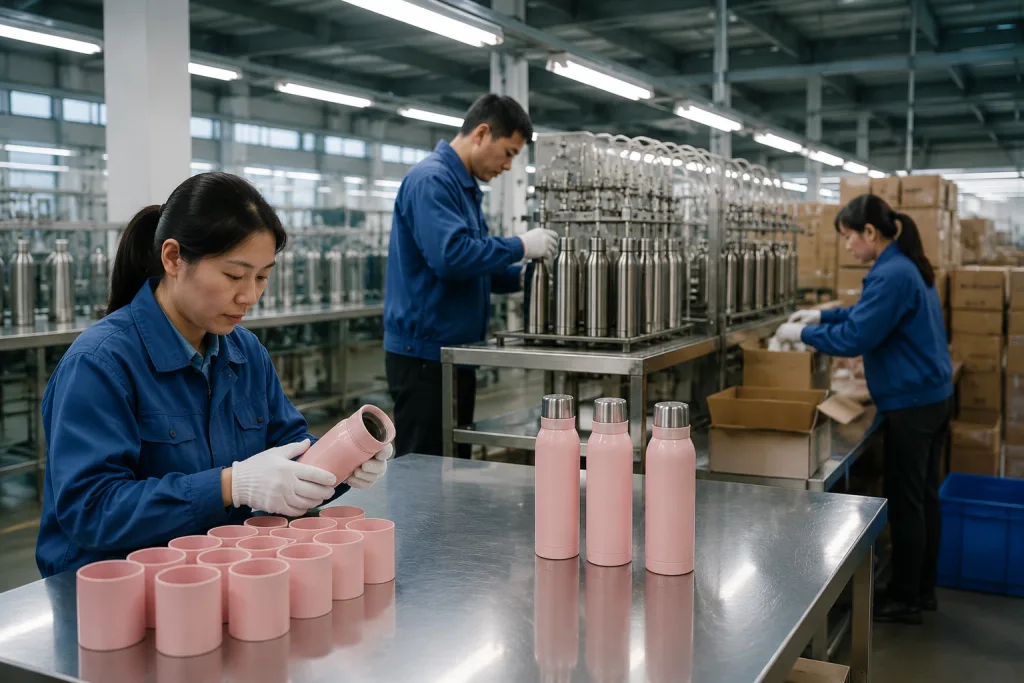
You are reading a factory brief for outdoor retail and promo accounts. The choice usually comes down to a stainless steel vacuum flask or a silicone-wrapped bottle. We run both lines in Zhejiang, and the gap shows up fast in margin, hand feel, and whether the logo stays clean after 3 months in a field kit. Pick wrong, and stock sits.
This guide breaks down the factory side of both builds. QC pulled the sample and checked the lid gap at 0.8 mm, which is where buyers start asking hard questions. The buyer flagged a PO typo on carton count once, and that kind of miss burns a day on the line. We cover insulation, decoration limits, and shipping math so you can place the next bulk thermos order with a clearer head.
Insulation Performance: Vacuum vs. Wrapped
Heat retention is the first number buyers check at a silicone thermos bottle factory. The vacuum gap between two steel walls does the work. On our Hangzhou line, 18/8 (304) stainless flasks with a clean weld seam usually come off QC at 12 to 24 hours hot and 24 to 48 hours cold, depending on lid design and fill volume. QC pulled the sample at 95C water, then checked the drop at the 8-hour mark.
Silicone changes the build, not the physics. If it is a sleeve over a stainless core, insulation stays close to the base flask. We have also seen so-called silicone bottles sold as single-wall items with thick silicone wrapped around them, and that setup loses heat fast in a cold tent. For bulk thermos orders going to hiking or camping buyers, the double-wall stainless core with a silicone grip is the better call. The buyer flagged a 12-hour claim on a PO last quarter, and the math did not work with a single-wall body. This is the wrong question to ask if the spec sheet says “thermos.”
Wall thickness matters. A standard stainless wall runs 0.4mm to 0.5mm. Add a 1mm to 2mm silicone layer and you get more hand comfort, plus a cooler outer feel, but you do not get the same insulation as a true vacuum bottle. We run this test with an infrared thermometer on the line. For commuter promo orders, that cold-touch exterior is the selling point, and a hot coffee cup that burns fingers is the wrong product. A 0.45mm wall plus a 1.5mm sleeve is normal; anything thinner starts to ring on drop tests.
Durability and Drop Test Metrics
Buyers ask for “unbreakable” thermos bottles all the time. That is the wrong question. 304 stainless holds up, but a 350 g bottle still dents when it hits concrete from a table edge. The silicone sleeve does the real job. On our Zhejiang line, we run a 1 m drop test onto a steel plate, and the bottle still ships after the hit.
QC pulled the sample after 10 drops. A bare stainless bottle showed visible denting on 8 out of 10 impacts at 1 m, while a custom thermos with a full silicone jacket held its shape at 1.5 m with no vacuum failure. The buyer flagged a scratch on the cap, not the body. Fair complaint. For outdoor retail, 3 fewer returns in a 1,000-unit batch beats a nice claim. Silicone still tears if it scrapes across sharp rock, so we call it impact-resistant, not bulletproof.
Best Use Case Fit
- Bare Stainless: Corporate gifts, office desks, indoor events. It looks clean, but a 1.2 mm dent shows fast if the bottle gets knocked off a table.
- Silicone Wrapped: Construction sites, hiking trails, gyms, and schools. It takes abuse better, but it picks up dust and chalk fast.
Customization Limits: Printing vs. Engraving
Branding is the first question a thermos distributor asks. On stainless steel, we run two standard methods: laser engraving and screen printing. Laser engraving strips the coating and leaves bare steel underneath. Clean edge. One color only. Screen printing gives 2 to 4 colors, but if the ink cure drifts, the edge starts to lift after 50 to 80 wash cycles. We saw that on the line, with the cross-hatch tape test failing at 3M pull strength before lunch.
Silicone is a different line. We do not laser engrave silicone; it scorches the surface and QC pulled the sample right away. The workable routes are debossing and pad printing. Debossing needs a mold insert and adds about 1.5 mm depth to the logo area, so it fits repeat orders with the same artwork. Pad printing works for small logos and low MOQ runs, but on soft silicone it wears faster than on hard plastic. This is the wrong question to ask if the buyer only wants a cheap logo.
If your client wants a full-color wrap-around image, stainless with sublimation coating is the right call. If they want a soft-touch body and a logo that stays low-key, silicone wins. One PO we checked had a 2 mm logo size typo, and the quote changed the same day because the insert and lead time both moved. Ask the manufacturer thermos for the branding method first. The math does not work any other way.
Cost Breakdown: Material and Tooling
Price sets the pace. A bare stainless bottle is the cheapest factory thermos we run. Steel comes in by the ton, the line stays mostly automated, and the weld cells keep moving. Put on a silicone sleeve or go to a full silicone body, and you pay for extra resin, one more assembly step, and another QC pull at the end of shift. On a 500ml model, FOB usually lands 10% to 20% above a plain stainless bottle. That gap is normal.
Tooling is where first-time buyers get caught. A standard stainless bottle needs a body mold and a bottom welding mold, and that already keeps the press room busy. A customized thermos with a shaped silicone shell needs its own silicone mold too. We have seen mold quotes sit at $2,000 to $5,000, depending on part depth and surface detail. For thermos bulk orders above 10,000 units, we spread that cost across the run; for 3,000 pieces, the buyer usually sees a setup fee on the proforma. One PO came through with 8,000 pcs and a mold priced like a 20,000-piece job. The buyer flagged it fast. The math does not work.
Here is a rough FOB estimate for a standard 500ml bottle, with steel prices moving week to week:
- Bare Stainless: $2.50 - $3.50
- Stainless + Silicone Sleeve: $3.00 - $4.20
- Full Silicone Wrapped: $3.50 - $4.80
Safety Standards: REACH, FDA, and LFGB
Ship to Europe or North America, and compliance is the gate. We run 304 or 316 stainless, then check FDA files for the US and REACH limits for heavy metal migration on the EU side. Last month the buyer flagged a missing lot number on the carton label, and QC held the pallet until the report matched the box. Simple job. Skip the paperwork, and the shipment sits at the port.
Silicone gets its own checks. We ask for BPA-free material and LFGB proof, because LFGB is tighter than FDA on odor and migration. Cheap silicone often carries plasticizer residue or filler, and the first sign is plain: the cap smells after a 100 degree hot-fill test. We had one sample fail on the bench because the gasket was 1.2 mm short and the seal leaked after 12 hours. Ask for the silicone report before you place the PO. The buyer pushed back on timing, but the math does not work any other way.
Tip: pull a boiling-water sample before mass production. Fill the bottle, seal it, and leave it for 10 minutes. If the cap or gasket gives off a rubber smell, QC should stop the line and check the LFGB file again.
Logistics: Volume and Shipping Efficiency
China freight is billed by CBM. That is the number that bites. Silicone weighs less than steel, but the soft body usually eats carton space. A bare stainless thermos nests tight on the line; a silicone bottle with a wide base does not. For a thermos supplier, that shows up in landed cost fast. We ran a carton test with a tape measure on the packing table, and the buyer still pushed back on freight before he saw the cube count.
A 20ft container holds about 25,000 to 30,000 standard 500ml stainless bottles. We have run the numbers on the packing table. With silicone bottles, wider bodies and single polybags to stop scuff marks can pull that down to 20,000 to 24,000 units in the same box. That is about 15% less shipping density. The math does not work in your favor. Ask for exact carton dimensions, `L*W*H`, plus the packing list from a silicone thermos bottle factory; we have seen buyers miss a 12 mm carton height change and pay for it at booking. QC pulled the sample and the shipper still caught a PO typo on the carton count.
Lead Times and Factory Capacity
Speed sets the schedule for a promotional thermos order. Standard stainless bottles ship in 25 to 35 days. Add silicone, and we plan 40 to 50 days, since that line runs a separate cure cycle. We mold, cool, then press-fit the sleeve onto the steel body. QC pulled a sample at 48 hours and found 3 mm flash around the cap ring; the buyer flagged it, and that lot sat on hold.
Our Zhejiang plant ships 150,000 units a month, and Q3 gets crowded fast once Christmas POs land. If you are a theros vendor lining up a Q4 launch, June is the booking window. Rush thermos custom work pushes the line into overtime, and the unit price usually climbs 10% to 20%. The math does not work any other way. We have seen a September ship date slip because a July PO carried the wrong artwork code, and that typo cost a week before we could start.
Ready to spec your next drinkware line?
Send us your drawings or reference photos. We provide a detailed quote and 3D rendering within 48 hours.
Frequently asked questions
Can I get a sample before placing a bulk thermos order?
Yes, we provide existing samples for $50 to cover shipping. For a custom thermos with your logo, we create a pre-production sample. This costs $100 to $200 depending on the mold complexity and takes 7 to 10 days. We deduct this sample fee from your first bulk order.
What is the MOQ for a customized silicone thermos?
The standard MOQ is 1,000 units per color. For silicone thermos bottles, this ensures the raw material batches are consistent. If you need less than 1,000, we can sometimes accommodate by using stock colors, but unit pricing will increase by 15% to cover setup inefficiencies.
Are silicone thermos bottles dishwasher safe?
Most are not. High heat in dishwashers can degrade the adhesive used to bond the silicone to the steel over time. It can also cause the silicone to become gummy. We recommend hand washing for all vacuum insulated drinkware to preserve the logo and insulation seal.
How do I verify the insulation quality during production?
We perform a 24-hour temperature retention test on random samples from every batch. You can also hire a third-party inspection agency (like SGS or Intertek) to perform an AQL inspection at our factory before shipment. They test for leaks, heat retention, and finish quality.
Can the silicone sleeve be removed for cleaning?
On some designs, yes. These are called 'sleeve bottles'. However, many promotional thermos models use a bonded or tight-fit design where the silicone is not meant to be removed. Removing it frequently can stretch the silicone, leading to a loose fit. Specify your preference when ordering.