Key Takeaways
- Typical MOQ for a customized silicone thermal bottle is 1,000-3,000 pcs per SKU, with 30-45 days lead time after sample approval.
- 304 stainless steel with a 0.5-0.7 mm inner wall is the practical baseline for most canteen customizable projects.
- Ask for ISO 9001, BSCI, REACH, and food-contact documentation before you place a deposit.
- A factory producing 80,000-150,000 units per month can usually support distributor drinkware programs without slowing your reorder schedule.
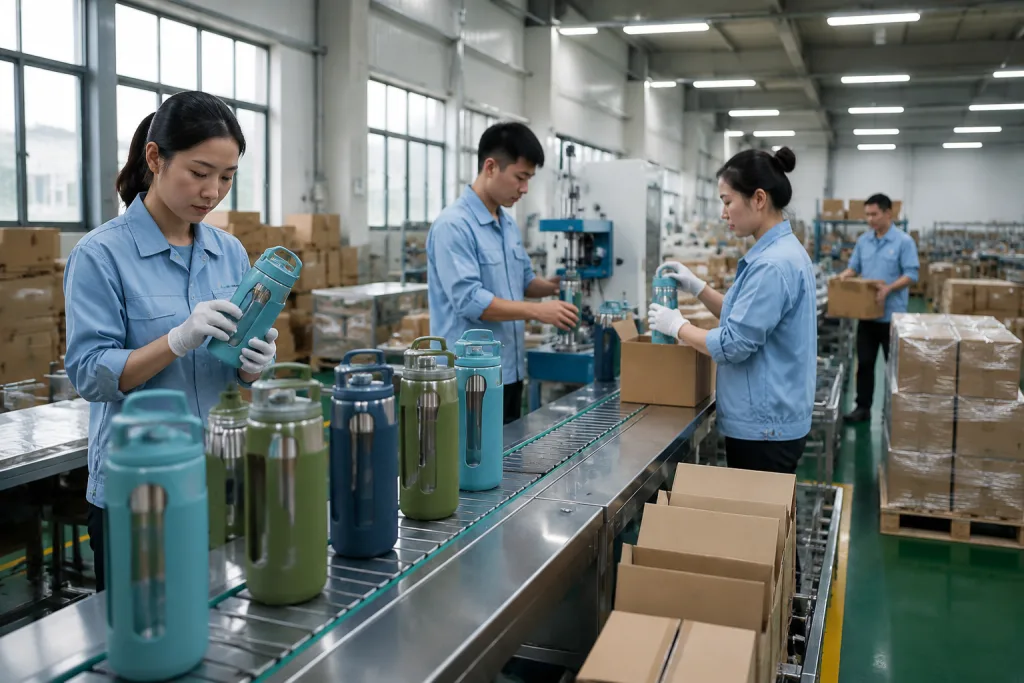
If you are sourcing from a silicone thermal bottle manufacturer, the mockup is the easy part. The hard part is whether the line holds temperature, passes drop and leak tests, and ships the same result at an MOQ you can actually move. We have seen a lid smell on day one and a sleeve slip 2 mm after 30 washes. That order goes sideways fast. This is the wrong question to ask if the supplier cannot show test data. Bring up the drop tester, not the render.
Buyers in Europe and North America usually want one partner for canteen custom work, custom growler programs, and retail packaging without turning every file into a special case. Normal request. The better suppliers in Zhejiang and across China quote by structure, not guesswork. On a recent PO, the buyer flagged a typo in the wall thickness, and QC pulled the sample with a caliper before we ran the next batch. A serious canteen factory should state the steel grade, silicone hardness, wall thickness, lead time, and monthly output before you discuss color swatches. The math does not work any other way.
Start With the Use Case
Before you ask for a price, define the job first. A silicone thermal bottle can go into a commuter bag, sit on a gym floor, ship as a distributor canteen line, or stand in for a growler in insulated beverage service. Same body. Different risk. We had one buyer order the wrong cap twice, then point at us when the bottle missed the channel spec.
If you want a canteen promotional item, the job is logo area, entry price, and a gift box that stacks clean on a 600 x 400 mm carton. If you want a customizable canteen for retail, we focus on lid wear, coating evenness, and color repeat across 3,000 pcs. For distributor drinkware, samples do not settle it; QC pulled the sample, then we checked cap torque and the vacuum seal on the next 5,000 pcs. That is the real test.
Write a short internal brief and make the supplier answer in writing. Put capacity, target retail price, decoration, packaging, and country of sale on one page. A good canteen manufacturer in Zhejiang will ask for the missing pieces instead of firing back a catalog PDF. The buyer flagged a PO typo on the lid color once, and we caught it before the line ran 12 days against an 18-day correction cycle. That saved the order.
- Retail: margin, shelf appeal, and carton efficiency
- Corporate gift: MOQ, lead time, and print visibility
- Distributor program: reorder stability and freight density
What Materials Matter Most
Buyers usually notice the finish first. Wrong question. Start with the material callout and make the supplier put the grade on paper. For a silicone thermal bottle manufacturer, the body should be 304 stainless steel at minimum; 316 only earns its keep when the buyer needs better corrosion resistance or a tighter premium spec. Inner wall thickness usually lands at 0.5-0.7 mm. If a factory cannot name that on the first call, you are buying on hope.
The silicone sleeve needs food-grade compound, and Shore A usually sits around 50-70 depending on grip and mold detail. We run into the same issue on the line: too soft and the sleeve stretches or dusts after 3 months, too hard and the hand feel turns cheap. For a canteen custom order, shrink control matters because a 32 mm logo patch or a deep texture will show molding flaws fast. QC pulled the sample, and the buyer flagged the edge ripple immediately.
Ask for the compliance file for your market, not a vague promise. For Europe, you want REACH-related declarations and migration test reports where applicable. For North America, ask for FDA food-contact statements tied to the exact resin and pigment batch. Real canteen manufacturers in China know the bottle is steel, silicone, adhesive, gasket, lid liner, coating, and ink. If the PO says “black ink” and the carton sample shows dark gray, the math does not work.
Practical rule: if the supplier only talks about appearance and never names the material grades, they are not ready for repeat B2B work.
How to Judge Temperature Claims
Temperature claims are where quotes go sideways. We see it on the line. A real vacuum insulated bottle needs a fill temp, ambient temp, and a test window. Without that, “12 hours hot” is just ink on a spec sheet. Wrong question.
Ask for a lab-style report under fixed conditions. Our standard check is 95 C fill, 20 C ambient, lid closed, then readings at 6, 12, and 24 hours. QC pulled the sample and logged the drop at each point. Results change with lid geometry, vacuum quality, and whether the outer shell has silicone or another coated layer. A silicone thermal bottle manufacturer should be able to explain why a wide-mouth canteen custom lid loses heat faster than a narrow sipping lid.
For a custom growler-style insulated bottle, the seal matters more than wall thickness. We run a one-hand pressure check, a 24-hour inversion test, and a hot-fill condensation check on every lot above MOQ 1,000. The buyer flagged a “12 hr hot” claim once, and the math did not work for retail. If you are buying canteen promotional stock, a softer thermal curve is fine. If you are buying a customized growler for retail, it is not. We’ve seen that go sideways fast.
- Hot retention: request test data, not catalog claims
- Cold retention: confirm with ice-water and lid type
- Seal integrity: ask for leak testing at 30-50 kPa equivalent
Decoration and Branding Choices
Decoration is where a custom drinkware order looks planned or rushed. On a canteen customizable run, we ship silkscreen, laser engraving, heat transfer, and pad print. Each method reacts differently on silicone and stainless steel. If a supplier says every method works on every surface, they are selling a story, not production.
Silicone sleeves take debossed or molded logos well, but fine type can wash out if the mold edge is off by 0.2 mm. Stainless steel shells take laser engraving and silkscreen better, especially when the logo has to survive weekly dishwashing. We had a buyer flag a 6 mm icon because the first proof looked sharp on screen and soft on the sleeve. For a canteen promotional launch with a low unit cost, one-color silkscreen is the practical route. For a customized canteen for premium retail, laser engraving gives a cleaner finish after 12 months on shelf. The line has no patience for fuzzy edges.
Ask for a decoration durability test: 50 dishwasher cycles, abrasion rub, and alcohol wipe resistance. On our line, QC pulled the sample and checked registration with a caliper; the usual tolerance is 0.3-0.5 mm for a tight logo. That matters when you are reviewing distributor canteen art across 8 SKUs and need every item to sit the same on shelf. We have seen a 2 mm shift turn into a claim on arrival. That is a bad week.
Do not let the word “customizable” hide the real constraint: more colors, gradients, and wrap artwork push up MOQ and sample cost fast. We have seen this go sideways on a 3-color wrap where the buyer wanted 1,000 pieces and retail-grade color match. A canteen distributor managing three territories feels that margin loss first. The buyer also once typoed the PO with Pantone 186 C instead of 185 C, and we had to stop the screen room for a recheck.
MOQ, Pricing, and Lead Time
For most silicone thermal bottle jobs, MOQ starts at 1,000 pcs for one color. Move that to 3,000 pcs once the buyer asks for a special lid, molded sleeve, or two-color print. We had a PO last month with “silcone” in the remark field. Small typo. Big spec gap. Samples usually come free or land at USD 30-80 per style, freight extra. For production, FOB China on a standard 500-750 ml insulated bottle usually sits around USD 3.20-6.80, depending on steel grade, decoration, and the carton spec.
Lead time is 30-45 days after sample sign-off and deposit. A factory that quotes 12 days on a fully custom structure is talking stock body plus logo only. We run that check on the line with a caliper and a lid jig. One buyer flagged a 2 mm wall change and the schedule slipped 9 days. A well-run factory in Hangzhou or elsewhere in Zhejiang should support 80,000-150,000 units per month across several bottle lines. That is enough for distributor programs and seasonal drops. The math does not work otherwise.
Compare quotes line by line. Carton count, lid type, and testing need to sit side by side. A low number that skips inner boxes, export cartons, or color matching is not landed cost. QC pulled the sample for a drop test and the print cracked on the third hit. For distributor drinkware programs, freight density can matter as much as unit price. A bottle that saves 8% carton volume often beats a cheaper bottle with bulky packaging.
- FOB: ask what is included in the quoted unit price
- Sampling: separate prototype cost from mass production cost
- Reorder: confirm whether molds and print plates are reusable
Checklist Before You Pay Deposit
Use a hard checklist. No sales talk. Ask for the business license, factory photos, ISO 9001 if they have it, BSCI if your buyer needs social compliance, and a fresh REACH or food-contact report. Match that report to the exact SKU. We had one buyer flag a 500 ml bottle because the test covered the same mold family, not the same lid.
Read the technical sheet line by line. Confirm capacity tolerance, silicone thickness, lid material, gasket material, carton size, and the drop-test standard. On our line, a 1.8 mm gasket can pass one build and fail the next if the mold insert shifts, so this is not paperwork fluff. Ask who updates the art file in-house, who checks the revision, and who signs off final QA if the factory also packs the goods. The math does not work if that split is vague.
For a distributor growler or a custom canteen rollout, insist on a sample that follows the production method. A hand-made sample only proves the shape. It does not prove color, print, or seam behavior under heat. QC pulled the sample on one run because the pre-production lid was molded in TPE, while the PO said silicone. If they cannot show a true pre-production sample, you are approving a sketch, not the product.
Minimum documents to request
- Material declaration for steel, silicone, and gasket
- Test report for leak, thermal retention, and migration where relevant
- Packing spec with carton qty, net weight, and gross weight
- Production lead time and monthly capacity statement
After-Sales and Reorder Reality
The first shipment is not the hard part. Reorders are. A serious silicone thermal bottle manufacturer keeps the mold record, print file, and color chip history under one SKU, or the second run comes back with a 1.5 mm lid tint shift and the buyer flags it. This is the wrong question to ask: the real test is whether the line can repeat the same piece after 90 days, not whether the sample looked clean once. We run this check on the same jig, and a 0.2 mm drift is enough to trigger a hold.
Ask how the factory handles complaints. You want a written response window, a photo review flow, and a replacement policy tied to defect type. On our side, QC pulled the sample under AQL 2.5 for major defects and 4.0 for minor ones; that works for a lot of mass goods, but the channel decides the bar. Distributor canteen programs usually reject a crooked print line faster than a promo run, because the stock sits on shelves and every mark stays visible. We've seen a buyer reject a whole batch over a 1 mm logo offset, and the math was brutal.
Check whether the canteen manufacturer supports mix-load container planning. If you are buying custom drinkware across 3-5 SKUs, a supplier that can combine them in one 40HQ saves freight and customs work. We ship this way all the time. The math does not work if the factory treats each SKU as a separate move, and we have seen buyers eat an extra week because the PO had one typo in a carton count. A single miss on "CTN" versus "PCS" can slow the line down for a day.
Good canteen suppliers do not disappear after invoice. They tell you when a reorder will use the same mold or when a small tooling adjustment is needed, and they keep the revised file with the old one. Last month we had a buyer push back on a 0.3 mm logo depth change; fair pushback. That is the difference between a vendor and a factory partner. We keep the rev files in one folder, and QC signs off before the next run starts.
Request a factory quote with real specs
Send your capacity, artwork, and target market. We will quote the right structure, MOQ, and lead time from Zhejiang, China.
Frequently asked questions
What MOQ should I expect from a silicone thermal bottle manufacturer?
For a standard customized silicone thermal bottle, expect 1,000-3,000 pcs per SKU. If you only change color or logo, 1,000 pcs is common. If you change the lid, sleeve texture, or packaging, the MOQ often rises. For a canteen custom program with multiple colors or territories, a factory may ask for 3,000 pcs because setup time and QC risk go up. The better question is not only MOQ, but whether the supplier can hold the same print, silicone hardness, and vacuum performance on the reorder.
How much does a custom silicone thermal bottle cost FOB China?
A realistic FOB China price for a 500-750 ml insulated bottle is usually USD 3.20-6.80 per piece, depending on steel grade, lid type, decoration, and packaging. A simple canteen promotional item with one-color print sits near the lower end. A premium customized growler or custom canteen with special lid parts, matte coating, and gift box can go higher. Always separate sample cost, tooling, and freight from the unit quote. A cheap quote that excludes packaging is not a useful quote.
What documents should I request before placing an order?
Ask for business license, material declarations, test reports, and compliance paperwork tied to the exact SKU. For Europe, REACH-related declarations matter. For North America, request FDA food-contact statements where applicable. If you need social compliance, ask for BSCI or equivalent audit evidence. For quality control, request a spec sheet with capacity tolerance, wall thickness, leak standard, and carton dimensions. A good canteen supplier in China should provide these without arguing.
Can a silicone thermal bottle be used as a custom growler?
Yes, but only if the structure is built for it. A custom growler needs a stronger seal, wider mouth design only if your use case demands it, and better lid torque control. Thermal performance usually drops a bit with wide-mouth formats, so you should test actual use conditions instead of relying on generic claims. If the product is for distributor growler programs, ask for inversion leak tests, hot-fill tests, and carrier fit checks. A canteen manufacturer that understands drinkware engineering will talk about the seal first.
How do I choose between a canteen factory and a trading vendor?
If you need repeated custom drinkware orders, choose a canteen factory whenever possible. A factory can lock in mold details, manage silicone hardness, and maintain color control better. A vendor may be fine for one-off canteen promotional buys, but reorders often suffer when there is no direct process control. Ask who owns the mold, who does final QC, and where the decoration is done. If the answer is vague, you are not dealing with a true manufacturer.