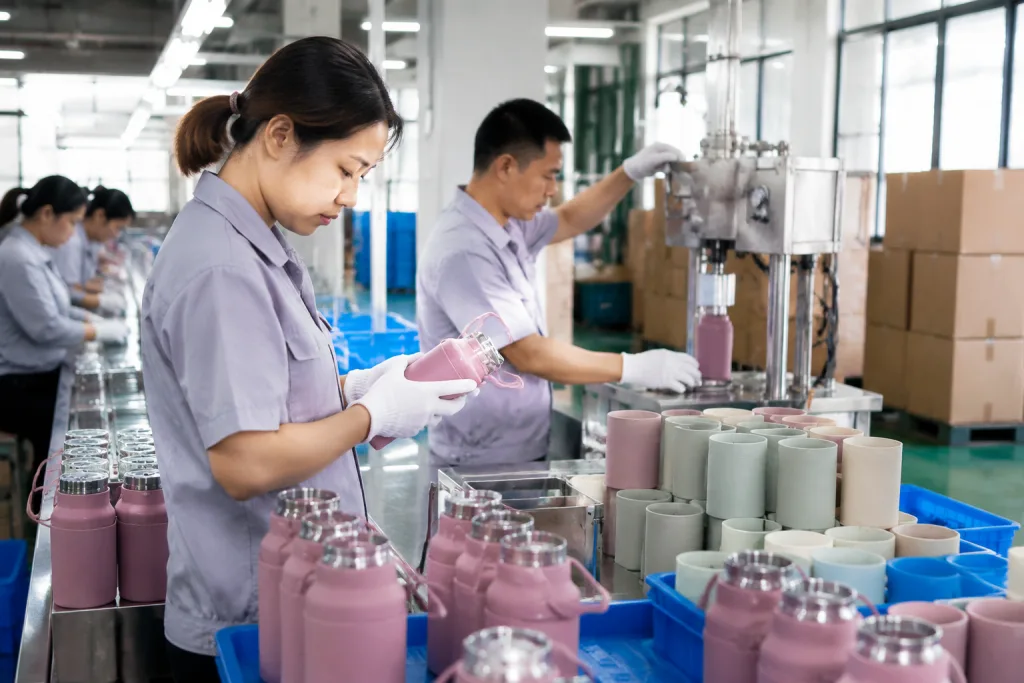
Key Takeaways
- A realistic silicone thermal bottle factory MOQ is often 3,000-5,000 pcs, with lead time around 25-35 days after sample approval.
- For custom drinkware, ask for 304 or 316 stainless, a silicone wall thickness of 1.0-1.5 mm, and a documented leak test.
- FOB China pricing for a 500 ml custom canteen typically lands around USD 2.80-5.20 depending on logo method, vacuum spec, and packaging.
- AQL 2.5 for major defects and 4.0 for minor defects is a practical starting point for shipment inspection.
You are not buying a bottle. You are buying a repeatable order: mold fit, insulation numbers, logo wear, carton strength, and a factory that can ship the same spec twice. That is where most custom drinkware jobs go off the rails. A silicone thermal bottle factory can look fine on paper and still miss neck tolerance, odor control, or a finish that scuffs after one carton drop test. We saw one buyer flag a 0.3 mm gap at the sleeve seam, and the line had to stop.
If you source from China, especially Zhejiang, ask the practical questions: can the canteen factory hold a 1.2 mm silicone sleeve tolerance, what is the MOQ at 3,000 units or 5,000 units, and how many days from sample approval to FOB shipment? We run this kind of order every month from Hangzhou, Zhejiang. QC pulled the sample at 18 days, not 12, because the first logo print lifted on rub test. That is the number that matters. The sales pitch does not ship goods.
Start With The Order You Need
Start with the order, not the color chip. A school campaign, a retail growler, and a corporate gift do different jobs, and the line builds them differently. Send a silicone thermal bottle factory a note like “good quality bottle, 500 ml, logo needed,” and QC pulls a generic sample. The revision loop gets ugly fast. We have seen that fail on day one.
Build the quote around four items: volume, user, target price, ship date. We ran an 8,000 pcs canteen order split into two colors, retail cartons, and barcode labels; the buyer flagged the carton size at 62 x 42 x 28 cm because it missed shelf space by 5 mm. A brand owner asked for 3,000 customized drinkware units with one PMS color, matte coating, and a laser logo. The math does not work unless the spec is fixed. Ask straight: “Can you make this exact version at this quantity by this date, and repeat it on reorder?”
Tell the China factory the target market upfront. EU and North America jobs usually need REACH paperwork, food-contact declarations, and carton labels that pass Amazon FBA intake. We had a PO with “500ml” typed as “500 ml” and one carton mark missing the origin line; that cost one extra day at pack-out. A good Zhejiang factory should treat that as normal order flow, not a special favor. If the buyer wants a shortcut here, we push back.
Check Materials Before Design
Silicone is the first thing the buyer sees. The body carries the load. For a silicone thermal bottle, check what sits under the sleeve: 304 stainless for normal orders, 316 when the buyer flags salt spray, coastal retail, or a higher shelf price. If the factory cannot name the steel grade, stop the discussion. We had a PO that read “SS inner cup,” and that one typo burned a day on the line. A solid canteen factory should also give wall thickness, usually 0.35-0.45 mm per wall on stainless vacuum builds, with the sleeve taking grip and impact.
The silicone itself can sink the order. A sleeve may feel soft, then QC pulls the sample and the odor test fails after post-cure. Ask for the post-cure method, durometer range, and whether the sleeve is platinum-cured or standard food-grade silicone. For canteen customized projects, 1.0-1.5 mm sleeve thickness is common; thinner sleeves look clean, but they protect the print and finish less. We shipped one outdoor retail run at 0.9 mm, and the buyer flagged the first carton drop test. This is the wrong question to ask if you only care about touch. The math does not work if the sleeve cannot survive a 1 meter drop onto tile or plywood.
Good canteen manufacturers in China show a material stack-up, not vague reassurance. That is the line. Ask for certificates, wall gauges, and sleeve spec on one sheet; a factory that only says “customizable canteen” is not ready for your project. We run this check with a caliper and a durometer on the packing table before we lock the sample.
Treat The Sample As A Contract Draft
Your sample is the contract draft. The line builds to that, not to a sales promise on WeChat. For a new project, we ask for 2 rounds: one for structure, one for decoration. On sample 1, QC pulled the gauge, checked vacuum retention, cap thread fit, sip or screw action, and whether the silicone sleeve sat flush without puckering. On sample 2, we check logo position, Pantone match, and carton print. A 1.5 mm miss at the mouth ring is enough to throw off the cap, and we have seen that go sideways.
A practical sample checklist for a silicone thermal bottle factory should include:
- Leak test for 30 minutes with the bottle inverted and shaken.
- Thermal retention target, such as 6 hours hot above 60°C or 12 hours cold below 10°C, depending on the design.
- Logo durability after 50 rub cycles with a dry cloth.
- Odor check after hot-water soak at 80°C for 2 hours.
Do not rely on photos. One buyer approved a neck size from a phone shot, then the real cap came in 1.5 mm off and the math did not work. Ask for a physical pre-production sample if the order exceeds 3,000 pcs. If the project is a canteen launch with retail packaging, we also need carton die line confirmation. We run these checks on a Vernier caliper and a 24-hour vacuum hold sheet. A Zhejiang supplier that ships export jobs properly will mark each revision and issue a signed sample approval sheet. That page kills later arguments.
Price Means More Than Unit Cost
Unit price matters, but only after you know what sits inside it. A quote of USD 2.95 can beat USD 2.60 if it covers individual polybags, one-color silkscreen, and a 5-layer export carton. We had a buyer flag a neat-looking PO once because the carton spec was missing, and the freight bill changed the math fast. Ask each canteen vendor to split out body, sleeve, lid, logo, packaging, and freight terms.
For a 500 ml custom drinkware order from China, the FOB range usually lands around USD 2.80-3.40 for plain or one-color print at 5,000 pcs; USD 3.50-4.20 for more complex finishes or multi-step lids; USD 4.50-5.20 when you add premium packaging or harder decoration. These are not fixed market prices. They are useful enough to catch nonsense. If a supplier comes in far below that, the cut is usually in steel grade, silicone quality, or QC time on the line. This is the wrong question to ask if you only chase the lowest number.
Tooling changes the picture too. If your canteen custom project needs a unique cap, shaped grip, or embossed base, the mold fee may be USD 800-3,500 depending on complexity, and we run that cost against expected volume before anyone signs off. For a canteen distributor building a SKU that should ship for 18 months, that is often the right spend. For a 3-month promo, it usually is not. The mold shop can turn a cap insert in 12 days or stretch to 18 days if the engraving is sloppy, and that delay hurts more than the fee.
Build The QC Plan Before Production
QC starts before the line runs. We lock the checkpoints first, then mix the first lot. For a silicone thermal bottle factory shipping export orders, that order matters. We run incoming material check, in-process inspection, final random inspection, and carton verification in sequence. For export, I set AQL 2.5 for major defects and 4.0 for minor defects unless the buyer sends a tighter spec. No guessing.
This is the defect list we expect a canteen manufacturer to control. We have seen it go sideways on the shop floor.
- Vacuum failure or weak heat retention after a 12-hour hold test.
- Loose silicone sleeve that twists by hand; QC pulled the sample on a 2 mm gap.
- Off-center logo, color drift, or ink rub-off after the tape test.
- Cap leak under pressure or cross-threading on the first 3 turns.
- Carton crush, barcode failure, or wrong quantity per master carton.
Ask for batch traceability. We link production date, line, inspector, and carton count in one sheet, then the buyer can trace a problem fast. In Hangzhou, Zhejiang, the better export factories keep it plain; they do not hide behind jargon. If you are sourcing as a canteen distributor or drinkware buyer, this is the wrong question to ask: the math does not work if you save five cents on the PO and eat 200 returns later. One sheet beats a long email chain.
One practical note: if the bottle is going to Amazon or a similar marketplace, confirm FNSKU labeling, suffocation warning text, and carton dimensions before production. We have seen a buyer flag a 1 mm carton overage after packing, and the rework ate two extra days. A typo on the PO is cheap; a pallet of wrong cartons is not. QC pulled the sample, measured 398 mm against the spec, and the line stopped until we fixed it.
Packaging And Shipping Decide Margin
Buyers skip packaging, then the landed cost lands hard and blows up the quote. We saw one 500 ml silicone thermal bottle order start at a clean factory price, then climb after inner boxes, 5-layer master cartons, pallet wrap, and ocean freight. Packaging adds USD 0.15-0.60 per unit, depending on the insert and print. If you want a retail-ready box, say it before the first sample. QC pulled the sample on the line, and the buyer had to redraw the pack spec.
For North America and Europe, carton strength beats pretty art. We run 5-layer export cartons, mark the unit count on two sides, and check drop performance with a corner test before shipment. One buyer flagged a carton typo on the PO, and that 1-digit mistake turned into a week of back-and-forth on labels and invoice data. A China canteen vendor should know HS code support, packing list details, and commercial invoice fields without hand-holding. If you need DDP or mixed-SKU consolidation, raise it early; FOB Ningbo and FOB Shanghai are normal for Zhejiang factories, but the number that matters is landed cost at your warehouse.
A buyer who knows the trade thinks in pallet count and cube efficiency. A shipment at 0.8 m3 per 100 pcs is a different job from 1.3 m3 per 100 pcs, and the math does not work the same way. Freight can wipe margin faster than a weak logo. We’ve seen that go sideways after a 28 kg sample run looked fine on paper, then failed once the cartons were stacked six high.
Questions That Separate Factories
By the time you are comparing suppliers, the answer should already be on the table. A real factory starts with process, not pitch talk. Ask for monthly output, inspection points, and the audit file your buyer will ask for. We run 300,000 units a month across drinkware lines in Hangzhou, Zhejiang, and standard custom orders ship in 25-35 days after sample approval. One typo on a PO can slow the whole line.
Then press on the details that split a factory from a trading desk. QC pulled the sample, and the buyer flagged color drift on the second reorder. That miss cost a week. This is the wrong question to ask if you stay polite.
- Can you hold the same color within Delta E 1.5 on reorder?
- Can you send REACH and food-contact paperwork for silicone and coatings?
- Can you keep lid torque steady across 5,000 pcs?
- Can you turn around art changes in 48 hours for a sample revision?
For a custom growler, customized growler, or customizable growler, mold fit and closure design matter more than the sales deck says. If the supplier cannot explain thread pitch, gasket material, or logo wear on a curved wall, you are talking to a reseller. We saw that go sideways on a 32 mm neck finish, and the buyer caught it after the first round of samples. The math does not work if you skip that check. China has plenty of vendors; only some are actual factories that keep repeat orders on spec.
A Buyer Walkthrough You Can Reuse
Run the same process on every order, whether it is a custom canteen for a trade show or a distributor SKU for retail. Start with use case and target price, then ask for a technical sheet with material grade, wall thickness, lid structure, logo method, and packout. Approve one signed sample with written checkpoints. Lock QC terms next: AQL, inspection timing, and shipment documents. Finish with export terms and post-shipment support. We run this on the line because a 0.5 mm wall change or a loose cap gasket shows up fast.
Most buyers skip this because they want speed. That is the wrong question to ask. Speed works for a plain stock bottle, but custom drinkware is not a stock bottle. If you are sourcing from a silicone thermal bottle factory in China, the edge is not a low sticker price. It is getting tooling, decoration, compliance, and shipping control under one roof, and that only works when you ask the hard questions before QC pulled the sample. In Zhejiang, we see the same issue all the time: the buyer flagged the logo position on a PO with one typo, then forgot the packaging note.
Treat the purchase like a controlled handoff. We ship better that way. A buyer once pushed for a fast yes on a 3,000 pcs order, then the carton spec missed the drop-test note and the line had to stop for rework. That is how a one-time customized canteen order turns into a repeatable program.
Send your spec and get a real factory quote
We can quote MOQ, sample cost, lead time, and export packaging from our Hangzhou, Zhejiang team without wasting your schedule.
Frequently asked questions
What MOQ should I expect from a silicone thermal bottle factory?
For a standard custom drinkware order, a realistic MOQ is usually 3,000-5,000 pcs per SKU and per color. If you need a new mold, a shaped lid, or premium packaging, the factory may ask for 5,000-10,000 pcs to make the setup worthwhile. Smaller test orders are possible, but the unit price will usually rise by 10-25%. For a canteen distributor, ask whether the MOQ applies per print color, not just per model. That detail changes the economics fast.
How do I check whether the bottle is really food-safe?
Ask for the material declaration, food-contact statement, and any third-party test report for the silicone, stainless steel, coating, and inks. For Europe, REACH is a basic expectation; for the US market, buyers often request additional food-contact support and traceability. You should also ask whether the silicone is post-cured, because odor and migration problems often come from skipped post-curing. A canteen manufacturer that handles export properly will answer with documents, not adjectives.
What lead time is normal for a custom canteen order?
For a standard decorated bottle, expect 25-35 days after sample approval. If the order needs new tooling, special packaging, or a very busy production season, 35-45 days is more honest. Air shipment can shorten transit, but it does not shorten molding or decoration time. A Zhejiang factory with enough capacity should be able to tell you the line schedule before you confirm the order. If they cannot, your ship date is a guess.
Which logo method should I choose for custom drinkware?
Use silkscreen for simple, low-cost logos on flat or gently curved areas. Use laser engraving for a cleaner permanent mark on stainless steel. If the bottle has a silicone sleeve, confirm whether the logo goes on the sleeve, on the steel body, or both, because each surface behaves differently. For a canteen promotional project, silkscreen is usually the best cost control. For premium retail, laser or multi-step decoration can justify the extra USD 0.10-0.40 per unit.
How do I avoid quality problems in shipment?
Lock a written QC plan before production. Use AQL 2.5 for major defects and 4.0 for minor defects, require leak testing, and confirm carton drop resistance. Ask for pre-shipment photos, carton counts, and batch traceability. If you sell through Amazon or a distributor channel, make sure the factory can label FNSKU, pack to your carton spec, and keep the quantity per master carton exact. The cheapest bottle is expensive if it creates returns.