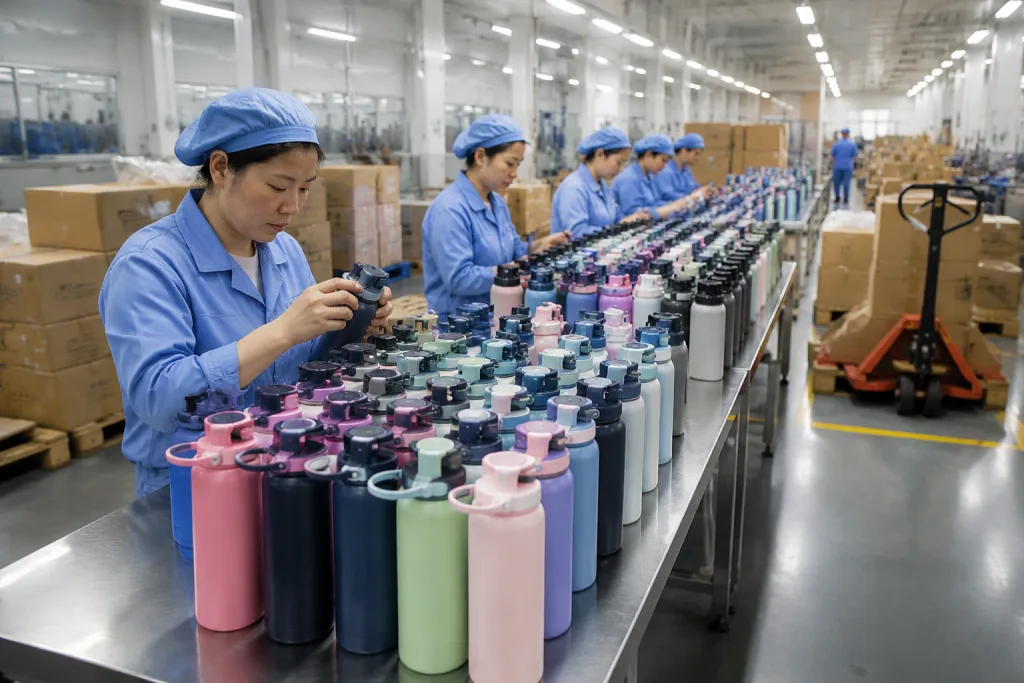
Key Takeaways
- Most silicone sport bottle wholesale programs start at 500-1,000 pcs MOQ, with FOB China pricing often landing around USD 1.20-3.80 per unit depending on size and closure.
- A practical spec target is 1.8-2.5 mm wall thickness with food-grade LFGB, FDA, and REACH documentation, plus leak testing at 3-5 psi.
- A factory with 80,000 units/month capacity and 18-30 day lead time will usually handle bulk drinkware better than a trading-first source.
- For mixed assortments, compare silicone bottles against canteen wholesale and wholesale growler programs on closure type, print area, and carton efficiency.
If you are sourcing silicone sport bottle wholesale, finding a supplier is the easy part. The hard part is sorting a clean sample from a bottle that breaks down once the carton count climbs. Silicone looks simple until we check wall thickness at 1.8 mm, Shore hardness, odor control, cap torque, print adhesion, and whether the bottle still holds shape after 300 dishwasher cycles. QC pulled the sample on our bench last week. That is where a lot of bulk drinkware orders go off spec.
You need a buying sheet that survives sample sign-off, mass production, and retail handoff. For procurement managers and brand owners, the real question is channel fit: gym, outdoor, travel, promo, or subscription. The math does not work any other way. In Zhejiang and across China, the factories that ship this category cleanly think in tooling, 48-hour cycle time, and compliance, not color chips alone. We run the line that way, and the buyer flagged it when a PO typo changed the cap code by one digit. That is the right way to compare silicone sport bottle wholesale options against broader wholesale drinkware ranges.
What you are really buying
A silicone sport bottle is not just a soft shell. You are buying a stack of parts: silicone body, internal liner if used, cap design, seal geometry, and the decoration method. We split those parts early on the line, because a 28 mm cap with a weak thread makes the bottle feel cheap before the buyer opens the carton. QC pulled the sample, ran it on a torque tester, and the slip showed up in the first round.
For silicone sport bottle wholesale, I start with four checks: does it collapse, does it need a rigid base, does it need one-hand drinking, and does it need hot-fill resistance. A 600 ml travel bottle can look compact, but if the neck is too narrow, flow drops. At 1.8 mm wall thickness it stayed usable; below that, the sample went soft in heat, and above 2.8 mm the carton count drops while unit cost climbs. The math does not work.
Buyers often compare this item to bulk canteen or canteen bulk orders because the use case overlaps, but the buying logic is different. A canteen can live with a simpler closure. A silicone sport bottle needs better hand feel, tighter odor control, and cleaner seal performance. That is the wrong question to ask if you are only looking at catalog photos. We’ve seen this go sideways when the buyer flagged the finish and ignored compression data; the factories worth your time ship test sheets, not showroom samples.
Compare specs before price
If you want the right silicone sport bottle wholesale price, compare specs first. Price without a spec table is noise. We saw one buyer shave $0.18 off unit cost, then lose it on a 28 mm cap that failed the first leak check. This is the wrong question to ask if the lid is weak. The table below is the fastest way to line up bulk drinkware offers from one factory or three suppliers.
| Spec | Good buying range | Why it matters |
|---|---|---|
| Capacity | 500-750 ml | Retail-friendly and easy to ship |
| Wall thickness | 1.8-2.5 mm | Controls feel, shape retention, and cost |
| Silicone hardness | 45-60 Shore A | Balance between grip and structure |
| Leak test | 3-5 psi, 30 seconds | Basic closure sanity check |
| Drop test | 1.0-1.2 m, 6 faces | Shipping and consumer handling risk |
| MOQ | 500-1,000 pcs | Typical wholesale threshold |
| Lead time | 18-30 days | Realistic for custom colors and print |
Those numbers come off the line, not a sales deck. We run this spec set with a durometer gauge, and if a supplier cannot state Shore A, seal material, and carton count in one reply, the quote is built on guesswork. The math does not work. Procurement gets burned on the PO, usually by a hidden insert or a carton count typo. We have seen that go sideways more than once.
Use the same rule for wholesale drinkware and drinkware wholesale assortments, even when the SKU changes. A tight bulk program stays on one test method and one file set. Ask for REACH, FDA, or LFGB where relevant, and keep ASTM or ISO references in your quality file if your market asks for them. QC pulled the sample last week and found a lid mismatch because the buyer flagged a typo on the drawing. One bad line item can slow a 12-day job into 18.
Use-case fit matters more
Not every bottle fits every channel. Buyers still choose the “best wholesale drink bottle” from photos, then we run samples that miss the brief and burn 7 to 10 days. A silicone sport bottle works when grip, foldability, or a softer hand feel matters. It falls apart on a rigid premium look, strong thermal hold, or a 90 mm-wide print panel.
Best fit by channel
- Fitness and gym retail: 500-600 ml silicone body with a carabiner-ready loop and one-hand opening.
- Outdoor promos: 600-750 ml with a wide mouth and dust cover.
- Travel and commuter sets: Collapsible profiles and low packed height.
- Subscription boxes: Custom Pantone color, sleeve print, and a retail-ready carton.
If the brief is closer to beer growler wholesale or beer growler wholesale bulk, the math does not work the same way. A growler needs rigid wall integrity, usually 64 oz or larger, and a closure that holds carbonation, not just water. QC pulled the sample on one run because the cap torque drifted after 18 turns on the torque meter. Same story for bulk growler and growler bulk programs: this is a carry-and-seal job, not a grip-comfort job. Do not force a silicone bottle into a growler role unless the buyer has a narrow use case. The same pushback applies to alcohol flask bulk, alcohol flask in bulk, alcohol flask wholesale, and alcohol flask wholesale bulk searches. Those are different product families, usually metal, with different compliance and branding limits.
For beer tumbler bulk or beer tumbler wholesale bulk, buyers usually care more about stackability and cold-chain presentation than soft-touch feel. We had one PO with “stackable” typed as “stakable,” and the buyer flagged it before production because the carton height was 42 mm over the case limit. Think in use cases, not just keywords. That is the right way to source wholesale growler, wholesale canteen, or wholesale drinkware programs without loading the warehouse with the wrong SKU.
Decoration and branding choices
Branding moves unit cost faster than most buyers expect. A silicone bottle takes pad print, screen print, debossing, embossing, or a mixed treatment on the cap or sleeve. On our line, QC pulled a sample at 0.25 mm stroke and the logo started breaking after two bend tests, so we tell buyers to keep the line weight honest. Clean edges are harder on silicone than on powder-coated steel. No shortcut there.
For silicone sport bottle wholesale, I point buyers to three paths:
- Silkscreen: best for 1-2 spot colors and runs above 3,000 pcs.
- Debossed logo: durable, clean, and low risk of wear.
- Laser engraving on metal cap parts: useful when you want contrast without ink.
On silicone, the math does not work the same way as canteen wholesale or wholesale canteen orders, because the body moves. Registration tolerance tightens fast. We had a buyer flag a PO that copied a 0.2 mm font from a stainless bottle; the proof looked fine on screen and went soft on the sample. This is the wrong question to ask if the MOQ is only 500 pcs. Build the art for silicone, then price the decoration, not the other way around.
For buyers handling mixed line items like wholesale drinkware or drinkware wholesale, branding consistency usually beats visual complexity. A plain bottle with a strong logo and correct Pantone match sells better than a crowded surface with weak contrast. We ship a lot of repeat programs, and the reorders tell the story: one clean mark, one exact color, fewer excuses at receiving. A simple art file saves headaches on the packing table.
Compliance is not optional
Food-contact compliance should be boring. If it gets exciting, somebody upstream is guessing. For silicone sport bottle wholesale, we ask for material declarations and lab reports for the market you sell into. Europe usually starts with LFGB and REACH. North America starts with FDA food-contact compliance. If the cap has metal, plastic, or a coating layer, each layer gets checked. We had a buyer flag a 0.3 mm coating stack on a PO typo, and QC pulled the sample before the line kept running.
I want a plain production-control plan: incoming material inspection, first article approval, in-process checks, and final AQL inspection. For export drinkware, AQL 2.5 is common for major defects, with 4.0 or tighter on critical leak issues if the order is retail bound. If a supplier cannot explain how they test odor, compression set, or seal integrity, the math does not work. We run a durometer on silicone batches, and a plant that cannot name the gauge is making you do their QC.
In Zhejiang, serious factories do not argue about paperwork. They show test reports, batch traceability, and how they handle rework. That is the standard you want in China, whether you are buying silicone sport bottle wholesale or a broader bulk drinkware program. We ship this way because a missing lot code on one carton can stall a 12-day booking and turn it into 18 days.
Keep compliance tight even when the order looks small. A 1,000 pcs pilot can still create customs problems if the documents are weak. The cost of re-testing is usually higher than doing it right on the first run. We saw a 500 pcs sample batch held because the carton mark said 5000 pcs, and the buyer flagged it on arrival.
MOQ, lead time, and FOB math
Buyers often ask for price before carton size. That is the wrong order. A real wholesale quote hangs on the mold, lid, packing style, print method, and whether the buyer flagged Pantone matching on the PO. For silicone sport bottle wholesale, MOQ usually sits at 500-1,000 pcs per color. If the cap or mold needs fresh tooling, we have seen it jump to 2,000 pcs.
On the floor, a Zhejiang line like ours can ship 80,000 units a month across three bottle lines. Standard production after sample approval is 18-30 days. A custom cap adds 7-12 days; QC pulled one sample last month and found a 1.5 mm flash on the neck ring, so the line stopped for rework. For a plain 600 ml bottle, FOB China often starts around USD 1.20-1.80, then moves to USD 2.20-3.80 once you add a tighter closure, more decoration, or a premium silicone grade.
That cost logic carries over to beer tumbler wholesale, beer tumbler in bulk, and beer tumbler wholesale bulk SKUs when you build a mixed catalog. The same goes for growler wholesale and wholesale growler programs. Bigger formats and heavier packs chew through freight fast. The math does not work any other way. A 20-foot or 40-foot container charge can wipe out the margin you thought you had on the spec sheet.
Ask for carton count, gross weight, and pallet setup before you approve the PO. We had a buyer send "pallet" as "pallett" once, and the shipping mark came out wrong on the first draft. Suppliers that track those numbers usually ship cleaner, and that matters if you are building a bulk drinkware line for repeat orders, not a one-off trial.
How to shortlist suppliers
Do not shortlist by website polish. Shortlist by answers. A solid silicone sport bottle wholesale supplier sends dimension drawings, material certificates, test methods, and a real production calendar. We had one buyer flag a glossy homepage, then the factory could not show a 0.5 mm wall-thickness check on the first sample. If they only send a catalog and a pretty sample photo, you do not have a sourcing partner yet.
Use this short screening list:
- Can they confirm food-grade silicone origin and color masterbatch traceability?
- Can they provide REACH, FDA, or LFGB documents without delay?
- Do they quote MOQ, lead time, and FOB separately?
- Can they explain final QC under AQL 2.5?
- Do they know how to ship to FNSKU labeling or mixed carton requirements if you need Amazon-ready packs?
If you are also buying bulk canteen, canteen wholesale, bulk growler, or wholesale growler items, ask whether the factory keeps the spec language aligned across product families. We run into trouble when one PO says "matte lid" and the next says "frosted cap"; QC pulled the sample, and the packing line had to stop. This is the wrong question to ask after approval. The best suppliers in Zhejiang usually have the scale, but they still need a clean brief from you.
When the short list is right, your sample approval cycle drops from 18 days to 12 days. That is real time. It also gives you more room at the table when you negotiate packaging, spare parts, and repeat-order pricing.
Request a spec sheet and FOB quote
Send your target capacity, logo method, and market. We will return a China-ready quotation with MOQ, lead time, and compliance notes.
Frequently asked questions
What MOQ should I expect for silicone sport bottle wholesale?
For a standard silicone sport bottle wholesale program, expect 500-1,000 pcs per color and per size. If you want custom tooling, special cap design, or multiple print positions, the factory may ask for 2,000 pcs. In Zhejiang, a well-run line can still support a lower pilot if you accept a slightly higher unit price. For a 600 ml bottle, FOB China pricing often starts near USD 1.20-1.80 for simple specs, then rises with decoration and packaging. Always separate MOQ for sample orders from MOQ for mass production, because they are not the same thing.
How do I check whether the bottle is actually food-grade?
Ask for the material declaration and the test report, not just a verbal claim. For Europe, you want LFGB and REACH documentation. For the U.S., ask for FDA food-contact compliance. If the bottle uses a cap, gasket, or liner, those components need review too. A serious China supplier will also show you batch traceability, incoming inspection records, and the silicone hardness range, usually around 45-60 Shore A for this product category. If the supplier cannot produce these documents quickly, they probably are not set up for export-grade wholesale drinkware.
Is silicone better than stainless for a fitness bottle?
Not always. Silicone is better when grip, flexibility, and lower packed height matter. Stainless is better when you need stronger thermal performance, a more rigid premium feel, or a larger decoration area. For a 500-750 ml fitness bottle, silicone can make sense if you want softer handling and lighter shipping weight. For heavy-duty retail or long insulation claims, stainless usually wins. If you are also comparing bulk canteen, bulk growler, or beer tumbler wholesale bulk options, keep the use case tight. Do not choose the material first and the channel second.
What lead time should I budget from order to shipment?
For a standard order from China, budget 18-30 days after sample approval and deposit. If you need new colors, custom caps, or special packaging, add 7-12 days. A factory in Zhejiang with around 80,000 units per month of combined capacity is usually comfortable with that timeline, assuming you do not change artwork late. If you also need Amazon prep, FNSKU labeling, carton barcodes, or mixed SKU packing, allow a few more days for final QC and packing.
Can I combine this with other drinkware in one PO?
Yes, and that is often smarter for freight. Many buyers combine silicone sport bottle wholesale with wholesale canteen, wholesale drinkware, or even beer tumbler bulk and growler wholesale programs to improve container utilization. The risk is spec confusion. Keep each SKU on its own drawing, test requirement, and carton format. If you are adding alcohol flask wholesale bulk or beer growler in bulk items, make sure the compliance file is separate because the product family and material rules are different. A combined PO only works when the factory has disciplined documentation.