Key Takeaways
- Expect an MOQ of 1,000-3,000 units for custom silicone sport bottles to secure competitive pricing.
- Tooling costs for custom molds range from $2,000 to $8,000 depending on complexity and collapse mechanism.
- Production lead times in Zhejiang factories typically run 25-35 days after sample approval.
- Require LFGB or FDA testing reports for all silicone parts touching liquids to ensure compliance.
- FOB Ningbo is the standard shipping term, saving you 10-15% compared to EXW quotes.
We have seen the shift. Polypropylene bins are shrinking, and collapsible silicone bottles are moving down the line. Brands in Europe and North America ask for a silicone sport bottle supplier first, then compare MOQ, mold lead time, and cap fit. That is the wrong question if the supplier cannot hold a 1.5 mm wall evenly or pass a food-contact check. QC pulled the sample, and the wall at one side came in 1.2 mm. The buyer flagged it fast.
This guide breaks the buying process into the parts that matter at the factory desk. We cover the PO items that get the order moving, the inspection points QC pulls on the sample bench, and the cost drivers we see from a Zhejiang canteen factory. A buyer once sent a PO with the cap size typed as 28m instead of 28 mm; we flagged it before tooling, because that kind of typo burns a week. Simple mistake. If you already source canteens or this is your first run, these steps help you avoid the usual mess when you work with a canteen manufacturer.
Defining Your Custom Drinkware Specifications
Before you send an RFQ to a canteen vendor, lock the specs down. Loose wording turns into 6 price gaps, then a week of back-and-forth. For a silicone sport bottle, the main cost drivers are 500ml, 750ml, or 1L, the silicone grade, and how many parts sit in the closure. We run into this every month.
Send a real tech pack to the canteen supplier. Put the capacity, Pantone color numbers for body and cap, and the exact carabiner or strap type on it. If you want a custom growler style with a wide mouth, call out the thread finish in mm, because the buyer flagged a plain “wide mouth” note as too loose. Most canteen manufacturers in China work with standard neck finishes, and the math does not work if you ask for a new thread profile without new tooling.
Material Grades and Compliance
Silicone grades are not interchangeable. For Europe, LFGB is tighter than FDA, and QC pulled the sample if the lab sheet missed one line. A solid silicone sport bottle supplier should hand over test reports for BPA, phthalates, and heavy metals, not just say the material is safe. If the bottle is for kids, name the cap material too, usually food-grade PP or Tritan. For canteen promotional orders, this is the wrong question to ask late, because one PO typo on the cap spec can stall the line for 3 days.
Vetting the Factory: Capabilities and Capacity
Once you have shortlisted potential canteen suppliers, check what they can actually run on the floor. A trading company may quote a lower MOQ, but a direct canteen factory gives you tighter control on price, lead time, and the line schedule. Ask for the latest BSCI or Sedex report, then match the factory name and audit date against the PO. We saw one buyer miss a one-letter typo on the PO, and it cost 7 days.
In Zhejiang, where most drinkware work sits, factories split by process. Some run stainless steel, others do plastic and silicone molding. If your chosen canteen manufacturer claims silicone capability, ask whether the LSR injection machines are in-house. Outsourced silicone parts drift on color; the buyer flags it fast. A plant that ships 50,000 units a month can usually take a 10,000-unit order at a 30-day lead time, but that math falls apart if the same line is tied up on a 2,000 kg silicone run.
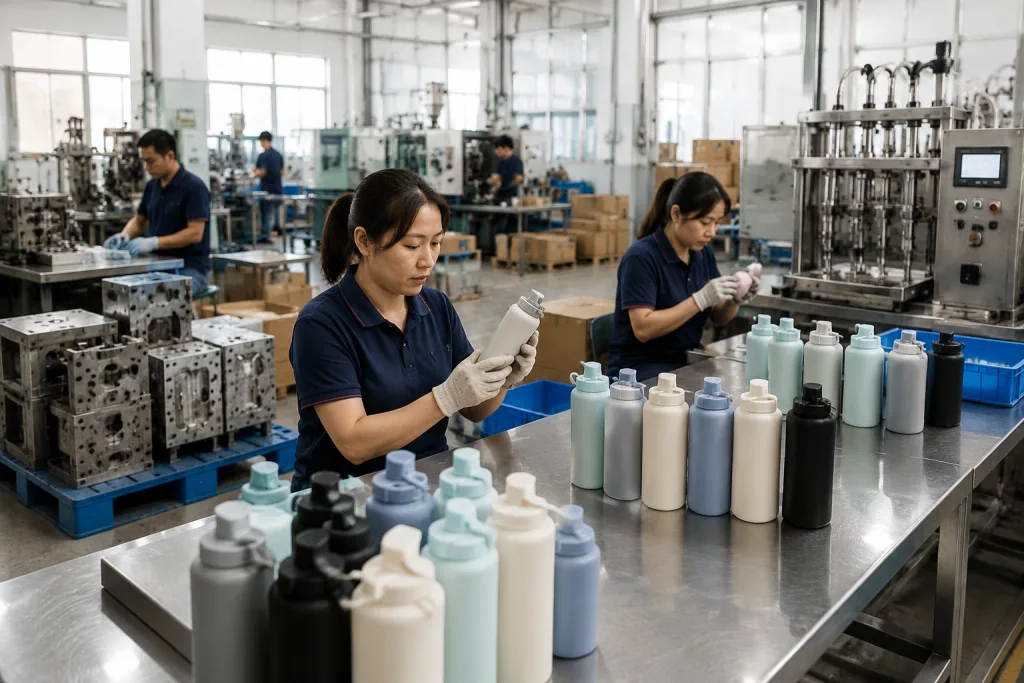
Ask for a live factory tour or a recent production video. Watch the molding workshop, the trimming bench, and the packing table. QC pulled the sample on one order because dust was showing near the gate line, and that is the kind of miss a clean shop catches early. A messy floor is not a style issue. It usually means the final custom drinkware lot will need more sorting at AQL 2.5 than the buyer wanted to hear.
The RFQ Process: Asking the Right Questions
Start the RFQ clean. Price alone tells you little. Ask for tooling, FOB unit price, and packaging on one line. A solid canteen vendor will send back MOQ and carton spec beside it. We run this every week. Last month the buyer flagged a quote because the dieline cost was missing from the packaging line.
For a customizable canteen, ask the setup cost for silk screening or laser engraving, then ask how many colors are included. One customer pushed back on an $80 per-color setup fee, and the math did not work for a 3-color logo at 5,000 pcs. If you need a customized canteen with a full-wrap sleeve print, ask for the max print area in mm, not a vague “full body” answer. We ship around that detail, and it changes the quote fast.
Ask for the overspray or flash tolerance on silicone parts. Loose trim leaves a rough edge, and QC pulled the sample on our bench with a caliper at 0.3 mm over spec. That is a real reject point.
Ask who owns the mold and how long it lasts. If you pay tooling, the mold should be yours to keep or move, and that needs to be written on the PO, not left to memory. Reputable canteen manufacturers already work that way, but first-time buyers still miss it. We have seen that go sideways when a buyer found a typo on the tool code after the mold was already cut.
Sample Validation: From Prototype to Golden Sample
Do not skip sampling. We run it in two steps: pre-production sample, then golden sample. The first piece checks shape and function on the bench. The golden sample is the one we sign off for mass production. On our line, QC pulled the sample with a caliper in hand, and a 0.8 mm gap stopped the batch before it moved.
Silicone shrinks more than buyers expect. A silicone sport bottle supplier has to build that into the mold, or the finished part drifts. Measure the sample, don’t guess. Does a 500ml bottle actually hold 500ml? We’ve seen buyers flag a 12 mm base that looked fine in CAD and went wobbly on the table. The math doesn’t work after tooling is cut.
For customizable growler orders, seal checks come first. The cap needs to lock down hard enough to survive carton shake and lane vibration. Run a 24-hour leak test on every sample you receive. If the factory is in Zhejiang, ask for DHL or FedEx shipment; 3-5 days is normal, and a PO typo on the consignee name can turn that into 8 days fast.
Structuring the Purchase Order: Essential Line Items
A clean Purchase Order keeps both sides aligned. We ship against the PO, and QC pulls the sample against the same sheet on the bench. Put these line items in on day one:
- Product Specifications: Material, color, volume, and weight. For a silicone sport bottle, write LFGB-grade silicone + PP cap, Pantone code, 500 ml, and target weight in grams. No guesswork. The buyer flagged a 12 g gap on one run, and that came from a loose spec sheet.
- Quantity Tolerance: Set a +/- 5% variance for production yield. That is the number we run on the line, and the math works. A 200-piece swing on a 4,000-piece order is not the fight to pick. We have seen this go sideways when a buyer wanted exact counts after molding loss.
- Packaging Details: State polybag thickness, master carton size, and shipping marks. If you sell on Amazon FBA, add FNSKU labeling on each unit. We once saw a PO list carton size as 56 x 38 x 38 mm instead of cm; the buyer flagged it before packing started, and that saved a messy repack. Tape gun, scale, pallet stretch. Simple stuff.
- Quality Standards: Write the Acceptable Quality Limit (AQL) in plain terms. Use AQL 0.0 for leaks and sharp edges, and AQL 2.5 for scratches or print errors. This is the wrong question to ask after mass production starts. QC pulled the sample first, and the difference showed up fast. One pinhole at 0.8 mm tells you enough.
- Payment Terms: Standard terms are 30% deposit by T/T and 70% balance before shipment. On repeat business with a trusted canteen distributor or factory, you can push for better terms. We have seen a PO typo turn “before shipment” into “after shipment”; that one froze the booking, and the math did not work. One wrong word, and the bank holds the file.
Put these details on paper and the distributor drinkware side knows exactly what to build, pack, and inspect. No drift. No surprises. That is how we ship without arguing at the dock.
Quality Control and Inspection Protocols
Quality slips get expensive fast once the cartons leave Ningbo. One 1,200-piece order turned into a 12-day freight fight over replacements, and the math does not work for a distributor canteen buyer. We run a strict QC plan. Third-party PSI at the canteen factory is standard for us, and QC pulled the sample against the PO before the line was boxed. If the PO says 1,200 pcs, the count needs to land there.
During inspection, the inspector pulls units by AQL lot size, not by guesswork. For silicone bottles, we check three points with a flashlight and a white glove on the bench. That is enough to catch most trouble.
- Odor: Good silicone should leave the line with no sharp chemical smell. If the cap still stinks after 24 hours, the curing cycle was off, and we stop arguing about it.
- Dust Attraction: Silicone grabs lint. We ask for a food-grade dust coating or a matte finish, then rub the sleeve with a white cotton glove; if fuzz shows up, the buyer flagged it.
- Seam Lines: Flash or a heavy parting line usually means a tired mold. On one 2.0 mm seam, the edge felt rough enough to fail a hand check, which is the wrong question to ignore.
If the inspection fails, hold the balance payment. Simple. A serious silicone sport bottle supplier will rework the lot, and the contract should spell out the remediation step, the re-inspection charge, and who pays for the second carton drop test. We have seen this go sideways when the buyer accepted a vague promise and nobody owned the next step.
Logistics: Managing Lead Times and Shipping
Lead time sets the stock plan. A Zhejiang canteen supplier usually needs 15-20 days for raw material prep, then 15-20 days on the line. QC pulled the sample, we checked cap torque at 1.8 N·m, and we still hold 5 days for inspection plus 2 days for inland truck booking to the port. That puts PO to FOB at about 35-45 days. The math does not bend.
Sea freight to North America usually runs 20-30 days; Europe is 30-40 days. We ship one 40HQ at a time. A buyer pushed back on air freight for a 1,200-piece rush order because the quote landed at 3x higher, and the margin was gone before the cartons left the line. For a distributor growler program with a fixed promo date, air can save the launch. It is still expensive. No mystery there.
Talk Incoterms early. FOB is the usual call. Under FOB, the canteen manufacturer covers costs to the port of departure, such as Ningbo, and you take over ocean freight plus insurance after loading. We have seen this go sideways when a PO typo said EXW and the buyer expected us to handle port pickup without a China agent. Check the trade term twice. That is the right place to be strict.
Building a Long-Term Partnership
Sourcing is not a one-off buy. After 3 or 4 POs, the gap shows up fast. A steady relationship with a silicone sport bottle supplier gets you first shot at the line, cleaner payment terms, and resin holds that cut lead time from 18 days to 12 days when PE granules run short. The math works. Chasing the lowest quote every round usually does not.
Send feedback on every shipment. QC pulled the sample at AQL 2.5, found the same cap flash on three cartons, and the buyer flagged it before the next run. Say it straight. A good canteen vendor takes that note and adjusts the mold; arguing over a 0.3 mm flash line wastes a week. We had one PO with a typo on the carton mark, and that small miss would have gone all the way to export if nobody caught it. Over time, a dependable partner ships like part of your team and can handle a tricky custom canteen order without turning a 2,000-piece PO into chaos.
Ready to Source Your Custom Silicone Bottles?
Contact our team in Hangzhou to discuss your specifications. We provide transparent quotes and LFGB-certified manufacturing.
Frequently asked questions
What is the typical MOQ for a custom silicone sport bottle?
The standard MOQ for a custom silicone sport bottle is usually 1,000 to 3,000 units per color. This quantity allows the factory to efficiently use raw silicone materials and justify the setup time for molding. Some canteen suppliers may offer a lower MOQ of 500 units, but the unit price will typically increase by 20-30% to cover the inefficiency.
How much does tooling cost for a custom silicone bottle?
Tooling costs vary based on complexity. A simple collapsible bottle mold costs between $2,000 and $4,000. A complex design with multiple parts or a unique closing mechanism can range from $5,000 to $8,000. Always confirm who owns the mold; if you pay for it, the canteen manufacturer should store it for your exclusive use.
Can I get a sample before placing a bulk order?
Yes, you should always request a sample. A canteen factory will typically provide existing samples for free, charging only for shipping. For custom designs with new tooling, expect to pay a sampling fee of $100-$300 to cover the mold trial and prototype creation. This fee is often deducted from your first bulk order.
What certifications should I require for silicone bottles?
For the US market, FDA compliance is standard. For Europe, LFGB certification is the gold standard and often required by major retailers. Additionally, ensure the product is BPA-free and complies with REACH regulations. A reputable silicone sport bottle supplier will have these test reports ready for review.
How long does production take after sample approval?
Production time typically ranges from 25 to 35 days after sample approval and receipt of deposit. This timeline can extend during peak season (August to December). It is wise to add a 10% buffer to your schedule. A canteen distributor should plan launches at least 4 months in advance to account for sampling, production, and shipping.