Key Takeaways
- A workable silicone sport bottle MOQ is often 1,000-3,000 pcs per color, with samples in 7-10 days and mass production in 25-35 days.
- For export, ask for REACH, LFGB, FDA, and an AQL 2.5 inspection plan before you talk price; a cheap quote without testing is a bad quote.
- A real silicone bottle spec needs capacity, wall thickness, durometer, lid type, and carton count; missing any one of those can change your landed cost by 8-15%.
- A Zhejiang canteen factory with 80,000+ units/month output is more useful to you than a vague “high capacity” claim.
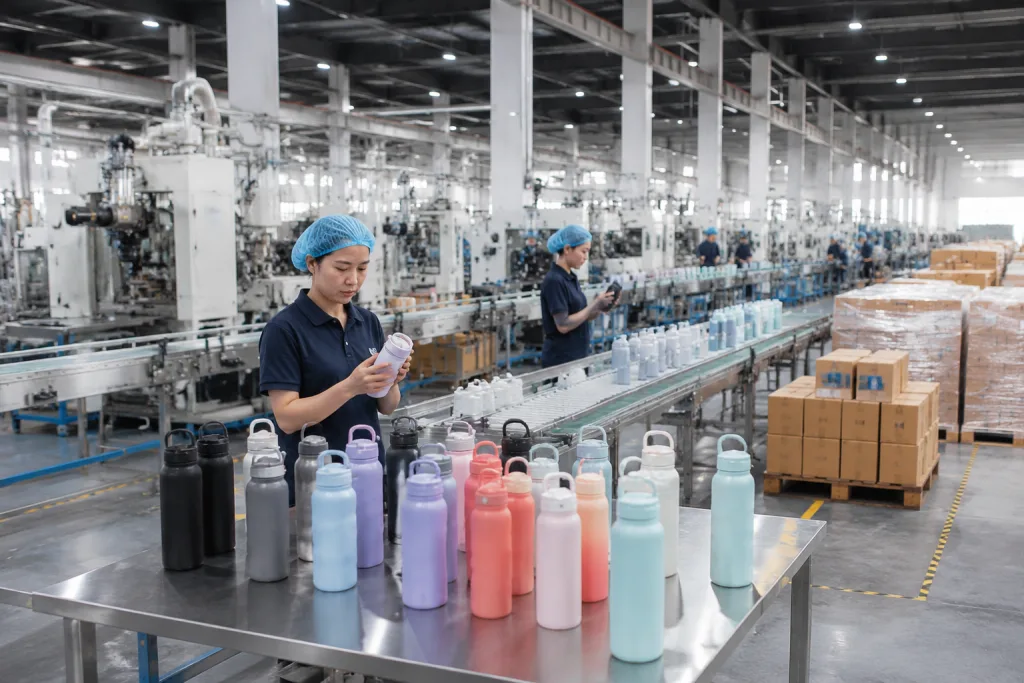
You are not buying a bottle. You are buying a repeatable order. That is the point. A silicone sport bottle manufacturer has to hold spec, keep decoration clean, and ship on time when your PO moves from 2,000 to 20,000 units. We run those numbers on the line every week. In China, 6 factories can send a quote in 2 hours. Two or three can keep wall thickness, smell control, leak testing, and carton count steady without the buyer flagging the lot at QC. We saw a PO once with “5000 pcs” typed as “500 pcs” and the line still had to stop.
If you are a procurement manager, brand owner, or distributor, ask for hard numbers: 500 ml or 750 ml capacity, 2.0 mm or 2.5 mm silicone wall, FDA or LFGB contact compliance, AQL 2.5 inspection, and a lead time that is real, not a guess. This is the wrong question to ask if the supplier cannot show a caliper reading, a pull-test sheet, and a sample book with your logo print. A Zhejiang factory should be able to tell you monthly output, sample timing, and how it handles custom canteen, custom drinkware, and distributor drinkware orders without mixing SKUs. QC pulled the sample on a 2.5 mm wall and caught a 0.3 mm drift; that kind of miss turns into a rejected lot fast.
Start With the Use Case
Lock the use case before you ask for price. A silicone sport bottle manufacturer will ask whether the order is for gym retail, outdoor promo, travel bundles, or a distributor canteen program. Those jobs do not cross over. A 500 ml foldable silicone bottle for a marathon pack needs a different lid load, print area, and carton insert than a 750 ml rigid-body sports bottle on a retail shelf.
For B2B buying, the use case sets the order structure. If you are building custom drinkware for a brand launch, we usually run a matte body, laser logo, and one PMS color across the lot. If the order is canteen promotional stock for a regional campaign, the math points to fast turnover, low decoration cost, and plain packaging. If you sell as a canteen distributor or distributor drinkware partner, re-order match matters more than styling. QC pulled a sample with a 0.8 mm seam line last month, and the buyer flagged it because the brief never said “promo shelf.” This is the wrong question to ask after tooling starts.
Do not let a factory jump straight into “we can do everything.” Ask whether the bottle is meant to be a custom canteen, customizable canteen, customized canteen, or a hybrid custom growler style with a wide mouth and carry handle. Those labels change the mold, cap choice, and freight density. We had one PO with “750ml” typed as “750 mlL”; the line caught it before packing, and that typo would have broken the carton count. In Zhejiang, the better canteen manufacturer teams ask the right questions first. The weak ones just send a catalog and hope you pick something safe.
Lock the Specification Sheet
A clean spec sheet cuts out most supplier mistakes. Put capacity, dimensions, silicone grade, wall thickness, lid material, and logo method on paper before you ask for a sample. We run into trouble when a buyer leaves one line vague. A solid start for a silicone sport bottle is 600-750 ml, 2.0-2.5 mm body wall thickness, PP or Tritan lid parts, and a leak test at 5,000 cycles or a 24-hour inversion test. If the body collapses, state the collapsed height and the expanded height in millimeters. QC pulled the sample at 2.1 mm once and the buyer flagged the grip as soft; that is the kind of miss a tight sheet stops.
For export programs, ask the factory to confirm the standards you actually need: REACH for Europe, LFGB when food-contact control matters, FDA for the U.S. market, and a migration test report if your compliance team asks for it. A decent supplier gives straight answers. A weak one hides behind “food grade” and hopes the PO moves anyway. That is the wrong question to ask. On one order, the buyer typed “LFGB? maybe” into the spec note, and the lab sample sat for 6 days while we chased the test scope. The math does not work if the compliance target is fuzzy.
- Capacity: 500 ml, 650 ml, 750 ml, or 1,000 ml
- Wall thickness: 2.0 mm minimum for flexible bodies, 2.5 mm for better hand feel
- Decoration: silkscreen, laser engraving, debossed logo, or molded mark
- Packaging: color box, mailer, or bulk pack for distributor canteen orders
Once this sheet is agreed, the quote moves faster. We ship faster too. One typo on a PO, like “7500 ml” instead of 750 ml, can throw the whole line off until sales checks the die drawing. Zhejiang factories are no different on that point.
Price Means More Than Unit Cost
The first quote from a silicone sport bottle manufacturer is seldom the real number. We had a 500 ml bottle quoted at USD 1.35, then it came out at USD 1.72 FOB Ningbo after printing, individual packing, test fees, and a carton upgrade. The surprise lands after sampling. By then, the line is already moving and your pushback room is thin.
For a standard 500-750 ml silicone sports bottle, export pricing usually lands around USD 1.10-2.40 FOB, depending on wall thickness, lid parts, and decoration count. A premium growler style with a carry loop, 2.5 mm thicker walls, and a multi-part lid moves fast on cost. We run that math on the shop floor every week, caliper in hand, sample on the bench. Zhejiang helps because silicone, PP caps, tooling, and cartons are close by, but "cheap" is the wrong question to ask.
Ask the factory to separate mold cost, unit price, print charge, sample fee, and packing charge. Then compare canteen manufacturers on the same sheet. Ask one more thing too: does the quote assume one color or mixed SKUs? QC pulled a sample last month and found a PO typo that changed "1 color" to "3 colors," and the rework ate the margin. A customizable drinkware program with two logos and mixed cartons is not priced like a clean reorder, and the reorder math is the part that matters.
Useful rule: if a quote is 12% lower but the supplier cannot show test reports, carton specs, or inspection standards, it is usually not cheaper. It is just less honest.
Samples Tell You the Truth
Sampling is where you find out if the factory is real. We run first samples in 7-10 days when the mold already exists, or 15-25 days if the line needs minor tooling. A promise of a fully customized canteen sample in 3 days is usually a close lookalike, not the real spec. The math does not work.
Check the sample like a buyer, not like a marketer. Smell the silicone. Pull out the calipers and check wall thickness to 1 mm. Fill it with hot water, flip it upside down, and press the logo edge. We had a buyer flag a lid thread that bound after 30 open-close cycles, and QC pulled the same issue on the bench. If the product is going to a retail shelf, carton print and barcode placement need the same check. For a canteen promotional order, a bad print is where margin leaks fast.
For distributor canteen or distributor growler programs, ask for two samples: one pre-production sample and one sealed mass-production sample. The second one should match the shipment run. That is the only way to catch small shifts in silicone finish, print density, and lid closure force before 10,000 pieces are on the water. We saw this go sideways on a 5,000-piece order when the PO had a typo in the lid color code. A strong canteen vendor gets that immediately; weaker factories need the point explained twice.
QC the Order Before Production
Once you approve the sample, the order still needs hard control points. Put them in writing. We usually spell out incoming material checks, in-process inspection, and final inspection against AQL 2.5 for major defects and AQL 4.0 for minor defects, or your own tighter limit. A serious silicone sport bottle manufacturer does not argue about an AQL plan; that is standard export work, and the math does not work without it. We had a 12 mm logo on one job that looked fine on screen and slid 1.5 mm on the first pilot shot, which is why we freeze the checklist before we run the line.
The failures we see are small and annoying. Silicone shade drift, weak mold-release cleaning, 1.2 mm carry loops, logos 2 mm off center, lids that squeak after assembly. One buyer flagged a PO typo on the lid code, and QC pulled the sample before the line ran 3,000 units. If your order includes a canteen customizable lid system, ask for assembly torque checks and closure cycle tests. If the bottle is a customizable growler format, request a drop test from 1.0 m onto hardboard; wide-body formats usually fail at the cap interface, not the body. This is the wrong question to ask after production starts.
- Pre-production: confirm PMS color, artwork, and carton dieline, then sign the 1:1 print proof before the first mold shot; we keep the film on a light table and check the seam line by hand
- In-line: inspect every 2 hours or every 5,000 units, whichever comes first, with a caliper on loop thickness and logo position; if the spec says 1.2 mm, do not let 1.5 mm pass because the buyer said it is close enough
- Final: 100% leak test on critical SKUs, random sampling on the rest, and keep the pressure test record with the lot number; we ship those sheets with the pallet, not after the truck leaves
If you buy through a canteen supplier in Zhejiang, insist on photo evidence from the production line, not just a promise. We ship these files all the time for export accounts, with date stamps and pallet labels visible. If they cannot show that, treat them as a canteen vendor of last resort. We've seen this go sideways after one loose carton mark forced a full recheck, and the delay ran 4 days on a 28-day order.
Packaging Changes the Margin
Packaging cuts margin fast. A quoted price of USD 2.35 turns into a different number once you add a 350 gsm color box, hangtag, barcode label, polybag, master carton insert, and pallet rules for North America or Europe. On a 20,000-piece order, we have seen landed cost move up by USD 0.18-0.60 per unit. That is the profit gone.
For e-commerce or retail, have the factory print FNSKU labels, batch codes, and carton marks before export. QC pulled a sample last month and found the carton mark 8 mm off-center. A prep center can reject that batch on the spot. If you run a distributor canteen program, bulk pack with dividers cuts packing labor. For a promo run with a tight target, a plain kraft box works better. This is the wrong question to ask: "What looks nicer?" Ask what the channel accepts. We run that check on the line before cartons close.
A factory with export experience is worth more than a shop that only knows bulk shipping. Packaging has to survive consolidators, warehouses, and Amazon prep. The line needs to hold that standard every time. We had a PO last quarter with a typo on the carton count—1,200 written as 12,000. The math does not work until the buyer caught it. Custom canteen and customizable drinkware are product terms on paper. On the floor, they are packing rules, carton strength, and a clean handoff at dispatch. We ship to that.
Choose the Right Factory Partner
You do not need the biggest factory. You need the one that fits your order profile. For a silicone sport bottle manufacturer, the numbers are plain: 80,000 units or 120,000 units a month, how many active molds, how many export accounts, and what repeat lead time the line actually holds. A Zhejiang plant running 80,000 to 120,000 units per month with 25-35 day lead times is enough for steady programs. We ran a 92,000-unit order last spring and the buyer still pushed for a famous name; the queue added 18 days. The math does not work.
Ask whether they are a real canteen factory or just a trading office passing quotations along. A real canteen manufacturer should pull up workshop photos, QC records, and test documents on the spot, not after three follow-up emails. If they also make custom drinkware, custom canteen, and custom growler items, check whether each product line has its own process or whether everything runs through one crowded line. On one audit, QC pulled the sample and found a 0.8 mm flash on the rim. That was the whole story.
For canteen distributors and canteen suppliers in North America or Europe, the stronger partner answers specifics fast: Can you do REACH? Can you hold color within Delta E 1.5? Can you ship FOB Shanghai or FOB Ningbo? Can you support reorders with the same mold number? We shipped a PO once with the buyer's typo on the carton mark, and the factory caught it before loading. That's the level you want. Zhejiang has plenty of factories. Only a fraction behave like export-grade partners.
What a Solid PO Looks Like
Once the PO is issued, keep it tight. Put the product name, capacity, material, color code, logo file, print area, packaging standard, carton quantity, inspection standard, shipment term, and target ship date in one place. If it is a customized canteen order, attach the approved sample photo and sample number too. We have seen a typo on the PO turn into a 12-day delay because the buyer flagged the lid color after the line had already started.
A clean PO for customizable canteen or customizable drinkware reads like this: 3,000 pcs, 650 ml, silicone body with PP lid, one-color silkscreen logo, individual color box, outer carton of 24 pcs, final inspection under AQL 2.5, and shipping in 30 days after sample approval. That level of detail keeps the job from drifting. The math does not work if the carton mark says 24 pcs and the buyer later asks for 20; QC pulled the sample and the mismatch showed up immediately.
The best orders are boring. Good factories in Zhejiang run faster on a plain PO than on a “let’s confirm later” email chain. If you are buying a customized growler or a canteen promotional run that has to land on time and repeat cleanly, the work is in the PO, not the sales call. We ship what is written, and we build to the approved sample, not to memory.
Send your spec sheet for a real quote
We can review capacity, wall thickness, logo method, and packaging before production so your next Zhejiang order lands on spec.
Frequently asked questions
What MOQ should I expect from a silicone sport bottle manufacturer?
For standard export orders, MOQ is often 1,000-3,000 pcs per color when the mold already exists. If you need a new tool, the factory may ask for 3,000-5,000 pcs or a mold fee of USD 800-2,500 depending on complexity. For mixed-color canteen custom runs, expect a higher admin cost. A Zhejiang supplier with stable export output can usually support smaller trial orders, but the unit price may rise 10-18% on a 500-piece test order. Always confirm whether MOQ is by design, by color, or by carton pack.
How long does production usually take in China?
If the mold is ready and artwork is approved, sampling typically takes 7-10 days. Mass production for a silicone sports bottle is usually 25-35 days after deposit and sample sign-off. If you need new tooling, add 15-25 days for mold work. Shipping time is separate: about 5-7 days for export trucking to port handling, then ocean transit depending on destination. A reliable canteen factory in Zhejiang should state these times plainly. If someone promises 12 days for tooling, sample, and production together, that is not a planning schedule; it is a sales pitch.
Which compliance documents should I request?
For Europe, ask for REACH and, when appropriate, LFGB food-contact testing. For the U.S., ask for FDA-related food-contact documentation and your own internal QA confirmation. If the product uses metal parts or coatings, ask for migration or heavy metal test reports as needed. For all markets, request a factory quality system reference, preferably ISO 9001, plus AQL inspection records on the shipment. If you buy custom drinkware through a canteen supplier, get the reports before mass production, not after shipment. That timing saves you from expensive rework and chargebacks.
How do I compare two quotes that look very different?
Break each quote into the same line items: unit price, mold cost, decoration charge, packaging, test fees, and freight term. A USD 1.28 FOB quote may become more expensive than a USD 1.42 quote once you add color box printing, barcode labels, and packaging inserts. Also compare material thickness and lid structure. A 2.0 mm wall and a 2.5 mm wall are not the same product, even if the photos look similar. For distributor drinkware programs, consistency matters more than the lowest first quote. Ask each canteen vendor to quote the same sample and packing standard.
Can I order branded canteen promotional items with mixed colors?
Yes, but mixed colors often affect both cost and lead time. If you split one order into three colors, the factory may need separate material runs and extra QC checks. Expect a 5-10% price increase or a higher MOQ per color, depending on the mold and pigment setup. For canteen promotional campaigns, mixed colors can work well if the decoration is simple and the carton spec is standard. A practical rule is to keep the base model fixed and limit the order to 2-3 body colors maximum. That keeps your reordering clean and helps the canteen distributor side of the business stay organized.