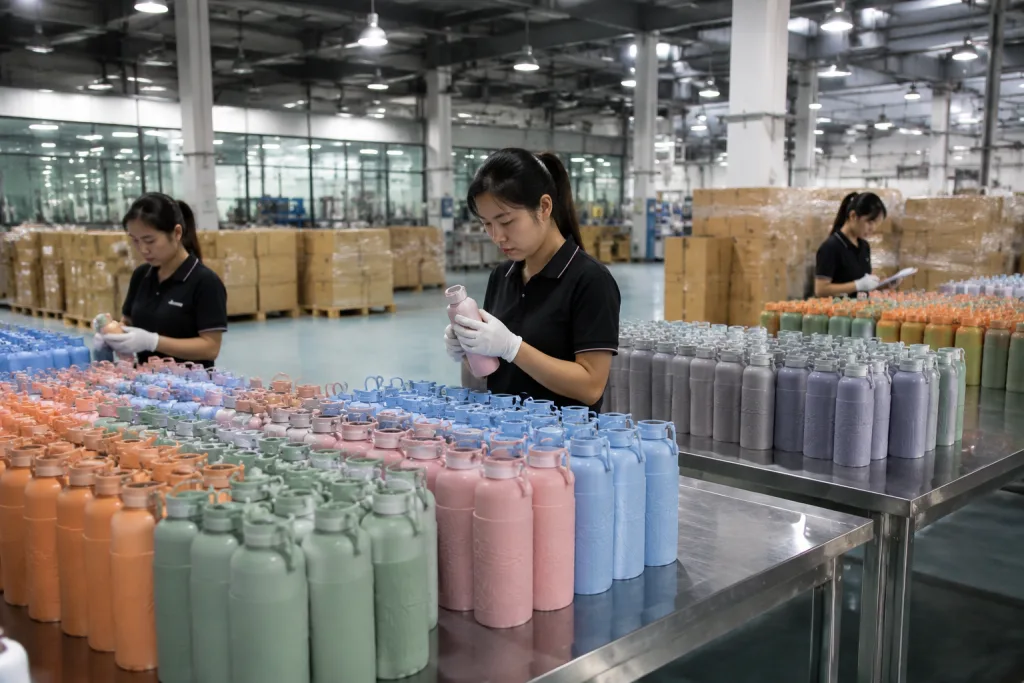
Key Takeaways
- Typical MOQ for silicone sport bottle bulk starts at 3,000-5,000 pcs, with a 35-45 day lead time after sample approval.
- Food-grade silicone bottles usually use 60A-70A hardness, 1.8-2.5 mm wall thickness, and stainless caps with 304 or 316 contact parts.
- A realistic FOB price for a 500 ml custom bottle is often USD 2.10-4.20 depending on mold, print, and packaging.
- For EU and US programs, ask for LFGB or FDA, REACH, and heavy-metal reports before you approve mass production.
Buy silicone sport bottle bulk the wrong way, and the bill shows up fast. A bottle that looks simple on a catalog page can fail on odor, squeeze recovery, cap torque, or print adhesion after 2,000 cycles. We had a buyer flag a 0.8 mm wall spec on the first PO, then QC pulled the sample and found the cap still creeping after 48 hours. If you are sourcing for retail, corporate gifting, or Amazon-style programs, read the spec line by line. Chasing the lowest FOB quote from China is the wrong question.
We build drinkware in Zhejiang, and the pattern is plain: buyers who lock in volume, wall thickness, cap style, and compliance before sampling get fewer surprises. Buyers who ask for a generic sample and talk price later usually end up reworking packaging, artwork, and cartons; we ship those fixes every week. On the line, a missing `MOQ` or a typo on the carton mark can burn two extra days. The same logic applies to bulk drinkware, canteen wholesale, or a silicone sport bottle with a custom logo for North America or Europe.
Read the spec before the sample
If you are buying silicone sport bottle bulk, the sample helps, but it is not the contract. The spec sheet carries the load: capacity, material grade, hardness, wall thickness, cap material, leak standard, and pack count. We ran a 500 ml sample with a soft 50A body last month. It felt fine in hand, then folded flat in a gym bag after a 12 kg carton test. A 70A body held shape better. The math does not lie.
Start with the use case. Is this for sports retail, corporate promotions, or a travel-friendly best wholesale drink bottle program? A buyer for wholesale drinkware in Europe usually asks for REACH papers and carton efficiency first. A North American brand owner pushes dishwasher durability, print wear, and where the UPC/FNSKU lands on the pack. QC pulled the sample on a 2 mm wall once and found the real run drifting wider than the hand sample. Write the tolerances down: capacity +/-3%, weight +/-5%, and leak test at 80 kPa for 30 seconds. Skip the PO and you are guessing. We’ve seen it go sideways when the PO typo said 5000 pcs instead of 5,000.
- Capacity: 350 ml, 500 ml, or 750 ml
- Body hardness: 60A-70A silicone is common
- Wall thickness: 1.8-2.5 mm depending on size
- Leak test: 80 kPa for 30 seconds minimum
Silicone grade and food contact
Split food-grade from marketing-grade first. A real food-contact silicone bottle needs a traceable material declaration, not a sales pitch. For Europe, ask for LFGB where it applies and REACH screening for SVHC. For the US, FDA food-contact compliance is the floor. If the bottle also has a stainless insert, spout, or cap ring, we spec 304 stainless at minimum, and 316 only when the use case or buyer spec justifies the jump. QC pulled a sample on the line last month and the buyer flagged a cap ring with no steel grade callout; that PO sat until we corrected it.
Color is not decoration. Dark pigments hide minor mold marks better than pastel shades, but they can make repeat-lot matching harder. For wholesale canteen programs with multiple SKUs, we keep it to 3-5 core colors. Push past that and the math does not work: more resin changeover time, more scrap, more risk on ship date. One batch in Hangzhou came back with a 1.2 mm shade drift after a hot-run cycle, and we stopped the line before packing. We run about 180,000 units a month across drinkware lines, and the simple color jobs move cleanest because the curing window stays stable.
Ask for a material declaration that names the silicone type, the pigment system, and any plastic additives. If the seller cannot send that fast, the order is not ready for bulk production.
Body shape and drinking performance
Shape is not decoration. It drives squeeze feel, grip, and how the bottle sits in a bag. A straight-wall body is easier to mold and print, which matters when the buyer is chasing drinkware bulk pricing. A tapered body feels better in hand and usually reads as more premium, but it adds tooling cost and can hurt carton pack-out. For a silicone sport bottle bulk program, we usually land on a body that narrows a little toward the neck, with a stable base and enough shoulder stiffness to keep the wall from wrinkling. QC pulled one sample at 62 mm across the shoulder, and the fold line showed up after two squeeze cycles. That is a line problem, plain and simple.
Watch the mouth diameter. A wider opening, usually 45-55 mm, makes ice fill easier and washing less of a pain. A narrower mouth cuts splash, but the buyer flagged it when the sip felt slow during a treadmill test. This is the wrong question to ask if you are trying to copy a flask spec. If you are sourcing beer tumbler bulk or beer tumbler wholesale bulk programs alongside sports bottles, do not assume the same mouth geometry works for both. Beer tumbler in bulk buyers want a different pour behavior, while sports bottle users want fast hydration. Same story with bulk growler and growler wholesale. We ship both, and the math does not match. One PO came through with 54 mm typed as 45 mm, and the sample was dead on arrival for the end user.
For procurement, ask how many grams of silicone go into the body, how fast it springs back after a squeeze, and whether it stands upright when empty. Those checks tell you more than a glossy render ever will. On one 500 ml run, the base leaned 4 mm after cooling, and that batch got held before packing. We used a caliper on that lot, and the number killed the shipment. We have seen that go sideways too many times to trust a pretty mockup.
Cap, seal, and closure details
Leaks usually start at the cap, not the bottle body. For a silicone sport bottle bulk order, we lock the thread pitch, gasket grade, vent path, and torque band before the line starts. On one 500 ml run, QC pulled the sample at 0.9 N-m, then the buyer flagged seepage after a 24-hour inversion. Loose spec. That was the lesson.
If the cap uses a PP top with a silicone sealing ring, ask whether the ring is molded in or fitted as a separate part. Molded-in seals keep the build cleaner, but the tooling gets more complex; separate seals are easier to replace, and they add press-fit risk at the assembly station. For a 500 ml bottle, we run 0.8-1.2 N-m for hand closure. Below that, you get seepage. Above it, users over-twist the cap, especially on a coated finish or soft-touch spray. The math does not work.
- Seal material: food-grade silicone or TPE, depending on design
- Cap material: PP, Tritan, or stainless accents
- Leak standard: inverted hold for 24 hours plus transit drop testing
- Drop test: 1.2 m on hard surface, 6 sides
If your buyer asks for alcohol flask bulk or alcohol flask wholesale bulk, do not copy the sport bottle seal spec and call it done. Liquid type and closure geometry change the job. We saw this go sideways when a PO typed "odor-free" but the sample still held smell after 48 hours in a closed carton. Different closure. Different test. Same line, same headache.
Print, logo, and decoration limits
Decoration is where a lot of wholesale drinkware orders go sideways. Silicone flexes, so grip stays fine and print life takes the hit. Put the method on the PO up front: silkscreen, pad print, heat transfer, or laser on a metal insert. On our silicone line, silkscreen holds if surface prep is clean, but we still run adhesion checks. QC pulled one sample that looked fine on day one and started cracking after 12 dishwasher cycles.
State the print area in millimeters, not “large logo.” 45 x 30 mm on the front panel is clear; one color, Pantone match within Delta E 3.0 or better, is clear too. If you want a debossed or embossed mark, say so early. The mold needs clean edges, and tooling cost goes up. The math does not work any other way. We had a buyer flag a PO that said “logo big” and left out the size; the sample looked neat, but it missed the shelf view they wanted.
Factories in Zhejiang will overpromise decoration options if you let them. Push back. Ask for an adhesion test, a dishwasher cycle test if the bottle will be washed that way, and a packing mockup that shows which side faces out on the shelf. This is the wrong question to ask: “Can you do it?” Ask, “Can you hold it after 500 units?” That is how we ship orders that survive bulk use, not the kind that pass a photo check and fail on the line.
Packaging, carton load, and freight math
Bulk price is never just the unit price. Packaging moves landed cost fast. On one silicone sport bottle bulk order, we packed the bottle in a polybag plus insert card and fit 52 pcs per master carton; the same bottle in a full-color gift box dropped to 31 pcs. One extra carton. Then another. That gap was the difference between a clean 40HQ and a split shipment. If you sell to Amazon or warehouse clubs, ask for carton dimensions, inner pack count, and a 1.5 m drop test before you sign off. This is where buyers get surprised.
For a 500 ml bottle, we run 24 or 36 pcs per carton. Add a straw, brush, or accessory set, and the count falls fast. QC pulled a sample last week and the carton height was 8 mm over spec; that small miss hurt pallet efficiency enough to wipe out the lower ex-factory price. Build the freight math before artwork approval. A buyer once flagged “36 pcs/carton” on the PO, but the line only held 24 after the pump cap was added, so the sea freight math broke. FOB China looks fine on paper. Oversized cartons still move air.
Use-case packaging matters too. A premium best wholesale drink bottle program may earn a rigid box. A promo canteen bulk order usually should not. We’ve seen this go sideways when the buyer pushed for a heavy box on a low-margin SKU; the carton picked up 1.2 kg, and the math stopped working. Pick the pack that survives distribution without dead weight. A tape measure on the packing table tells the truth. That is the point of sourcing from China with discipline.
Testing, compliance, and AQL
Do not release production without a test matrix. For silicone sport bottle bulk, we run material compliance, leak checks, dimensional tolerance, and visual inspection against AQL on the first 300 pcs. AQL 2.5 for major defects and 4.0 for minor defects is a normal baseline for consumer drinkware, though some buyers push major defects down to 1.0 when the brand is new or the market is touchy. That is the wrong question to ask first. Lock the limit before the line starts, not after warehouse receiving finds a split cap or a crooked logo. On one run, QC pulled the sample with a 0.5 mm feeler gauge and caught a cap gap before the cartons moved.
For Europe, keep REACH and LFGB files sorted by SKU and colorway. For the US, hold FDA declarations, migration results where needed, and carton labels that match retail and marketplace rules. If the shipment goes through Amazon, FNSKU placement and carton labels need to be set before packing, not guessed at the end. We lost 6 days once because the buyer flagged a PO typo on the barcode format, and the printer had already run 8,000 labels. That kind of delay is avoidable. The math does not work when the art file says one code and the PO says another.
At our Hangzhou site in Zhejiang, the clean orders are the ones with one approval sheet, one packing spec, and one test standard. QC pulled the sample on a caliper at 0.2 mm, the data matched, and the carton count stayed clean. Simple files move faster. They also keep shipping on time. We ship better when the buyer stops changing the cap color after the pre-production sample.
- AQL: 2.5 major / 4.0 minor as a practical baseline
- Lead time: 35-45 days after sample approval
- MOQ: 3,000-5,000 pcs for custom silicone sport bottles
What changes the FOB price
For a real FOB China number, start with the parts that move. Silicone resin is one line. Tooling amortization, cap stack-up, print colors, packaging, and QC scope all hit the sheet. For a custom 500 ml silicone sport bottle bulk program, we usually see FOB at USD 2.10-4.20 per piece. A one-color body with a standard cap and plain polybag sits at the low end. Add a multicolor body, a special closure, a premium box, or a tight Pantone match, and the price jumps fast. Last week QC pulled the sample at 1.5 mm print tolerance; the buyer flagged the cap groove, and that sort of detail costs money.
MOQ drives the price because setup cost has to be spread across the run. A 3,000 pc order and a 20,000 pc order do not land in the same place. This is the wrong question to ask if you only look at the quote header. On canteen wholesale, wholesale growler, or growler wholesale requests, we run the same math: unit cost, rework, carton loss, and freight cube. A cheap line item can turn expensive once 8% of cartons get rejected or the pallet fills badly. One PO typo for 3000 pcs without the cap code was enough to stall the line for half a day.
Some buyers ask us to price a silicone sport bottle like generic bulk drinkware. The math does not work. The same bottle can swing 25-40% in landed cost based on silicone hardness, cap material, test scope, and box format. A 50 Shore A body with LFGB test and a rigid gift box is a different job from a soft body with no print and an OPP bag. We write those points down in plain terms. In Zhejiang, that is the clean quote. We have seen this go sideways when the buyer tried to compare ten vague offers instead of three exact specs.
Send your spec sheet and get a quote
We price silicone sport bottle bulk orders by real production variables, not guesswork. Send capacity, cap style, artwork, and target market, and we will quote cleanly.
Frequently asked questions
What MOQ should I expect for silicone sport bottle bulk?
For a custom silicone sport bottle bulk order, a practical MOQ is usually 3,000-5,000 pcs per color or per SKU. If you need a new mold, the factory may ask for 5,000 pcs or more to recover tooling and setup time. For repeat orders with an existing mold, some Zhejiang factories can flex lower, but pricing usually rises on smaller runs. If you also want custom packaging, the carton count and box type can push MOQ up because print setup and packing line changeovers add cost.
What compliance documents should I ask for?
For Europe, ask for REACH and, if applicable, LFGB food-contact documents. For the US, ask for FDA food-contact declarations and any migration or material test data tied to the exact silicone formula. If the bottle includes stainless parts, ask for 304 or 316 material confirmation. You should also request an inspection report using AQL 2.5 for major defects and 4.0 for minor defects. For retail or marketplace shipping, keep carton labels, barcode format, and FNSKU details aligned before mass production starts.
How much does a custom silicone sport bottle cost FOB China?
A realistic FOB China range for a 500 ml custom silicone sport bottle is often USD 2.10-4.20 per piece. The low end usually means standard cap, single-color print, and simple packaging. The high end comes from special closure design, extra decoration, premium box, or tighter testing and color control. If you are sourcing from China in Zhejiang, ask the supplier to break out mold cost, sample cost, print cost, and packaging cost separately so you can see where the money goes.
Can silicone bottles be used for sports, travel, and promo programs?
Yes, but the spec changes with the use case. For sports, you want stable grip, a dependable leak seal, and a mouth size that handles ice. For travel or promo programs, packaging and carton efficiency matter more. If you are also buying bulk canteen, bulk growler, or alcohol flask wholesale bulk items, do not assume one closure or body shape fits all categories. The liquid type, branding surface, and transit risk differ, so your spec should differ too.
What lead time should I plan for production?
For a normal custom order, plan 35-45 days after sample approval and deposit. If you need a new mold, first samples can add another 15-25 days depending on tooling complexity. Peak season in China can stretch the schedule if you wait until the last minute. If your order includes multiple SKUs such as beer growler wholesale bulk, canteen wholesale, or wholesale drinkware bundles, build extra buffer for assembly and packing. A factory with about 180,000 units per month still needs line time to be booked in advance.