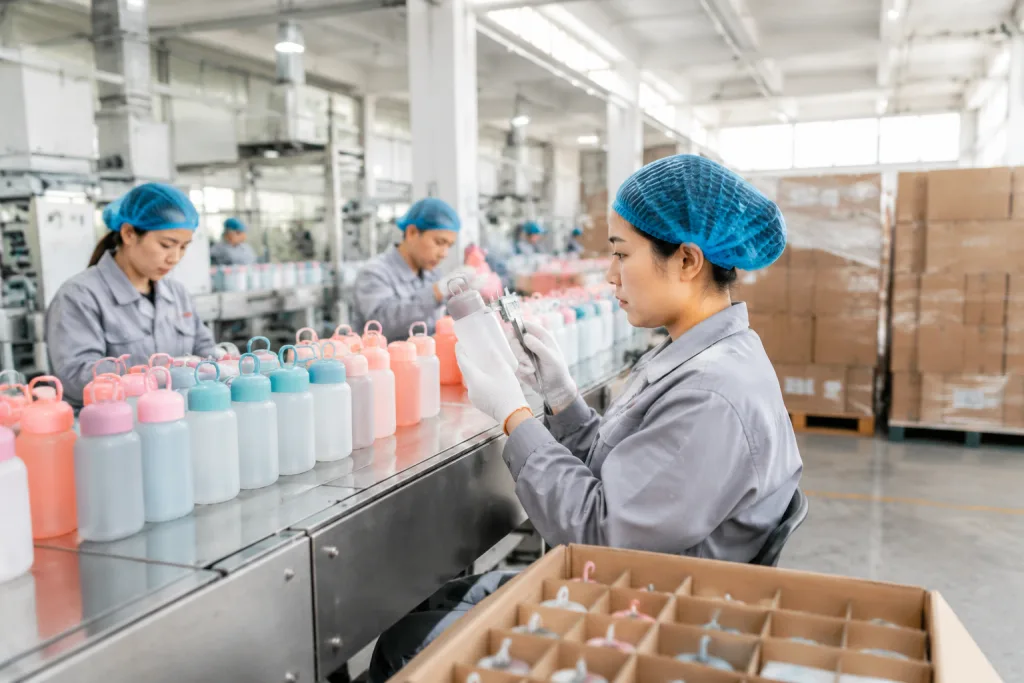
Key Takeaways
- A practical MOQ for a silicone polypropylene bottle supplier is often 3,000-5,000 units per SKU, with 25-35 days lead time after sample approval.
- For export, ask for REACH, LFGB if needed, and an AQL 2.5/4.0 inspection plan before you pay tooling or deposit.
- A PP body with silicone sleeve usually saves 15-25% versus all-silicone designs while keeping grip and branding flexibility.
- If you want a canteen customizable for retail or promo use, confirm decoration area, print durability, and carton pack count before tooling.
If you are sourcing a silicone polypropylene bottle supplier, you are usually trying to avoid the same mess we see every week: a sample that looks clean on the desk but ships badly, print that flakes after two dishwasher cycles, or an MOQ that blows up the forecast. We run those checks on the line with a torque wrench and a 2.0 mm wall gauge before we quote a bottle. The wrong question is, “Which model looks best?” Ask, “Will this hold up in use and still leave margin when it lands FOB China or into a warehouse in Europe or North America?”
We start with the order, not the catalog. A serious canteen factory in Zhejiang asks for volume, wall thickness, closure style, decoration method, and the sales market before any price goes out. That sequence matters. QC pulled the sample last week because the buyer flagged a 3 mm cap mismatch on the PO, and that kind of miss burns a week fast. This is not a shopping trip. Treat it as custom drinkware sourcing, and you get a bottle that fits the channel, fewer QC surprises, and a cleaner handoff from sample approval to production.
Start With the Order, Not the Bottle
Talk to a silicone polypropylene bottle supplier with the order first, not the bottle. Start with units, margin, and channel. We run quotes off the commercial shape before anyone starts arguing about cap color. A 1,500-piece promo chain launch is one job; a 12,000-piece replenishment run for a distributor is another. The math does not work the same.
A buyer once sent a PO for 5,000 units and left the capacity blank. QC pulled the sample at 650 ml, but the buyer wanted 600 ml for shelf pricing, so the line had to stop and recheck the tooling gauge. This is the wrong question to ask after the quote lands. Give the factory the landed cost target, the sales channel, and whether you want an off-the-shelf body with print or a new mold with a custom lid. In Zhejiang, that split can move the price by $0.35 to $1.10 per unit.
A competent canteen supplier will ask for four items: capacity, closure, decoration, destination market. A 600 ml order for a U.S. retailer is not the same job as an 800 ml distributor run for Germany. Silicone sleeve color, PP resin grade, and lid seal type all change the quote. Send a spec sheet with target dimensions, annual volume, and carton style, and the buyer flagged it gets handled fast instead of sitting in inbox back-and-forth for 3 rounds.
- Capacity: 450 ml, 600 ml, 750 ml, or 1,000 ml
- MOQ: 3,000-5,000 units per color
- Lead time: 25-35 days after sample sign-off
- Common EXW or FOB Ningbo terms from Zhejiang
Choose the Right Body Mix
Silicone and polypropylene do different jobs. PP brings stiffness, low weight, and clean injection molding. Silicone brings grip, shock buffering, and a better hand feel in a cold warehouse or gym bag. We had a buyer flag a sample because the sleeve was 0.8 mm off on one side. A real silicone polypropylene bottle supplier should spell out the stack plainly: full PP body with a silicone sleeve, PP lid with a silicone gasket, or a hybrid shell that keeps silicone on the touch points. Do not accept fuzzy material talk. Ask for resin grade, silicone hardness, and PP wall thickness.
For most custom canteen programs, a 1.8-2.2 mm PP wall is enough for durability without pushing weight up. A 50-60 Shore A silicone sleeve usually gives grip without going floppy. QC pulled the sample on our line when the lid gap hit 0.4 mm, and that was the number that mattered. If the product is sold as customizable canteen or customized canteen for outdoor use, ask for drop-test data from 1 meter on concrete and a heat resistance range. PP takes hot fill better than a lot of buyers think, but the lid and gasket usually fail first. The math does not work any other way.
Do not buy the idea first. Buy the material stack, the sealing system, and the lid test results.
Sample the Functional Details
A sample is not a souvenir. It is a check on whether the line can repeat the same result 5,000 times. Before you sign off a canteen customizable sample, we run closure torque, leak behavior, and thread alignment on the bench. QC pulled the sample at 18 Ncm last month, and the buyer flagged a 0.4 mm thread step. That kind of miss shows up again in bulk. If the bottle uses a flip lid, shake it with 200 ml of water for 60 seconds and watch the hinge area. If it uses a screw lid, open and close it 200 cycles. A good canteen factory should pass hot-and-cold cycling without excuses.
For export buyers, ask for dimensional tolerance within +/-1.5 mm on critical fit points and weight variance within +/-5%. That is the math. If you are buying customized drinkware for a chain program, one weak bottle in every 50 is a real loss, not a rounding error. We had a PO last quarter with a carton count typo, 5,000 instead of 50,000, and the same sloppiness shows up when the sample and bulk part do not match. We keep the master sample, production sample, and golden sample on the same rack, then check them with a caliper and a scale. If they drift, approval is dead. The buyer can push back, but this is the wrong question to ask: the sample has to match the line, not the other way around.
- Leak test: 1 bar inverted shake test or equivalent water inversion test
- Cycle test: 200-500 open/close cycles depending on lid type
- Drop test: 1 meter, 3 sides, 3 times
- Seal material: silicone gasket, not generic rubber unless specified
Branding That Still Survives Washing
Decoration is where a lot of canteen vendors talk big and ship weak. We have seen a screen print look sharp on day one, then go dull after 30 dishwasher cycles because the ink system was wrong for the line. Laser mark holds on PP parts, but on a canteen promo run it can vanish on the shelf. Clean branding is the right question only after you know the channel. Retail buyers want more pop. Corporate gifts can live with one color.
Ask the supplier to quote two methods at minimum: silkscreen and laser engraving, or silkscreen and heat transfer if the shape holds it. We run logo checks in mm, not in “big” or “small.” A 35 x 45 mm panel on a 600 ml bottle takes a simple wordmark, not a full wrap, and the math does not work any other way. For Europe and North America, ask for ink and decoration compliance statements tied to REACH and local food-contact limits. QC pulled the sample, and the print still read after a 600-cycle rub test. If you want the bottle to stay a distributor canteen item for 12 months, durability matters as much as bottle color.
Price the Program Like a Buyer
Do not let the talk stay at unit price. A silicone polypropylene bottle supplier should break it into mold cost, piece price, print, packaging, and carton loading efficiency. On a 5,000-piece canteen order, we have seen tooling land at $800 to $2,500, depending on lid puller structure and whether the shape is new. Piece price for a plain PP bottle with a silicone sleeve often sits at $1.10 to $2.40 FOB China. A growler-style custom run climbs fast. The math does not lie.
Ask what moves the quote by 5% or more. Second sleeve color. Different gasket. Individual polybagging. A drop test or carton compression test. QC pulled one sample last month and found a 1.2 mm lid gap after the 1.5 m drop check, so the buyer flagged it and the price had to move. Packaging is not free, and anyone on the line knows that. If you need retail-ready packing, expect another $0.15 to $0.45 per unit for an insert card, barcode label, and carton spec. We shipped one PO with a typo on the carton mark, and the buyer pushed back hard. For a canteen manufacturer in Zhejiang, clean pricing starts with EXW, FOB Ningbo, or DDP on the PO. That is the wrong question to skip.
- Basic PP + silicone sleeve: about $1.10-$2.40 FOB
- Complex lid or custom mold: add $800-$2,500 tooling
- Retail carton and label: add $0.15-$0.45
- Sample lead time: 7-12 days
QC the Production Run Properly
Once the sample is signed off, the brochure stops mattering. Production control pays the bill. We run a pre-production sample, then keep the same resin batch, color masterbatch, and gasket spec through the full order. If the line swaps material to save 0.03 RMB a unit, the buyer flags it fast in smell, lid fit, or surface gloss. Set the AQL before the first shot; for most drinkware orders, AQL 2.5 for major defects and 4.0 for minor defects is a sane start, and we tighten it for a retail chain that will reject a pallet for one scuffed cap.
QC should check color consistency, print alignment, torque, leak testing, and carton count. No guesswork. On a distributor canteen program, mixed cartons create extra sorting hours at the warehouse, and the math does not work. We ask for in-line checks every 2 hours, then a final inspection before loading. A plant in China running 300,000 units per month should not be hand-waving this; if they are, we have seen that go sideways. Also confirm whether the factory is BSCI audited or can pull other social compliance files when the buyer asks. One PO typo on “carton” versus “ctn” has burned a shipment before, so paperwork matters as much as the leak test bench.
Good QC will not fix a weak design, but it keeps a solid one from turning into a claim.
Pack for Landed Cost and Reorder
Packaging is not a side note. It sets freight, damage rate, and warehouse speed. One Amazon buyer flagged a carton change after QC pulled the sample: 24 bottles per master carton instead of 20, and the pallet count moved 12%. Landed cost went up more than the unit price. Ask the silicone polypropylene bottle supplier for master carton size, units per carton, gross weight, and pallet pattern before the line runs. If you need FNSKU labeling, say it before production starts. If the barcode has to match a distributor system, send the file early. A typo on the PO can turn into a week of rework.
Reorder planning is where experienced buyers save money. Keep the approved bottle spec locked: resin grade, sleeve hardness, lid gasket, print layout. Then you can reorder a customized canteen without opening a new qualification round. We keep molds on file, and on a stable run we hold master color inside a Delta E target of 1.0-1.5. That is the edge of working with a steady canteen manufacturer in China. The math does not work any other way. On reorder, you want a sample check and a quick color pull, not a full redesign. We run it this way on the line because a 0.5 mm carton shift can throw pallet math off fast.
- Confirm carton count before booking freight
- Lock artwork files and barcode data
- Keep a retained sample from the first run
- Reorder from the same mold and resin spec
Request a production-ready bottle quote today
Send your capacity, artwork, and target price. We will quote a silicone polypropylene bottle supplier spec with MOQ, lead time, and QC terms.
Frequently asked questions
What MOQ should I expect from a silicone polypropylene bottle supplier?
For a standard program, expect 3,000 to 5,000 units per SKU and color. If the design uses a new mold, the factory may ask for 5,000 to 10,000 units or a tooling fee plus a lower trial MOQ. In Zhejiang, some canteen suppliers will quote lower for stock shapes, but the real number depends on lid complexity and decoration. For custom drinkware, I would treat anything below 2,000 units as unusual unless it is a simple print-on-stock item. Always ask whether MOQ is per color, per artwork, or per lid type.
How much does a custom silicone PP canteen usually cost FOB China?
A basic PP bottle with silicone sleeve and standard lid often lands around $1.10 to $2.40 FOB China at 5,000 units. If you add a new mold, special lid, or more complex packaging, the number climbs fast. Tooling can be $800 to $2,500 depending on the part count and mold finish. A custom canteen promotional program can stay near the low end if you keep to one-color printing and standard carton packing. For a customized growler-style model or premium retail finish, budget higher.
What compliance documents should I request before paying deposit?
Ask for material declarations, REACH compliance, food-contact declarations, and testing reports if your market requires them. If you sell into Germany or other EU markets, LFGB may be relevant for the complete contact system, especially lids and gaskets. For the U.S. market, buyers often ask for FDA food-contact references, but they still need proper product-specific documentation. A serious canteen manufacturer should also provide factory audit files like BSCI if your customer asks. Request the documents before tooling approval, not after production starts.
Can I use laser engraving on a polypropylene bottle?
Yes, but check the exact resin and surface finish first. Laser marking works well on some PP parts and gives a clean, durable mark, but it is not always the best branding choice for a canteen promotional item because the contrast can be subtle. On a silicone polypropylene bottle supplier program, I usually compare laser against silkscreen for legibility and cost. For a 35 x 45 mm logo area, silkscreen may be stronger visually. For a minimal custom canteen look, laser can work well on the PP lid or base.
How do I avoid QC problems on a large reorder?
Lock the golden sample, the resin grade, and the gasket spec before you approve the first shipment. Then require AQL 2.5 for major defects and 4.0 for minor defects, plus leak testing and carton count verification. Ask the canteen factory to keep the same masterbatch and avoid substitution without written approval. For a reorder of 10,000 units or more, I would also request retained samples from the previous batch so you can compare color and fit. That is how you keep customized drinkware consistent across seasons.