Key Takeaways
- A real silicone polypropylene bottle manufacturer should quote MOQ, lead time, and monthly output up front; a common start point is 3,000 pieces and 30-45 days.
- For EU and North America, ask for food-contact declarations, REACH paperwork, and migration testing before you approve a customized canteen.
- Silicone overmolded parts usually add 12-25% to unit cost versus plain PP, but they improve grip and perceived value.
- For distributor canteen programs, check carton pack, drop resistance, and logo durability before you commit to 10,000+ units.
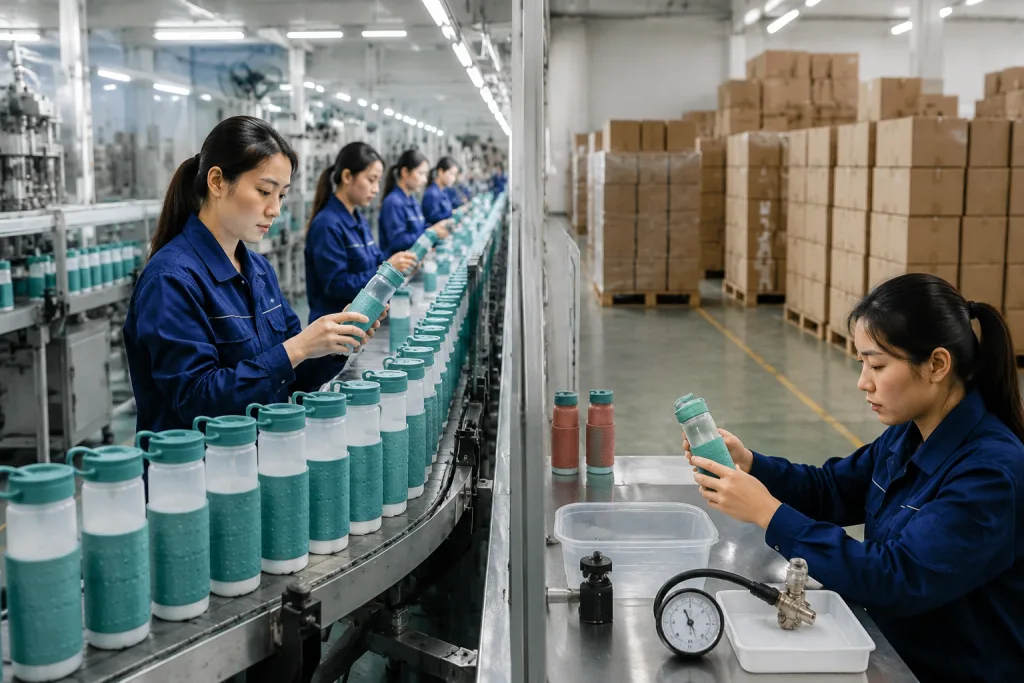
If you are sourcing from a silicone polypropylene bottle manufacturer, do not treat it like a generic bottle order. We run this category with food-contact resin, silicone overmold parts, leak control, and print registration on the same line. Last month QC pulled a sample where the cap looked fine but the gasket sat 1.2 mm off center; the carton test failed in 12 drops. Miss one piece and you get a label that peels or a distributor asking why the MOQ jumped from 3,000 to 12,000 units.
The right question is not “can you make bottles?” Ask whether the factory can hold the same shade, the same fit, and a steady 300,000 units per month without drift. The math does not work if the buyer signs off a PO with a typo and then wants the PMS code fixed after approval; we have seen that turn into a 3-week delay on one 30,000 pcs order. For retail, promotion, or distributor drinkware in Europe and North America, that is the job.
What you are really buying
Buyers say they want a silicone polypropylene bottle, but that phrase can mean a PP body with a silicone sleeve, a silicone grip band, a silicone lid detail, or a full soft-touch build. Four builds. We run them differently on the line, and the quote moves with tooling, assembly time, and scrap. Last month QC pulled a sleeve sample at 0.8 mm, the buyer pushed back on price, and the math did not work.
Ask the question that matters: what does the bottle need to do in your market? A promo bottle for a sports event can live with basic print and a 5,000-piece MOQ. A retail SKU for North America may need barcode labels, tighter cosmetic control, and a closure that passes 1.2 meters drop testing. A silicone polypropylene bottle manufacturer in China should tell you where the silicone sits, what PP grade is used, and whether the part runs in one injection cycle or as a two-step assembly. We have seen this go sideways when a PO said “silicon lid” and the buyer meant “silicone”; one typo cost 12 days.
Buyer check
- Ask for resin grade, silicone type, and wall thickness in millimeters.
- Confirm whether the lid uses PP, Tritan, or a mixed structure.
- Request the actual production drawing, not just a sales render.
Questions to ask the factory
Start with questions that force a straight answer. How many units can the canteen factory run per month? What is the MOQ by color and by logo method? Can they handle canteen customized orders with two-color molding, or only surface printing? We had one buyer flag a PO typo on the logo method, and that dragged the first pilot run by 4 days. If a supplier cannot answer this in one email, the line is not ready for a distributor canteen program.
Ask about lead time by stage, not one loose number. Sample making: 7-10 days. Mold modification: 12-18 days. Bulk production: 25-35 days. Ocean freight from Ningbo or Shanghai sits on top of that. QC pulled the sample on a 3 mm wall spec and found a color shift at the shoulder, so the buyer pushed back on the whole schedule. In Zhejiang, we see factories quote low on samples and hide the bulk clock; the math does not work. A serious canteen vendor will show the critical path, including approval of Pantone color, artwork proof, and carton master sample.
Good sourcing questions are boring. That is a feature. If the answer sounds polished but skips numbers, you do not have enough information to buy.
Use this checklist:
- MOQ per SKU and per logo method
- Monthly capacity in units
- Lead time for sample, tooling, and bulk
- Accepted tolerances for color, weight, and logo position
Materials and compliance
For EU and North American buyers, material questions matter more than marketing claims. PP stays on the line because it is light, keeps unit cost down, and runs clean in mass production. Silicone adds grip and a better hand feel, but we still check the grade, the pigment batch, and the 65 Shore A spec before we quote. A silicone polypropylene bottle manufacturer should hand over food-contact declarations, REACH statements, and test reports tied to ASTM or FDA-oriented requirements for your market. We run this check before samples leave Hangzhou, not after the buyer starts asking customs questions.
Do not assume a canteen supplier understands importer paperwork. We had a buyer flag a PO with the wrong mouth diameter, 38 mm instead of 48 mm, and the compliance pack still failed because the migration data was missing. Ask for migration test data if the bottle has a colored inner liner, printed graphics near the mouth, or a silicone part that touches liquid. For custom drinkware sold into retail, the file should also cover carton dimensions, net and gross weights, country of origin marking, and FSC paper documents for inserts. On one run, the tape measure at packing read 515 mm on the master carton, and that number had to match the booking sheet. If the program goes through a distributor drinkware channel, that pack needs to be complete before shipment. After the PO is issued is too late. This is the wrong question to ask at the end.
From procurement, this is where cheap orders turn costly. A REACH miss or one missing declaration can park 8,000 units in customs for 14 days while your team answers emails. We have seen it go sideways on a 3,000-piece trial run because QC pulled the sample and the inner liner ink bled at the 95 deg C check. The math does not work. On the line, one typo on the carton mark can turn into a reprint and a missed vessel. This is a supplier discipline issue, not a design issue.
Customization that actually sells
There is a real gap between giveaway decoration and a custom drinkware SKU that passes retail checks. We run one-color screen print on a flat panel, and it stays clean through abrasion tests. Laser engraving is a different job; it fits hard parts and gives a sharper premium look. Silicone parts are the trouble spot. If you want a mark on a soft grip or molded band, we need to confirm whether the logo is molded in or overprinted cleanly. A buyer once flagged a PO typo, “silcone” instead of silicone, and QC pulled the sample before the line ran. Margin lives here. Rework kills it.
If you are a distributor, do not overload the first order. Start with one body color, one silicone color, one logo position. Every extra variable can add 7-14 days and push MOQ up. A mixed-color canteen can sell well, but it also raises shade drift between lots. The math does not work if you stack too much on the first run. We have seen a 5,000-piece order go sideways on that exact setup. In Zhejiang, the better factories say that plainly; the weak ones nod at everything and fix it later with touch-up ink at the bench.
Use a practical customization ladder:
- Level 1: stock mold, one-color print, 3,000-5,000 MOQ
- Level 2: molded color match, silicone accent, 5,000-8,000 MOQ
- Level 3: new lid or body tooling, 8,000-20,000 MOQ
Cost drivers you can control
Buyers ask for the lowest canteen factory quote, then the landed cost walks up on them. We see it on the line every week. The spend sits in resin grade, mold work, decoration, pack-out, and carton efficiency. A plain PP bottle can land at about USD 1.10 to 1.60 FOB on a large order, while a silicone-accented bottle with tighter packaging and a stronger closure can move to USD 1.70 to 2.80 FOB, depending on size and print. Those are normal China numbers.
Complexity is what you can control. Keep the shape simple, hold color to one or two, and pick a closure we already run. If your custom brief asks for a new lid, print on two surfaces, and a custom carry loop, the tooling bill rises, assembly takes longer, and QC pulls more samples. We had a buyer flag a 3 mm lid-wall spec once; the math did not work, and the quote had to be rebuilt. A canteen vendor that knows the trade should split mold amortization, unit price, packaging, and decoration instead of burying everything in one line.
Packaging gets missed on distributor programs. It should not. A retail carton with barcode, hangtag, and individual polybag can add USD 0.08 to 0.25 per unit, and that spend often beats a failed warehouse receiving check. We checked one export lot at 500 pcs MOQ; the outer carton mark was off by one character, and the receiving team held the pallet for a day. That is the sort of problem that costs more than the print itself.
Quality checks before you approve
Do not approve a customized canteen from photos alone. We run a pre-production sample first, then keep one gold sample at both ends. Check logo position, silicone fit, lid torque, odor, cap sealing, and drop performance. On the line, a 0.3 mm logo shift is enough to trigger a buyer complaint. If the bottle is for hot liquid, test deformation and leaking at the stated temperature. For cold-use products, check condensation, grip, and carton crush performance. QC pulled the sample, and the stopper still felt loose at 1.8 N·m. We’ve seen buyers sign off too early, then spend 12 days arguing over a 2 mm lid gap that showed up after packing. A real canteen factory should have incoming inspection, in-process checks, and final AQL control, usually AQL 2.5 for major defects and 4.0 for minor defects unless your program is stricter.
Ask how the factory handles mixed lots. This is the wrong question to skip. In a 10,000-unit batch, are they checking every 500 pieces for logo smear, flash, and color mismatch? Can they send QC photos before shipment? Can they trace a defect back to one cavity or one shift? The math doesn't work if they only spot-check the first carton and call it good. We’ve seen this go sideways when a buyer approved a sample, then found the same lid crack across three pallets. A silicone polypropylene bottle manufacturer in China can ship a clean sample and still miss repeatability if the process is loose.
Minimum documents to request:
- Pre-production sample signoff
- Gold sample with reference code
- Inspection report with AQL level
- Carton drop test or transit test data
Who should buy this category
This category is not for every buyer. If you need a tough, light canteen for school retail, outdoor promo, gym chains, or distributor bundles, PP plus silicone makes sense. If you want a desk bottle with a premium feel, a custom growler, or a heavy insulated vessel, this is the wrong build. We had a buyer push for a 24 oz office bottle once; QC pulled the sample, and the wall felt thin in the hand. Use the material where it fits the job. Simple. A lot of canteen distributors try to make one bottle do four jobs, then the feedback comes back mixed and they point at the supplier.
For canteen distributors and brand owners, the sweet spot is large repeat orders with simple decoration and 2 to 4 color counts. For canteen suppliers serving promotions, the sweet spot is fast output and steady pricing. For canteen manufacturers serving retail, the sweet spot is clean molding, stable supply, and compliance paperwork that passes import review. We run the line with a 6-cavity mold, and that is where the math works. A factory in Zhejiang pushing 300,000 units a month can beat a small workshop with nicer sample photos. Capacity matters when the PO lands, and the buyer flags a lead-time slip.
If your channel is Amazon or other marketplace retail, think through labeling, FNSKU placement, and carton pack before you lock the design. A typo on the PO for a 24-pack carton can turn into a dock issue fast; we have seen that go sideways on a Friday unload. A good bottle still becomes a bad listing if the pack-out is wrong. That is the piece people miss.
Request a factory quote with real specs
Send your target volume, logo method, and market. We will price the bottle honestly, with MOQ, lead time, and compliance paperwork spelled out.
Frequently asked questions
What MOQ should I expect from a silicone polypropylene bottle manufacturer?
For a standard stock mold with one-color print, expect 3,000 to 5,000 pieces per SKU. If you add a custom lid, new silicone parts, or mixed colors, MOQ often moves to 8,000 to 20,000 pieces. For a canteen promotional order, some factories in China will accept lower trial volumes, but the unit cost usually jumps 15% to 30%. A serious canteen factory should state MOQ by color and by decoration method, not just one vague number.
How long does production usually take?
For a normal canteen custom order, sample lead time is often 7 to 10 days, tooling or mold changes 12 to 18 days, and bulk production 25 to 35 days after approval. Add freight time separately: 20 to 35 days by sea to Europe or North America depending on route and season. If a canteen supplier promises bulk in 10 days on a custom silicone part, treat that as a warning sign unless the mold and colors are already in stock.
What compliance documents do I need for EU and North America?
At minimum, ask for food-contact declarations, REACH documentation for the EU, and relevant test reports for migration and material safety. For North America, many buyers also ask for FDA-oriented declarations or market-specific compliance support. If the bottle has silicone parts touching liquid, request separate paperwork for both PP and silicone. A proper silicone polypropylene bottle manufacturer should be able to package these documents with the PI and shipping docs.
Is silicone worth the extra cost on a PP bottle?
Usually yes, if your buyer values grip, comfort, or a more premium feel. Silicone accents commonly add 12% to 25% to FOB cost, depending on the design and color count. On a USD 1.40 PP bottle, that might push you to USD 1.65 to 1.85. For distributor canteen programs, that extra cost often pays back in better shelf appeal and fewer breakage complaints, but only if the decoration and packaging are also done properly.
How do I compare canteen manufacturers without getting misled by price?
Compare the quote line by line: resin grade, wall thickness, silicone content, print method, packaging, test reports, and lead time. Ask for a sample and the expected AQL level, typically 2.5 for major defects. Also check monthly capacity; a factory quoting a very low price but producing only 50,000 units per month may not hold your replenishment schedule. In Zhejiang and across China, the best canteen manufacturers are usually the ones that explain their limits clearly.