Key Takeaways
- A typical silicone polypropylene bottle factory MOQ is 3,000 units for print-only orders and 5,000-10,000 units for fully customized molding.
- Sample lead time is usually 5-7 days, while mass production runs 25-35 days after approval at a Zhejiang canteen factory.
- A basic customized canteen often lands at USD 1.85-3.40 FOB, before freight and duties, depending on volume and decoration.
- AQL 2.5 for major defects and 4.0 for minor defects is a practical inspection baseline for custom drinkware shipments.
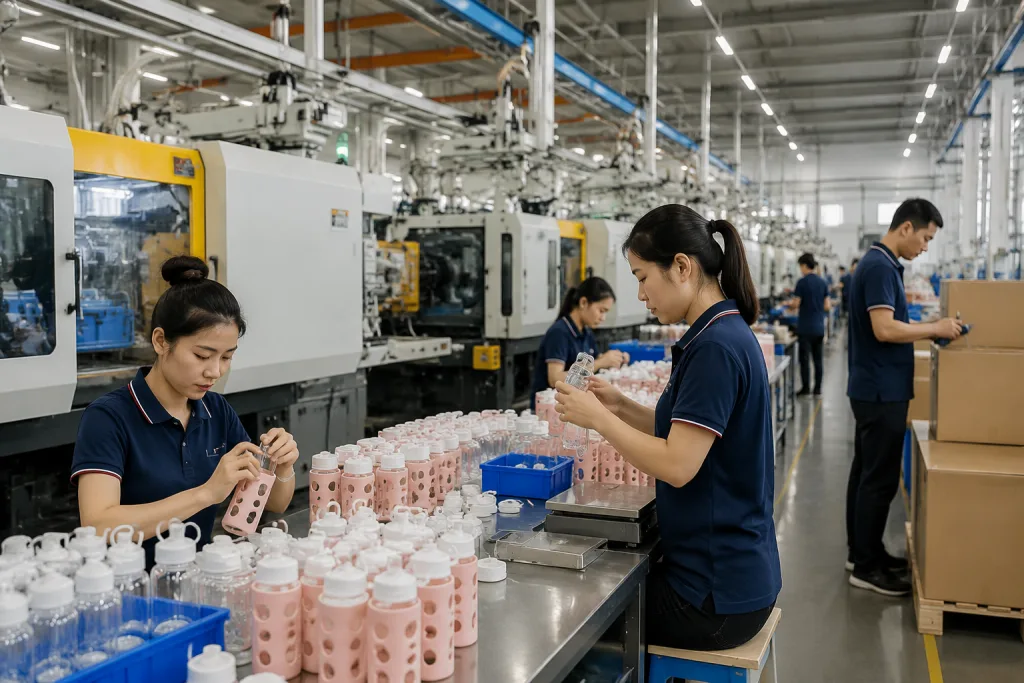
If you source from a silicone polypropylene bottle factory, do not price every quote the same way. The math does not work. A custom canteen with a silicone sleeve, PP cap, logo print, and retail carton can move 18% to 35% depending on mold status, decoration method, and packing spec. We run this every week on the line, and the buyer usually flags the quote after the carton size is already fixed. Last month the PO showed "3000 pcs" but the carton line said "3000cts"; that typo changed the pallet count.
At BottleForge in Zhejiang, we see buyers lose 7 days on vague RFQs, then panic when lead time slips from 25 days to 45 days because they skipped the mold, sample, or packaging step. QC pulled the sample with a 0.5 mm print shift last Thursday, and that is the wrong place to find it. If you buy custom drinkware for Europe or North America, ask for MOQ, unit cost, decoration fee, carton packing, and freight assumptions in writing. That is how a canteen supplier becomes a predictable canteen factory instead of a guess-and-check vendor in China.
What drives the quote
Ask a silicone polypropylene bottle factory for a price, and the quote should break into four lines: raw material, processing, decoration, packing. We run it that way on the line. A buyer once sent a PO with one line only, then called the quote “too high” without reading the 0.9 mm wall spec. Wrong question. For a 500 ml custom canteen with a PP body and silicone grip, material usually sits at 22% to 35% of FOB. The rest is mold amortization, labor, scrap, and packing loss. If a seller will not split those out, you are buying blind.
Raw material moves the number fast. Food-grade PP resin is priced by weight, so wall thickness changes unit cost in a clean, ugly way. A 0.9 mm wall on a 650 ml bottle uses less resin than a 1.3 mm wall, but the thicker shell feels stiffer in hand and cuts dent complaints. Silicone does the same job to the quote. A 35 Shore A sleeve costs more than a simple ring gasket, and a full wrap sleeve is a different cost stack again. QC pulled the sample last week and found a 0.2 mm flash on the cap skirt; that tiny defect is where margin leaks. If you want canteen customized for retail, add print and carton structure. A one-color silk screen may add USD 0.06-0.12 per unit; a wrap label or multi-color print can add USD 0.18-0.35. We’ve seen buyers push back on the printing line and then lose the money in packing anyway.
- Material: PP resin, silicone sleeve, gasket, lid insert
- Process: injection, assembly, leak test, trimming
- Decoration: print, laser, heat transfer, label
- Packing: polybag, insert card, color box, master carton
MOQ tiers that make sense
The right MOQ depends on how far you push the spec. For a canteen custom run with no mold change, just logo and color swap, we start at 3,000 units. That keeps the unit price steady without loading the line with extra setup. Once you ask for a new lid shape, a custom grip profile, or a new body section, 5,000 units is the floor, and 10,000 units is where the math starts to work. Last month a buyer pushed a 500-unit quote; the math does not work, and the gap usually sits in tooling or freight. We have seen that one go sideways before the first carton landed.
Here is the split we use in Zhejiang. QC pulled the sample on a 280 mm bottle and the lid sat 1.2 mm off-center, so we know where the process starts to drift. That is the kind of detail that decides whether we ship clean or chase rework.
- Print-only custom canteen: 3,000 units MOQ, 15-20% lower setup burden
- Color-customized canteen: 5,000 units MOQ, small surcharge per color
- New mold or structural change: 10,000 units MOQ, tooling amortized over volume
- Distributor drinkware reorder: 2,000-3,000 units if the mold already exists
For canteen distributors, the mistake is stacking too many variants too early. Three colors and two lid styles turn one SKU into six, and the margin drops fast. We have run that job at 12 days, then watched it stretch to 18 days when the buyer kept changing the logo plate. Start with one customized drinkware version, then open the range after sell-through is real. If the supplier is a real canteen manufacturer, not a trading desk, they will tell you which part of the MOQ comes from labor and which part comes from tooling. That is the wrong question to avoid asking.
Lead time by production stage
Lead time is where buyers lose the calendar. A silicone polypropylene bottle factory should split it by stage, not toss out one blanket promise. For a standard custom drinkware order, sample making takes 5-7 days if the mold is already on the shelf. New mold? Add 15-25 days for tooling design and CNC work. After sample approval, mass production usually runs 25-35 days for a 3,000-10,000 unit order in China, if resin, caps, and packing cartons are already on the floor. We once had a 2 mm logo shift push the line back two days. The math does not work if you call that a small change.
Here is the timeline you should expect from a competent canteen supplier:
- RFQ and spec review: 1-2 days
- Quotation with artwork: 1-3 days
- Sample production: 5-7 days for existing tooling
- Tooling development: 15-25 days if custom mold is needed
- Mass production: 25-35 days after sample sign-off
- Pre-shipment inspection and packing: 2-4 days
On our Hangzhou line, monthly output reaches 600,000 units, so capacity is not the choke point. The buyer usually stalls us on artwork sign-off, carton text, or test criteria. QC pulled the sample twice last month because the master carton had a typo, and that burned 2 days. We ship faster when the PO is clean on the first pass. If your retail window is fixed, your review cycle matters as much as ours. This is the wrong question to ask if you only count factory days. Buyers in Europe and North America miss that point all the time.
What a unit price really means
Unit price without context is noise. A USD 1.20 canteen quote looks clean on paper, but once packing, logo work, and carton testing drop out, it is not a landed number. We run this math every week on the line. For a 5,000-unit order, a basic custom canteen with a standard PP body and silicone detail usually lands at USD 1.85-2.60 FOB Ningbo or Shanghai. Add retail-grade packaging and a two-color print, and the range moves to USD 2.40-3.40. Push into a custom growler format or a larger capacity, and resin use plus cubic volume drag the price up. The buyer flagged this on a PO once: “unit price only.” Wrong question.
The main cost drivers are plain once you see where the money moves. A 350 ml cup and a 750 ml cup do not pull the same resin weight, and that gap shows up fast on the scale. We weighed both on the floor with a bench scale, and the 750 ml part came in 38% heavier before decoration.
- Capacity: 350 ml versus 750 ml changes resin consumption by 20% to 45%
- Decoration: single-color silk screen costs less than laser or multi-pass print
- Color matching: custom Pantone adds material handling and QC time
- Packing: plain master carton versus printed retail box can add USD 0.12-0.45
- Testing: FDA-style migration checks, REACH, LFGB, or ASTM-aligned testing adds lab cost
A proper canteen vendor should say whether the quote is built on AQL 2.5, drop-test packaging, and leak testing at 100% or on sample basis. If that line is missing, you are not comparing the same offer. QC pulled the sample on a 1.5 mm wall bottle last month, and the cheap quote had skipped carton drop testing. We have seen that go sideways. The lowest number is usually the one with the biggest gaps, and the math does not work once you fill them in.
Material and compliance choices
For Europe and North America, start with compliance, not branding. PP is standard because it is light, stable, and low cost, but the food-contact file still has to line up. Silicone parts need checks for odor, compression set, and what happens after 40C storage. A serious silicone polypropylene bottle factory in Zhejiang should hand over REACH papers, food-contact declarations, and lab reports matched to the destination market. We run this check on the line: did the lid seal pass hot-fill or cold-chain storage, 12 days versus 18 days?
Do not accept “safe material.” That phrase says nothing. Ask for exact data. We see this every week, and the math does not work otherwise. A normal supplier packet can include one of these:
- Material declaration for PP and silicone grades
- Migration test results from a third-party lab
- RoHS or REACH declaration if required by the buyer
- Odor test or sensory check where relevant
- Dishwasher resistance guidance, usually 50-70 cycles for printed items
If you are sourcing canteen promotional products for retail or events, compliance still matters at lower price points. A canteen distributor shipping into the EU cannot afford a border stop because the carton ink missed the spec. Buyers often flag the bottle body and stop there. Wrong question. QC pulled the sample on a 58 mm lid last week, and the risk sat in the cap assembly, gasket compound, and ink system. We saw one PO with “silcion” typed in the material column, and the line stopped until the buyer confirmed the spec. A factory in China that knows the job will talk test scope before it talks volume.
How to compare factories
Do not compare canteen manufacturers on sample photos alone. Compare process control. A real canteen factory shows the line, the inspection points, and the paperwork behind each batch. We have seen buyers get burned by a nice tabletop sample and a messy run on the floor. If a factory cannot tell you when it uses AQL 2.5, how it handles assembly loss, or what its monthly output is, that is a weak signal. Same story if it cannot give you the color changeover time. On our line, 18 minutes versus 45 minutes changes the schedule.
When you check a silicone polypropylene bottle factory, ask for these specifics:
- Capacity: units per month, plus peak season output
- Tooling: in-house mold shop or outsourced mold making
- Inspection: leak test, drop test, torque test, print adhesion
- Traceability: batch labels, date codes, carton lot numbers
- Audit status: BSCI, ISO 9001, or buyer audit history
For distributor canteen programs, consistency beats novelty. You need repeatable color, repeatable logo placement, and carton counts that do not drift by 2 or 3 pcs. A canteen vendor that ships one clean sample and then slips in mass production gets expensive fast, even on a low quote. The buyer flagged a PO typo on carton count last month, and QC pulled the sample against the master. We run into this all the time. In Hangzhou and across Zhejiang, the better factories are plain in the right places: the same tolerances, the same QC gates, fewer excuses. That is what matters when you ship a reorder to North America on a fixed window.
Packaging and freight math
Packaging is not a side line item. On a custom drinkware run, the packout changes unit cost and landed freight fast. We have seen a simple polybag plus master carton keep the cube tight and the cost down, while a printed retail box, insert card, barcode sticker, and shrink wrap pushed the unit price up 8% to 18% before freight. QC pulled one sample with a loose shrink sleeve, and the buyer flagged it before the line started. If you ship to Amazon or a retail chain, carton labeling and FNSKU application need to be set at the factory, not left for your warehouse crew. We run this check with a 300 mm ruler on the packing table.
For a 3,000-unit order, freight often costs more than the bottle if the packout is wrong. A wider canteen shape can land at 24 units per carton instead of 36, and that extra carton count drives up CBM and the ocean or air bill. We saw this go sideways on a 2,400-piece PO where the carton size typo changed the pallet count by 6. Ask for the packing plan with the quote. The supplier should give you carton size, gross weight, units per carton, and estimated CBM before you sign the PO. This is the wrong question to leave until after deposit.
Typical cost changes you should expect:
- Retail carton: +USD 0.12-0.45 per unit
- Barcode or FNSKU label: +USD 0.02-0.05 per unit
- Drop-test inner packaging: +USD 0.08-0.20 per unit
- Air freight sensitivity: every extra 0.5 kg can matter on a high-volume canteen
For a canteen promotional program, lean packaging is usually the better call unless the customer is paying for shelf appeal. We run the carton count on the packing table before production, with a tape measure and a scale, because the math does not work any other way. A good canteen manufacturer in China will show you the carton count before we ship. If they do not, they are not helping you buy; they are filling a purchase order.
A practical buying sequence
Keep the buy in stages. Lock the bottle size, cap fit, and use case first. Then confirm the silicone and PP grades, logo method, packing, and compliance papers. Price comes last. We lost 6 weeks once on artwork loops while the mold sat on the press, and the buyer flagged a typo on the PO that pushed sample approval back 3 days. That order keeps the job under control whether you are buying a custom canteen, a customizable growler, or a distributor drinkware line for a chain buyer.
A clean sequence looks like this:
- Send exact capacity, target market, and logo file.
- Ask for a quote with MOQ, unit price, tooling, and sample lead time.
- Approve one physical sample, not just photos. QC pulled the sample on the bench, and the 0.5 mm wall check caught a mismatch before the line ran.
- Confirm test scope: REACH, food contact, leak, and drop requirements.
- Release mass production only after artwork and carton text are final.
This is where the better canteen suppliers split from the average ones. A disciplined factory in Zhejiang will tell you straight when your target cost and spec do not fit. That is the wrong question to dodge. The math does not work otherwise. If you want a customized canteen on a promo budget, cut the packing or stay with one-color decoration. If you want a premium distributor drinkware line, pay for better tooling, tighter inspection, and a first run that takes 18 days instead of 12. We run the line to repeat, not to win on promises.
Get a factory quote with real numbers
Send your capacity, logo, target market, and packout spec. We will return MOQ, FOB price, sample timing, and compliance scope from Zhejiang.
Frequently asked questions
What is the usual MOQ for a silicone polypropylene bottle factory?
For a normal custom drinkware order, 3,000 units is a common MOQ if the mold already exists and you only need print or color changes. If you need a new lid, new body shape, or a true customized growler structure, 5,000 to 10,000 units is more realistic. A factory in Zhejiang may accept smaller quantities, but the price per unit usually rises sharply. For canteen distributors, the better move is to consolidate SKUs and keep one or two core variants. That protects margin and makes reorders easier.
How long does production take after sample approval?
For existing tooling, expect 25-35 days after sample approval and deposit. Sample making usually takes 5-7 days. If a new mold is required, add 15-25 days before samples. If you are sourcing from China during peak season, add another 5-10 days of risk buffer for packaging or artwork corrections. A reliable canteen factory should show you a stage-by-stage schedule rather than one vague promise. That is especially important for North America and Europe, where shipment windows are tight.
What is a realistic FOB price for custom canteen orders?
For a basic 5,000-unit order, a realistic FOB range is usually USD 1.85-2.60 per unit for a simple canteen customized spec. Add better packing, two-color print, or a more complex silicone part, and the price can move to USD 2.40-3.40. Larger capacities or custom growler-style products cost more because of material usage and carton volume. The quote should state whether printing, cartons, and testing are included. If not, the number is incomplete.
What documents should I ask from a canteen supplier?
At minimum, ask for food-contact declarations, REACH-related documentation for Europe, and third-party test reports if you need them. For North America, many buyers also request material declarations and migration test summaries. If the canteen manufacturer has BSCI or ISO 9001, that helps with due diligence, but it does not replace product testing. You should also ask for carton dimensions, net/gross weight, and batch traceability. That is basic discipline, not a luxury.
Can I order a small run for distributor canteen testing?
Yes, but be realistic. A small distributor canteen test run is possible if the factory already owns the mold and the decoration is simple. Expect 2,000-3,000 units as a workable pilot, sometimes less for repeat tooling. If you want full customization, a tiny order will distort cost and make freight inefficient. In practice, a canteen distributor testing a new line should validate one SKU, one lid, and one packaging spec first. That gives you useful sales data without overcommitting cash.