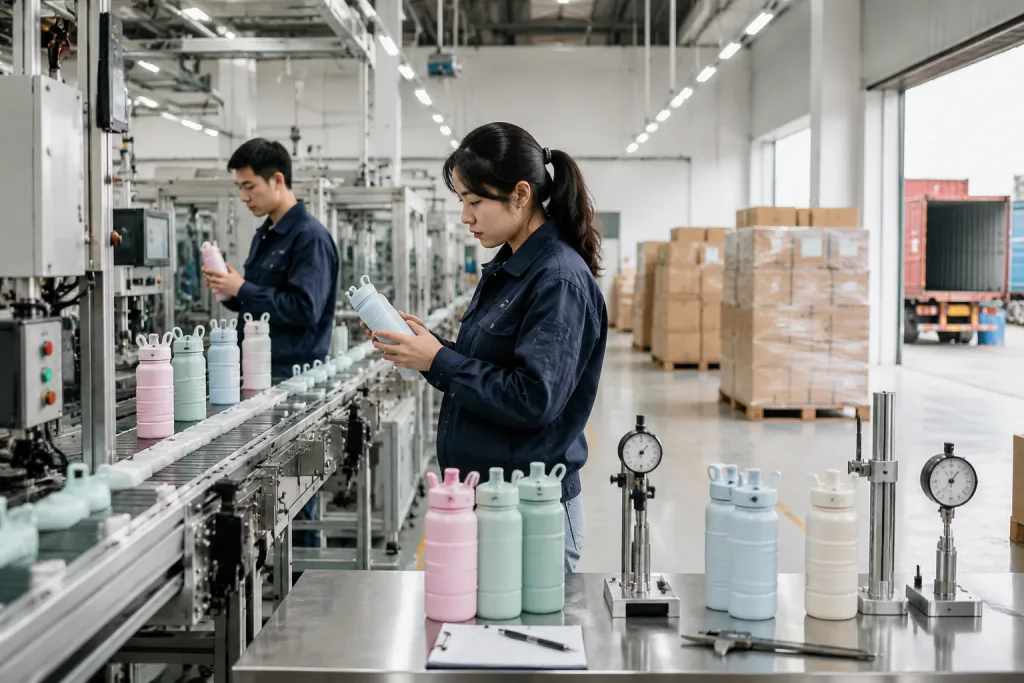
Key Takeaways
- For silicone polypropylene bottle bulk, spec the PP grade, silicone durometer, and lid torque, not just the capacity.
- A realistic MOQ is 3,000-5,000 pcs for standard tooling; custom colors and logo work can push it to 8,000 pcs.
- Expect 30-45 days for repeat production in China, plus 5-10 days for testing and packing if artwork is stable.
- Use AQL 2.5 major / 4.0 minor on appearance, and require migration or material compliance such as REACH or FDA where needed.
You are not buying a bottle shape. You are buying a repeatable production result. On silicone polypropylene bottle bulk orders, trouble usually shows up after approval: sleeves peel at the bond line, lids warp at 70-80°C washing, odor complaints come back from the first shelf test, or the Pantone match drifts between runs. We run into this after a buyer signs off on the photo and skips the material stack, mold tolerance, and test method. A 0.2 mm gap in the cap fit is enough to start trouble. We’ve seen it go sideways on the first carton check.
If you handle silicone polypropylene bottle bulk for retail, promo, or e-commerce, this is the wrong question to ask: does the sample look good in a flat lay? The math does not work that way. What matters is whether the bottle passes 10,000 open-close cycles, a 1.2 m drop, and a 24-hour odor check without turning into returns. QC pulled the sample on the line, and one buyer still flagged a PO typo on the cap color code. A serious factory in Zhejiang should quote a 30-45 day lead time for repeat orders, a 3,000-5,000 pcs MOQ on standard tooling, and monthly output above 300,000 units. Anything less predictable goes in the risk column.
Where these orders usually fail
The first failure mode is plain. The buyer signs off one sample and assumes the line will repeat it. It does not. On a silicone polypropylene bottle bulk order, PP shrinkage can move the cap fit by 0.2-0.4 mm, silicone overmolding can flash at the parting line, and a wrap label can hide a bruise that shows up under 5000-lux warehouse lights. We run into this every month. If you buy drinkware bulk, call out the boring specs: wall thickness, Shore A, seal geometry, drop test, and color delta.
The expensive mistakes are functional, not cosmetic. A loose cap on a 750 ml bottle leaks in transit. A silicone grip that picks up oils turns into odor complaints after a few weeks on retail shelves. We had a buyer flag a lid hinge at 1.1 mm; QC pulled the sample, and it cracked in the cold-drop test. The math does not work if the drawing is vague, because the factory follows it exactly and ships what you asked for.
- Cap fit: define thread pitch, torque range, and leak test pressure.
- Grip layer: specify silicone Shore A, commonly 40-60.
- Body: set PP wall thickness, often 1.8-2.5 mm for hand bottles.
- Inspection: use AQL 2.5 for major defects and require photo reports from mass production.
Material stack, not marketing words
“Silicone polypropylene bottle bulk” looks like one SKU on paper. On the line, it is 3 parts and 3 failure points. The PP body goes through injection molding. The silicone grip, seal ring, or cap insert is a second shot. That split matters. PP shrinks one way, silicone cures another, and if mold temp drifts 5°C or cooling slips by 2 seconds, QC sees it on the first tray.
PP is light and cheap. It works for cold fill and dry storage. Push it too thin and it warps. Silicone gives grip and sealing, but low-grade compound can smell, bloom, or split at the ribs after a few wash cycles. For a bulk canteen order, we ask for the exact PP resin grade, the silicone compound family, and the food-contact paper tied to FDA, LFGB, or the standard your market actually uses. The buyer once flagged a PO typo on “silicon” versus “silicone”; that looked small until QC pulled the sample and the spec sheet no longer matched the order.
Practical spec note: for a 650 ml to 1,000 ml bottle, start with a 2.0 mm PP wall and a 1.6-2.0 mm silicone sealing lip. We run a go/no-go gauge on the lip and a leak test at 1.5 bar. If a factory quotes thinner than that, ask how they will hold warp and stop seepage. The math does not work otherwise.
Lid leaks and torque drift
Leakage is the fastest way to turn a wholesale bottle into a returns pile. We saw it on a 4-cavity lid tool last spring: the hand sample passed, then the closure lost bite after 20 heat cycles. On silicone polypropylene bottle bulk, the neck finish and the seal line carry the risk. A 0.2 mm shift is enough to move the cap from clean to leaky. We had one buyer push back on that number until QC measured it with a go/no-go ring gauge. The math does not bend.
Ask for a torque window, not a loose “tight fit.” On screw-top bottles, 0.8-1.5 N·m is a normal starting point, depending on cap height and thread pitch. QC pulled the sample through a 30-minute water inversion test, and for shipping-sensitive lanes we also run vacuum or pressure leak checks. If the job includes growler bulk or beer growler wholesale, this is the wrong question to ask less of, because carbonation and truck vibration will show the weakness fast. One typo on a PO can hide a 1.5 N·m spec as 15 N·m, and we have seen that go sideways.
Do not approve a cap by feel alone. If one cavity passes and the other cavity slips, that closure is not ready for production.
For canteen wholesale or canteen bulk runs, ask for cavity mapping. Multi-cavity tooling often gives you one loose cavity by 0.15 mm, and the buyer flagged it only after mixed packing. We ship by cavity number when the program needs it, because sorting after fill is too late. Ask the factory how they mark the cavity on the line and whether a bad pocket can be pulled before packing. On our bench, the caliper and the cavity stamp tell the story faster than a sales promise.
Odor, taste, and migration risk
Odor complaints show up fast on low-cost drinkware bulk orders. We see it on the line. PP holds processing smell when the pellets are not dried right or when regrind creeps past the limit. Silicone does the same if curing is short or filler load goes too far. A buyer approved a sample after one rinse, then flagged the same part after 24 hours in a closed cabinet. That is the check. Not five minutes under a tap.
If you want a best wholesale drink bottle claim on the pack, you need paper behind it. In Europe, ask for REACH declarations and, where needed, LFGB or food-contact migration data. In North America, FDA food-contact compliance is the base line most buyers ask for. For alcohol flask bulk and alcohol flask wholesale bulk, we run a tighter screen because flavor carryover shows up fast. Same thing for beer tumbler bulk and beer tumbler wholesale bulk used in bars or event sets. The math does not work if you skip this step. One wrong lot of pellets can sink the order.
- Require odor evaluation after 24 hours of closed storage.
- Reject extra regrind in food-contact parts.
- Ask for curing or post-bake details on silicone components.
- Get written food-contact compliance by material.
If you are sourcing from China, do not assume last year’s test report still covers this batch. QC pulled the sample and found a pigment change on one run that was not on the old file. Ask for batch-level declarations when the factory changes pigment, mold release, or silicone supplier. We have seen this go sideways on a simple PO typo too.
Decoration that fails in transit
Logo work sends back more cartons than buyers expect. On silicone polypropylene bottle bulk, we run silkscreen, heat transfer, laser on a PP insert, or a molded logo. Each one has a weak point. Silkscreen can rub off when the surface is too smooth or curing gets rushed. Laser on dark PP can look sharp, then vanish on a textured panel. A molded logo drifts when wall thickness moves even 0.3 mm.
For bulk drinkware and drinkware wholesale orders, I would take a plain, durable mark over a high-gloss finish that flakes after two dishwasher cycles. The buyer pushes for shine. The math does not work. If the bottle will be reused, ask for two checks: a hand-rub with alcohol and one dishwasher or heat wash cycle. For custom-logo programs, put artwork tolerance in mm, not just Pantone color. QC pulled the sample on one job and the logo sat 1.2 mm off the shoulder; that is the kind of miss that turns into a claim.
Separate body color approval from logo approval. We run the body under one light source and the decoration under another, because bright red on matte silicone does not read like bright red on glossy PP. That is normal. What is not normal is approving both in one pass and then acting surprised when the buyer flags it on the first carton. If the spec does not spell out the difference, the line gets blamed for your missing rule.
MOQ, price, and factory reality
Most buyers ask for unit price too early. That is the wrong question to ask. For silicone polypropylene bottle bulk, the cost starts with tooling, cavity count, resin blend, and print method. A 750 ml PP bottle with a silicone grip and one-color logo usually lands around USD 1.10-2.10 FOB China at 3,000-5,000 pcs, and the number moves fast once the buyer flags a custom cap, a tight Pantone match, or a retail box. On the line, a 0.3 mm logo shift is enough to slow approval. We once held a run because the cap gap came in at 0.8 mm instead of 0.5 mm. Simple mistake. Fast fix, too.
A Zhejiang factory with steady export work should push 300,000+ units per month across drinkware lines, but that number means little if the schedule slips and QC is loose. We run this with first-article records, in-line checks, and BSCI audits on file. Ask for those three, then ask who signs off the top tray sample. If you are buying wholesale drink bottle, wholesale canteen, or wholesale growler, the real test is whether the factory keeps the same cavity, same resin, and same carton spec on the next run. A PO typo on carton size has burned more than one shipment. We had one buyer write 42x31x28 cm instead of 43x32x29 cm. The pallet math broke.
For canteen wholesale and growler wholesale buyers, we keep it simple: standard tooling, same logo position, same carton, same inner bag. That usually trims lead time by 5-8 days on repeat orders and cuts packing mistakes. The math works. If your order is for Amazon FBA, lock the carton dimensions and FNSKU label before production starts, not after the goods are wrapped. QC pulled the sample on one job because the label height was 2 mm off and the buyer did not want a repack. We ship faster when the spec stays still.
How to spec the order sheet
A purchase order is a control document. Full stop. If you want silicone polypropylene bottle bulk to land without late fixes, the order sheet has to tell the line what to make and what to reject. Put capacity, overall height, neck finish, lid type, body color, silicone color, logo method, packaging, and compliance papers on one page. Then set limits QC can check with a caliper, not by eye. We run the same check at 8:30 every morning.
Use this structure:
- Material: PP body, silicone grip or seal, no regrind on food-contact parts unless the buyer signs off. We caught a PO that said "food grade" and nothing else, and the line still had to stop for a 15-minute call over a missing material code.
- Dimensions: nominal capacity, tolerance ±3%, critical fit dimensions ±0.2 mm. The vernier on our bench gets used on these points every day, and a 1 mm mistake will show up on the cap ring. This is where vague specs fail.
- Tests: leak test, drop test at 1.0-1.2 m, dishwasher or heat-cycle requirement if needed. One buyer pushed for "normal use" and the math did not work. We asked for the actual drop height and got 80 cm, not a guess.
- Quality plan: AQL 2.5 major, 4.0 minor, with photos of reference defects. QC pulled the sample and found a lid gap at 0.8 mm, which would have turned into a claim. We blocked the batch on the spot.
- Documents: REACH, FDA, LFGB if requested, and packaging artwork approval. The buyer flagged a typo on the carton PO before we printed 5,000 units, which saved a reprint and a week on the packing line.
If the bottle is for sport retail, promo gifting, or private label, keep the wording plain. The factory in Zhejiang does not need brand copy. It needs a measurable brief. Better brief, fewer samples, fewer back-and-forth rounds, cleaner replenishment. We've seen vague sheets go sideways on MOQ 3,000 and delay shipping by 12 days versus 18 days. That is the wrong question to ask; the real issue is whether the sheet gives us one clean standard to run.
Buyer questions worth asking
The wrong questions burn weeks. The right ones tell you whether the supplier runs the line or just sends quotes from a desk. For silicone polypropylene bottle bulk, ask how many cavities the mold has, the cycle time in seconds, whether they run virgin PP or controlled regrind, and how they check silicone seal consistency with a go/no-go gauge. Ask for a pre-production sample, an in-line inspection report, and a final carton count sheet. If they stall on those, the program gets shaky fast. We run a 16-cavity lid mold on one line, so this is not theory.
For beer growler bulk, alcohol flask wholesale, or beer tumbler wholesale orders, the same rule holds. Repeatability matters. We had a buyer flag a 3 mm cap gap on a 12-day sample run, and QC pulled the sample back to the bench before we shipped the lot. A factory that can explain defect causes, show the control points, and commit to a 30-45 day production window usually beats one bragging about 5-day samples. The wrong question is which supplier talks the loudest. In Zhejiang, the good ones speak in measurements and failure modes, not slogans.
When you compare canteen bulk, bulk canteen, and drinkware wholesale options, keep the list short: compliance, closure reliability, surface quality, packing accuracy. Four checks. No more. We once found a PO typo on a carton mark that would have sent 1,200 units to the wrong buyer code, and the math did not work until we fixed it at the packing table. Those four items decide whether the shipment clears the first sell-through cycle or turns into a service headache. A 0.5 mm print shift is enough to trigger a buyer complaint.
Send your spec, get a real production quote
We will review your bottle drawing, confirm the failure risks, and quote the MOQ, lead time, and test plan from our Zhejiang factory.
Frequently asked questions
What MOQ should I expect for silicone polypropylene bottle bulk?
For standard tooling, a normal MOQ is 3,000-5,000 pcs per SKU. If you want a custom Pantone color, special lid, or retail box, the MOQ often moves to 8,000 pcs or more. In Zhejiang and other export factories in China, that threshold is tied to setup loss, cavity balance, and packing labor. If a supplier offers 500 pcs with full customization, check whether they are using stock parts or whether they are hiding tooling risk in the unit price. For repeat orders, you can usually keep the same MOQ but shorten lead time once the artwork and carton spec are frozen.
How do I check if the bottle will leak in transit?
Ask for a water inversion test for 30 minutes at minimum, and for travel or carbonated-use programs, add a pressure or vacuum leak test. The lid should have a defined torque window, often 0.8-1.5 N·m depending on the closure. Also request sample cartons be shipped in the same packaging you will use for the bulk order. A bottle that passes bench testing can still leak if the cap neck finish is off by 0.2 mm or if the seal lip is too soft. For silicone polypropylene bottle bulk, the leak risk is mostly in the interface, not the body.
What compliance documents should I ask for?
For Europe, ask for REACH-related declarations and food-contact support such as LFGB or migration data if your market requires it. For North America, request FDA food-contact confirmation where relevant. If you are buying drinkware wholesale for retail, also ask for material declarations for PP and silicone separately, not just one combined certificate. A good factory in China should be able to provide batch-linked paperwork, not only old reports. If the product will be used for alcohol flask wholesale bulk or beer tumbler bulk, confirm odor and flavor neutrality in writing, because those products are judged more harshly by end users.
What is a fair FOB price for a basic bottle?
For a plain 750 ml PP bottle with a silicone grip and one-color logo, USD 1.10-2.10 FOB China is a realistic working range at 3,000-5,000 pcs. Special tooling, matte textures, multi-color parts, or premium packaging will move it up. In Zhejiang, labor and mold amortization are not the biggest cost drivers; complexity is. If a quote looks much lower than this, check whether the factory excluded logo, carton, testing, or whether the quoted material thickness is too light for stable production.
Can I use the same supplier for canteen wholesale and growler wholesale?
Sometimes, but only if the factory can handle the relevant closure, wall thickness, and compliance requirements for both. A canteen wholesale item may focus on light weight and everyday carry, while growler wholesale or beer growler wholesale needs better seal integrity and sometimes thicker walls or a stronger handle. Ask for separate sample approvals and separate defect criteria. If the supplier has a monthly capacity above 300,000 units and can manage multiple SKUs in China without cross-mixing parts, that is a good sign. If they cannot keep cavity tracking clean, do not combine those programs.