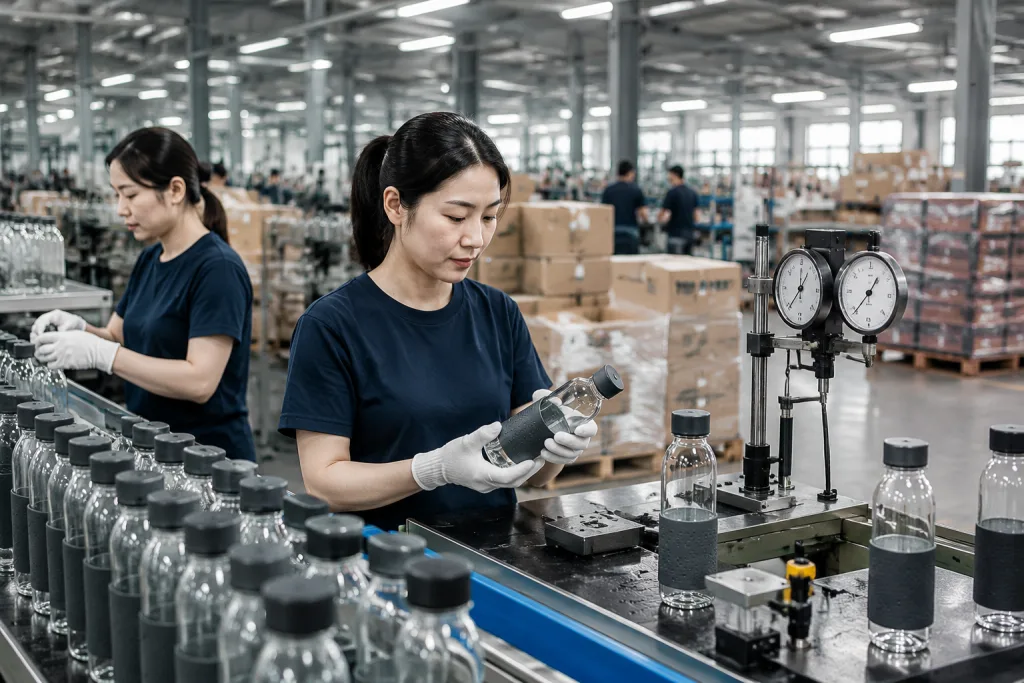
Key Takeaways
- Typical silicone glass bottle wholesale MOQ starts at 3,000 pcs per design, with 30-45 day production lead time in Zhejiang.
- A 500 ml bottle with 2.0 mm borosilicate glass and 1.2 mm silicone sleeve usually lands around USD 1.45-2.10 FOB China.
- For EU and US retail, ask for food-contact declarations, LFGB or FDA support, and carton drop-test data before you approve bulk drinkware.
- AQS-style inspection at AQL 2.5 major and 4.0 minor is a practical baseline for wholesale drinkware shipments.
Buy silicone glass bottle wholesale, and the sample can fool you. The PO is where the trouble starts. We check glass grade, wall thickness, whether the silicone sleeve is molded on or slip-on, what the cap is made of, and how many cartons show chipped rims after a 35-day ocean run. Margin sits in those lines.
At BottleForge in Zhejiang, we run bulk drinkware for Europe and North America every week, and the same mistake keeps showing up. Buyers compare unit price and skip the details. A bottle at USD 1.42 and one at USD 1.76 can look the same on a screen, but they are not the same once QC pulled the sample, freight lands, and the print rubs off after 12 days of carton rubbing on the line. That is the wrong question to ask. Read the spec sheet like the line does.
Start With The Glass Body
The glass body pays the bill. The silicone sleeve is backup. We check that on the line every week. If the glass spec is weak, the sleeve will not stop breakage, complaints, or chargebacks. For silicone glass bottle wholesale, borosilicate is the cleaner call because it takes thermal shock better than soda-lime. A normal spec is 500 ml, 2.0 mm wall thickness, 55-65 mm body diameter, and 185-220 mm overall height, depending on closure style. That stack gives enough stiffness without turning the bottle into a brick.
Weight hits procurement twice: FOB, then cartons and sea freight. We shipped a 500 ml sample at 262 g last month, and QC pulled the sample after a drop test cracked the shoulder on a 360 g thinner build. The math does not work below 1.8 mm wall thickness. Ask for height tolerance and mouth finish tolerance, not just nominal size. Straight neck, wide mouth, and threaded finish each change cap sourcing and filling line fit. The buyer flagged a canteen wholesale job once, and the shape was wrong for filling. That goes sideways fast.
Silicone Sleeve Is Not Decoration
The sleeve is not decoration. Buyers often pay for the look and miss the job. On a silicone glass bottle wholesale order, we run food-grade silicone at 1.0-1.5 mm, and QC checks the cutout edge with a caliper because a sleeve that feels soft but splits there fails fast. One buyer pushed back on the extra cost for a 1.2 mm jacket, then the 1.2 m drop test settled it. The wrong question is “does it look premium?” Ask whether it survives filling, carton compression, and the first week on shelf.
Ask straight away whether the sleeve is full-wrap or partial-wrap. Full-wrap gives better grip and impact protection, but it adds silicone weight and mold cost; partial-wrap trims the quote, yet the exposed glass takes more abuse in packing and at the store. For 350-750 ml bottles, we usually point buyers to full-wrap unless they want a lighter visual line. The math has to work. On one PO, the buyer typed “Panton 186C,” and the line held the wrong red for 12 days before we caught it, so we lock color against the retail assortment before tooling. If the compound is not in stock, a sleeve color change can add 7-10 days.
- Best grip: full-wrap 1.2 mm silicone
- Best for price: partial-wrap sleeve
- Best for branding: molded logo on a flat panel
Closure Specs Decide Leakage
The cap decides whether a bottle lands dry or comes back wet. On our line, we run stainless steel caps, bamboo caps with silicone seals, PP caps, and TPE-lined lids. The buyer usually points at the pretty one first. That is the wrong question. A stainless cap can look premium, but if the liner is not food-grade silicone or the torque drifts after a 30-minute vibration test, the spec is weak. QC pulled one sample at 0.8 N·m and it opened after three shakes.
Leakage is a number, not a slogan. We ask for inverted leak testing for 24 hours at room temperature, then we run it again after a hot-fill cycle if the bottle will see tea or warm water. Last month a PO typo changed “silicone gasket” to “silicon gasket,” and the buyer flagged it before production. For export orders, I want the gasket hardness range and cap torque target written down, not just a product photo. The math does not work any other way. If your program also includes alcohol flask wholesale bulk or alcohol flask in bulk requests in other SKUs, do not copy the same seal spec across them. Water, spirits, and carbonation fail in different ways. For beer growler bulk or beer growler wholesale bulk, the closure has to hold pressure, not just liquid.
Dimensions Shape Your Freight
On paper, dimensions look secondary. On a truck, they set the freight bill. The same 500 ml silicone glass bottle wholesale item can ship three ways, depending on whether the carton holds 12 pcs, 24 pcs, or 48 pcs. Tall and narrow gives better pallet count, but top-load risk jumps. Short and wide does the opposite. We ran this on the line last month with a 58 x 39 x 30 cm outer carton, and QC pulled the sample because the neck spacer was 2 mm short. For a canteen program, 48 pcs per master carton only works when the divider set is stiff and the bottle neck is locked in place.
Ask for three numbers in the quote: unit size, inner box size, outer carton size. Then ask for gross weight and CBM. That is the only way to see landed cost before the buyer flags it. We have seen quotes go sideways when a clean-looking bottle shape adds 12-18 percent to freight because the carton does not cube cleanly. This is the wrong question to ask: "Is the unit price low?" The better one is, "What does the packed carton cost to move?" A PO typo on our side once showed 560 ml instead of 500 ml, and the whole carton plan had to be redone. For a 500 ml bottle, 58 x 39 x 30 cm can work, but closure height and sleeve geometry decide the final number. Compare wholesale growler, beer tumbler bulk, or best wholesale drink bottle offers on cube efficiency first.
Decoration Changes The Cost Curve
Decoration is where a plain bottle turns into a SKU a buyer can list. In silicone glass bottle wholesale, we quote silk screen, laser engraving on metal parts, debossed or embossed mold details, and full-color label application. Silk screen is still the lowest-cost route at scale, but the line needs a flat pad, a fixed jig, and a clean spot-color count. We had a buyer flag a two-color logo on a curved shoulder, and QC pulled the sample in 10 minutes because the edge lifted on the first rub test. Laser engraving is cleaner on stainless cap parts and holds up better. Molded branding on silicone sleeves gives the strongest mark, but once you sign off that cavity, you own the tool cost.
If the order is promo or seasonal, ask for decoration pricing at 3,000 pcs, 10,000 pcs, and 30,000 pcs. On paper, unit cost can drop 8-15 percent as volume climbs, but only when setup time stays under control. The buyer usually wants one landed number and skips the screen fee, plate fee, or mold charge. That is the wrong question to ask. We had a PO last month with "lasor" on the artwork line, and the quote came back wrong until we matched it to the actual cap part. For brand owners comparing drinkware wholesale programs, the decoration method should fit the channel: e-commerce needs repeatable photo output, retail needs abrasion resistance, gift sets need a better hand feel. If you are also sourcing bulk drinkware across canteen bulk, growler bulk, or beer tumbler wholesale bulk, keep the print spec aligned so the shelf line does not look stitched together.
Compliance Is Not Optional
For Europe and North America, compliance is the gate. Not a sales feature. A silicone glass bottle wholesale order needs food-contact declarations, REACH support, and LFGB or FDA-aligned material data, depending on where it lands. We had one buyer flag a 2 mm sleeve because the colorant file was missing azo dye limits. If the cap carries metal parts, ask for migration and corrosion data. Hot-fill or repeat washing? Get the temperature limit in writing. No guesswork.
Ask for a test pack before you place a large order. I want material specs, third-party lab reports, and production controls tied to ISO-style processes. QC pulled a sample last month and the barcode on one carton printed 1.5 mm too low; that sort of thing burns time on the dock. If you ship into Amazon or retail, carton labels and FNSKU handling matter too. A factory in Zhejiang with export work should state monthly output, QA steps, and test cadence without hedging. We run 120,000 units per month across drinkware programs, and a 3,000 pc MOQ usually ships in 30-45 days, depending on sleeve color and print. The math does not lie.
MOQ And Price Bands
Buyers often start with the lowest silicone glass bottle wholesale quote, then try to build the spec around it. That is the wrong question to ask. We run it the other way: lock the build, then price the build. For a 500 ml borosilicate bottle with silicone sleeve and standard closure, FOB China usually sits at USD 1.45-2.10 at 3,000 pcs. On one order, the buyer flagged a PO typo on sleeve color code, and the corrected Pantone added a small setup fee. Glass wall thickness, cap material, and print method move the number fast. At 10,000 pcs, unit price often drops 6-12 percent, but a tricky mold or a special cap finish can wipe out that gain.
MOQ is a production math problem. Silicone color matching, glass forming, printing setup, and carton sourcing each have their own floor, and QC pulled the sample before we released one recent run. For canteen wholesale and wholesale canteen programs, buyers sometimes ask for 500 pcs because the bottle looks simple. The math does not work. If you want a pilot, ask for mixed SKU consolidation or start at 3,000 pcs with a written re-order price. That beats a low-MOQ promise the factory cannot hold when the line is running in China.
Inspect Like A Buyer, Not A Tourist
The sample room hides problems. The line exposes them. For a silicone glass bottle wholesale audit, ask for incoming material checks, sleeve fit checks, drop-test logs, and finished goods sampling. We run calipers on sleeve thickness at 1.2 mm to 1.5 mm, and QC pulled the sample when the print sat 3 mm off center. Use AQL 2.5 for major defects and 4.0 for minor defects, with chips, bubbles, off-center printing, cap leakage, and color drift on the watch list. For a glass-and-silicone build, the misses are usually visual or mechanical. Skip that part, and you buy trouble.
Before you approve bulk drinkware, ask for a pre-production sample, a gold sample, and a packed sample. They are not the same thing. The packed sample shows whether the divider system, master carton, and pallet pattern actually protect the product. We had a buyer flag a PO typo once: 24 pcs per carton became 42 pcs, and the pallet math broke on the floor. A factory that ships regularly from Zhejiang should show QC photos, in-process checkpoints, and a simple corrective action trail. If the supplier cannot explain how it keeps breakage below 1.5 percent in transit trials, walk. This is the number that matters, not the brochure.
Request a factory spec quote today
Send your target size, color, logo method, and annual volume. We will quote the exact spec, packing, and lead time from Zhejiang.
Frequently asked questions
What MOQ should I expect for silicone glass bottle wholesale?
For a standard 350-750 ml silicone glass bottle wholesale order, a realistic MOQ is 3,000 pcs per design. If you want custom sleeve color, printed logo, and retail carton, 5,000 pcs is more common because the color setup and packing materials need scale. Smaller trial orders can be possible, but the unit price usually rises 12-20 percent and the lead time becomes less predictable. In Zhejiang, production planning is built around line balance, so the factory will usually ask for one clear spec package instead of piecemeal changes.
What is a fair FOB China price for this bottle?
For a 500 ml bottle with borosilicate glass, silicone sleeve, and standard closure, a fair FOB China range is usually USD 1.45-2.10 at 3,000 pcs. The lower end fits simpler caps and standard colors; the upper end covers thicker glass, better closure hardware, or more complex branding. If you see a quote much lower than that, check carton spec, wall thickness, and compliance support. Very cheap quotes often hide weaker glass, thinner sleeves, or incomplete packing.
How do I reduce breakage in bulk drinkware shipments?
Use 2.0 mm glass wall thickness where possible, specify protective dividers, and insist on a packed sample before mass production. For export cartons, ask for drop-test data and confirm master carton compression strength. A sleeve helps, but it does not replace good packing. For sea freight, breakage below 1.5 percent is achievable when the bottle shape, divider, and carton size are designed together. If the supplier cannot show a transit-tested packing pattern, the shipment is not ready.
Which compliance documents should I request for Europe and the US?
Ask for food-contact declarations, REACH support, and LFGB or FDA-aligned material documentation depending on destination. If the cap or logo parts include metal, request migration or corrosion-related data. For colored silicone, ask about heavy metals and dye restrictions. If you are selling on retail or marketplace channels, barcode readiness and carton labeling matter too, including FNSKU handling if you use Amazon fulfillment. Keep the document set tied to the exact SKU, not a generic product family file.
Can I use the same supplier for growler bulk or alcohol flask wholesale bulk orders?
Yes, if the factory has the right tooling and compliance setup, but do not assume the same spec works across categories. A growler bulk SKU needs closure and seal control for carbonation or beer storage, while an alcohol flask wholesale bulk SKU has different lining and odor considerations. For beer growler wholesale bulk, sealing and pressure resistance matter more than sleeve comfort. For alcohol flask in bulk, stainless finish and leak control usually take priority over grip. A supplier that understands drinkware wholesale across multiple categories can usually consolidate your sourcing better.