Key Takeaways
- Lock the glass wall at 2.0-2.4 mm and the silicone sleeve at 50-60 Shore A to control breakage and fit
- Ask for AQL 2.5 for critical defects and a 1.2 m drop test on packed units before PO release
- A usable MOQ for custom canteen or custom growler work is usually 3,000-5,000 pcs, not 300
- For China sourcing, a realistic custom lead time is 20-30 days plus 7-12 days for sea freight prep
You can buy a glass bottle anywhere. The hard part is getting a silicone glass bottle through filling lines, transit, and customer use without ending up with a warranty pile. The weak points show up fast: sleeve shrinkage, cap torque drift, chipped rims, weak glass-to-silicone bond, and packaging that looks fine on paper but fails a 1.2 m drop test. We’ve seen that go sideways in week one. If you source from China or Zhejiang, the supplier needs to talk numbers, not slogans.
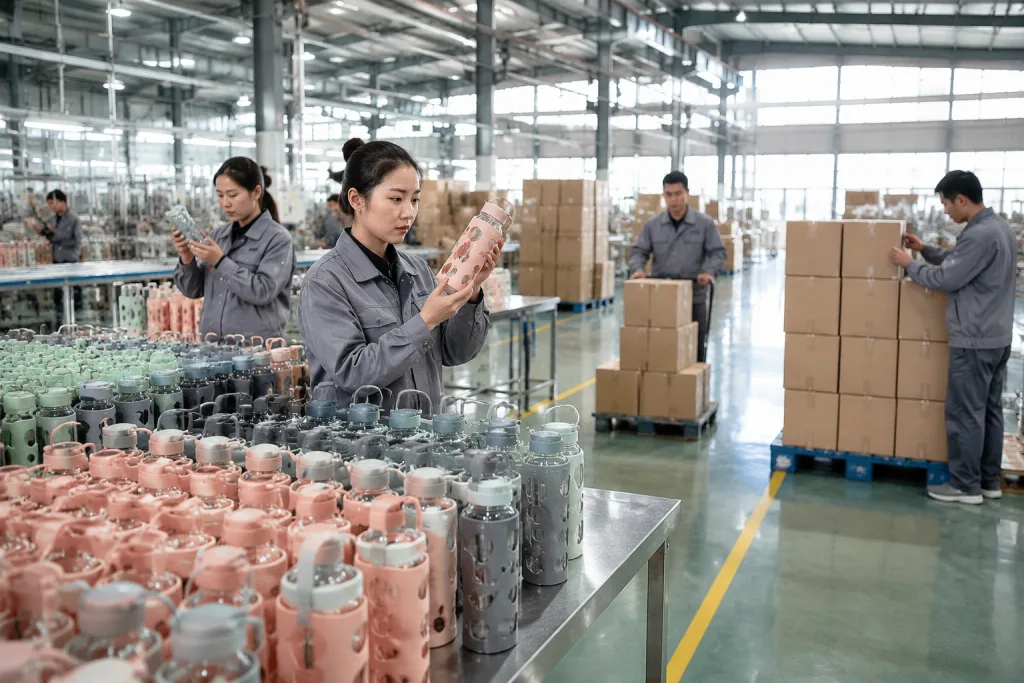
A serious silicone glass bottle supplier should hand over a spec sheet, not a story. You want exact glass wall thickness, silicone durometer, cap material, print method, and packing standard. At our Hangzhou factory in Zhejiang, the line runs 120,000 units per month, MOQ starts at 3,000 pieces, and standard lead time is 20 to 30 days after sample approval. QC pulled the sample with calipers at 1.8 mm last week. That detail matters. The buyer flagged a 0.3 mm drift on a PO typo once, and the whole carton label run had to be corrected before we ship.
Where silicone bottles actually fail
The first failure is not the glass. It is the joint between the glass body and the silicone sleeve. We run into this on the line every week. A loose sleeve shifts in the carton and leaves rub marks. A tight one drives assembly damage up, and QC pulls cracked shoulders or a twisted base. Put sleeve hardness, tolerance, and covered height in the spec. For retail bottles, 50-60 Shore A works. Softer than that feels cheap and slides in hand; harder than that makes insertion fight the glass. We saw a 1.2 mm shoulder crack on a 500 pcs trial after the sleeve ID was copied from the wrong sample, and that was the end of the debate.
The second failure is cap fit. A bottle can pass a hand-tight sample and still leak after 300 open-close cycles if the thread form is sloppy or the liner swells. Ask for torque data, a closing torque window, and a leak test at 0.2-0.3 bar for vacuum or pressure-sensitive SKUs. This is the wrong question to ask if the buyer only cares about artwork. The cap is what gets you a return. We had one PO where the buyer flagged a typo on the thread callout, and the lot failed at 18 days instead of 12 because the liner sat 0.4 mm too high. Printing is the third weak point. Silk screen on silicone looks clean before rub testing starts, then it smears. If you need branding that holds, confirm whether the logo sits on the glass, sleeve, or cap, and ask for abrasion data. Don't assume it will survive shipping.
Glass spec is not cosmetic
Buyers often treat glass as a color choice. Wrong question. A silicone glass bottle supplier has to lock down the glass type, wall thickness, rim finish, and annealing control before artwork starts, or you get a bottle that looks fine on a render and cracks on the line. We run 2.0 mm for light domestic orders, but 2.2-2.4 mm is the safer export band, and anything below 1.8 mm only works when the pack is built for it. On one 500 ml run, QC pulled the sample after a corner rub left a hairline chip at 1.9 mm. Courier sorters are brutal.
Check the rim finish next. A rolled or fire-polished rim cuts mouth-cut risk and keeps the fill line from rejecting bottles for small edge defects. We had a buyer flag a PO typo on the neck spec once, and the cap seal failed on the first 300 pcs because the neck surface was not clean enough. That was a 0.3 mm mismatch, and the math does not work. For a wide-mouth custom growler or a canteen custom format, that becomes a bottleneck fast. Ask for ASTM or ISO language where it applies, then ask for internal stress checks and a visual inspection under steady light. Weak canteen manufacturers will talk only about color. We do not.
- Glass wall: 2.0-2.4 mm
- Rim finish: fire-polished or rolled
- Critical inspection: 100% visual on neck and rim
- Pack drop target: 1.2 m outer carton test
Silicone sleeve fit and smell
The sleeve is where a lot of canteen suppliers overpromise. Silicone is not a color choice. We run odor, compression set, and surface finish checks on every pilot run, because a sleeve that comes off the bag smelling sharp gets flagged by the buyer on day one. Ask for REACH compliance and, for North America, material declarations that back up FDA food-contact claims. If the supplier says “food grade” but cannot show test data, that is a red flag. QC pulled one sample last month that still carried odor after 48 hours in a sealed carton.
Fit matters just as much as chemistry. A sleeve that is 0.3-0.5 mm off leaves air pockets or wrinkles, and those turn into dust traps on the line and in the warehouse. For canteen promotional items that need a clean shelf look, we want repeatable surface tension and a stable matte or glossy finish, not a sleeve that shifts batch to batch. If you are buying a customizable canteen for outdoor or fitness channels, ask for a compression recovery test after 24 hours. We have seen a sleeve rebound slow and leave a dent after cartons sat stacked for 14 days. The math does not work when the fit is loose.
Practical rule: if the silicone part is not measured, it is not controlled.
Printing and branding failures
Custom branding is where buyers burn 5 to 7 days on sample rounds. We see it on the line every week. The real question is not whether a logo can be printed. It is whether the mark still holds after rub, wash, and packing scuff. Glass gives cleaner edges than silicone, so if you need a distributor canteen line or a canteen distributor private label program, put the main brand on the glass or use a laser mark on a metal cap where the cap spec allows it. Silicone ink can work, but QC should pull the sample after detergent wash and 500 rub cycles, then check edge lift under a loupe.
For canteen custom programs, ask the supplier to name the print method by substrate: silk screen, pad print, UV, laser, or hot transfer. A vendor who says they can do all of them without limits is guessing. The math does not work. If you need a canteen customizable for retail and a second version for corporate gifting, keep the decoration files separate. One SKU’s artwork tolerance should not be mixed with the other. We had a buyer flag a PO typo on a 1.5 mm logo clearance once, and the rework cost more than the print itself. Lock the Pantone target, minimum stroke width, and curved-glass clearance before we run the first batch.
Packaging decides your damage rate
Most breakage shows up after the carton leaves the line. We see it in the warehouse first, then the buyer flags it with photos. Packaging sits in the spec, not on the side. For a custom drinkware launch, lock down the inner tray, carton wall strength, dividers, and whether the bottle ships assembled or partly knocked down. A glass bottle in a loose insert will fail on a 20 ft consolidation run. For export, we run E-flute or heavier outer cartons with molded pulp or die-cut inserts that lock the neck and base. 30 mm of slack is enough to turn into a claim.
Ask your canteen factory to run a carton compression test and a transit simulation with a 1.2 m drop on corners and edges. QC pulled the sample with a steel tape and checked the headspace twice. If the item is fragile, add a spare cap liner and make sure the bottle does not rattle. A packing design that is dialed in can cut breakage from 3-5% to under 0.8% on real freight. That gap matters. The math does not work any other way. For Zhejiang suppliers shipping from China, sea freight consolidation can hide weak packing until the first warehouse receiving report, so you need the test before booking, not after.
MOQ, lead time, and sample control
You should not accept vague production promises. A credible silicone glass bottle supplier will split sample time, tooling time, and mass production into separate lines. For a plain customized drinkware job with existing mold geometry, sample turnaround runs 5-7 days. New mold work takes 20-35 days, and first bulk production needs another 20-30 days after sample signoff. We had a buyer flag a PO typo once, “1,000 pcs” turned into “1000 sets,” and the line sat until the carton mark was fixed. If someone offers 1,000 custom pieces in a week, the math does not work; they are probably moving stock with a logo patch, not a true customized canteen or customized growler program.
MOQ should match the production method. For straight print-on-stock jobs, 1,000-2,000 pieces is workable. For a truly custom canteen with sleeve color, cap finish, and packaging changes, 3,000-5,000 pieces is normal in China. That is fine for a distributor canteen buyer with a channel order behind it. It is the wrong question to ask if you are trying to treat factory production like a retail sample counter. QC pulled the sample at AQL 2.5, and the supplier should still confirm pre-production sample retention, golden sample approval, and batch traceability by date code or carton mark.
Quality checkpoints that matter
Good QC is boring. That is the point. We run the same gates every time: incoming glass inspection, silicone durometer check, assembly check, logo inspection, leak test, drop test, and final carton audit. On the bench, we use a durometer gauge and a 1.5 m drop fixture, because hand-waving here gets expensive fast. AQL 2.5 works for some major defects in drinkware programs, but for leakage or breakage the math does not work, and we push tighter control with zero-tolerance language. If a canteen manufacturer only says “QC team” and never names the checkpoints, you are taking their risk onto your books.
Ask for a pre-shipment inspection report with actual counts, not pass/fail. The report should show lot numbers, defect classes, photo evidence, and carton counts. QC pulled a sample on a branded retail run last month and found a 2 mm logo shift that would have failed the buyer's shelf check. For canteen suppliers shipping into Amazon or similar channels, barcode verification matters too. If FNSKU labels are in scope, check that the factory applies them under fixed position and adhesion rules, not wherever the line has space. The buyer flagged a PO typo on one run, and that one line would have wrecked a pallet mix. In Zhejiang, the better shops run process sheets and line audits; the rest sort at the end, which is too late for export.
How to compare suppliers properly
Do not compare silicone glass bottle suppliers by catalog prettiness. Compare what they can hold on the line. A real canteen manufacturer should answer glass wall spec, silicone hardness, leak test, carton drop standard, and MOQ by decoration method without hand-waving. We had a buyer flag a 1.8 mm wall callout on a PO typo once; QC pulled the sample, and the supplier who could not match it was done. If the answer is weak, that factory is not ready for distributor drinkware work. The same goes for a canteen promotional run, a customized canteen for retail, or a custom canteen for corporate gifting.
The buyers who do this well use one scorecard across all custom drinkware. Score the factory on compliance, sample speed, packing engineering, and communication quality. That is the right question, not whether the brochure looks polished. In our shop, the suppliers that ship clean documents usually run cleaner jobs too. Ask for process references, not brand names, if you need a canteen vendor for a repeat program. A proper quotation should show EXW or FOB terms, unit weight, carton size, and accessories. That gives you the landed-cost math without guesswork, and it keeps the cheap unit price from hiding freight damage on a 12-day versus 18-day schedule.
Spec your next silicone bottle the hard way
Send the drawing, target MOQ, and packaging brief. We will quote the glass, silicone, print, and carton plan with real production numbers.
Frequently asked questions
What MOQ should I expect from a silicone glass bottle supplier?
For stock geometry with custom printing, 1,000-2,000 pieces can be realistic. For a true custom canteen with sleeve color, packaging, or cap changes, expect 3,000-5,000 pieces. If the supplier claims 300 pieces for a full custom build, they are usually offering a lightly modified stock item. In China and Zhejiang, the sensible MOQ is tied to assembly labor, print setup, and carton allocation. Ask for the MOQ by decoration method, because laser marking, silk screen, and sleeve molding do not carry the same setup cost.
How do I know if the bottle will leak in transit?
Ask for a leak test on every cap SKU, not just one sample. A practical method is a 0.2-0.3 bar pressure or vacuum check, plus a 24-hour inverted hold test. For export cartons, add a 1.2 m drop test on corners and edges. A factory that can only show a photo of a sample bottle is not enough. For distributor canteen programs, you want written acceptance criteria and a pre-shipment report with actual pass rates.
What materials should I require for compliance?
For the glass body, request a material declaration and any relevant food-contact or migration test support. For the silicone sleeve, ask for REACH compliance and food-grade documentation; for North America, you may also want supporting FDA food-contact statements. If a metal cap is used, check coating and liner details. Good canteen suppliers in China should be able to provide test references without delay. If they cannot, treat that as a sourcing risk.
Can I use the same supplier for canteen custom and custom growler projects?
Sometimes, yes, but only if the factory understands the functional differences. A canteen customized for daily hydration may need a slimmer profile and a smaller mouth, while a custom growler usually needs a wider neck, stronger cap seal, and heavier packing. The decoration and carton requirements are different too. If the supplier can quote both with clear specs, that is useful. If not, split the projects and avoid forcing one process onto two very different products.
How long does production usually take in China?
For an existing mold and simple printing, 20-30 days after sample approval is normal. New tooling or more complex packaging can add 20-35 days before mass production starts. Freight to Europe or North America then adds roughly 7-40 days depending on sea or air. In Zhejiang, a strong canteen factory will separate sample time, mass production time, and shipment time clearly. That matters because a lot of buyer frustration comes from mixing those three into one vague promise.