Key Takeaways
- Typical MOQ for a silicone glass bottle order is 1,000 to 3,000 pcs, with sample lead time around 7 to 10 days.
- A serious canteen manufacturer should quote wall thickness, silicone durometer, and lid torque, not just bottle capacity.
- FOB pricing for a 500 ml silicone glass bottle often starts around USD 1.80 to 3.80 depending on decoration and packaging.
- For export to the EU or US, ask for REACH, LFGB where relevant, and AQL 2.5/4.0 inspection terms before you confirm.
If you are buying from a silicone glass bottle manufacturer, do not treat it like a simple bottle order. We run glass neck tolerance at 0.3 mm, sleeve fit, closure sealing, decoration, and carton drop risk in one file. Miss one point and QC pulls the sample for leaks. We have seen a pallet land with two broken necks and the buyer flags it before the truck leaves the dock.
For B2B buyers in Europe and North America, the right question is not “who can make it?” It is “who can make it every run, at the right MOQ, with the right papers?” In China, especially Zhejiang, a lot of canteen factory names look fine on paper, but only a smaller group can hold REACH docs, keep lead time at 18 days instead of 12 days slipping to 24, and ship with no PO typo on cap color or logo size. The math does not work otherwise.
What you are really buying
When you ask a silicone glass bottle manufacturer for a quote, you are not buying glass and silicone alone. You are buying how the bottle rides in a carton, sits on a shelf, and survives 200 wash cycles. The sleeve is not decoration. It changes grip, takes light knocks, and shifts the first price impression. We have seen buyers skip that part and get burned later.
Start with the construction details. A proper spec sheet should show the line items below; QC pulled the sample against these before we shipped:
- Glass type and wall thickness, usually 1.8 mm to 3.0 mm for hand-held drinkware
- Silicone sleeve durometer, commonly 50A to 70A
- Closure material, such as PP, stainless steel, or bamboo composite
- Capacity, for example 350 ml, 500 ml, or 750 ml
- Drop-test target, often 1.0 m to 1.2 m with packed cartons
If a canteen supplier only says “nice look” and skips these numbers, that is the wrong question to ask. The math does not work. In Zhejiang, the better factories give you wall thickness, durometer, and carton drop target up front because buyers in Europe and North America flag missing data fast; one PO typo on a 500 ml order cost us a full day on the line. That applies to a custom canteen, customizable drinkware, or a customized growler-style bottle for promo use.
Questions to ask first
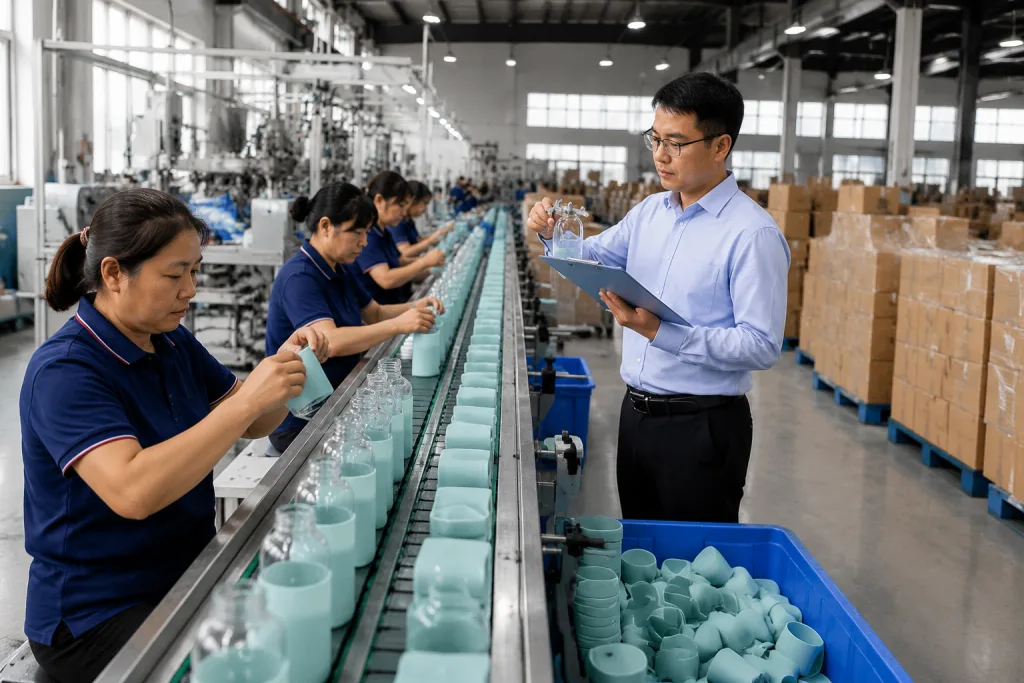
Start with a screening call. Before artwork or Pantone, ask how the factory holds variation on the line. A solid silicone glass bottle plant should give you the cavity count, the monthly output, and the QC pull point without hunting around. At BottleForge Industrial in Hangzhou, Zhejiang, one line runs 180,000 units per month across stainless and glass drinkware, but that number means little if the inspection chart is weak. We run a caliper check on the first article before lunch. Capacity without control just ships defects faster.
Ask these questions first:
- What is the MOQ for stock color versus custom Pantone silicone?
- How many days for sample production, and is the sample charge refundable against bulk?
- Which tests are standard: dishwasher, thermal shock, leak, drop, and odor?
- Can you supply REACH, LFGB, FDA-style declarations, or third-party test reports?
- What carton configuration do you use for export, and how many pieces per master carton?
If the answers come back slow or thin, you are probably talking to a canteen vendor doing domestic trade, not export work. We've seen this go sideways: a buyer flagged one PO typo on the carton count, and the correction added 3 days before booking. The math doesn't work if the factory cannot read a shipping line correctly. For canteen distributors and distributor drinkware programs, the gap shows up later in chargebacks or returns. Better to catch it on day one.
MOQ and pricing reality
Pricing gets messy fast in custom drinkware. We run this on the line every week. A 500 ml clear borosilicate-style bottle with a plain sleeve and basic carton usually lands around USD 1.80 to 2.40 FOB China at 1,000 pcs. Add a one-color logo, a colored sleeve, and a premium lid, and the quote moves to USD 2.80 to 3.80 FOB. That is normal. The buyer who says “same bottle, lower price” is asking the wrong question.
Tooling is where the math starts to bite. A custom canteen or customizable canteen run may need new molds, sleeve tooling, or branded closures. QC pulled the sample on a 65 mm closure once, and the buyer flagged the fit before we shipped. Without that check, we would have eaten a return. Common ranges are:
- Silicone color matching: no tool cost if the factory uses standard compounds, but custom Pantone usually pushes MOQ up
- Silkscreen or pad print: often USD 0.05 to 0.20 per location
- Laser engraving on metal parts: often USD 0.10 to 0.30 per unit
- Custom packaging: usually adds USD 0.15 to 0.60 depending on insert and print
If you are comparing canteen manufacturers, compare landed cost, not the factory quote alone. We have seen this go sideways when a low quote passed pricing but failed carton compression at 12 kg stack load, then broke in export vibration. For canteen promotional campaigns, a slightly higher per-unit price often wins because the damage rate stays lower and reorders do not turn into a headache.
Quality checks that matter
Quality is where a lot of canteen suppliers get vague. We do not. Put the acceptance criteria on paper: AQL 2.5 for critical and major defects, 4.0 for minor defects. For glass-inside bottles, I want incoming QC, in-process QC, and final inspection records on the table. If a factory only says “we check carefully,” that is shop talk, not a process. Last month, QC pulled a sample with a 0.8 mm lid gap, and the buyer flagged it before we shipped.
For glass and silicone drinkware, ask for these tests where applicable. The line should show the result, not a promise. A 5 kg dumbbell and a 1.2 m drop box tell you more than a sales line ever will.
- Leak test at the lid and seal interface
- Thermal shock, such as 20 C to 100 C transitions if the product claims hot-fill tolerance
- Drop test from 1.0 m or 1.2 m in packed form
- Dishwasher resistance for print and sleeve stability
- Odor and migration checks for silicone and coatings
You also need material traceability. If the supplier says LFGB or REACH, ask for the report number and the lab name, not a screenshot. We ship enough bottle programs to know the math does not work when a factory cannot tie one lot back to one test report. A good canteen manufacturer in China gives you that path fast. A weak one sends a PDF with no chain behind it, and we've seen that go sideways on a retailer PO with a typo in the carton count.
Packaging and shipping risk
Glass changes the shipping math fast. A silicone glass bottle can sit fine on the shelf, then fail in the carton, on the pallet, or at transshipment. We run export packs with 12 mm dividers and 5-layer cartons because retail artwork does nothing when a 1.2 m pallet gets crushed. Ask for sea-freight abuse, not store-display packing. We had one buyer push back on a 28 kg master carton limit, then QC pulled the sample and the corner pad failed the 0.8 m drop test. That is the part that matters.
As a baseline, look for:
- Master carton burst strength rated for sea freight, not domestic truck runs
- Individual polybags or paper wraps to protect the silicone surface from scuffing
- Barcode labels and FNSKU placement if you sell into Amazon channels
- Pallet height and stacking limits written into the packing list, with no guesswork
For distributor growler or custom growler style programs, overpacking can lift freight cost by 8% to 15%, and underpacking can wipe out margin through damage claims. The math does not work either way. We saw one buyer flag a 3 g typo on the carton spec, and the whole pack plan had to be rerun on the test line. Another order had “FNSUK” on the PO, and the label printer stopped the job until we corrected it. Zhejiang exporters who ship to North America every week usually know carton logic and pallet specs better than first-time buyers expect. Ask for a packing sample before mass production starts.
Customization without chaos
Custom drinkware is easy to oversell and hard to run on the line. Add one variable, and QC wants a new gauge. We had a 500 ml silicone glass bottle job where the body, sleeve, and lid looked clean on paper, then the sleeve fit missed by 1.5 mm after a Shore A change. One Pantone shift can sink a retail PO fast. We’ve seen that go sideways.
Keep customization decisions in this order. We run it this way for a reason:
- Confirm bottle shape and capacity
- Lock material specs and tolerances
- Choose logo method: silkscreen, pad print, decal, or engraving
- Approve sleeve color against a physical standard
- Finalize packaging and barcode requirements
This sequence matters whether you buy from a canteen supplier, a canteen vendor, or a broader drinkware manufacturer. Same logic on custom growler runs and custom canteen programs. The buyer flagged the artwork first once, and the line had to stop because the neck finish was still under review. That was a 30-day job on paper; it turned into 58 days, and the math does not work. QC pulled the sample at 3.2 mm, and that saved us from a worse miss.
Picking the right factory partner
You do not need the biggest factory. You need the one that fits your channel, your compliance file, and how often you reorder. A supermarket canteen distributor watches carton crush tests and weekly replenishment. A brand owner launching a seasonal custom canteen run cares about Pantone match and sample speed. A North America drinkware buyer usually asks for warehouse labels, FOB terms, and one clean PO trail. We see the same mistake every month: buyers chase size, then the line slips behind a bigger account. That is the wrong question to ask.
Check the supplier on three points that actually move the job:
- Capacity: can they hold 180,000 units per month without bumping your order for a bigger customer? Ask for the line plan, not a sales promise.
- Compliance: can they support BSCI, REACH, LFGB, plus in-line inspection records the buyer can audit? QC pulled the sample on a Friday, and the file still had to pass.
- Communication: do they send drawings, tolerances, and QC photos, or just say "no problem" and wait for trouble? A PO typo on the carton count can burn two days before you even catch it.
In Zhejiang, plenty of canteen manufacturers have decent machines. The gap is management. We saw one factory with a 12-head filling line lose a 40,000-piece order because the PO said 12 pcs/ctn and the buyer wanted 24; the math does not work. A solid silicone glass bottle manufacturer will send a sample in 7 to 10 days, ship bulk in 30 to 45 days depending on decoration, and keep the path from PO to carton label tight. That matters when the ship date is fixed and nobody wants a last-minute typo on the outer carton. We run it that way for a reason.
Get a factory quote with real specs
Send your capacity, logo method, and target market. We will quote MOQ, lead time, testing, and FOB pricing without guessing.
Frequently asked questions
What MOQ should I expect from a silicone glass bottle manufacturer?
For a standard silicone glass bottle, expect MOQ around 1,000 to 3,000 pcs per design and color. If you want custom Pantone silicone, a branded lid, or special packaging, the MOQ may move to 3,000 to 5,000 pcs. Samples usually take 7 to 10 days, and bulk production often runs 30 to 45 days after sample approval. A serious factory in Zhejiang should state this clearly up front, not after you have already spent time on artwork. If the supplier cannot commit to MOQ by component, you are likely dealing with a weak canteen supplier.
How do I check whether the bottle is safe for EU or US sale?
Ask for material declarations and third-party test reports, not just a verbal claim. For the EU, REACH is a basic expectation, and LFGB is often requested for food-contact reassurance. For the US, buyers typically request FDA-style food-contact compliance documents and migration evidence from recognized labs. Also confirm whether the silicone is odor-free after washing and whether the print survives dishwasher cycles. A proper canteen manufacturer will know which documents apply to glass, silicone, and closure parts separately. Do not accept one generic certificate for the whole product if the materials are different.
What decorations are best for custom drinkware?
For durability and cost control, silkscreen is usually the first choice for simple logos, often USD 0.05 to 0.20 per color position. Pad print works for smaller surfaces or curved areas. Laser engraving is best on metal lids or accessories, typically USD 0.10 to 0.30 per unit. Decals can look premium, but they need more process control. For a customized canteen or customized drinkware program, choose the method that matches your order size and wash requirements. A promotional order may prioritize fast setup, while a retail order should prioritize abrasion resistance.
Can I source a custom growler or canteen promotional item with the same factory?
Yes, if the factory has broader bottle and closure capability. Many canteen manufacturers in China produce both standard water bottles and custom growler-style drinkware, but you should confirm mold access, lid options, and packaging strength before you mix categories. A promotional order often needs quicker turnaround and lighter decoration, while a retail growler needs tighter leak and transport control. Ask whether the supplier can handle both customized growler and custom canteen programs under the same QC system. That is the real test, not just whether they can print a logo.
How should I compare quotes from canteen vendors?
Compare on the same basis: capacity, wall thickness, material grade, closure, decoration, carton spec, and test requirements. A quote that is USD 0.20 lower but excludes export cartons, drop testing, or barcode labels is not actually cheaper. Ask each canteen vendor for an itemized FOB quote and a packed carton cost. If you are selling through Amazon or a distributor channel, include FNSKU labeling, master carton marks, and pallet specs. This is how you separate a real canteen factory from a supplier that is only good at sending samples.