Key Takeaways
- Most silicone glass bottle bulk orders start at 3,000 units and ship in 25-35 days after sample approval.
- A 2.5-3.0 mm glass wall and 40-50 Shore A silicone sleeve is a sensible commercial baseline.
- FOB Hangzhou pricing for standard 500-750 ml bottles often lands around USD 1.20-2.40 per unit at 3,000+ pieces.
- REACH, LFGB, and food-contact compliance should be locked before decoration, not after.
Buying silicone glass bottle bulk looks simple until the spec hits the line. A 1.2 mm wall behaves differently from 1.5 mm, and Shore A on the sleeve changes grip and mold cost in a way the buyer usually misses on the first quote. Cap torque drives leak rate. We had one logo tweak add 7 to 12 days in Zhejiang last month, and a PO typo on a 2 mm art line pushed the sample back a week.
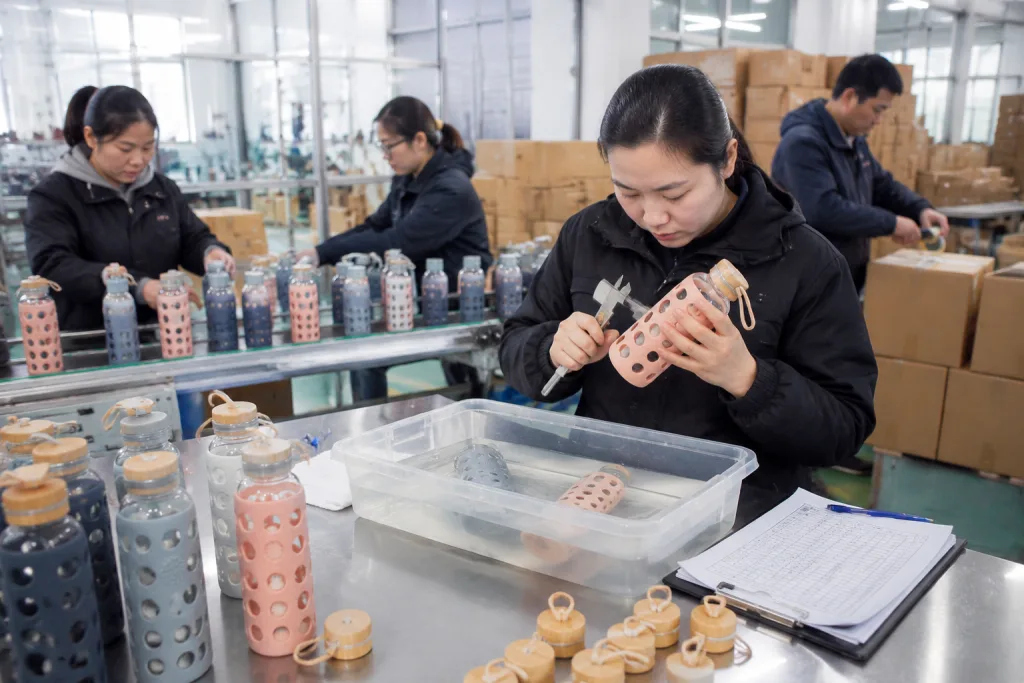
At BottleForge in Hangzhou, Zhejiang, we see the same split every week. Buyers start with “glass bottle” and end up comparing wall thickness, sleeve durometer, closure torque, and carton drop performance. That is the right question to ask. Cheap looks fine on paper, then QC pulled the sample and the 80 cm drop test told a different story. For retail, corporate gifting, or e-commerce, the bottle has to pass compliance, survive transit, and still leave margin on the order.
Start With the Bottle Spec
Do not start with color, logo, or gift box. Start with the bottle body. For silicone glass bottle bulk, the checks that matter are capacity, wall thickness, neck finish, and whether the glass is soda-lime or borosilicate. We run that before we quote. A 500 ml soda-lime bottle with a 2.2 mm wall comes in cheaper, but a 2.8 mm wall usually survives carton rub and pallet knocks better on the line. Borosilicate adds 15% to 30% to the price, and that extra spend only pays when the buyer wants hot-and-cold use without a week-two complaint pileup.
Capacity drives the carton math. The same shape at 350 ml and 750 ml changes pack count, pallet density, and freight, and you see it on the PI fast. For e-commerce, 500 ml is the safer size. For corporate programs, 600-700 ml gives better hand feel. This is the wrong question to ask if you start with print art. We had one buyer flag a 1.5 mm typo on the PO, and QC pulled the sample because the mouth opening missed the drawing by 2 mm on the caliper. The spec line should state nominal capacity, overflow capacity, body diameter, overall height, mouth opening, and target net weight. Good Zhejiang factories quote those numbers on the first call. If they stall, move on.
- Common commercial range: 350-750 ml
- Useful wall thickness: 2.5-3.0 mm
- Typical bottle weight: 220-420 g depending on size
- Typical MOQ: 3,000 pcs per color/spec
Silicone Sleeve Is Not Decoration
The silicone sleeve is not decoration. It changes grip, cushions the glass on the line, and decides how the bottle lands in carton packs and retail bins. For canteen wholesale and drinkware wholesale buyers, sleeve hardness is the number to watch. We run 40-50 Shore A as the working band: enough grip, not so soft that it stretches during demolding. QC pulled the sample last month and the 38A version already picked up lint in the warehouse. Too soft looks tired fast. Too hard feels like a rubber shell that does nothing.
Coverage is the next call. Full-body sleeves cut breakage risk and give more print area, but they add silicone grams and labor minutes. Half-sleeve builds cost less and leave more of the glass body visible. If the buyer wants a premium look, matte silicone in a Pantone-matched color usually beats a glossy molded surface. For bulk drinkware or wholesale drinkware programs that go through pallet scanning and shelf stacking, the sleeve cannot push the bottle outside diameter out of tolerance. Ask for sleeve thickness, mold shrinkage rate, and whether the sleeve is removable or permanently overmolded. We had one PO typo that called out 72 mm instead of 70 mm, and the buyer flagged it before sampling. The math does not work if you skip that check.
Practical rule: if the sleeve carries the branding story, ask for a 30-day color stability note and a 1,000-cycle abrasion check. A 2 kg rub test drum is cheaper than finding out the first retail season washed the logo flat.
Closure Choice Drives Leakage
The cap looks simple until we run it through real shipping abuse. On a silicone glass bottle bulk order, the closure is where the buyer flags the first complaint. A bamboo lid can look clean on a shelf, but it still needs an internal liner and torque control. Last month QC pulled one sample at 0.35 N.m, and the cap wept after two turns. A stainless lid holds up better for beer growler bulk or beer growler wholesale bulk programs when the bottle gets opened again and again. PP or ABS cuts cost, sure. The math does not work for premium retail.
Call out the thread standard, liner material, and target tightening torque on the PO. If the fill is cold only, you do not need a heat-resistant gasket. If hot drinks or thermal cycling are in play, ask for silicone or food-grade TPE seals and get the temperature range in writing. We had a buyer push back on a 1-meter upside-down leak test because he thought it was overkill, then the carton failed a wet-box check at 18 days versus 12 days in transit. For alcohol flask bulk or alcohol flask wholesale bulk-type jobs, the seal spec needs to be tighter because one drip ruins the unboxing and stains printed cartons. Do not treat the cap as a spare part in China sourcing. It is a cost item and a risk item.
- Leak test: 1 meter inverted, 30 minutes
- Drop test: 3 feet / 0.9 meter, packed
- Cycle expectation: 500+ open-close cycles
Decoration Should Match Volume
Logo method is where buyers lose margin. We see it on the line all the time. A 1-color silkscreen on a silicone glass bottle bulk order keeps unit cost tight and fits most wholesale canteen and wholesale growler programs. Laser engraving belongs on stainless caps or a metal sleeve, not on the glass body the way some buyers picture it. For glass, frosted etching, decal, or UV printing fit better, depending on order qty and wear target. If the line is for gifting, do not push a bargain print onto a bottle that should feel deliberate. This is the wrong question to ask: the cheapest mark is not the right mark if the bottle needs a premium shelf look.
Decoration also moves lead time. A standard 1-color silkscreen order in Zhejiang usually adds 5-7 days; we ran that schedule last month on a 3,000-piece MOQ, and QC pulled the sample after one typo on the PO. Full-wrap decals, gradient effects, or multi-color printing can add 10-15 days and lift reject risk. For beer tumbler bulk or beer tumbler wholesale bulk jobs, a plain mark often sells better than a busy layout. North American and European buyers usually care more about logo repeatability than color count. Ask for artwork placement tolerance, Pantone match tolerance, and whether the print survives 50 dishwasher cycles if the bottles are going into retail resale or hospitality. If the supplier cannot spell out the decoration process, the production plan is not under control. The math does not work otherwise.
Compliance Before Production
Compliance decides whether the carton clears customs, passes a retailer audit, and survives the first complaint from a buyer who reads every line. We run REACH for EU orders, LFGB when the channel asks for it, and food-contact declarations for glass, silicone, and inks. For North America, ask for food-contact compliance statements plus material traceability. If the bottle is sold for infant or family use, the bar jumps fast. A 25 kg case pack is not the point here. The paper trail is.
Do not accept a loose “safe material” statement. Ask for test reports tied to the exact item number, exact color, and exact decoration method. A proper factory in China should show batch traceability, incoming material records, and retained samples from the line. QC pulled a 12 mm gasket once and found a dye mismatch; the buyer flagged it before shipment, and that saved a problem. For BSCI or social compliance, procurement teams ask for audit evidence too. Fair ask. One wrong file can stall a chain account for 18 days, and we have seen that go sideways. Build the file first, then place the PO.
- Ask for: REACH, LFGB, food-contact declarations
- Good practice: batch traceability and retained production samples
- For retail chains: BSCI or similar social audit support
MOQ, Pricing, and Lead Time
For silicone glass bottle bulk, the math is clear once you open the carton spec. At 3,000 pcs, a standard 500 ml bottle with a single-color logo usually lands around USD 1.20-1.80 FOB Hangzhou. Change to a borosilicate body, a better closure, or heavier packaging, and you move into the USD 2.00-2.40 range or above. We had one buyer push back because the sleeve came in at 2.2 mm instead of 1.8 mm; the quote only moved 7 cents, but the drop-test result changed fast. Compare landed cost, not unit price. Freight cube, carton strength, and reject loss set the real number.
MOQ in China is tied more to sleeve color and cap style than to the glass bottle itself. A Zhejiang factory will quote 3,000 pcs for one color, then ask for 5,000 pcs if you want custom molded hardware or a Pantone-matched silicone sleeve. On our line, QC pulled the sample after a cap torque test landed at 0.8 N.m against a 1.0 N.m target. That kind of miss is why we check the gauge before the run starts. Lead time usually runs 25-35 days after sample approval and deposit, with another 5-12 days if you need custom packaging. For bulk growler or growler wholesale programs, that timing matters because a missed season is gone. Ask for a production calendar with sampling, incoming material, assembly, inspection, packing, and loading dates. A factory that can ship 300,000 units per month still misses your slot if the SKU is not booked early.
FOB is not the final number. Add inland trucking in China, ocean freight, duty, warehouse receiving, and any FNSKU or retail prep if you sell through e-commerce. We once caught a PO typo that said 30,000 pcs on the body line and 3,000 pcs on the carton line, and the buyer flagged it before the line started. The math does not work any other way. The product can look cheap until landed cost shows up on the spreadsheet. That is where experienced procurement managers separate a real program from a noisy quote.
Packaging and Carton Math
The box is part of the product. For glass, carton spec drives breakage, pallet count, and freight. We had one buyer shave $0.12 off the inner tray, then eat 3% more breakage on the first shipment. The math does not work. If the bottle goes through Amazon FBA or direct-to-retail, the pack has to survive vibration and drop tests, not just sit clean on a shelf. For a 500 ml bottle, a 1-piece inner box with molded pulp or a stiff paper insert usually beats loose packing. For 750 ml or gift sets, double-wall corrugate earns its keep. QC pulled one sample at 18 kg gross, and the tray flexed at the corners.
Ask for master carton dimensions, gross weight, carton drop rating, and pallet loading plan. This is where beer growler in bulk and beer growler wholesale buyers get clipped, because a 12 mm diameter jump can wreck container utilization. The buyer flagged a PO typo once: 24 pcs/carton became 42 pcs/carton, and we had to stop the line before packing. If you are buying alcohol flask in bulk or alcohol flask wholesale-style glass gift bottles, the insert and carton presentation can matter as much as the bottle itself. Request a carton mock-up before mass production. We ship a pre-production packed sample, then check stacking, squeeze resistance, and label position. Normal work.
How to Qualify the Factory
We qualify a China supplier the practical way. No theatre. We want proof the line can repeat the same silicone glass bottle 10,000 times without drift. Ask who owns the glass mold, which gauge they pull for wall thickness, and how they log defects by line. On our floor, QC pulled the sample and checked 1.8 mm neck tolerance before the shift changed. A Zhejiang factory worth your time will show in-process QC, final AQL sampling, and material certificates without a song and dance. For most wholesale drinkware buyers, AQL 2.5 for major defects and 4.0 for minor defects is a fair starting point, though some retail programs ask for tighter numbers.
Check whether sleeve fitting and cap torque control stay in-house, or get pushed to a subcontractor. In-house control usually keeps the schedule cleaner. Ask how many units they ship per month, how many SKUs they run at once, and the repeat-order lead time in days, not slogans. We’ve seen buyers accept a 300,000 units/month claim, then get burned because the decoration spec was off by 1 mm. The math doesn’t work. A factory that can keep a bulk canteen, wholesale canteen, and growler bulk program stable across seasons is the one you want. They ask the right questions before the PO goes to print; we once caught a typo on a carton mark and saved a 12-day delay.
Send your spec for a factory quote
Get a line-by-line quotation from our Zhejiang team with MOQ, FOB pricing, compliance support, and packaging options matched to your channel.
Frequently asked questions
What is a realistic MOQ for silicone glass bottle bulk?
For a standard bottle with one sleeve color and one logo position, 3,000 pcs is a realistic MOQ in China. If you want custom glass mold work, special cap tooling, or multiple Pantone sleeve colors, expect 5,000 to 10,000 pcs. In Zhejiang, some factories can split MOQs across colors only if the base mold and cap stay unchanged. Ask whether the MOQ is per design, per color, or per shipment. That detail changes your cash flow more than the unit price does.
Is borosilicate worth the extra cost?
Usually yes if the bottle will see thermal change, premium retail placement, or repeated use. Borosilicate often adds 15% to 30% versus standard soda-lime glass, but it gives you a better margin for hot and cold applications and a stronger quality story. If your bottle is only for cold beverages and short cycle consumer use, soda-lime with a 2.5-3.0 mm wall is often enough. The right choice depends on your channel, not on a generic “premium” label.
How do I reduce breakage in transit?
Use a 2.5-3.0 mm wall, fit a sleeve that actually cushions impact, and specify an insert or molded pulp tray. Then test packed cartons for 3-foot drops and vibration. For larger bottles like beer growler bulk or growler wholesale programs, carton size and pallet pattern matter a lot. A better inner pack can reduce claims by several percentage points, which is worth more than shaving a few cents off the carton. For FBA or retail distribution, insist on a packed sample before mass production.
What compliance documents should I ask for?
At minimum, ask for food-contact declarations for glass, silicone, and any printed inks. For EU-bound goods, request REACH-related support and, where the channel demands it, LFGB testing. For retailers or distributors with audit requirements, ask for BSCI or equivalent social compliance documentation. Make sure every report matches the exact SKU, color, and decoration method. A generic certificate for “similar bottles” is not enough. Good suppliers in China will link reports to the item code and batch.
Can I use the same bottle for drinkware and promotional flask orders?
Sometimes, but not always. A bottle built for wholesale drinkware retail may not suit alcohol flask bulk or alcohol flask wholesale bulk positioning if the closure, shape, or branding language feels wrong. Promotional liquor bottles often need a tighter seal, smaller volume, and more gift-oriented packaging. If you want one platform product for multiple channels, define the spec around the strictest use case. That is safer than trying to force one generic bottle into every market.