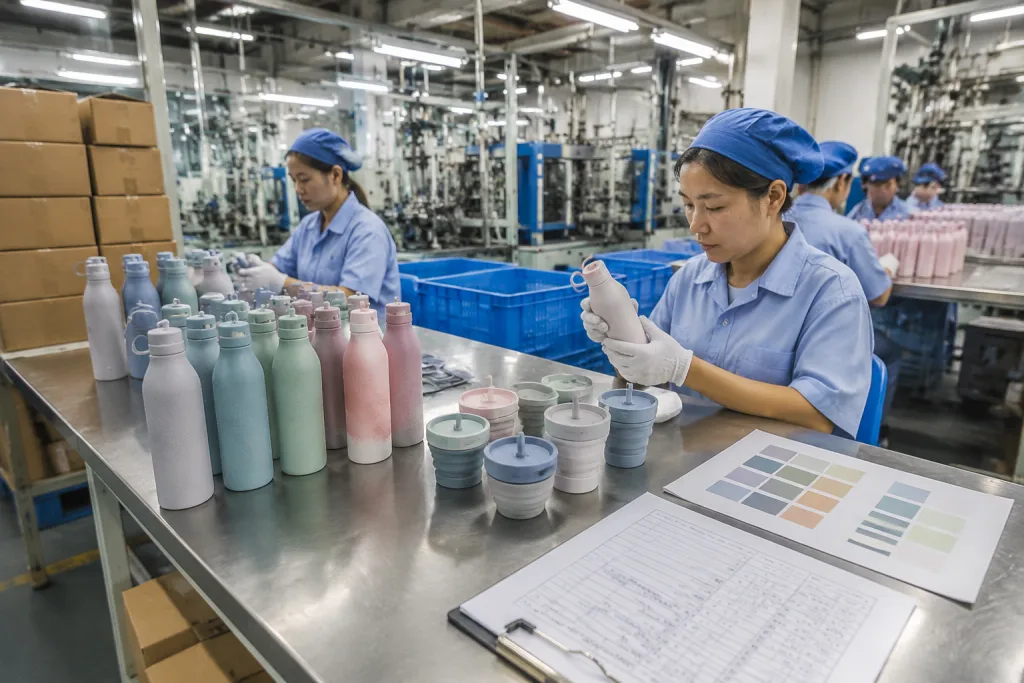
Key Takeaways
- Most silicone drinkware private label projects start at MOQ 1,000-3,000 pcs, not 200 pcs.
- FOB pricing for simple silicone cups often lands around USD 1.20-3.80 per unit, depending on tooling and print.
- Lead time is usually 20-35 days after sample approval and deposit, with 7-10 days for custom color matching.
- For Europe and North America, ask for FDA, LFGB, REACH, and CA Prop 65 support before you place the order.
If you are sourcing silicone drinkware private label, the hard part is not finding a bottle shape. We can pull 20 or 30 samples from China and Zhejiang in one week. The real issue is picking a format that survives freight, passes compliance, and still leaves margin after decoration, packaging, and carton crush. A soft bottle can look clean on the sample table, then land in returns once it hits hot-fill limits, odor complaints, or a print that peels after 30 dish cycles.
For B2B buyers, the choice runs on use case, not trend. A silicone bottle for yoga retail is not the same as a canteen promo item for events, and a custom growler is not the same as a lightweight travel cup. QC pulled the sample with a 2 mm wall thickness gauge, and that tells the story fast. Pick the body, the closure, and the decoration method first. Color comes later. We have seen orders go sideways because buyers choose by photo instead of unit economics. This is the wrong question to ask.
Below is a practical top 5 ranking based on what actually matters: MOQ, mold flexibility, food-contact compliance, shipping efficiency, and how easily you can turn a sample into a profitable customized drinkware line. If you are comparing canteen manufacturers or canteen suppliers, this is the filter that saves time. We ship to buyers who ask for numbers, not mood boards, and the math has to work on the first PO. One typo on a PO can push a 3,000-piece run into a 12-day delay.
How to rank silicone drinkware
A serious buyer should rank silicone products by how they run on the line and how they sell. Looks come last. First filter: material grade. Food-grade silicone should stay soft enough to fold, yet hold its shape in a carton. We saw 1.5 mm walls buckle in a drop test after QC pulled the sample from the packing table. Second filter: compliance. For Europe, ask for LFGB and REACH. For North America, ask for FDA food-contact support and a clean statement on additives and pigments. If you sell into retail or Amazon, the pack has to survive FNSKU labeling, a 1 m carton drop, and warehouse handling. This is the wrong question to ask if the pack falls apart in transit.
The third filter is decoration. Silicone does not forgive sloppy print. Screen print can work, but it needs the right ink system and cure control. Laser marking looks clean on some hybrid parts, but it will not hold on every pure silicone surface. We run a cross-hatch tape test at 5 mm spacing when the buyer pushes for a darker logo, because that is where the weak ink shows up. A canteen supplier that knows the line will tell you where adhesion fails and where it stays put. The fourth filter is economics. A colorful customized drinkware program can look cheap on the sample bench and turn expensive once you add silkscreen passes, individual polybags, and outer cartons. We quoted one buyer at 5,000 MOQ both ways, and the math did not work until we split pack cost from print cost. If the factory cannot quote with and without packaging, you do not have a real quote.
One practical rule: if the supplier cannot explain wall thickness, usually 1.8 mm to 3.0 mm depending on the shape, and cannot state monthly output in units, keep looking. A canteen factory in Zhejiang should be able to tell you whether it runs 200,000 units per month or just assembles trading stock. We had a PO last month with “silocon” typed on the draft, and the buyer flagged it before production; that is the kind of typo that tells you who is actually checking the job. This is the wrong question to ask if the seller only talks pretty. That difference matters more than a polished catalog.
1. Folding bottle for travel
The folding travel bottle is the clean first move for silicone drinkware private label. It is simple. It ships light. The body collapses flat, so it takes less shelf space and less carton space. For distributors, we run this format with the least drama because the selling point is plain: fold it, carry it, reuse it. A 500 ml bottle usually cuts carton volume by 20% to 35% versus a rigid bottle of the same size, and buyers price that into FOB China right away. We have seen a 12-day freight quote beat an 18-day one by a clear margin on the first round, so this item keeps coming back.
This format fits when you want a canteen customizable program without too many moving parts. One body color. One lid color. One logo position. Keep the mark simple. Deep embossing looks neat in a mockup, but QC pulled the sample and the fill around the logo went uneven on a 2 mm wall, so the line slowed down. A good canteen manufacturer will usually steer the first run toward a single-color silkscreen or a small deboss. Typical MOQ sits around 1,000 pcs for the basic version and 3,000 pcs if you want custom Pantone matching and retail packaging. The buyer once sent a PO with the cap color as "sliver," and that typo burned a week. This is the wrong question to ask if the spec keeps changing.
Best for: distributor drinkware, event kits, travel retail, and price-sensitive private label launches.
2. Silicone tumbler with sleeve
The silicone tumbler with sleeve is the safer pick when you want a cleaner shelf look without getting dragged into tricky tooling. It sits between low-end promo and higher-margin retail stock. Buyers know the shape. The print panel stays clean, and the cup reads as custom drinkware, not a handout. We ship this style a lot for canteen distributors. On the line, a 58 mm sleeve mold is a simple run.
Cost control is tighter here than a lot of buyers expect. A 350-450 ml tumbler with a silicone sleeve and PP or stainless lid usually lands around USD 1.60-3.20 FOB, depending on print, color count, and lid type. One buyer flagged a typo on the PO last month: 450 ml became 540 ml, and the quote moved by 12 percent before QC pulled the sample. If you choose a two-part body with a removable sleeve, ask whether the sleeve is molded separately or overmolded. That one detail shifts assembly labor and defect rate. We run odor checks after the first wash cycle, not just a dry visual check. On inspection, we hold AQL 2.5 for major defects and 4.0 for minor defects.
Retail buyers still use this format as canteen promotional merchandise, but it also sells well for gyms, coworking spaces, and hospitality programs. We’ve seen it go sideways when the buyer wants a soft-touch sleeve but skips the ink adhesion test on a 60 mm print panel. The math does not work. Ask for the rub test and a packed sample, then decide.
3. Hybrid canteen for retail
If you need a custom canteen program that looks retail-ready, the hybrid build usually gets the budget. Silicone body, harder lid, ring, or base. Clean on shelf. We run these at 0.3 mm tolerance because a 0.5 mm lid gap shows up fast when the buyer opens the carton at receiving, and that is where the line gets judged.
For a buyer, this is the right lane when the product has to sit in a store planogram, not just on a trade-show table. A 400-600 ml format moves better than a full soft collapsible body. The hard part is tooling coordination. If the lid and body come from separate molds, we run fit checks and sample approval before anyone signs off. Photos do not count. Ask for 10 to 20 test drops from 1 meter, leak testing at room temperature and after 50°C fill, and 300 open-close cycles. We once saw a latch start popping at 80 cycles on the torque tester. The buyer flagged it, and the math did not work.
If your target is Europe, ask for REACH paperwork on pigments and adhesives. If your target is North America, request a food-contact compliance statement and a check on California reporting exposure. A serious canteen vendor will hand over the file. The wrong question is whether they have "a certificate"; the real question is whether QC pulled the sample, checked the ink lot, and matched it to the PO, because that is where problems start. We had one PO with a lid color typo, and it cost 12 days to fix.
4. Collapsible cup for events
The collapsible cup is not the top-margin item, but it moves fast when the buyer needs a compact giveaway with one clear use case. We ship it for 5K runs, 10K marathon packs, university stores, and tourism campaigns. For a canteen order, it is the cleanest promo pick, and it is a low-risk first run before a bigger custom growler or insulated cup. Simple designs land around USD 0.85-2.10 FOB, and that still leaves room for print, inserts, and plain carton packing. One buyer flagged a PO typo on lid color, and we caught it before the line ran.
Durability is the problem. Cheap units crack at the hinge or leak at the lid seal. Ask for the cycle count, not a smooth sales line. We run 1,000 fold cycles and a leak test after thermal cycling; QC pulled the sample twice on one batch because the seal opened after the third hot-water round. If the factory cannot give you those numbers, the price is built on appearance, not on use. Carton compression matters too. Event stock gets stacked hard. A flimsy window box looks fine on a quote and arrives crushed.
This is where a Zhejiang canteen factory with export experience earns its fee. It pushes packaging that protects the cup, not packaging that pads the invoice. That is the wrong question to ask. We’ve seen the math go sideways when a buyer saves USD 0.03 on the box and loses 8% of the shipment to dented packs on arrival.
5. Silicone growler for niche use
The silicone growler sits at the edge of this category, which works if the sales channel is locked in. We run production for breweries, outdoor retailers, and lifestyle brands looking for a softer alternative to rigid bottles. For private label buyers, it becomes a signature piece. It can also fail on the first run. QC flagged a 500 ml sample last month, the buyer caught a weak cap seal, and they rejected the lot before it packed out.
Plan on MOQ 2,000 to 5,000 pcs for custom molding, proprietary closures, or mixed-material handles. The math doesn't work on small orders. For a premium build, we spec wall thickness at 2.5 mm to 3.0 mm and ship a rigid base insert; the insert adds 38 g, which stops the wobble and cuts claims. We saw a project go sideways when a client saved $0.18 on the cap tooling, then asked why AQL 2.5 inspection caught seepage marks. A well-made custom growler lands in the USD 3.50-7.00 FOB range, depending on material stack and print colors.
Do not price this against a standard canteen. That is the wrong comparison. It is a niche SKU, and experienced buyers know that from the first call. We received one PO with "growler" typed as "growelr," and errors like that signal where the account will have problems down the line.
What your factory should prove
Once the format is locked, ask for numbers, not promises. Buyers get burned when they accept a loose date from sales and never see the line plan. We ask for the sample schedule, the production calendar, and monthly capacity in kg, then we check whether the molding machines can actually cover it. A solid Zhejiang factory quotes 20-35 days after sample approval and deposit, plus 5-7 days for custom cartons. If someone says 7 days, they are shipping stock or hand-waving.
Require these documents before you sign. No shortcuts.
- Material declaration for silicone grade and colorants
- Third-party test support for LFGB, FDA, REACH, or ASTM where applicable
- Inspection method, preferably AQL 2.5 or equivalent for critical items
- Packaging spec, including master carton size and drop resistance
- Print durability after dishwasher or heat-cycle testing
Distributors protect margin at this stage. A higher FOB from a disciplined factory beats a cheap quote from a vague vendor, and the math does not work on a 12,000-piece PO with one typo in the carton spec. QC pulled the sample, found a 1.8 mm print rub-off after the dishwasher run, and the buyer flagged it before shipment. The gap between 1% and 5% defect rates is the difference between a clean P&L and a mess.
How to choose your private label path
If this is your first silicone line, start with the channel, then pick the product. E-commerce sellers usually do better with folding bottles or tumblers. The photo set stays tight, and the offer fits on one screen. Retail distributors usually get more pull from a hybrid canteen or a silicone sleeve tumbler, because the shelf reads faster at 1.2 m. Promotional buyers can move collapsible cups on price. A brewery or beverage brand can go after a custom growler, but only if the channel can carry the price and the turns. We had a buyer flag a 58mm lid detail on a sample because it looked fine online and felt wrong in hand. This is the wrong question to ask if the lid squeaks at the counter.
Keep the first order tight. One body shape, one lid type, two print positions, one carton spec. That is enough. Once the line is stable, add a canteen customizable colorway or a second size. A 500-piece MOQ with 12-day lead time beats a messy 3-SKU launch that slips to 18 days and gums up QC. The math does not work when a supplier pushes five SKUs before the first sell-through. Then you hold their inventory risk, not yours. We ship cleaner when the PO stays simple, and a missing carton mark on the first run can stall the whole batch.
The best private label programs are boring in production and profitable in distribution. That is the standard. We run it that way for a reason. QC pulled the sample, checked the cap torque, and moved on. A 0.3 mm wobble on the lid is enough to start trouble, so we do not pretend that detail is small.
Request a silicone quote built for your channel
Send your target size, logo file, and sales market. We will quote MOQ, FOB price, lead time, and compliance for your private label line.
Frequently asked questions
What MOQ should I expect for silicone drinkware private label?
For most silicone drinkware private label projects, expect MOQ of 1,000 to 3,000 pcs for a simple bottle or tumbler. If you want custom Pantone colors, special packaging, or a hybrid lid system, MOQ often moves to 3,000 to 5,000 pcs. For a niche custom growler, 2,000 pcs is common and 5,000 pcs is not unusual. A real canteen factory in Zhejiang should tell you the MOQ by SKU, not give you one number for everything.
What is a realistic FOB price for a custom silicone bottle?
For a basic silicone bottle, FOB China pricing often lands around USD 1.20-2.80 per unit. A silicone tumbler with a sleeve or harder lid can sit around USD 1.60-3.20. A more complex customized growler can reach USD 3.50-7.00 depending on wall thickness, closure quality, and print method. If a quote is far below that range, check what is missing: compliance, packaging, or actual decoration. Cheap quotes usually move costs somewhere else.
Which compliance documents should I request first?
For Europe, ask for LFGB and REACH support. For North America, ask for FDA food-contact support and confirm whether any California exposure applies. If the product includes metal or coated parts, ask for relevant ASTM or material testing. You should also ask for the factory's internal inspection standard and whether final inspection follows AQL 2.5 for major defects. A canteen supplier that hesitates on documentation is usually not ready for export programs.
How long does private label sampling and production take?
Sampling usually takes 7 to 10 days if the mold is simple and colors are standard. If you need a new color match, special logo placement, or packaging artwork, plan 10 to 15 days. Mass production after sample approval and deposit is typically 20 to 35 days. If you are ordering from a China factory during peak season, add buffer. A reliable Zhejiang supplier will give you a schedule with milestones, not just a final ship date.
Can silicone drinkware work for Amazon FBA?
Yes, but only if you treat packaging seriously. Amazon FBA drinkware usually needs barcode placement, carton labeling, and packing consistency that the warehouse can scan quickly. You should confirm FNSKU placement, carton dimensions, and drop protection before shipment. For a customized drinkware program, one damaged carton can create an expensive review problem. Ask your supplier to provide master carton specs and unit pack photos before booking freight. If they have done Amazon orders before, they will know the drill.