Key Takeaways
- MOQ for silicone custom drinkware often starts at 1,000 to 3,000 pcs per SKU, not 100 pcs
- A realistic sample cycle is 7 to 10 days, and production is usually 25 to 35 days after approval
- Ask for REACH, food-contact declarations, and AQL 2.5/4.0 inspection terms before PO
- For print or logo work, specify the exact area in mm, not just "logo here"
Buying from a silicone drinkware factory looks simple on paper. It is not. The trouble starts when specs stay loose. You ask for a custom drinkware item, the factory sends back something close, and 6 weeks later the wall thickness is off by 0.5 mm, the print edge is fuzzy, or the lid seal starts leaking in drop tests. We ship enough cartons to see this pattern again and again. For a brand, a canteen distributor, or a private-label run, that miss turns into rework, chargebacks, and a buyer who stops answering emails.
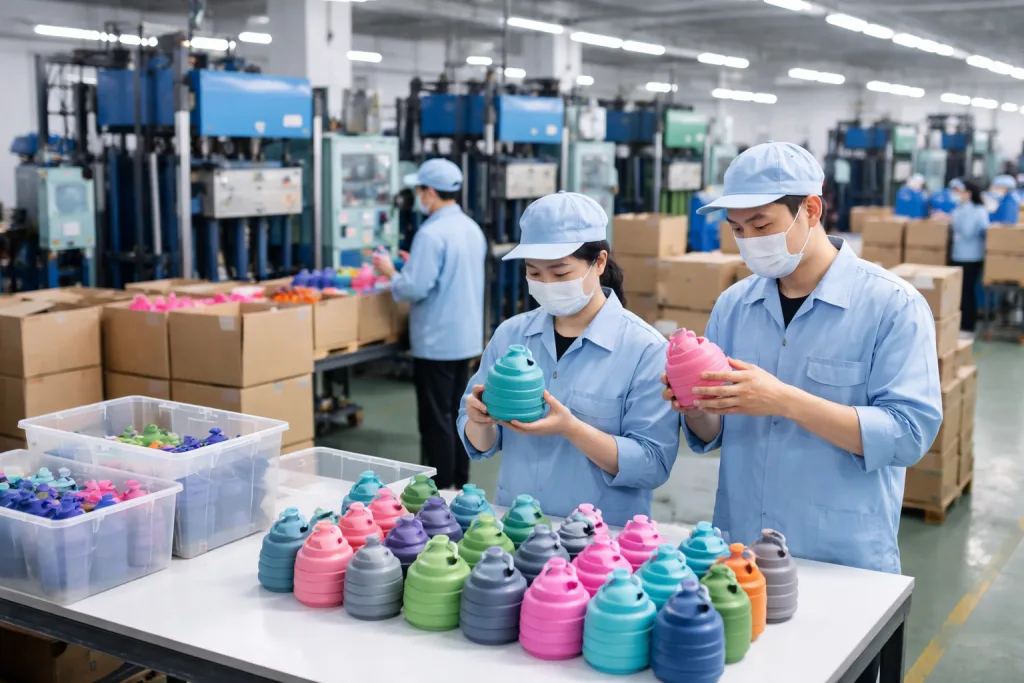
In Zhejiang and across China, the better factories talk in numbers, not soft talk. A serious silicone drinkware factory should quote MOQ, lead time, monthly output, and test standards on the first call. At BottleForge Industrial in Hangzhou, the line runs at 300,000 units per month, sample lead time is 7 to 10 days, and normal production is 25 to 35 days after approval. QC pulled the sample with a durometer meter last week, and the buyer flagged the typo on the PO before we cut steel. That is the bar. Anything looser, and the math does not work for a canteen custom order or a broader customizable drinkware program.
What you are really buying
Most procurement mistakes start here. The buyer thinks they are buying a product; the factory is buying a process. Silicone looks simple on a sample table, but on the line we are choosing compound, curing curve, compression or injection settings, demolding time, odor control, and post-bake treatment. QC pulled one batch at 72 Shore A last month, and the cap still twisted loose after 200 cycles. That is where the money goes.
Start with the use case. A canteen handed out at a 3-day event can live with looser tolerances and a rougher finish; a retail program cannot. If the bottle will hold liquid at 60 to 90 C, ask for the silicone hardness, usually 50 to 70 Shore A for drinkware bodies, and confirm whether the mouthpiece or lid uses platinum-cured or food-grade silicone. For North America, the buyer flagged a missing food-contact statement on a PO typo, and we had to fix the paperwork before shipment. For Europe, buyers usually want REACH and LFGB support from the supplier. “Customizable” is a lazy answer. Ask what is changing: shape, color, durometer, logo, lid, strap, packaging, or all six.
The spec sheet you need
A clean RFQ for a silicone drinkware factory reads like a short engineering note, not a shopping message. Skip wall thickness and we may quote 1.8 mm when you were counting on 2.5 mm. That gap changes stiffness, squeeze feel, and cooling time. We saw it on the line last month. For a custom canteen, I would lock these points before asking for price:
- Material grade: food-grade silicone, platinum-cured if needed
- Hardness: 50, 55, 60, or 70 Shore A
- Wall thickness: 1.8 mm, 2.2 mm, or 2.5 mm
- Color: Pantone code, not a photo reference
- Logo: silkscreen, pad print, laser, or emboss/deboss
- Package: bulk, polybag, gift box, or FNSKU-ready retail pack
QC pulled the sample and the shrinkage issue showed up fast. Silicone is not dimensionally neutral, so a 1.5% to 3.0% shrink factor is normal, depending on the compound and mold build. If you are buying a canteen with a rigid ring or base insert, ask for that material too. This is the wrong question to ask after tooling. Mixed builds can smell off when a supplier drops in recycled plastic where virgin PP or stainless was expected, and the buyer flags it the first time they open the carton.
MOQ, tooling, and price reality
Price goes sideways when the buyer starts with unit cost only. Wrong question. Tooling and MOQ decide whether we can run the job at all. For a simple custom canteen or custom growler style in silicone, mold cost usually sits at USD 1,500 to 5,000, and the jump comes fast once cavity count goes up or the part has a thicker wall. We had a buyer flag a 62 mm lid drawing because the draft angle was too tight for demolding, and QC pulled the sample off the line before we wasted another shot. If you need a lid, strap, and printed retail pack, the project cost climbs again. A common MOQ from a canteen supplier in Zhejiang is 1,000 to 3,000 pcs per color per SKU. Ask for 12 colors at 300 pcs each and the math does not work; you are asking the factory to carry your inventory risk.
For standard-sized customizable drinkware, FOB China pricing can start around USD 2.10 to 3.80 per piece at 1,000 to 3,000 pcs, depending on size, packaging, and branding. A larger customized growler with a more complex lid or insulated construction may sit in the USD 4.50 to 7.20 range. We shipped one job where the PO had "1,000 pcs" in the body and "1,100 pcs" in the remarks; that typo held the line for a day until the buyer corrected it. Those numbers move with resin grade, mold count, and labor. The lower quote is not always the better one. Sometimes it is a bare-shell offer with printing, packaging, and testing left out. Ask the canteen manufacturer to split product, tooling amortization, print, pack, and inspection so you can compare line by line.
Sampling and approval workflow
A clean sample flow saves 2 to 3 weeks. A sloppy one eats a month. We ask for a pre-production sample, not a polished sales piece, and we inspect it like it goes into a carton tomorrow. On silicone drinkware, QC pulled the sample with a caliper on the rim and found a 0.8 mm flash line; that tells you more than a glossy photo ever will. For a custom canteen bound for retail, ask for the real print method and the real insert, not a mockup. The buyer flagged it fast when the logo bled on a curved wall. Fair point.
The sequence stays tight: drawing confirmation, sample quotation, sample production in 7 to 10 days, internal approval, then production sign-off. If a Zhejiang factory says they can skip the sample because the item is “simple,” trouble is usually sitting behind that line. This is the wrong question to ask. A canteen distributor should insist on a signed spec sheet and a golden sample; otherwise, the line keeps guessing, and we have seen that go sideways in 12 days vs 18 days on the same mold. One PO typo on the lid color can turn into 5,000 wrong units. The math does not work.
Testing that matters in export
Export buyers do not ask for test reports as decoration. Customs checks them first, and chain buyers do the same. We run food-contact checks for the target market: REACH for EU chemical limits, LFGB for Germany, FDA-related declarations for the US, plus batch traceability back to the silicone lot number on the drum label. On a silicone drinkware line, the tests that matter are odor, dishwasher resistance, boiling water resistance, and compression set on a lid that seals under pressure. We once had a buyer reject a PO because the lot code on the drum was typed as `SIL-24O8` instead of `SIL-2408`; that typo cost a day. This is the first gate, not a side note.
Inspection needs the AQL called out in the PO. We usually see AQL 2.5 for major defects and 4.0 for minor defects, with carton sampling by lot, not by guesswork. QC pulled the sample once and found a 3 mm lid gap on one colorway; the buyer flagged it, and the math did not work for shipment. For Amazon-bound custom canteen or distributor canteen stock, outer cartons, inner packs, and master labels must match the warehouse rule before the line starts packing. We ship by label, not by hope. In Zhejiang, plenty of factories can do this. The real question is whether they will write it down and hold the line to it.
How to vet the factory
Do not pick a silicone drinkware factory from catalog photos. You are buying process control. Ask how many units they run each month, what share of orders goes to export, and whether molding, printing, and packing sit under one roof. A factory that handles canteen manufacturer work at scale should answer in one pass. At BottleForge Industrial, monthly capacity is 300,000 units, and that matters because your reorder is not waiting behind a subcontractor’s open slot.
Check BSCI audit status if your retail channel asks for social compliance, then ask for incoming material checks, in-process inspection, and final random inspection records. QC pulled the sample on the last bulk run, and we caught a 1.5 mm flash line before it left the line. If the canteen distributor program includes mixed SKUs, ask how they separate batches so one Pantone tone does not bleed into the next lot. For a custom growler job, we also run cap seal cycle testing at 500 open-close cycles. That is factory-floor reality. If the answer stays vague, you are talking to a sales desk, not a production partner. The math does not work.
Packaging and logistics choices
Packaging is where margin slips fast. We’ve seen a plain polybag turn into a printed box, barcode label, compliance mark, and insert card, then the quote jumps from USD 0.12 to 0.40 per unit on a 20,000 pcs order. For a distributor canteen program in Europe or North America, lock the pack spec early: hang tab, shelf-ready carton, pallet pattern. The buyer flagged a missing EAN once, and the line had to relabel 8,000 pcs with a handheld Zebra printer.
Silicone ships better than glass, but it still compresses and grabs dust. Ask for double polybags if the finish is dark matte or the surface is meant to look premium. If you are mixing silicone with stainless or plastic parts in a custom canteen or customizable growler, confirm the assembled weight and the carton drop-test spec before we run it. This is the wrong question to ask after QC pulled the sample and found a loose lid at 1.2 kg gross. FOB China is the normal quote base, but DDP needs its own line because freight, duty, and last-mile charges move by lane; the math does not work any other way.
Request a real silicone quote sheet
Send your target volume, logo method, pack style, and destination market. We will quote the tooling, MOQ, and lead time without hiding the difficult parts.
Frequently asked questions
What MOQ should I expect from a silicone drinkware factory?
For a real production run, expect 1,000 to 3,000 pcs per SKU or per color. A very simple item may go lower, but the unit price usually jumps fast below 1,000 pcs because tooling, setup, and labor are spread too thin. If you are testing a new canteen custom concept, ask for one color first and lock the mold before expanding the range. Many canteen suppliers in Zhejiang will offer mixed SKUs only when the common parts stay unchanged.
How long does custom sample and production take?
A normal sample cycle is 7 to 10 days if the mold already exists or the part is straightforward. New tooling adds time. For mass production, 25 to 35 days after sample approval is a realistic window for most custom drinkware orders. If the factory claims 10 days for everything, check whether they are quoting from stock or assuming no print, no packaging, and no testing. In China, real lead times are tied to mold load and packaging schedule, not sales optimism.
What tests should I ask for on customized drinkware?
At minimum, ask for food-contact compliance documents suitable for your market, plus material traceability, odor control, and basic physical checks. For EU buyers, REACH support is important; for Germany-related channels, LFGB is often requested. For a custom canteen or custom growler with a seal, add leak testing and cycle testing. Use AQL 2.5 for major defects and 4.0 for minor defects in the purchase order, and require batch photos before shipment.
What is a fair FOB price for canteen promotional items?
For simple silicone promotional drinkware, FOB China pricing often lands around USD 2.10 to 3.80 per piece at 1,000 to 3,000 pcs, depending on size, color count, logo method, and packaging. More complex customized canteen or customizable growler builds can run USD 4.50 to 7.20 or more. Do not compare only the unit price. One quote may include print and pack while another excludes both. Ask for a line-by-line breakdown from the canteen manufacturer.
How do I verify the factory is legit?
Ask for the business license, export history, audit reports such as BSCI if needed, and a list of in-house processes. A proper silicone drinkware factory should be able to show molding, trimming, printing, QC, and packing under one roof or explain clearly which steps are subcontracted. Also ask for current monthly output, a named QC contact, and recent production photos. A factory in Zhejiang that handles 300,000 units per month will usually have those records ready.