Key Takeaways
- Silicone drinkware bulk usually starts at MOQ 1,000 pcs and sample lead time of 7-10 days in Zhejiang factories.
- Food-grade platinum silicone typically lands at USD 0.85-2.40 per piece depending on size, mold complexity, and print.
- For export, you should ask for REACH, LFGB, FDA, and migration test files before approving any wholesale drinkware order.
- A 0.2-0.4 mm wall thickness shift can change hand feel, collapse force, and carton yield enough to affect margin.
For silicone drinkware bulk, the first question is not whether silicone is “good.” The real check is whether the spec fits the use case, the margin, and the compliance file your buyer will audit. A 350 ml silicone cup for travel retail, a folding canteen for outdoor packs, and a beer growler for promo work are three different buys. Treat them as one item and the math breaks fast. We saw it on a 20,000-piece PO when the lid spec added 18 g per unit and freight went sideways.
From our Zhejiang factory, we see this mistake on the line every week. Buyers send silicone drinkware bulk RFQs, then QC pulls the sample and finds the wall moved by 0.4 mm, the deboss logo washed out after curing, or the odor test missed REACH expectations. This is the wrong question to ask. Read the spec line by line, match it to the channel, and buy against measured limits, not a brochure. That is how wholesale drinkware ships cleanly into Europe or North America and still leaves margin in the order.
Start With the Use Case
Silicone is not the default for every cup, flask, or tumbler. We run it where flex, drop resistance, or fold-flat storage pays back in the field. A 500 ml fold-flat canteen for hiking, a canteen wholesale promo item, and an alcohol flask bulk program all need different wall thickness and cap builds. On the line, a soft body can help packability, then fail the tabletop test because the buyer wants a firmer hand feel. QC checked a 2.2 mm wall on one sample, and the complaint came back fast.
Before decoration, lock the use case and the container type. This is the wrong question to ask after sampling starts. If the order is retail, check how it hangs on a peg, stacks in carton, and scans at POS. If it is a corporate gift, the buyer will flag the cap style, carabiner, and dishwasher claim. If it is for outdoor or sports, we check whether the part needs a fold-down form factor or a rigid base. We split silicone drinkware bulk into four buckets, and QC pulled the sample on each one before we quote. MOQ on one of those runs was 3,000 pcs, and that number changed the print plan.
- Flexible cups for travel and event kits
- Foldable canteens for backpack and camping programs
- Silicone sleeves or hybrid tumblers for grip and insulation
- Specialty bar items such as beer tumbler bulk or growler bulk promotions
The mistake is forcing one mold to do everything. We saw a 500 ml folding bottle pass for wholesale canteen stock, then get rejected for a premium beer tumbler wholesale bulk program because the wall felt too soft in hand. The math does not work. Buyers who state the use case early usually cut one tooling revision and save 10 to 15 days on sampling, while a PO typo like “5000pcs” instead of “500 pcs” can stall the line for a day. We have seen that go sideways more than once.
Read the Material Line First
If the material line is fuzzy, the order is weak from the start. For silicone drinkware bulk, the spec sheet needs the food-grade silicone type, hardness, temperature range, pigment system, and whether the rigid parts are PP, Tritan, or stainless steel. We run this check every week on the line. Buyers talk about hand feel; the real risk is migration, odor, and shape loss after 50 hot-wash cycles. Soft silicone at 30-40 Shore A feels fine in the hand, yet it folds in on itself. 50-60 Shore A holds shape better for canteen bulk and growler wholesale jobs.
Ask for the exact silicone grade. Platinum-cured silicone usually comes out cleaner on odor and fits premium export orders better. Peroxide-cured material can work in lower-cost drinkware bulk, but only if the supplier shows post-curing records and an odor test, not a sales note. For direct food contact, the compliance paper should match the actual resin lot, not a generic PDF. We keep incoming raw material records by lot code in Zhejiang for 2 years, and QC pulled the sample once when the buyer flagged a missing batch mark on a PO.
Practical note: if a supplier cannot tell you Shore A, wall thickness, and curing method in one reply, they are not ready for a wholesale drinkware order with export compliance attached.
For pricing, raw silicone is only one line on the sheet. A simple foldable cup may land around USD 0.85-1.20 FOB at 5,000 pcs, while a silicone and PP hybrid can reach USD 1.80-2.40 FOB. The math does not lie. A quote that hides the material system and then tries to recover cost later through “sample upgrades” is the wrong move; we have seen that go sideways on a 12-day sample cycle versus 18 days when the buyer pushed back on the first draft.
Measure Wall Thickness, Not Just Capacity
Capacity sells the listing. Wall thickness sells the product. A 450 ml silicone mug with a 1.6 mm wall behaves differently from one at 2.0 mm. The thinner piece saves resin and freight, but QC pulled the sample, and it dented on the bench, ran hotter in hand, and looked cheap in a canteen or beer tumbler program. Retail buyers spot that on day one. Bulk kits feel it fast.
For silicone drinkware bulk, we run these working ranges with the caliper on the line:
- Flexible cup walls: 1.2-1.6 mm
- Foldable body sections: 1.0-1.4 mm with rib reinforcement
- Grip sleeves or hybrid bases: 1.8-2.5 mm equivalent
Those numbers are not decoration. They change cooling time, cycle time, and shrink. A 0.3 mm shift can move demolding enough to slow output by 5-8%. On our Zhejiang line, that has meant 18,000 units/month on one side and overtime on the other. The buyer flagged it once on a PO that said 1.4mm and 1.6 mm in the same line. The math doesn't work. If you are sourcing beer growler wholesale bulk or alcohol flask wholesale bulk, the wall spec also has to hold seal integrity around the closure. Ask for a sectioned drawing and a measured cross-section, not just a glossy sample.
For buyers comparing bulk growler and wholesale growler options, I would take a slightly heavier wall with steady spring-back over a light spec that turns soft after three dishwasher cycles. We have seen that go sideways. This is the wrong question to ask if you only chase grams. A 2.0 mm wall with proper rebound beats a 1.4 mm spec that comes back with wrinkles after compression.
Closures Decide Leak Risk
Most leaks start at the cap, spout, hinge, or gasket seat. Not the cup body. We ran one batch on the line where the body passed and the buyer flagged a lid that seeped 2 ml after a 30-minute shake test. A silicone cup with a bad lid is still a bad cup. Same goes for bulk drinkware and drinkware wholesale promo packs. Once the closure leaks, the customer blames the whole item. For export orders, check the closure on the drawing before sampling starts.
We see three closure patterns every week: friction-fit caps, threaded caps, and flip tops with a gasket. Friction-fit is cheap and fast, but it is a bad match for travel cups or alcohol flask wholesale bulk orders where spill control matters. Threaded caps are the safer call for wholesale growler and beer growler wholesale jobs. Flip tops work for sports and daily-use drinkware wholesale if the hinge cycle holds up. QC pulled the sample and we ask for 3,000 open-close cycles on standard runs, 5,000 cycles when the pack goes into a higher-end retail set. The math does not work any other way.
Check the gasket material next. A silicone gasket should match the food-contact file and survive heat; we have seen a 62 mm seal pass on paper and then smell off after the oven test. If the closure uses a TPE insert, confirm it does not clash with your market’s recycling or odor rules. For beer growler in bulk orders, sealing beats logo size. A closure can pass a static leak test on the bench and still fail under vibration in transit. Ask for inverted-leak and drop-test data, not a hand-held demo. If a factory in China cannot send that within 48 hours, the closure spec is not ready.
Decoration Changes the Cost Curve
Buyers often underprice decoration because they expect silicone to print like a plastic cup. It does not. Silicone needs tight process control, and the line shows it fast. For logo work on silicone drinkware bulk, you choose between silkscreen, pad print, heat transfer, deboss, emboss, or laser on a rigid insert. Each route has its own setup fee, wear rate, and cure distortion risk. We run a 120-mesh screen on simple jobs, and that is where the first cost jump usually shows up.
For one-color logos on plain cups, silkscreen is usually the lowest-cost option. At 5,000 pcs, we see USD 0.05-0.12 per piece, and that number comes from ink changeovers on the floor, not a brochure guess. Debossed logos look clean, but you pay for tooling and you lock the brand position. That matters on wholesale canteen runs, best wholesale drink bottle style programs, and corporate gifting. One buyer flagged a 1.5 mm logo shift at proof stage, and the sample got bounced. If the SKU goes to Amazon FBA, sort out FNSKU placement early. A decorated panel and a scannable label can clash.
For premium drinkware bulk, buyers usually want a restrained mark with a clean color band. That is the right call. Silicone shifts pigment under heat, so PMS matching has to be checked against a physical swatch, not a PDF on a laptop. We ask for a 3% to 5% color tolerance window and confirm whether the pigment is masterbatch or liquid colorant. On one Zhejiang run, QC pulled the sample after a 2.4 mm edge blur showed up on the first cured lot. Setup took 2 days, then 3 days of back-and-forth before approval. The math does not work any other way: decoration changes MOQ, lead time, and scrap rate.
Compliance Is Not Optional
If you ship wholesale drinkware into Europe or North America, compliance is part of the product. Not an add-on. We held a 500 ml silicone tumbler for 12 days because the carton looked clean but the food-contact file was thin. Ask for food-contact declarations, REACH screening, and the market test reports tied to the exact material lot. For silicone drinkware bulk, odor, total migration, and heavy metals are the first gates we run. If the cup has metal hardware, add nickel release or coating checks. If there is a printed surface, confirm the ink system before we run the line. Skip that step and the file gets bounced.
Do not accept a supplier that sends a certificate with no batch linkage. You need the report number, the test standard, and the sample ID. A PO typo like “sillicone” burns half a day, and the same sloppy hand shows up in compliance files. For a repeat material, a solid supplier in China should send the document set in 3 working days; a new combination usually needs 5-7 days. If you are buying beer tumbler wholesale bulk or alcohol flask wholesale, the closures and trims may need separate handling. One weak cap can sink the whole file. The math does not work.
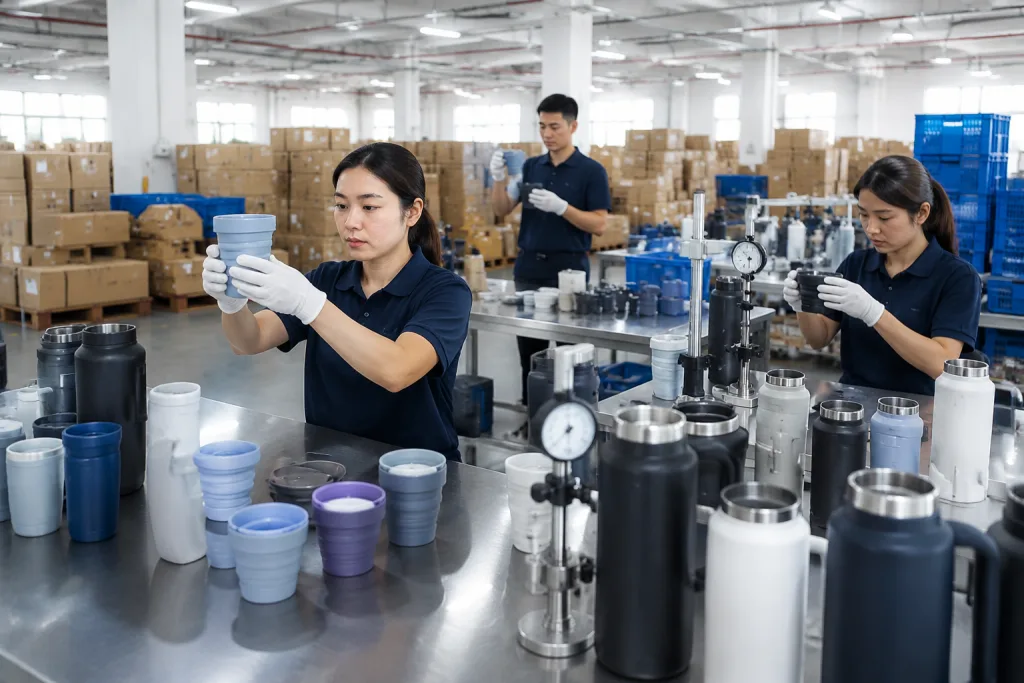
Our own factory in Zhejiang runs export orders with documented incoming inspection, in-process checks, and final AQL inspection before carton sealing. QC pulled a sample with a 0.3 mm flash mark last week, and we stopped the line instead of shipping it. That call saves refunds later. For branded buyers, this is baseline work, not a premium line item. When a supplier talks only about unit price and says nothing about compliance scope, the buyer has already been handed a problem in nicer wording.
What a Real MOQ Means
MOQ is where a lot of buyers lose a week. One loose question. One loose answer. For silicone drinkware bulk, MOQ is not one fixed number. It moves with mold type, Pantone color count, decoration method, and whether the part carries stainless or PP inserts. A plain cup may start at 1,000 pcs. A custom canteen bulk item with a new mold may start at 3,000-5,000 pcs. A hybrid beer growler wholesale SKU with stainless hardware usually sits higher because the line needs extra assembly, and QC pulled the sample twice before we signed off with the caliper on the bench.
The practical rule is blunt: lower MOQ costs more per unit. A 1,000-piece order may carry a USD 0.20-0.40 premium versus a 5,000-piece order because setup, waste, and packing labor get spread over fewer units. Ask the right question: is the MOQ per color, per design family, or per carton? We had a buyer push back on that split once, then the PO showed 3 colors with 1,000 pcs each. The math does not work any other way, and the line does not care about hope.
Lead time has to be split into sample, tooling, and production. A workable timeline from a Zhejiang supplier is often 7-10 days for samples, 15-25 days for new tooling depending on complexity, and 20-35 days for mass production after deposit and sample approval. If someone promises a custom molded wholesale canteen in 10 days total, they are skipping steps. The buyer flagged a PO typo once, writing 5,000 pcs as 5000pcs with no color split, and that held the line for a day while we confirmed the booking with the tape measure on the packing table.
Choose the Right Product Family
Not every buyer should start with the same silicone item. A procurement manager building outdoor kits should not source the same SKU as a distributor setting up a premium bar program. We sort by channel first, then use case. For quick mapping, we run it like this:
- Best for compact retail: foldable silicone cup or travel tumbler
- Best for outdoor packs: bulk canteen with secure cap and carry loop
- Best for beverage promos: beer tumbler bulk or drinkware bulk with simple print
- Best for gifting: hybrid silicone-and-rigid-body canteen wholesale item
- Best for niche barware: alcohol flask in bulk or beer growler in bulk only when closure and compliance are fully documented
If you want the best wholesale drink bottle result, stop trying to cover every category. Pick the SKU that matches how the buyer will use it. A growler bulk order for a brewery campaign needs a different spec from a canteen wholesale item for a hiking brand. One lives on shelf pull; the other lives on leak control and carry comfort. QC pulled a 58 mm cap and the glove-box test failed. The buyer flagged it. Fair call. On our Hangzhou line, we start with retail price, channel, and target market on day one, then build around the number that matters. That is how wholesale growler, wholesale canteen, and drinkware wholesale sourcing stay tight instead of drifting.
Send your spec sheet for a clean quote
We will check wall thickness, closure, decoration, and compliance before pricing. You get a realistic FOB quote, not a guess.
Frequently asked questions
What is a normal MOQ for silicone drinkware bulk orders?
For a simple silicone cup or sleeve, MOQ is often 1,000 pcs per color. For a custom foldable canteen or hybrid product, 3,000-5,000 pcs is more realistic, especially if you need new tooling. If the order includes multiple colors, confirm whether MOQ applies per color or per design. In our Zhejiang factory, repeat stock models can sometimes ship below 1,000 pcs, but custom export programs usually need the standard MOQ to hold pricing and packing efficiency.
How much should I budget per piece FOB China?
A basic food-grade silicone cup can land around USD 0.85-1.20 FOB at volume. More complex items with rigid parts, gaskets, or custom lids usually run USD 1.35-2.40 FOB. Decoration adds more: silkscreen can add USD 0.05-0.12 per piece, while molded logos increase tooling cost instead. Freight, duties, and carton configuration can change landed cost by 15-30%, so do not judge the item only on unit price.
Which compliance documents should I request before ordering?
For Europe and North America, ask for food-contact declarations, REACH screening, and market-specific test reports such as LFGB or FDA-related documentation where relevant. If there is a metal part, ask for coating or nickel-release data. If there is print, request ink-system confirmation. The key point is batch linkage: the report should match the actual material and article code. A generic certificate without sample identity is not enough for wholesale drinkware approval.
How long does production take in China?
For repeat silicone drinkware bulk items, sample lead time is usually 7-10 days and mass production is 20-35 days after deposit and approval. New molds can add 15-25 days depending on complexity. If you need a decorated launch for retail or Amazon FBA, build in extra time for color approval, packaging proof, and label verification. In Zhejiang, experienced factories can move faster, but only if the spec is locked early.
Is silicone a good choice for beer growler wholesale or alcohol flask wholesale bulk?
Sometimes, but only when the closure and compliance are right. Silicone works well for flexible or travel-oriented designs, but a beer growler wholesale bulk item usually needs stronger seal control and a stiffer structure. For alcohol flask wholesale bulk, check odor, migration, and cap performance carefully. If the product is meant for premium shelf presentation, a hybrid structure may be better than full silicone. Buy the function first, then the material.