Key Takeaways
- A workable silicone drink bottle factory quote usually starts at 3,000 pcs, with FOB China pricing around USD 2.40 to 6.80 depending on capacity and decoration.
- For leak resistance, ask for cap torque and drop-test data, not just a “tight seal” promise; 1.2 m drop testing is a sensible minimum.
- Food-contact compliance matters: request REACH, LFGB, FDA, and migration test reports matched to your market before you approve a custom canteen.
- The right factory for custom drinkware depends on channel fit: retail needs cleaner finish and tighter tolerances, while promo canteen orders prioritize price and branding speed.
Buying from a silicone drink bottle factory is not about picking the prettiest sample on the table. It is about matching silicone grade, cap build, leak risk, print method, and landed cost to the channel you sell into. We had one PO land with a cap color typo, and the buyer flagged it before we ran the line. If you sell into retail, e-commerce, or corporate programs, one weak detail turns into returns, slow reorders, or a compliance mess. Europe and North America buyers should judge the factory by specs, not a glossy catalog.
In Zhejiang and across China, the better suppliers run like engineering shops. They quote wall thickness in mm, durometer, cap torque, and test method, not just color chips. QC pulled the sample on a 50 mm neck bottle and checked the closure 12 times. That kind of check saves a shipment. A serious canteen manufacturer should show 304 or 316 stainless options, LFGB or REACH documentation where needed, and a production plan with dates that hold. For standard silicone bottle programs, MOQ is often 3,000 pieces with a 25 to 35 day lead time after sample approval. The math does not work any other way.
What a good spec sheet proves
If you are comparing a silicone drink bottle factory, the spec sheet is where the job starts. A usable one spells out body material, lid material, capacity tolerance, wall thickness, hardness, and decoration method. For a silicone body, ask for platinum-cured or food-grade silicone details, then confirm whether the inner liner is stainless steel, Tritan, or full silicone construction. “Food grade” alone does not clear customs or satisfy a retail buyer. We saw a PO claim fall apart at QC when the wall measured 1.6 mm instead of the stated 2.0 mm.
A decent buyer-facing sheet also gives the numbers that affect use. Wall thickness usually sits around 1.8 mm to 3.0 mm, depending on the design. If the bottle is collapsible, check the compression recovery cycle, because soft silicone that looks fine on day one can deform after 300 to 500 folds. On one canteen program, the buyer flagged a 24 h inversion test typo on the PO, and the line had to rerun leak testing with the torque wrench set at 0.8 N·m. If the factory cannot state freezer tolerance and dishwasher cycles, the math does not work for scale.
- Material callout: 100% silicone, silicone + stainless, or silicone + PP lid
- Capacity tolerance: usually +/- 5%
- Surface finish: matte, glossy, sand-blasted, or molded texture
- Testing: 1.2 m drop, 24 h inversion, migration where required
Buyers who source from China and Zhejiang usually get faster answers when they send a structured RFQ. We ship cleaner quotes that way. A complete sheet cuts 7 days of back-and-forth on a normal 500-unit MOQ, and it shows who actually runs a factory and who is just passing messages. QC pulled the sample on a 30 mm cap mismatch once, and that was the end of the guesswork.
Silicone body or hybrid build
Not every custom drinkware run should be all silicone. Start with the use case, not the catalog photo. Full silicone stays flexible, rides quiet in transit, and grips well, but on the line a loose wall profile can feel soft in hand. A hybrid build with a stainless inner wall and silicone outer sleeve runs stiffer, holds heat better, and lands at a cleaner retail price. For a customized growler look or a premium customized drinkware range, that is usually the cleaner call. We had one buyer flag a 1.2 mm wall as too floppy, and QC pulled the sample off the bench. The math did not work.
If the channel is gym, travel, or outdoor, a collapsible silicone body can still win. If the customer expects a desk bottle, go hybrid. A custom growler for beverages brings its own load: thermal retention, odor control, and cap seal matter more than collapsibility. A good canteen supplier should tell you the build weight, not hide behind a low quote. On a 500 ml order we ran last month, full silicone landed around 180 g to 240 g, while a hybrid insulated version came in at 320 g to 480 g depending on steel gauge and structure. We leak-tested one lot to 12 hours, and the cap torque held on the torque wrench. This is the wrong question to ask if the buyer only wants the cheapest assembly.
Spec choice is channel choice. If the bottle feels wrong in the hand, the market will tell you fast.
For distributor drinkware orders, I push a rigid build when the client wants repeat stocking and e-commerce fulfillment, because cartons stack cleaner and returns stay lower. We ship fewer crushed cartons that way. A PO once had the sleeve color code off by one digit, and the buyer flagged it before production. That kind of miss costs time and freight.
Use cases by channel and margin
Think channel first, not bottle first. A canteen distributor serving sporting goods shops wants steady replenishment, the same decoration on every batch, and cartons that survive pallet freight. A promo buyer wants art approved fast, one or two print colors, and a price that keeps the program inside budget. A corporate gifting distributor can pay more if the logo sits clean and the lead time stays under 30 days. The wrong factory pushes one bottle at every buyer. We see that go sideways fast. The right one changes the build by channel.
For retail, I would line up the use cases this way: insulated daily-use bottle, collapsible travel bottle, then promotional canteen. For events, the order flips because speed beats insulation. If you are building a canteen promotional program, the supplier should offer one-color silkscreen, pad print, or laser engraving, with decoration cost held below USD 0.30 to 0.90 per unit at scale. For a canteen customized retail line, expect extra tooling and tighter QC; on one run, QC pulled a sample with a 1.2 mm logo shift, and the buyer flagged it before we shipped. That is the right filter. The math does not work any other way.
- Retail: higher finish, stronger carton drop test, lower defect tolerance
- Promo: lower MOQ flexibility, faster artwork turns, simpler color count
- Outdoor and travel: grip, spill resistance, lighter freight weight
That is why seasoned canteen distributors ask for a use-case matrix before they ask for the final price. We run quotes this way on the line, and it keeps the spec honest from the first sample. A PO typo on a 24 oz order once turned into a reprint of 5,000 sleeves; nobody forgot it after that. A 2 mm sleeve mismatch can kill a margin line fast. It helps the factory quote the right build the first time.
Price drivers you can verify
Silicone drinkware pricing looks simple until you split it into parts. We quote a bare promo bottle at FOB China USD 2.40, and a better insulated build with custom tooling can start at USD 6.80. The drivers are silicone grade, lid structure, print method, packaging, and how hard QC runs the line. A bottle with a PP cap and one-color print moves fast. Add a stainless insert, a 0.8 mm mold texture, and a retail box with barcode, and the cost jumps the same day.
Ask the factory to split material, mold amortization, decoration, and packaging on the quote. If everything sits in one number, you cannot compare suppliers with any discipline. We see this go sideways on canteen orders from China all the time, because the gap usually comes from mold ownership and process control, not raw resin alone. QC pulled the sample last week and found a 1.2 mm flash line on the rim; that is the kind of detail that moves the price and the rework rate.
One practical benchmark: a 500 ml silicone bottle with custom color, one logo, and basic carton packing often sits at 3,000 pcs MOQ, 25 to 35 days lead time, and first-pass sampling in 7 to 10 days if the mold is ready. A premium finish usually adds 10% to 20% for tighter QC and better packing. That math works. What does not work is a factory that gives you one flat number and cannot show where the extra cost went; we had a buyer flag a PO typo on “3000” vs “300 pcs,” and that kind of slip changes the whole quote.
Compliance for Europe and North America
Compliance is where buyers get sloppy and pay for it later. For Europe, we ask for REACH and, where it applies, LFGB food-contact test reports. For North America, we want FDA food-contact compliance plus the material declarations behind it. If the order goes through Amazon or a retail program, carton labels, drop test results, and traceability that still works after a complaint 6 months later all come up fast. We ran that check on a 2,000-piece batch last month. No drama. The paper had to match the goods.
Ask about ink and adhesive compliance too. A clean logo means nothing if the print system misses migration limits. Silicone is only one part. The cap, gasket, ink, and any metal parts all need to match the file. QC pulled one sample with a 0.3 mm print shift and the buyer flagged the batch before ship. For an EU order, I want lot traceability and one retained sample per production run. That is normal shop-floor control in Zhejiang.
If the product is sold as sustainable drinkware, do not let the word “eco” outrun the paper. Ask for material composition, recyclability statements where they apply, and packaging reduction options. We had a buyer push back on a carton spec last quarter because the MOQ math did not work. Fair point. Compliance is not a sales add-on. It sits inside the product, and the line shows it fast.
Factory capabilities that matter
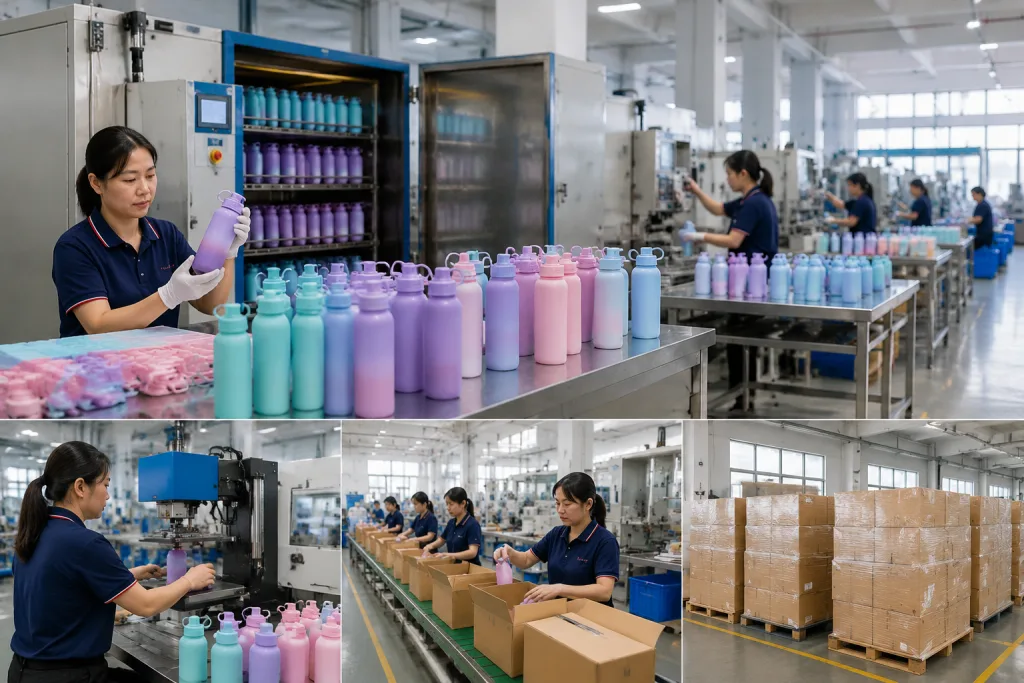
A real silicone drink bottle factory is more than a showroom. Walk the floor and you should see molding capacity, pad printing lines, leak test fixtures, and carton control running in the same building. We run 200,000 to 400,000 units a month on stable programs, and that is what keeps repeat orders from drifting on lead time. One buyer flagged a plant that promised 8 weeks and landed at 12; the issue was line balance, not order size. That matters for a canteen distributor filling stock every 6 to 8 weeks.
Ask how many molds sit in the rack, whether they can run 55A and 70A silicone, and how they place logos across 3 or 4 SKUs without mixing parts. If they also sell as a canteen vendor for mixed drinkware, check whether they are a desk in Yiwu reselling stock or a plant that actually runs the line. Ask what they control, from molding to packing. This is the right question. QC pulled a sample once with a 0.8 mm flash edge, and a real plant catches that before shipment.
What to request before sampling
- 2D drawing with dimensions and tolerance bands
- Material declaration for silicone, lid, and gasket
- Decoration method and PMS color target
- Packaging spec with carton size and drop test
- Production lead time and replenishment timing
If the factory answers these five points cleanly, you are dealing with a team that knows custom drinkware, not export chatter. We saw a PO typo on carton size once, 48 pcs vs 40 pcs, and the whole ship plan moved; the math does not work when details are loose.
How to compare sample sets
Samples are where a buyer has to get stubborn. Put 2 or 3 factory samples on the table and score the same points every time: seam line visibility, cap alignment, logo sharpness, odor, squeeze recovery, and water retention after inversion. On a silicone body, we run a 24-hour deodorization check before anyone signs off on smell. If the raw silicone odor still leads the way, the sample is not ready. Simple.
We also run a bench check with dyed water. Fill each bottle, invert it for 12 hours, then shake and inspect the gasket. That is not lab work, and that is fine. It tells you fast whether the line is holding assembly. A weak factory will shrug at a 1% seepage rate; the math does not work. One leaky carton turns into a distributor complaint the week the shipment lands.
For branded programs, compare the logo against the bottle curve and the hand feel at the same time. A customized canteen for premium retail should read clean from 1 meter away and still sit right in the hand, usually after QC pulled the sample and checked print registration under a 3x loupe. We once had a PO with the logo size typed as 18 mm instead of 8 mm, and the buyer flagged it before the line ran. This is the wrong question to ask: whether the price is the lowest. Ask whether the factory can keep the logo, mold line, and grip feeling consistent across the whole run.
Ordering terms without surprises
Clear terms keep a job from drifting. For most custom canteen orders, we run FOB China pricing, 30% deposit and 70% before shipment, plus a signed sample approval sheet. If the buyer asks for DDP, we put duty assumptions and carton size on paper because on a 2,000-piece run the freight bill can outrun the bottle price. One PO came in with the Pantone typed wrong, and the line stopped until the buyer confirmed the right code.
Use AQL 2.5 for critical defects and AQL 4.0 for minor defects if the product is going to retail or e-commerce, and spell out what counts as critical. A missing gasket is critical. A 1.5 mm shade drift is minor unless it breaks a branded color program. QC pulled the sample for a lid leak test, found 3 drips in 10 presses, and the buyer flagged it fast. If the first inspection fails, write down rework, replacement, or shipment hold before production starts. That is normal. Anything else turns into a fight.
Most buyers start with 1 SKU, then add a family of customizable canteen or customizable drinkware items after the first run holds up. That is the right sequence. We have seen this go sideways when a buyer jumps straight to 6 colors and 3 cap styles; the math does not work on a 500-piece MOQ. One clean run tells you more than a fancy sample ever will. We ship the proof on the line, not on a sales deck.
Send your spec sheet, not just a logo
We can quote a silicone bottle program in 24 hours if you give capacity, material, decoration, target market, and monthly volume.
Frequently asked questions
What is the usual MOQ for a silicone drink bottle factory?
For a standard custom bottle, 3,000 pieces is a realistic MOQ at many factories in Zhejiang and other parts of China. If you need a new mold, custom color, or specialty packaging, 5,000 pieces is more common. Some canteen manufacturers will quote 1,000 to 2,000 pieces for simple stock tooling, but the unit price is usually higher by 15% to 30%. For a first order, I would rather see a clean 3,000-piece run with stable QC than a tiny trial that teaches you nothing about production behavior.
How long does production usually take?
For a silicone drink bottle factory with a working mold, 25 to 35 days is a normal production window after sample approval and deposit. If you need a new mold, add 15 to 25 days for tooling and first sample corrections. Complex decoration, special packaging, or a hybrid insulated build can push the schedule to 40 to 50 days. In China, the factories that hit their dates usually give you a written schedule with molding, printing, assembly, inspection, and packing milestones, not just one vague delivery promise.
What compliance documents should I ask for?
For Europe, ask for REACH and, if relevant, LFGB food-contact reports. For North America, request FDA food-contact compliance documents and material declarations for silicone, lid, and gasket. If your bottle includes metal parts, ask for migration testing tied to the full assembly, not just the raw silicone. A proper canteen supplier should also provide lot traceability, carton marks, and retained samples. If they cannot give you these, treat the quote as unfinished, no matter how attractive the price looks.
Is a full silicone bottle better than a hybrid one?
It depends on channel and price point. A full silicone bottle is lighter, softer, and better for collapsible or travel-friendly use. A hybrid bottle with a stainless inner body and silicone outer sleeve is better if you need rigidity, premium feel, or better thermal performance. For a custom growler or premium retail line, hybrid usually wins. For a canteen promotional program or lower-budget custom drinkware order, full silicone can make more sense because the tooling and assembly are simpler and the FOB price is lower.
How do I reduce leak risk before ordering?
Do not rely on a visual check. Ask the factory to do 24-hour inversion tests, 1.2 m drop tests, and torque confirmation on the cap and gasket. Then test the sample yourself with dyed water and leave it upside down overnight. If you are buying canteen customized products for retail or distribution, define acceptable leak criteria in writing before production. A small issue at sample stage becomes a warehouse problem at scale, and that is expensive for any canteen distributor or distributor drinkware buyer.