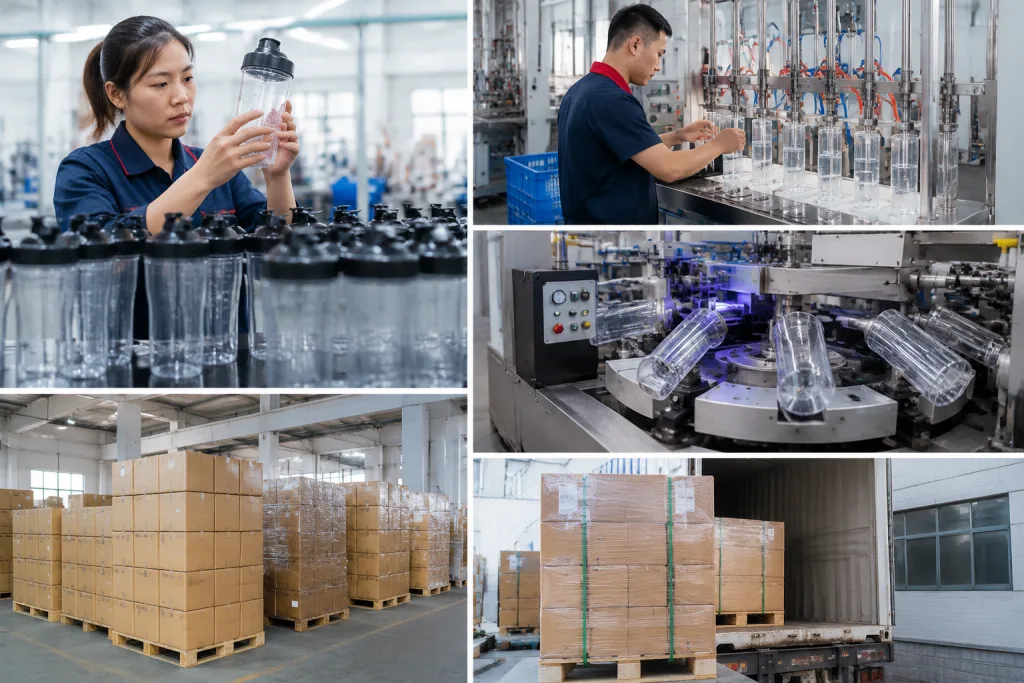
Key Takeaways
- A workable shaker bottle wholesale order usually starts at 3,000-5,000 pcs MOQ and 25-35 days lead time after sample approval.
- Leakage is mostly a cap-thread and gasket problem; demand 100% air-pressure checks on the lid and random water inversion tests.
- For custom logo shaker bottle orders, expect USD 0.12-0.45 per unit for one-color print and higher for laser or multi-color decoration.
- Good buyer specs name material grade, wall thickness, AQL 2.5/4.0, carton drop test, and REACH/food-contact compliance.
Shaker bottle wholesale looks easy until the first run hits the line. The sample passes. The logo prints clean. Then QC pulls the sample and finds a cap leak, a loose blend ball, and a faint plastic smell that fails the buyer’s smell check. We see this all the time. That is where a fitness brand learns the gap between a decent prototype and an order that stays under control.
If you buy from China or Zhejiang, the job is not chasing the cheapest bulk shaker bottle. The math does not work. We build and ship drinkware from Hangzhou, Zhejiang, and we run the same checklist whether the PO says 3,000 units for a launch or 80,000 units per month for replenishment: lock the resin, the seal, the print method, the test standard, and the defect limit before any money moves. Last month a buyer flagged a PO typo on the lid color code, and that small miss would have turned into a 12-day delay at the packing table. That is the wrong question to ask if you want stable supply.
Start With the Failure Map
Most shaker bottle wholesale failures do not start with one big defect. They stack up: a cap that leaks, a lid that warps 0.8 mm on the line, a weak flip-top hinge, a smell complaint, and print that peels after 50 washes. We saw that on a 600 ml run last month. If you treat the bottle like a plain commodity, you miss where it breaks in use.
For fitness brands and gym chains, map the failure points against real use first. A bulk fitness water bottle in a studio gets opened and closed 30 to 40 times a day. A distributor shaker bottle may sit in a hot container for 6 to 8 weeks before the end user sees it. That changes the spec. The buyer flagged lid feel on one order, and he was right. In Zhejiang, the factories that get this right ask about cap type, fill line, dishwasher exposure, and whether the bottle needs a protein-mixing ball or blender insert. That is not sales fluff. It drives the tooling and the QC plan.
Use a simple spec sheet before quoting:
- Capacity: 500 ml, 600 ml, 700 ml, or 28 oz/32 oz
- Material: PP, Tritan, AS, or stainless where needed
- Wall thickness: 1.8-2.5 mm for plastic bodies
- Closure: screw lid, flip lid, or dual-lock cap
- Compliance: REACH, food-contact, BPA-free declaration, if required ASTM or FDA-aligned testing
Once those fields are locked, the math works. Before that, we quote blind and pay for rework when QC pulled the sample and found cap torque off by 12 N-cm. We've seen this go sideways on a 2,000-piece PO with one typo in the lid code.
Leakage Starts in the Thread
Leakage is the fastest way to turn a bulk sports water bottle order into a service problem. On the line, we usually trace it to three spots: thread mismatch, gasket compression, or a lid that twists during cooling. The buyer flags the cap first. Wrong question. We check the bottle as one closed system, with the torque wrench, not by eye.
If you want a custom shaker bottle that survives real use, lock the thread pitch and gasket material before mass production. A good PP or Tritan shaker bottle should use a silicone gasket with stable compression after 500-1,000 open-close cycles. We run a 0.2 mm thread gauge on the first article, and QC pulled the sample last time a 0.3 mm offset showed up at the neck. For flip-top lids, the hinge needs extra thickness or it cracks under repeat loading. We usually call for a 100% quick leak test on assembled caps and a random water inversion test at AQL 2.5. For premium programs, add a 1-meter drop test on a full bottle. Static pressure is one thing. A gym bag is another.
Do not approve the bottle on looks alone. A cap that seals in the sample room can still leak after 20,000 lids come out of the mold.
If you are planning a custom logo shaker bottle for retail or club distribution, make the closure system the first drawing you approve. Printing can be fixed. A leaking lid is a redesign. We have seen a PO typo turn a 28 mm neck into 38 mm on paper, and that mistake burned 12 days versus 18 days once tooling had to be checked again. The math does not work.
Material Choice Controls Odor
Odor complaints show up fast in bulk shaker bottle work. Buyers often assume all plastics behave the same. They do not. We have seen low-grade PP hold protein smell after one overnight soak, and a cheap blend still stink after a 70C heat cycle on the line. If the bottle is a daily carry item, that turns into a return.
For a customizable fitness water bottle, Tritan is the cleaner pick when clarity and low odor retention matter. PP still fits a lot of bulk gym water bottle programs if the target price is tight and the buyer accepts an opaque body. This is the wrong question to ask: "which material is best". Ask which resin grade passed which test. Ask for migration data or a food-contact declaration, and check whether the resin is virgin or mixed. We run incoming resin checks with a melt-flow meter and lot tags on 25 kg bags. In Zhejiang, a serious factory will also do oven-aging on samples, because some smell only shows up after heat cycling.
Practical spec points:
- PP body: cost-effective, usually opaque, good for high-volume distributor fitness water bottle programs
- Tritan body: clearer, better shelf feel, usually adds USD 0.20-0.60 per unit
- Stainless insert: useful for a premium custom sports water bottle, but it adds weight and freight cost
If odor matters to your brand, test after 50 dishwasher cycles or equivalent heat exposure. That is where weak material choices show up. QC pulled the sample, and the bad resin smelled by cycle 12, not 50.
Print Failure Ruins Margins
Decoration is where margin gets shaved off. We have seen a custom gym water bottle pass structure check and still turn into dead stock when the logo scuffs in transit or peels after two dishwasher cycles. Curved bottles with a 28 mm print window and soft-touch finishes are the usual trouble spots. QC pulled the sample, ran tape twice, and the print lifted on the second pull.
Pick the decoration method from use, not from looks. Silkscreen fits one-color branding on a custom sports water bottle when the print panel is flat enough. Laser engraving holds up on stainless or coated surfaces when abrasion resistance matters. Heat transfer and full-wrap graphics work for seasonal retail, but the line needs tighter control. For a custom fitness water bottle sold through clubs, we run one-color silk print for price-sensitive orders and laser for premium jobs. Expect about USD 0.12-0.45 per unit for standard logo work, with setup fees tied to color count and plate size. The math does not work any other way.
The failure mode is plain: the buyer approves a clean sample, then skips rub testing. Put abrasion, alcohol wipe, and dishwasher resistance into the order spec. We have seen this go sideways on a PO with a typo in the logo font size, and the buyer flagged it only after 5,000 pcs were already packed. A logo that cannot survive repeated handwashing is a warranty problem.
Use the decoration brief to answer these questions:
- Is this a custom logo shaker bottle for retail shelf impact or for club handout volume?
- Does the print need to survive detergent, sweat, and bag friction?
- Do you need a custom made shaker bottle with molded logo or just a printed mark?
Cap Hardware Needs Real Testing
Flip-tops, mixer inserts, and carry loops look small until they start failing on the line. A loose hinge on a 600 ml bottle turned into 300 complaints in one gym chain rollout. We saw it. A weak snap fit on the spout cover can pop open in transit, and then you get leaks, returns, and a buyer who is already annoyed.
For a bulk sports water bottle with a flip-top, we ask for opening force and closing retention. No need to demand a thick lab packet for every sample, but the pass/fail line has to stay the same. The cap should open with one hand and stay shut after a 1-meter drop test at 80% fill. If the design uses a mixer ball, call out 12 mm or 14 mm diameter, the steel grade, and the retention groove. We have seen loose balls scuff the inside wall after 5,000 cycles on the cap rig.
Too many distributor gym water bottle programs fail because the buyer checks the body and skips the cap assembly. That is the wrong question to ask. The cap gets touched all day, and it is the part we hear about first when a chain manager flags a defect. On one 80,000-unit monthly run, QC pulled the sample and found hinge wear after 1,200 open-close cycles. If a supplier cannot tell you how they test hinge life, the math does not work.
Boxing and Transit Matter Too
A shaker bottle wholesale order can land with broken lids, scuffed bodies, or crushed cartons even when the bottle itself is fine. We have seen it on the dock. The weak point is usually the inner pack, not the molding. Saving 0.03-0.08 USD a set on packing is the wrong question to ask, because the buyer flags the damage fast and the chargebacks cost more than the carton.
For China export, ask for carton compression resistance, drop protection, and pallet stack details before you sign the quote. We run a compression test on the line with a pressure gauge, and if the carton bows at 5-7 layers, we stop there. A bulk pack can work for a distributor fitness water bottle order going straight to club shelves, but retail programs usually need individual polybags, barcode labels, and master cartons sized for warehouse handling. If you use FNSKU or a similar warehouse label, check the first 20 cartons before production starts. We had one PO with “FNSFKU” typed wrong, and the buyer flagged it before the truck left. A wrinkled label is not a print issue. It turns into a warehouse chargeback.
Recommended controls:
- Inner pack: 1 pc per polybag or paper sleeve if retail-facing
- Master carton: 24-48 pcs, depending on capacity and weight
- Drop test: 1 meter on corners and edges for sample packs
- Stack test: 5-7 layers for export cartons if container loading is dense
China freight does not forgive weak cartons. QC pulled the sample after a 3-week ocean move and the top flaps had already buckled, while the same carton looked clean in Zhejiang. A 5-ply board that passes in the factory can still fail on a humid route. We ship enough of these to know the math does not work.
Buyer Specs That Prevent Rework
If you want a custom shaker bottle order to run cleanly, the PO has to read like a line sheet. “Food-grade plastic” is loose. “Good quality” gives QC nothing to check. We have seen rework start from a 0.3 mm miss on the wall gauge, before the mold file even opens.
Use one sheet that covers the build and the commercial terms:
- Product: custom shaker bottle or customizable sports water bottle
- Capacity tolerance: +/- 5%
- Wall thickness: 2.0 mm target, minimum 1.8 mm
- Color control: Pantone or sample reference
- Inspection: AQL 2.5 major, 4.0 minor
- Compliance: REACH, food-contact, BPA-free, as required by market
- Packing: retail or bulk, label format, carton count
For a bulk gym water bottle you plan to reorder, ask the supplier to keep the mold cavity record, print plate reference, and raw material lot trace. We saw this go sideways on a 12,000 pcs repeat: the buyer flagged a tiny logo shift, and the only change was a print plate swap nobody wrote down. The wrong question is the last cent. Ask whether the spec survives a second run. Buyers in Europe and North America who ship clean orders lock the spec, ask for production photos, and block any material swap that was not approved in writing. On our line, that means one signed sample and no loose edits.
One practical rule: if the supplier cannot tell you MOQ, monthly output, and lead time without checking three departments, the order will slow down later. A capable Zhejiang factory should quote a 3,000 pcs MOQ, 25-35 day lead time, and 60,000-80,000 units per month on common shaker bottle lines. QC pulled the sample on a Friday, and the lot matched the sheet. The math does not work any other way.
How to Compare Factory Offers
Price checks on shaker bottle wholesale only mean something when the build matches. We had two quotes 12% apart, then QC pulled the sample and found one bottle with 1.2 mm walls, a snap cap, and inner cartons that looked fine until the drop test. The cheaper offer turned costly after breakage claims and air freight replacements.
Compare offers on landed risk, not just FOB China. Ask straight whether the quote covers mold ownership, sample fees, print setup, and packaging. For a custom sports water bottle run, FOB usually sits around USD 0.85 to USD 2.20, depending on material, decoration, and accessories. That spread is normal. The math does not work if the factory cannot back it with a build sheet. We ship from Zhejiang, and the better line will give you the cap structure, resin grade, and QC points without dodging the details. A caliper on the packing table tells the story fast.
Use these comparison points:
- FOB unit price: same capacity and decoration method
- MOQ: whether 3,000 pcs is real or only for one color
- Lead time: sample, tooling, and mass production separated
- QC: leak test, visual AQL, carton drop test
- Traceability: lot code and production record
If you buy as a distributor shaker bottle customer, ask for a reorder path before the first PO closes. We have seen this go sideways when the buyer flagged a typo on the PO and the factory had no spare carton spec on file. Good supply should be boring on repeat. That is the point. A clean reorder sheet saves a week, sometimes 10 days.
Request a factory spec and quote today
Send your target capacity, logo method, and annual volume. We will map the failure points, set the QC controls, and quote FOB China clearly.
Frequently asked questions
What MOQ should I expect for shaker bottle wholesale?
For standard plastic shaker bottle wholesale, a realistic MOQ is usually 3,000-5,000 pcs per color and design. If you need a custom logo shaker bottle with multi-color print or special lids, the MOQ can move to 5,000-10,000 pcs because of setup and print plate costs. For a premium custom made shaker bottle with Tritan or special packaging, expect a higher minimum. A capable Zhejiang factory should still give you a clear sample lead time, often 7-10 days, and a production lead time around 25-35 days after sample approval.
How do I prevent leaks in a bulk shaker bottle order?
Start with the lid system, not the body. Ask for gasket material, thread design, and closure test criteria before you approve tooling. A good bulk shaker bottle should pass 100% assembly leak checks on the cap and random water inversion testing at AQL 2.5. For larger orders, add a drop test on filled samples from 1 meter. If the supplier cannot explain how the gasket compresses or how the hinge is tested, you are buying a future return problem.
Is Tritan worth it for a custom gym water bottle?
Usually yes, if odor, clarity, and brand perception matter. Tritan often costs about USD 0.20-0.60 more per unit than basic PP, but it gives you better transparency and generally better resistance to smell retention. For a custom gym water bottle used daily, that can cut down complaints. If the bottle is for heavy-distribution use and price is the main driver, PP can still work. The choice depends on whether you are building a premium retail product or a volume distributor sports water bottle program.
What compliance documents should I ask for from China?
At minimum, ask for food-contact compliance documents, material declarations, and REACH-related testing if you sell into Europe. For North America, many buyers also want BPA-free declarations and market-specific safety testing aligned with their own standards. If your packaging or claims require it, request traceable lot records and inspection reports. A factory in China or Zhejiang should be able to provide these without drama if they regularly export. If they cannot, treat that as a process warning, not a paperwork nuisance.
Can I get custom logo printing on a low MOQ?
Yes, but the decoration method matters. A one-color silk print on a custom logo shaker bottle can sometimes start around 3,000 pcs, while more complex print or molded logos usually need higher volumes. Expect a setup charge plus a per-unit print cost, often USD 0.12-0.45 depending on the method. If you need a fully customized gym water bottle with special packaging and labels, the MOQ rises faster. The clean way to manage it is to separate body MOQ, print MOQ, and carton/label MOQ in the quote.