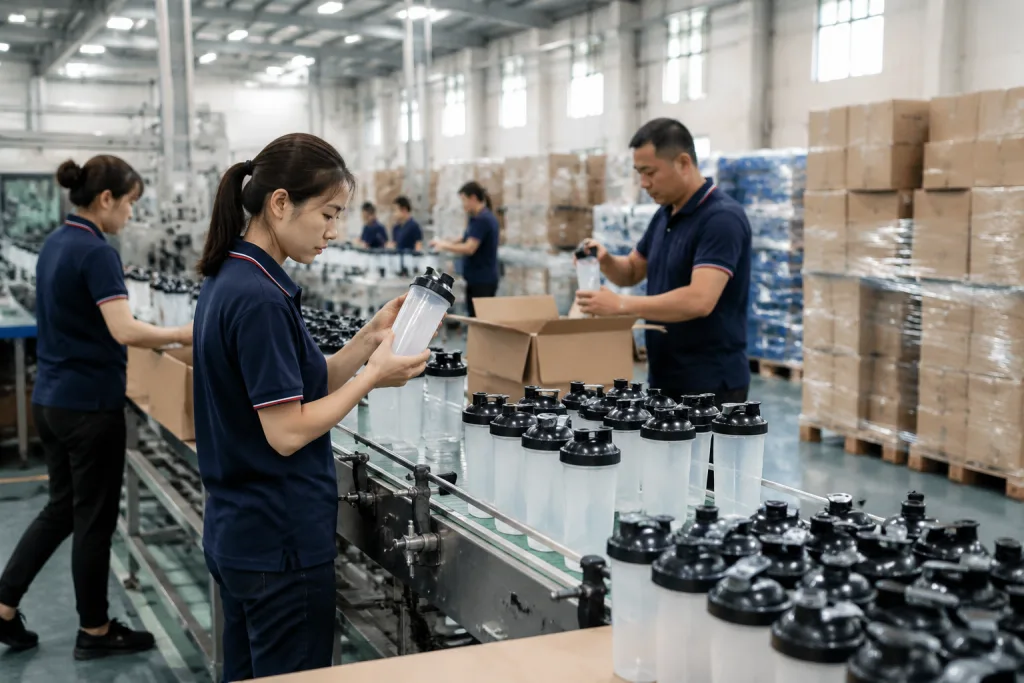
Key Takeaways
- Most shaker bottle vendor MOQs start at 3,000-5,000 pcs per design, with lead time around 25-35 days after sample approval.
- A practical bulk shaker bottle spec uses PP or Tritan, 1.0-1.5 mm wall thickness, and a lid leak test at 1 meter drop plus 24-hour inversion.
- Custom logo shaker bottle pricing usually lands around USD 0.85-2.40 FOB depending on material, print method, and accessory count.
- For distributors, carton efficiency matters: 50-100 pcs/carton can change freight cost by 8-15% on a container shipment.
If you buy from a shaker bottle vendor, the first issue is not the bottle. It is the gap between what a gym buyer puts on paper and what a factory in China can hold through 5,000 or 50,000 units. A clean sample is easy. On the line, we run leak tests on a 0.8 mm lip, and that is where bulk orders show their weak points.
For fitness brands and gym chains, the job is to buy a bulk shaker bottle that stays boring in the right ways: stable resin, lid fit within 0.3 mm, steady color, and a logo that still looks sharp after three dishwasher cycles. QC pulled the sample in Zhejiang, and the buyer flagged a PO typo on carton count before we shipped. Start with price alone and you will miss the real cost. The math does not work.
What you actually buy
Buyers usually ask for a custom shaker bottle first, but the order lands in three buckets: a standard gym shaker, a premium Tritan shaker, or a hybrid sports bottle with a mixer insert. For a chain gym run, the fancy unit is often the wrong pick. We shipped a 12,000-piece job last quarter, and the buyer flagged the cap after 30 days because the hinge looked thin under warehouse light. Gym ops care about breakage, wash cycles, and replacement cost. Brand teams care about print area, hand feel, and whether the lid still looks clean after 30 days.
For most programs, a bulk gym water bottle in PP is the lowest-cost route. It ships light, costs less, and fits giveaway runs and entry retail. Tritan adds about USD 0.25-0.60 per unit, and that buys you a cleaner surface and a stronger premium read. A custom made shaker bottle with a stainless steel whisk ball or an integrated mixer insert can carry a higher shelf price, but paying for extra parts makes no sense if the user mixes protein twice a week, not twice a day. We saw one PO typo turn the lid color to black instead of blue, and QC pulled the sample before the line started. Start with use case, then check the finish. The math does not work the other way.
- Budget line: PP body, basic snap cap, one-color logo, usually 600 ml for promo runs
- Mid-tier line: Tritan body, screw lid, laser or silk-screen branding, often packed at 24 pcs per carton
- Premium line: custom logo shaker bottle with multi-part lid and measured markings, built for 500 ml retail sets
Ask for the right material
The material call is not theoretical. It decides whether the bottle survives a drop test, goes through the dishwasher, or gets parked by a buyer who sets it beside a retail bottle they already trust. For food-contact drinkware in the US and Europe, ask for REACH-compliant resin and a food-grade resin declaration. For private label retail, require FDA food-contact testing, and LFGB if the buyer is headed into Germany or a nearby market. We had a PO last quarter where the buyer flagged a "PP+Tritan" typo on page 2 of the spec sheet; QC pulled the sample, and we still had to fix the paperwork before we ran the line.
PP is the default for mass-market shaker cups because the unit math works. Tritan is the better call when the buyer wants a clearer body and a cleaner shelf look. It holds up better on a custom fitness water bottle program because it resists staining and clouding after repeated washes. Wall thickness matters more than most new buyers think: 1.2 mm works for PP, while 1.3-1.5 mm is the safer band for a premium Tritan feel. If a supplier cannot state that number, you are talking to the wrong shaker bottle vendor. We ship from Zhejiang, and the better factories put the thickness in writing on day one because procurement will ask anyway.
Do not approve a sample based on appearance alone. Confirm resin grade, wall thickness, and the standard used for migration testing before you place a bulk order.
Print and branding rules
Branding turns a plain bulk shaker bottle into something a retail buyer will keep on the shelf, and the bad calls show up fast. A custom logo shaker bottle can be silk-screen printed, pad printed, heat transferred, or laser marked if the lid or metal part allows it. On our line, we check the artwork against a 0.3 mm registration spec before print starts. For plastic bodies, silk screen is usually the first choice because it stays clean on flat panels and keeps cost under control. Curved or glossy surfaces need pad print, and QC pulled the sample for an adhesion rub on the first trial. For a custom gym water bottle with a full-wrap graphic, lock the print tolerance early. If you don’t, the art drifts 2-3 mm and the logo lands off-center on the shelf.
Ask for a durability check. Fifty dishwasher cycles is a solid baseline for higher-end retail, while a promo run may only need a 10-cycle rub test. A customizable shaker bottle also needs a hard imprint limit, because a bigger logo is not a better logo. We saw a 62 mm logo fail on a 28 mm curved panel last spring, and the buyer flagged it before packing. For distributors fitness water bottle programs, one-color branding usually gives the best cost-to-impact ratio. A custom shaker bottle with two print colors usually adds USD 0.08-0.20 per unit; a full wrap or metallic ink costs more, and the reject rate climbs if the setup is rushed. The math does not work any other way.
MOQ, price, and lead time
Buyers want the straight answer. A normal shaker bottle vendor in China quotes a tooling-free standard model at 3,000 pcs MOQ. If the lid or insert is custom, 5,000 pcs is the number we see on live POs. We run that on the line. Lead time usually sits at 25-35 days after sample approval, plus shipping. For a new body shape, plan 20-30 days for tooling and another 30-40 days for production. That is the real schedule, not a sales pitch.
For FOB pricing, a basic PP shaker bottle usually lands around USD 0.85-1.20. Tritan or multi-part closures push it to USD 1.35-2.40. Add a metal mixer ball, printed measurement scale, and a colored lid, then the carton spec starts moving the number too. QC pulled the sample once and found a 0.8 mm print offset; the buyer flagged it on first check. This is the wrong question to ask if you only stare at unit price. For a gym chain, landed cost wins every time. A carton of 60 units that is 12% smaller can save more freight than a supplier who is USD 0.04 cheaper on the bottle. We have seen that go sideways. In Zhejiang, a lot of factories quote fast, but only a few hold stable monthly output above 300,000 units without color drift or missing accessories.
- Standard promo order: 3,000 pcs MOQ
- Typical lead time: 25-35 days after approval
- Factory output to ask for: 300,000+ units/month
Checklist for sample approval
Do not sign off on the first sample just because the photos look clean. We have seen that go sideways. A proper sample check for a custom sports bottle needs leak performance, lid fit, thread start, logo edge sharpness, and carton packout. On our line, QC pulled the sample, filled it with 350 ml, then left it upside down for 24 hours; if the cap weeps, the bottle is not ready for bulk shaker bottle orders.
Keep the checklist short and on one page. A 1 mm gap at the closure already tells you something is off. We run a go/no-go ring gauge on the lid, and that catches more trouble than a pretty photo ever will.
- Drop test from 1 meter, body and lid assembled
- 24-hour inversion leak test
- Thread engagement without cross-threading
- Logo sharpness at 30 cm viewing distance
- Marking accuracy for ml or oz scale
- Carton pack count and inner bag protection
For retail cartons, ask for AQL 2.5 for major defects and 4.0 for minor defects on final inspection. The math does not work any other way. If the vendor cannot show how they inspect closures, print rub resistance, and color deviation, they are guessing. We once caught a PO typo on the inner bag spec, and the buyer flagged it before ship; that is the kind of miss that turns into a port problem later.
What distributors need to watch
Distributors do not buy bottles the way a brand owner does. Shelf appeal matters, but repeat-order consistency and carton strength decide whether the line keeps moving. We had a buyer flag a 1.5 mm wall shift on a reorder, and that was enough to stop release. A distributor gym water bottle order can land in a warehouse, a retail chain, and a B2B promo account in the same quarter. So your shaker bottle vendor needs shade match tight across reorders and the same mold and lid fit for at least 12 months. If the second order looks off, the buyer sees it fast.
For a distributor sports water bottle line, ask for carton details that make picking easier and cut damage: 12-24 units per inner box, 48-60 units per master carton, and dividers if the lid can rub the body in transit. QC pulled the sample and found lid scuffing at the shoulder after a 1.2 m drop test, which turns into a warehouse complaint later. A customizable gym water bottle with too many loose accessories creates SKU confusion and returns. The math does not work. If you are serving multiple gym chains, keep the shape fixed and change only print, cap color, or a sleeve. We run that way on export jobs, and it holds up better in China and Europe without resetting the whole line every season.
Quality checks worth paying for
Most shaker bottle failures are plain. A lid backs off on a 1.2 m drop test. The logo rubs off after 200 rub cycles. The bottle starts holding odor after 48 hours in PE bags. We lock the spec before the line starts; a clean sample photo does not save a weak cap. On our side, QC runs a torque wrench, logs the cap turn at 0.35 N·m, and holds the lot until the first 500 pcs pass.
A solid quality package for a custom shaker bottle starts with raw material certificates, a food-contact declaration, and a final inspection report tied to your agreed AQL. BSCI helps with retailer onboarding, but it does not tell you whether the mold gate is clean or whether the print will hold after a week in a gym bag. Different checks. For North America, the factory should handle Amazon carton labels and FNSKU without turning the PO into a rewrite job. We saw the buyer flag one carton-mark typo on a 1,200 pcs order, and the math does not work if you burn 12 days fixing labels instead of shipping. A distributor fitness water bottle program runs smoother when the line prints barcodes, batch codes, and carton marks in one pass.
Get a shaker bottle quote built for bulk buying
Send your target MOQ, logo file, and packaging spec. We will return a practical quote with material, lead time, and carton data.
Frequently asked questions
What MOQ should I expect from a shaker bottle vendor?
For a standard custom shaker bottle, a realistic MOQ is 3,000 pcs per design. If you want a new mold, colored lid, or special insert, 5,000 pcs is more common. Some Zhejiang factories can quote lower for stock shapes, but the economics are usually weaker. A serious buyer should also ask for sample lead time, which is often 5-7 days, and bulk lead time, which is usually 25-35 days after sample approval.
How much does a custom logo shaker bottle cost FOB China?
A basic PP unit often sits around USD 0.85-1.20 FOB. A Tritan custom logo shaker bottle with better printing and a more complex lid may land around USD 1.35-2.40 FOB. Add another USD 0.05-0.15 for upgraded packaging, and more if you need a metal mixer ball, measurement scale, or multicolor print. Freight can move the landed cost enough that carton efficiency matters.
Which material is better for a bulk shaker bottle, PP or Tritan?
PP is cheaper and fine for promo use, gym giveaways, and high-volume bulk gym water bottle programs. Tritan is better if you want a clearer body, stronger premium perception, and better stain resistance. For walls, 1.2 mm is a practical starting point for PP and 1.3-1.5 mm works well for Tritan. If you are selling into retail, Tritan usually supports a higher price point more easily.
What quality tests should I require before shipment?
At minimum, require a 1-meter drop test, a 24-hour inversion leak test, lid torque or closure fit checks, logo rub testing, and AQL inspection. For retail channels, ask for food-contact compliance documents such as REACH, FDA food-contact declarations, and if needed LFGB. A good factory should also track batch codes and carton marks so you can isolate one lot if there is a complaint.
How do I source for both gym chains and distributors?
Keep the bottle platform stable and vary only the branding, cap color, or packaging. That gives you a custom gym water bottle for the chain account and a customized sports water bottle or distributor sports water bottle version for resale without changing the whole SKU. This reduces reorder risk and keeps inventory simpler. If your vendor can hold 300,000+ units per month, you can usually support multiple accounts without long gaps between runs.