Key Takeaways
- A serious shaker bottle supplier should quote MOQ at 3,000 pcs and sample lead time at 7-10 days.
- For leak control, demand lid flatness within 0.3 mm and a closure cycle test of at least 5,000 opens.
- For private label orders, custom logo shaker bottle printing typically adds USD 0.15-0.45 per unit depending on method and coverage.
- If you sell through distributors, insist on REACH, LFGB or FDA-aligned material declarations and AQL 2.5 major / 4.0 minor inspection.
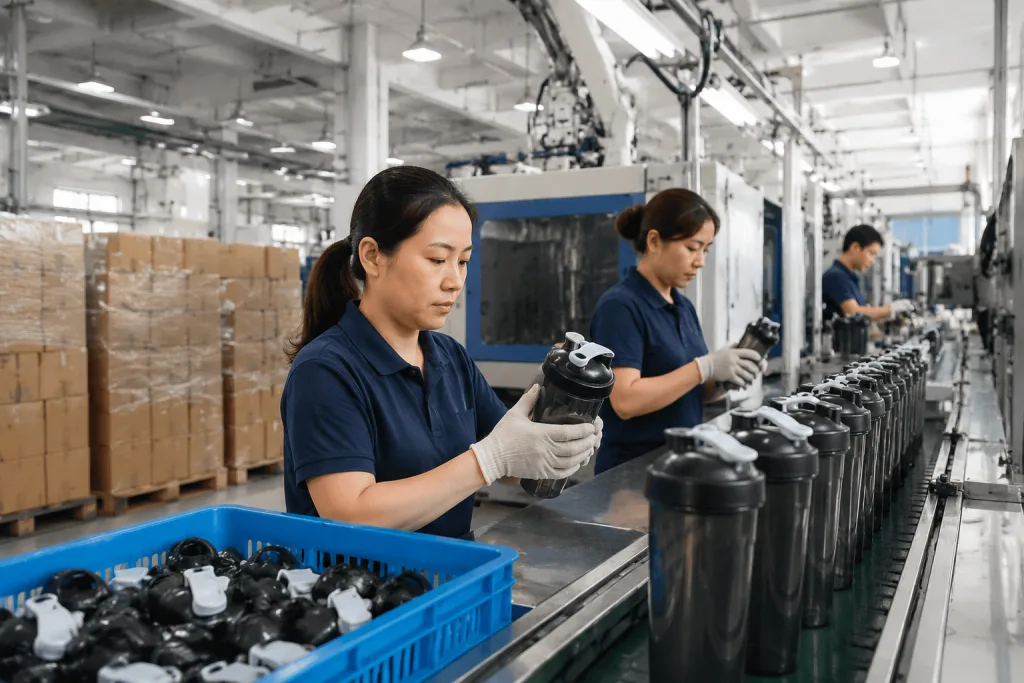
A shaker bottle looks simple until we ship 5,000 units and 312 come back with a loose cap, a warped lid, or a mixer ball that rattles out of spec. That is the real work with a shaker bottle supplier: not picking a clean render, but controlling the failure points that show up at scale. On our line in Zhejiang, the guys check cap torque with a simple gauge, and that is where weak builds get exposed. If the fit is off by 0.5 mm, the buyer flags it fast.
If you buy for a fitness brand or gym chain, you are balancing retail price, odor resistance, print quality, and packaging that survives distributor handling. A good factory should give you the MOQ, lead time, and test standards straight, no dancing around. At BottleForge Industrial in Hangzhou, Zhejiang, our standard shaker bottle line runs 80,000 units per month with a 30-day lead time on standard custom colors, so the question is not whether production is possible. The math is whether your spec is tight enough to stop rework, because we have seen that go sideways on a PO with one wrong lid code.
Where shaker bottles actually fail
The ugly part of shaker bottle sourcing is that the failures are small, repeatable, and expensive. A lid 0.4 mm out of round still closes by hand, then starts leaking after 20 to 30 cycles on the torque tester. We saw that on line 2 last month. A PP cap with poor mold cooling warps after hot-fill at 60-70°C, and a mixer ball that is 1-2 g too light passes a casual shake but leaves protein clumps when the user mixes 30 g powder in 300 ml water. That is where returns start.
Ask a shaker bottle supplier about the failure modes they control on the line, not the colors they can print. This is the wrong question to ask in a sample room. We want numbers: closure cycle life, cap thread hardness, wall thickness, cavity-to-cavity spread, and the QC record. On a Tuesday run here in Zhejiang, we check calipers, not slogans, and if the buyer wants “good quality” without data, the math does not work.
- Leakage: weak thread match, distorted gasket, and poor torque control.
- Odor: recycled resin contamination, low-grade colorant, poor post-bake control.
- Print loss: thin ink film, oil contamination, or bad flame treatment.
- Warp: uneven cooling, thin walls below 1.8 mm, or poor stacking in transit.
That is why a bulk shaker bottle order should be treated like a controlled part, not a promo throw-in. We had a buyer flag a PO typo once: 10,000 pcs turned into 1,000 pcs, and the order only made sense after we caught it before molding. Treat it like a part spec, or we have seen it go sideways.
Material choices that cut returns
Material choice is where returns start. Before artwork. Before box specs. For a custom fitness water bottle or custom gym water bottle, the body usually runs in Tritan, PP, or SAN, and the wrong pick shows up fast on the line. Tritan gives clearer walls and a better shelf feel, but it adds cost and usually pushes FOB up by USD 0.35-0.90 per unit on a 5,000-piece order versus basic PP. PP stays cheaper and stable. If the wall comes in too thin, or the resin grade is weak, the buyer flags it as flimsy even when it passes the gauge. We run that check with a caliper at 1.8 mm, and the bad calls are easy to spot.
For North America and Europe, get the paperwork before we run samples. REACH declaration, FDA contact-material suitability, and LFGB when the market asks for it are standard for a bulk gym water bottle program, and the math does not work if you chase them after approval. For stainless components or mixer inserts, use 304 stainless steel and call out wire diameter at 1.0-1.2 mm for the whisk ball. For a silicone gasket, spec food-grade silicone at 50-60 Shore A so the seal holds without making the cap a fight to close. QC pulled the sample last month and found a 0.4 mm mismatch on the insert; that kind of miss is where returns start. A torque wrench on the cap line would have caught it sooner.
What to write into the PO
Do not leave material quality vague. A PO should list resin type, wall thickness, color masterbatch limits, and whether recycled content is allowed, or you will spend a week untangling a typo from procurement. For a bulk sports water bottle meant for gym chains, 2.0 mm on the body and 1.6-1.8 mm on the cap is a sane starting point. If the buyer pushes back on price, this is the wrong question to ask. For retail fitness, pay for better resin and a clean finish. We've seen it go sideways when a 1.4 mm cap looked fine in photos and came back with stress marks after 12 days in transit instead of 18. The PO should also spell out MOQ, or you end up reworking the same line twice.
Leakproof means measurable
“Leakproof” gets thrown on the PO too early. We run the test first. A shaker bottle supplier should spell out the method: inversion at room temperature for 10 minutes, then a 5,000-cycle open-close run on the cap. On the line, we also drop a flip cap from 1 meter; if the latch does not seat cleanly, the claim is dead. Simple.
The gasket usually gets blamed. Wrong target. The leak often starts at the cap thread and bottle neck interface. We have seen a 0.2-0.3 mm thread mismatch pass visual QC and still seep into a gym bag after 2 days in transit. A buyer once pushed back until we put the thread ring under a caliper. The buyer flagged it, then the sample failed the dye test.
For any custom shaker bottle, ask for a neck gauge drawing before mass production. If the supplier cannot show the neck spec, the leak claim is just marketing.
For a custom sports water bottle going to gym chains, require one filled and one unfilled test in every pre-shipment sample lot. QC pulled the sample with a 25 mm neck gauge last month and caught a cap that looked fine but failed under pressure. We ship against that kind of check because chargebacks cost more than one extra inspection. The math does not work any other way.
Print, branding, and surface prep
Branding failures show up fast. That is the problem. A custom logo shaker bottle with ink that scratches off in transit looks cheap even if the bottle body is fine, and we have seen buyers reject a 5,000-piece lot over one bad carton rub. On smooth PP or Tritan, the supplier should state whether the print is silk screen, UV print, heat transfer, or laser on metal parts. Each one behaves differently on the line. Silk screen stays common and keeps cost down, often adding USD 0.15-0.30 per unit for one-color artwork. Laser engraving on a stainless detail costs more, but it holds through repeated washing and the buyer stops arguing after the first inspection. We ran a 72-hour carton rub check on a black sample last quarter, and the ink held on one side only. That's the split you watch for.
Surface prep matters more than the logo file. We run flame treatment or a proper wipe-down before print, and if that step is skipped, ink adhesion falls off fast on glossy custom made shaker bottle surfaces. One PO came in with a typo on the artwork placement note, and QC pulled the sample because the logo sat 3 mm too close to the grip. If your logo sits near a grip area, put abrasion resistance in the test plan. A dry-cloth rub test of 50 double strokes is not enough for a retail program. Ask for alcohol rub, dishwasher stress, and carton rub tests. We have seen a 0.2 mm shift turn into a rejected shelf sample, so this is the wrong question to ask after the goods are packed.
For distributor fitness water bottle programs, artwork consistency has to hold across every reorder. A 1.5 mm logo shift may look minor on screen, but it shows up on a store wall, and the math does not work when a gym chain expects the same shelf line in 40 locations across North America or Europe. We ship enough repeats to see this go sideways: one batch lands at 0.8 mm off-center, the next is dead on, and the buyer flags it on the second PO. On repeat runs, we lock the pad plate and check the first-off sample at 10x magnification before the line starts.
Packaging is part of the product
Most buyers book packaging as a cost line. Wrong question. Packaging is part of the product, and we have seen the line prove it: a shaker bottle can pass in-house, then the cap cracks at the collar after a 2,000 km truck run because the inner tray lets it float. For bulk shaker bottle orders, we specify carton compression strength, inner tray thickness in mm, and whether the shaker ball ships inside the bottle or in a sealed bag. If the ball rattles loose, it scuffs the inner wall or dents a thin cap.
For Amazon and retail shipments, barcode discipline matters. QC pulled the sample and found one PO with the FNSKU sticker 12 mm off center; that gets flagged fast. If you ship to warehouses, ask for label placement rules, carton marks, and master carton size limits. A standard export carton for a custom gym water bottle can hold 48 pcs with an outer carton target below 13 kg, which keeps handling clean and lowers crush risk. We run an 80 cm drop test on corners and edges before we sign off.
- Inner packaging: opp bag, paper insert, or molded tray.
- Carton spec: 5-layer corrugated for export, 7-layer if stacking is heavy.
- Labeling: SKU, color code, batch number, and country of origin.
That is normal work for a distributor shaker bottle program. Not overengineering. On one job, the buyer wanted to save 0.03 USD per set by dropping the insert, and the math did not work once returns started.
Inspection that catches repeat problems
Inspection is where a disciplined shaker bottle supplier earns trust. We run incoming material checks, in-process control, and pre-shipment inspection on every export lot. No hero move at the end. For a 5,000 pcs order, AQL 2.5 for major defects and 4.0 for minor defects is the working number. Retail brands push on leak, odor, cap fit, print registration, and accessory count, and they should. QC pulled a sample last month that looked clean, then the 50°C oven test showed resin smell after 2 hours. That batch was dead for Europe. North America would have kicked it back too.
Ask for a defect map by cavity if the factory runs multi-cavity molds. If cavity 3 keeps giving a 0.8 mm oval neck, the supplier should call it out before cartons move. We had one PO typo where the buyer wrote 58 mm instead of 56 mm, and the line caught it before molding started. A decent Zhejiang plant separates top-off items from the main lot. Saying “just send inspection photos” is the wrong question to ask.
For a customizable shaker bottle program, keep retained samples by color and batch. One signed master sample per revision is enough, with the cap code and print position marked on the bag. Old-school. Still useful. When a distributor calls six months later, you need a physical reference, not a memory of “the blue one.” We keep them on a labeled shelf beside the torque wrench records, and that habit saved us 12 days versus 18 days when the buyer flagged a shade dispute.
How to price the order correctly
Price is not resin cost plus print. We run this every week on the line, and landed unit cost moves with volume, accessory count, and pack-out. A plain PP shaker at 3,000 pcs may land around USD 1.20-1.80 FOB China. Add a stainless whisk ball, custom color, and one-color logo, and you are in USD 1.65-2.80 FOB, depending on mold status and carton spec. Tritan bodies and premium caps go higher. If a quote looks too low, a line item is missing.
The right comparison is failure cost, not the lowest sticker. A 5% return rate on a 10,000-piece distributor sports water bottle order burns more cash than paying an extra USD 0.22 per unit for better resin and tighter QC. QC pulled the sample last month and found a cap torque issue at 0.8 N·m, then the buyer flagged it after the first pilot batch. That is basic math. The first invoice hides it.
For brands buying from China, ask for FOB terms, sample charge policy, tooling amortization, and whether the quotation includes carton artwork. We had one PO with a typo on the outer carton count, 1,200 instead of 12,000, and the math broke before the truck booking was even set. If the supplier in Zhejiang cannot break down the quote, you do not have a real basis for a reorder.
What a useful supplier looks like
The best shaker bottle supplier is usually not the one with the loudest brochure. It is the one that answers process questions with numbers. How many units per month? What is the MOQ? How many days for samples? Which standards do you test against? At BottleForge Industrial in Hangzhou, Zhejiang, our monthly capacity is 80,000 units and the MOQ for standard shaker bottle projects starts at 3,000 pcs, with 7-10 days for samples and about 30 days for mass production. That is the planning line.
For fitness brands and gym chains, that matters because you are lining up campaign launches, distributor buys, and store rollout dates. One PO typo can waste a week. A supplier that keeps color matching stable, shows compliance on paper, and holds closure fit from lot to lot is worth more than a low first-order quote with shaky follow-through. We have seen this go sideways when a buyer pushed for a cheaper cap and QC pulled the sample at 1.5 mm flash on the rim.
If you need a custom shaker bottle, start with the failure mode you can least tolerate, then spec backwards. This is the right question to ask. The line stays honest that way, and you avoid finding the problem after cartons leave.
Send your shaker bottle spec for a quote
We will check material, mold, print, and packaging before pricing. If your order needs compliance documents, we can quote that with the production plan.
Frequently asked questions
What MOQ should I expect from a shaker bottle supplier?
For a real custom program, 3,000 pcs is a normal MOQ for a shaker bottle supplier in China. If you want a new mold, custom color, and printed logo, some factories will ask for 5,000 pcs to make the tooling and setup worthwhile. Sample lead time is usually 7-10 days, and mass production often needs 25-35 days depending on color and packaging. If the supplier claims 500 pcs with full customization, check whether they are using stock goods and simple sticker branding instead of a true production setup.
Which material is better for bulk gym water bottle orders?
For a bulk gym water bottle order, PP is the cost-effective default and Tritan is the premium upgrade. PP is fine for price-sensitive distributor programs, especially when you need volume and a lower FOB target. Tritan is better when you want clearer walls, a more premium feel, and better resistance to cracking. For Europe and North America, ask for material declarations and testing against REACH or FDA-aligned contact standards. If odor is a problem in your market, do not save USD 0.20 per unit and then lose customers over smell.
How do I stop leaks in a custom shaker bottle?
Do not rely on a marketing claim. Specify the thread drawing, gasket material, and a real leak test. A practical standard is inversion for 10 minutes with no visible seepage, plus 5,000 open-close cycles without thread damage. Make sure the cap and bottle neck are measured together, because a 0.2-0.3 mm mismatch can create slow leaks. For a custom shaker bottle program, also ask for sample torque values and a retained master sample so the supplier cannot quietly change the closure later.
What should I pay for a custom logo shaker bottle?
For a standard custom logo shaker bottle, FOB China pricing often starts around USD 1.20-1.80 for basic PP at 3,000 pcs, then moves up with color, accessory count, and packaging. Adding a one-color silk screen logo usually adds about USD 0.15-0.30 per unit. Tritan, premium closures, and better packaging can push the total into USD 2.00-3.50 FOB or more. If you get a quote far below that, you should ask what they removed from the spec, because the missing cost usually shows up later as returns or rework.
Can a distributor shaker bottle order be customized for retail chains?
Yes. A distributor shaker bottle program is usually built around repeatability, case pack efficiency, and barcode discipline. You can specify custom colors, branded print, retail cartons, shelf-ready packaging, and even FNSKU or SKU labels if you are shipping to fulfillment. For gym chains, I would keep the product family narrow: one bottle shape, 2-4 colors, and one or two print positions. That reduces complexity and makes reorders faster. A good supplier in China should be able to hold the same look across multiple production lots without color drift.