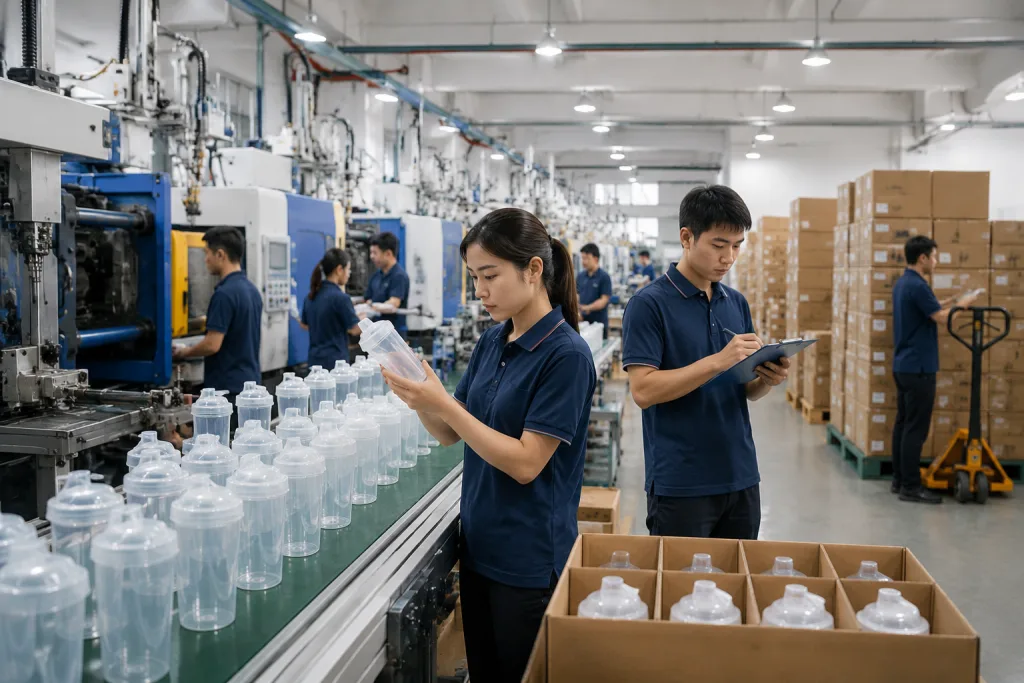
Key Takeaways
- A serious shaker bottle OEM manufacturer should quote 3,000 pcs MOQ and 25-35 days lead time, not vague timing.
- For fitness use, PP and Tritan usually outperform cheap PET when you need a customizable shaker bottle that survives repeated washing.
- A 600-700 ml bulk shaker bottle usually costs about USD 1.05-2.40 FOB China depending on lid, ball, and decoration.
- For distributor programs, ask for REACH, LFGB, and AQL 2.5 inspection terms before you approve artwork.
Pick the wrong shaker, and the bill shows up later. Leaks. Returns. Dead stock. The bottle can pass a sample table, then crack in a 0-5°C warehouse, an Amazon prep center, or a gym bag with a bent lid. A 600 ml PP shaker is common. The fault sits in the spec sheet, not the shape.
At BottleForge in Zhejiang, buyers often fixate on print area and miss the parts that move the needle: lid torque, mesh fit, wall thickness, closure tolerance. QC pulled the sample and the cap slipped at 1.2 N-m. This is the wrong question to ask. For China sourcing, start with the use case, then check mold cost, MOQ, and lead time. We run a 3,000-unit MOQ, 25 to 35 days lead time, and monthly output above 500,000 units; if the buyer changes one detail late, the math does not work.
What You Are Really Buying
Shaker bottles are not one product. We split them by resin grade, lid geometry, mix ball or blender insert, print method, and freight math. If you are buying for a gym chain, supplement brand, or distributor program, color is the wrong first question. Ask duty cycle. Does it need to survive daily protein use, cold water service, or a giveaway job where the unit cost has to stay under control? A custom made shaker bottle for a retail fitness brand is a different spec from a bulk gym water bottle for a club handout. Last month a buyer flagged a PO because the lid callout said "silicon" instead of "silicone" -- one typo, three extra days at the desk.
Start by splitting the job into three roles. One is a daily protein shaker, one is a hydration bottle, one is a promo bottle. The math changes fast.
- Daily protein shaker: needs a tight screw lid, secure flip cap, and a 500-700 ml usable volume.
- Hydration bottle: can run a simpler cap and more transparency in the body.
- Promo bottle: can chase low FOB, usually under USD 1.20 for PP at higher volume.
In Zhejiang and across China, export factories talk in wall thickness, cycle time, leak rate, and carton pack-out. That is the language that matters. If a supplier cannot tell you whether the cup body is 1.2 mm or 1.8 mm thick, you are not comparing the same part. We run calipers on the line for that. QC pulled the sample and found one batch drifting 0.3 mm on the sidewall, and that is how you end up with lid complaints after shipment. We've seen this go sideways after a buyer pushed for the cheaper wall spec, then the cap came back loose in hot water testing.
Spec Table That Actually Matters
Use the spec table before anyone starts talking about color chips or logo placement. We run this check first on the line because a gloss sample can hide a bad quote fast. The table below is the cleanest way to compare a shaker bottle OEM manufacturer on commercial terms, and it shows where a low price is just thin resin and loose QC.
| Spec | Entry Program | Mid-Range Brand Program | Retail / Premium |
|---|---|---|---|
| Material | PP | Tritan or PP+Tritan lid | Tritan, stainless insert, or specialty copolyester |
| Capacity | 500-600 ml | 600-700 ml | 700-800 ml |
| Wall thickness | 1.0-1.2 mm | 1.2-1.6 mm | 1.6-2.0 mm |
| MOQ | 3,000 pcs | 5,000 pcs | 8,000 pcs |
| FOB China price | USD 0.85-1.35 | USD 1.20-2.20 | USD 2.20-3.80 |
This is the number set that matters for bulk fitness water bottle sourcing. A quote that looks cheap on paper is not cheap if 4% of cartons leak or warp after summer transit; we saw that on a 600 ml run last August, and the buyer flagged it the day the pallet arrived. If you are building a customizable fitness water bottle program for a chain rollout, ask for cap thread tolerance and silicone gasket hardness, not just the logo method. The math does not work any other way.
Practical rule: if the supplier cannot explain why a 600 ml custom shaker bottle costs USD 1.48 instead of USD 1.08, they are hiding resin grade or QC. QC pulled the sample, checked the cap gauge, and the gap showed up in 12 seconds.
Material Choice By Use Case
Material is where buyers try to save USD 0.12 and lose the whole program. We have seen it on the line: a 65 mm PP cup looked fine in sample, then the buyer flagged odor after three dishwasher runs. For a bulk shaker bottle, PP is the low-cost workable choice, but it fits giveaways and short-run promos better than premium retail. Tritan is the cleaner pick when you need clarity, odor resistance, and a custom fitness water bottle that survives repeat washing and brand checks. The extra USD 0.35-0.90 per unit usually earns its keep.
When PP makes sense
Use PP for bulk gym water bottle orders where the target price is tight and the bottle will move fast. MOQ is usually the pressure point; on one 10,000-piece PO, the buyer tried to push the cap color after sampling, and the math did not work. PP molds easily, ships light, and runs in plenty of factories across China. Plain and simple. Do not sell it as premium.
When Tritan makes sense
Use Tritan for customizable shaker bottle programs sold through retail, e-commerce, or distributor fitness water bottle channels where appearance and odor resistance matter. QC pulled the sample after 18 wash cycles and the wall still held shape; that is the sort of result buyers pay for. It handles supplement staining and dishwashing better than PP, and the shelf look is stronger too.
For export, get the papers first. REACH for Europe, LFGB when Germany wants food-contact proof, and ASTM or CPSIA-related requirements if the program touches North America retail channels. We ship from Zhejiang, and a factory that does this every week should send the file set without drama. If they stall on a test report or send a PO with a typo in the material code, that is a sourcing risk, not a paperwork delay.
Lids, Balls, And Leak Risk
The lid sets the order. The body comes second. We have seen a shaker pass 20 samples and start leaking on carton 300 because the gasket sat 0.3 mm shallow or the snap tab was too soft. The wrong question is, "Can you show a nice render?" Ask for the leak spec in writing. Give us the method, the hold time, and the pass rate. One buyer pushed back on a 24-hour inverted test and wanted to cut it to 8 hours; the math does not work.
- Screw cap + flip top: best for daily training and protein powder use. QC likes the hinge because it is easy to check with a go/no-go gauge.
- Wire whisk ball: fine for low-cost bulk sports water bottle programs, but it adds one more assembly step on the line. We count the ball, the cage, and the spring clip, so missed parts show up fast.
- Mixing grid insert: cleaner than a loose ball, but it needs tighter mold control and cleaner parting lines. If the grid gap drifts by 0.2 mm, powder clumps stay in the cup.
For QC, we run a 1-meter drop test at room temperature and a 24-hour inverted leak test. For premium retail, ask for 5,000 open-close cycles on the hinge. Those numbers matter more than a glossy render. A buyer once flagged a PO typo that changed the lid color code, and the line still caught it because the sample note did not match the carton label. This is how we ship. If the supplier stays vague, the product usually ships vague too.
Branding Methods That Hold Up
Decoration has to match the way the bottle gets used. A custom shaker bottle for gym chains does not need a full-wrap graphic if staff wash it every day and hand it out at the front desk. We run a lot of 1-2 color silk screen jobs for that reason. Clean logo. Fewer headaches. For retail programs, laser engraving only works on stainless parts or metal lids; on a standard PP cup body, the buyer usually flags it for the wrong look, and the math does not work.
Here is the split we use on the line: after one trial run, QC pulled a cracked print from a cap with a 38 mm curve, and that saved us a repeat complaint. Good catch.
- Silkscreen: best for simple logos, lower cost, steady on bulk fitness water bottle runs.
- Pad print: useful for curved caps or small marks.
- Heat transfer: better for complex artwork, but wash resistance needs a real check.
- In-mold color: best when you want a clean customizable sports water bottle look without surface ink.
Logo setup charges usually sit around USD 35-120 per color, based on plate size and print area. If you want a custom made shaker bottle that feels retail-ready, ask for a decorated sample and a dishwasher test. We have seen this go sideways when a buyer approved art from a PDF and missed a typo on the PO; the cartons were fine, the print was not. A decent factory in Zhejiang will tell you whether the mark holds at 50 cycles, 80 cycles, or 100 cycles. That is the real question.
MOQ, Price, And Lead Time
Most sourcing mistakes start when a buyer treats MOQ like a nuisance. It is a signal. A factory quoting 3,000 pcs MOQ on a customizable shaker bottle is saying the line has enough order flow to run cleanly, and the packing table will not get dragged into one-off jobs. We saw this on a 30mm cap run last month: the buyer pushed for 1,000 pcs, QC pulled the sample, and the carton marks drifted by batch.
For a standard custom sports water bottle program, this is the frame we run in China:
- MOQ: 3,000-5,000 pcs per color or design.
- Sample lead time: 5-7 days for stock mold items, 12-18 days for new decoration setup.
- Mass production: 25-35 days after deposit and sample approval.
- Capacity: a stable factory should produce 300,000 to 600,000 units per month across drinkware lines.
For price comparison, a custom gym water bottle in PP may land around USD 0.85-1.35 FOB, while a Tritan version may sit around USD 1.20-2.40 FOB. Freight, carton count, and pallet efficiency can move landed cost by 8-15%. The math does not work any other way. If you are buying shaker bottles as a distributor, that is the number to watch, not the last five cents on factory price. We once fixed a PO typo where the buyer wrote 12,000 pcs but the artwork file matched 10,000; the line stopped for half a day.
Quality Checks That Prevent Returns
You do not need a lab on site. You do need a QC plan the line can run every day. A shaker bottle OEM manufacturer should accept AQL terms and show check points for the lid, bottle body, and final packing. For export runs, we start with AQL 2.5 for major defects and 4.0 for minor defects, unless the buyer wants retail packing and pushes it tighter. QC pulled the sample on a 24 mm cap last week; the thread missed by 0.3 mm, and that turns into returns fast.
Check these before release:
- Material verification: resin grade confirmation and food-contact declaration.
- Thread fit: manual torque sample and visual check on closure alignment.
- Leak test: inverted soak or pressure test on random samples.
- Carton test: drop and compression check for export cartons.
Ask for a pre-production sample, then a gold sample signed by both sides. We had one PO where the buyer flagged a typo on the FNSKU label, and the carton had to be reprinted before we could ship. If you buy for Amazon or a distributor network, confirm FNSKU labeling, carton barcode placement, and pallet height limits before shipment. This is the wrong question to skip. A carton that passes on the bench can still fail after 12 days on the road if the pallet stack is wrong, and we have seen that go sideways more than once.
Best Fit By Buyer Type
One buyer type should not drive the whole spec. A gym chain wants repeat stock, quick replenishment, and a clean logo on a bulk gym water bottle. A supplement brand wants shelf pop and tight leak control. A distributor wants room in the margin and cartons that stack clean on the warehouse floor. We ran a 64 mm lid sample last month; the spec shifted by channel.
For fitness brands, pick Tritan or a better PP grade, then lock the lid drawing and print method. QC pulled the sample twice after the buyer flagged a fuzzy logo edge. This is where people chase noise; the second order is what pays for the setup.
For gym chains, keep the custom gym water bottle simple: one or two colors, solid lid function, lower FOB. The math does not work once you add glossy paint and a fancy cap. Unit cost beats a flashy finish.
For distributors, build a distributor sports water bottle program around color options, carton yield, and easy reordering. We ship cartons at 24 pcs or 48 pcs, and that choice changes freight and shelf handling. A messy SKU set goes sideways fast.
One bottle will not fit every channel. A bulk fitness water bottle for a membership giveaway should not be spec’d like a retail shaker. We saw a PO typo once: 500 ml on one line, 550 ml on the next, and the line had to stop. Source to the channel, and you get cleaner pricing, less risk, and fewer awkward calls back to sales.
Send your shaker bottle spec for a fast quote
We will quote material, MOQ, FOB price, and lead time clearly, with sample options for your gym chain or fitness brand program.
Frequently asked questions
What is a normal MOQ for a shaker bottle OEM manufacturer?
For a standard custom shaker bottle, 3,000 to 5,000 pcs per design or color is common in China. If the factory quotes 500 pcs, check whether it is a stock item, because true custom molding and decoration usually need a higher run to keep unit cost sane. For more complex lids or multi-part mixing systems, 8,000 pcs is not unusual. In Zhejiang, a factory with stable export output should still handle 3,000 pcs without trouble if the spec uses existing molds.
How much should a bulk shaker bottle cost FOB China?
For a 600-700 ml bulk shaker bottle, expect roughly USD 0.85-1.35 FOB for basic PP and USD 1.20-2.40 FOB for Tritan or a more refined lid. Print, tooling, and special packing can add USD 0.05-0.35 per unit. If a quote is much lower, ask what was removed: wall thickness, gasket quality, decoration, or inspection. Cheap on paper often becomes expensive in claims.
What tests should I ask for before approval?
At minimum, ask for a 24-hour inverted leak test, a 1-meter drop test, and a lid open-close cycle check. For a custom logo shaker bottle headed to retail, I would also ask for food-contact declarations, REACH for Europe, and AQL 2.5 inspection terms. If your bottle will be washed in dishwashers, request a print durability test at 50 to 100 wash cycles. Those numbers are far more useful than vague quality promises.
Can a factory in China handle custom artwork and fast lead times?
Yes, if the factory already runs drinkware lines with real export capacity. A credible supplier in China should quote 5-7 days for samples, then 25-35 days for production after approval. In Zhejiang, larger factories often run 300,000 to 600,000 units per month across multiple bottle categories. The key is whether your artwork changes the mold or only changes printing. Mold changes slow everything down and raise cost.
Which is better for gyms: PP or Tritan?
For a bulk gym water bottle used as a low-cost giveaway, PP is fine. For a custom gym water bottle sold to members or used in branded retail, Tritan usually performs better because it looks clearer, resists odor better, and feels more premium. The price difference is often USD 0.35-0.90 per unit. If the bottle needs to support repeat daily use and stronger brand presentation, Tritan is usually the safer call.