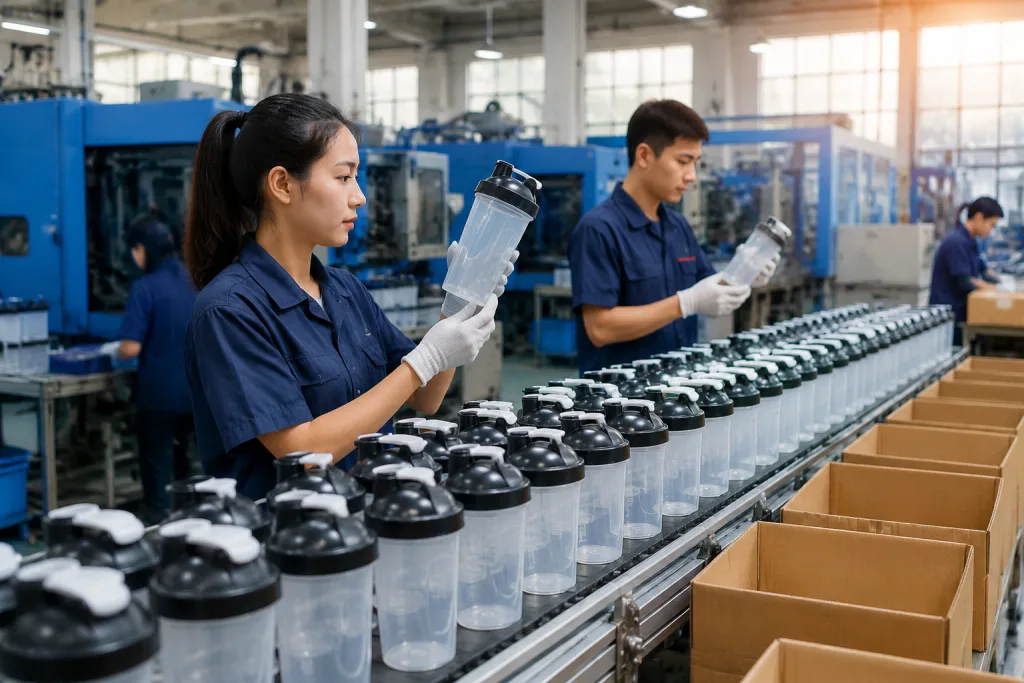
Key Takeaways
- A proper shaker bottle RFQ should lock 8 items: material, capacity, lid type, insert, logo, packaging, MOQ, and lead time.
- Typical factory MOQ for a custom shaker bottle is 3,000-5,000 pcs, with lead time around 25-35 days after sample approval.
- A bulk sports water bottle quote is incomplete without carton spec, AQL target, and test standard such as LFGB, REACH, or FDA.
- For China sourcing, compare FOB price, sample cost, and outer carton efficiency, not just unit price.
If you are sourcing from shaker bottle manufacturers, the first mistake is treating a shaker like a generic sports bottle. It is not. A bulk shaker needs a tighter lid, a clean sealing line, a mixing insert that stays put, and wall thickness that still passes a 700 g drop test on tile. We run that check on the line with a caliper and a simple leak jig. The weak ones show it fast. Logo first is the wrong question to ask.
At our Zhejiang factory, we see the same pattern every week: buyers ask for a custom logo shaker bottle, then find out the real work sits in the spec sheet, not the artwork. One PO last month had “mixing insurt” typed three ways, and QC pulled the sample before we packed it. A serious RFQ needs material, capacity, mixing system, MOQ, and packout locked before price. The math does not work any other way. China is still the practical supply base if you give us the details up front. Skip them, and you pay in samples, 12 days turning into 18, and cartons that get rejected at receiving.
Start With the Use Case
Before you talk to shaker bottle manufacturers, lock the use case. A gym chain buying a custom gym water bottle for front-desk retail wants shelf pull and a clean logo read. An Amazon seller or regional wholesaler watches carton size, damage rate, and repeat replenishment. We had one buyer flag a 580 ml sample because the cap sat 8 mm too tall for their display tray. Same bottle. Different job.
For most fitness programs, 600 ml is the working size. The common range is 500-700 ml, and 600 ml leaves room for powder and liquid without feeling clumsy in a bike cage. If the customer carries it every day, keep the body slimmer and the cap lower. If you are setting up a chain program, lock the spec and stop flipping it. We saw a 12-day vs 18-day reorder gap on a program that kept bouncing from 550 ml to 700 ml. The math does not work. QC pulled the sample at 600 ml, the fit passed, but the buyer still pushed back on the taller lid.
PO line items to define here:
- Capacity: 500 ml, 600 ml, or 700 ml
- Material: PP, Tritan, or stainless hybrid components
- Mixing method: wire whisk ball, fixed insert, or molded grid
- Target user: retail, gym giveaway, distributor sports water bottle program
In Zhejiang and across China, the line can build almost any version. We run samples with a 32 mm cap thread gauge before mass production, and that tells you fast whether the spec is stable. The real question is not whether the factory can make it. It is whether the model fits the channel, the carton, and the buyer's reorder pattern. We have seen this go sideways when a PO typo changed the capacity by 100 ml and nobody caught it until packing. Do not ask for a customized fitness water bottle until you know how it will be sold, stored, and used.
Write a Hard RFQ
A soft RFQ gets you range estimates. A tight RFQ forces shaker bottle manufacturers to show their hand on every line item. We need one page covering dimensions, resin grade, lid style, logo method, packaging, compliance, and annual volume. We send these out weekly. The pricing spread appears within 48 hours. Specify if a custom made shaker bottle requires a dishwasher-safe body, odor resistance, or BPA-free certification under FDA and REACH. Last month, QC rejected a sample at 72 mm mouth diameter because the buyer just wrote "sports bottle" on the spec sheet and assumed we would guess the rest.
Color and logo are just the starting point. For a custom logo shaker bottle, placement drives cost. A one-color silk print on a matte body runs a different line than a laser-etched stainless cap or a wrap print on a translucent cup. If you manage a customizable shaker bottle program, define what varies and what stays fixed. We had a buyer flag a PO requesting "custom color" while the mold was locked to three Pantone codes. That request went back for revision.
Require these fields in the quote:
- FOB Ningbo or FOB Shanghai price, not just EXW
- MOQ by color and by SKU
- Sample fee and sample lead time, usually 7-10 days
- Mass production lead time, typically 25-35 days
- Carton spec, units per carton, and gross weight
A clear RFQ cuts sourcing time. It filters whether the supplier in China operates on export terms or only domestic factory language. We saw a 5,000-piece order stall because carton weight was missing and the buyer had to rebook freight space. Good shaker bottle manufacturers quote in numbers, not adjectives.
Compare Quotes Like a Buyer
Price alone is a lazy way to compare a bulk gym water bottle offer. Two quotes can both show USD 1.18 and still hide two different builds. One quote may carry a 2.0 mm wall, a lid torque spec QC pulled at 18 Ncm, and an AQL 2.5 check. The other looks cheaper on paper, then the buyer flagged it after freight because the carton packout was sloppy. This is the wrong question to ask.
For a standard 600 ml customized gym water bottle in PP, factory pricing in China often lands between USD 0.85 and USD 1.60 FOB, depending on print, lid structure, and packaging. Tritan versions usually sit higher, often USD 1.40 to USD 2.40 FOB. A more complex customizable sports water bottle with a built-in mixer, carry loop, and gift box can go above that range. Normal. We run the line this way every week, and the ultrasonic weld station alone can add a clean cost jump when the lid gets busy. Cheap is only cheap if it survives use, transit, and shelf handling.
Compare quotes on three points:
- Mass and wall thickness: a 2.0 mm bottle can cost a few cents more, but a thin shell comes back as cracked caps and returns
- Packaging density: 24 pcs/carton versus 48 pcs/carton changes the freight math fast
- Test scope: REACH, FDA, LFGB, and drop test requirements need to be written into the PO, not left as chat history
A distributor shaker bottle program should also ask for pallet dimensions and container load count. We ship by pallet, not by guesswork. I have seen a PO typo turn 4,800 pcs into 48,000 pcs, and the math does not work. Good factories in China build around freight and carton size. Bad ones just quote plastic. The buyer usually learns that after a 1,200 kg trial run lands short on volume.
Treat Sampling as a Gate
Sampling is the gate, not a courtesy. On our Hangzhou line, we run three rounds: a pre-production body sample, a printed logo sample, then the golden sample before we release the mold plan. For a custom shaker bottle, pull the sample from the same mold cavity and, if the lid tool is already cut, the same lid set that will run mass production. The math does not work any other way.
Check lid alignment, threading smoothness, leak resistance, insert fit, and stress whitening around the neck. We shake with 250 ml of water and ice, then invert the bottle for 60 seconds on the bench. If the cap drips, the job is not ready. QC pulled one sample last month with a 0.6 mm mismatch at the neck; the buyer flagged it before we packed the cartons. Good catch.
PO line items for sample stage should include:
- Sample quantity: 2-5 pcs per version
- Sample charge: often USD 30-80, refundable on bulk order in many cases
- Courier cost: DHL or FedEx billed separately
- Approval version number and date
Keep comments short and numbered. A good supplier in Zhejiang can turn redline notes into revised samples in 3-5 days if the issue is clear. A sloppy one will argue about wording instead of fixing the part. We have seen this go sideways on a 1,000-piece MOQ when the PO had a typo on the lid color code.
Lock the Production PO
Once the sample is signed off, turn the quote into a production PO with exact line items. Do not send a vague “proceed” email. We run the line from the PO, not from memory. A manufacturing PO should spell out SKU, capacity, material, color code, logo method, packaging style, approved sample reference, quantity, unit price, total value, and delivery term. If the buyer wants a retail window for a bulk sports water bottle shipment, add the ship date and any delay penalty terms in the contract. The buyer flagged this once on a 500 ml shaker bottle order because the logo position was only written as “front side”; that is the wrong question to ask.
The floor-level minimum for a custom gym water bottle or bulk fitness water bottle is usually 3,000 pcs per color, and 5,000 pcs is the real floor when the mold or lid is complex. Lead time usually sits at 25-35 days after deposit and sample sign-off. QC pulled the sample with a 0.2 mm gap at the lid insert once, and that job slipped 4 days while we reworked the tooling. For larger programs, a Zhejiang factory with real capacity can run 300,000-500,000 units per month across several drinkware lines, but the slot still depends on tooling and current loading. The math does not work any other way.
Good PO lines include:
- Product name and internal SKU
- Quantity by color and by carton
- Printing area and artwork file reference
- Inspection standard: AQL 2.5 or AQL 1.5
- Outer carton mark, FNSKU, or distributor label requirement
This is where a distributor fitness water bottle order turns into a real manufacturing job. One PO typo on our side can cost a day on the line, and we have seen that go sideways. China factories move fastest when the paperwork is exact. On a recent 12,000 pcs shaker bottle run, the carton mark said “FNSK U” in the buyer's draft, and we had to stop the pack-out until QA cleared the reprint.
Check Quality Before Shipment
Inspection is where weak sourcing habits get expensive fast. We pull the golden sample back to the line, then check the first mass-production batch before balance payment. On a 5,000-unit shaker run, the buyer flagged lid sealing, print adhesion, plastic odor, and scratch marks from loose packing. For a custom sports water bottle headed to retail, the cap gets judged first. Shelf buyers see that before they touch the body.
We run a plain inspection plan: 100% visual check on appearance, random sampling by AQL 2.5 for minor defects, and AQL 1.5 when the launch window is tight. For leak testing, 10-20% spot checks are not extra; they catch the cap that passes hand-tight but fails after a 2 kg carton drop. On one customized shaker bottle with a whisk insert, QC pulled the sample through repeated shaking and found the insert creeping 3 mm. If you ship into the EU, ask for REACH-compliant material files and traceability records. For North America, confirm FDA food-contact declarations and carton labeling before the booking leaves the warehouse.
Practical packout checks:
- Each unit in a polybag or kraft sleeve as specified
- Barcode readable at 300 dpi or better
- Carton compression strong enough for export stacking
- Quantity variance within agreed tolerance, usually +/- 2%
We treat that as normal work in a Zhejiang export factory. The math does not work any other way.
Plan Distribution and Reorder
The last step is not shipping. It is repeatability. A custom fitness water bottle program only works when you can reorder the same item 90 days later without reopening the spec. We keep the approved sample, final artwork, carton file, and test reports in one shared folder on the server. That saves 6 to 7 days when the warehouse asks for the next batch and the buyer flags a typo on the PO.
If you run a gym chain, match the replenishment pack to the way goods are received. A bulk gym water bottle order packed in 12 pcs inner boxes may look neat in a showroom, but 24 pcs cartons usually move better on a pallet jack and cut repack work at intake. If you buy for distribution, stick to one mold and 3 to 5 colors. The math does not work when every reorder turns into a new SKU. We have seen that go sideways at 500 cases.
A practical reorder model looks like this:
- Initial order: 3,000-10,000 pcs
- Reorder trigger: 30-45 days before stockout
- Artwork lock: no changes after sample approval
- Forecast review: quarterly, not ad hoc
That is the part a lot of buyers miss. The best custom gym water bottle is not the one with the most features. It is the one your supply chain can repeat without drama, whether it ships from China or from a second run in Zhejiang. QC pulled the sample, checked the cap gap at 0.3 mm, and that is the kind of boring you want on a reorder.
Request a shaker bottle RFQ review today
Send your spec sheet, target MOQ, and packout plan. We will flag the gaps before you ask shaker bottle manufacturers for pricing.
Frequently asked questions
What MOQ should I expect from shaker bottle manufacturers?
For most custom shaker bottle projects, expect 3,000-5,000 pcs per color as a workable MOQ. Simple PP models can go lower, sometimes 1,000-2,000 pcs if the factory already has an existing mold and standard lid. Tritan or multi-part versions usually need more volume because tooling and setup costs are higher. If you want multiple colors, ask whether MOQ applies per color or per total order. That detail changes the quote by a lot. For a first run, many buyers do better starting with one SKU, one lid, and one print method.
What is a normal sample lead time?
A normal sample lead time is 7-10 days for a standard custom logo shaker bottle. If the product needs new tooling, special packaging, or a complex insert, 12-15 days is more realistic. Couriers add 3-5 days depending on destination. I usually tell buyers to plan one revision round, not three. If the supplier cannot produce a usable golden sample within two cycles, the production run will not be cleaner than the sample. Good factories in Zhejiang usually move fast here because the mold shop and printing team are under one roof or in the same industrial cluster.
How do I compare FOB prices properly?
Compare FOB prices only after you have locked the same spec. A USD 1.05 bulk shaker bottle and a USD 1.28 bottle are not comparable if one includes a thicker wall, better lid, and retail carton. Ask for the exact material, wall thickness, logo method, and carton count. For export, check whether the quote includes inner packaging and whether the carton dimensions are efficient for ocean freight. Sometimes a cheaper unit price loses once you factor in volumetric weight or damaged goods. That is especially true for bulk fitness water bottle programs with premium packaging.
Which compliance documents should I request?
For Europe, request REACH declaration and food-contact compliance documentation. If the bottle is plastic or silicone, ask for material test reports tied to the batch or material lot. For North America, ask for FDA food-contact declarations and any applicable ASTM or CPSIA-related paperwork if the item is marketed to youth. If you are sourcing from China, also ask for factory audit evidence such as BSCI if your retailer requires it. Do not rely on a verbal promise. The document set should be named in the PO, and the supplier should confirm it before production starts.
What should be in the bulk PO for a custom shaker bottle?
A good bulk PO should include SKU, capacity, material, color code, logo size and position, packaging, carton count, unit price, total quantity, approved sample reference, and delivery term such as FOB Ningbo. Add inspection standard, usually AQL 2.5, and state whether you require barcode labels or FNSKU if the bottles are for Amazon or a similar channel. Also specify the latest ship date and the permitted quantity tolerance. For a custom made shaker bottle, this paperwork is not bureaucracy; it is what keeps the factory and buyer aligned when the line goes live.