Key Takeaways
- Most shaker bottle in bulk orders start at 3,000-5,000 units, with OEM lead time around 25-35 days after sample approval.
- A 20-24 oz PP shaker bottle usually lands lower than stainless versions, often at USD 0.75-1.40 FOB China depending on mold and print.
- For chain gyms, a leak-tested cap and a 0.8-1.2 mm wall spec matter more than a fancy shape.
- If you need retail-ready packaging, budget an extra 8-15% for insert cards, barcode labels, and carton configuration.
If you are buying shaker bottle in bulk, the real call is not which bottle looks nice. It is whether the bottle survives 300 drops, keeps powder from clumping, passes REACH and food-contact checks, and still leaves margin on the PO. A bad pick shows up fast on the line: leaks, smell complaints, cracked lids, returns. We have seen a 12-day delay turn into 18 days because a lid gasket was 0.3 mm off and the buyer pushed back on rework.
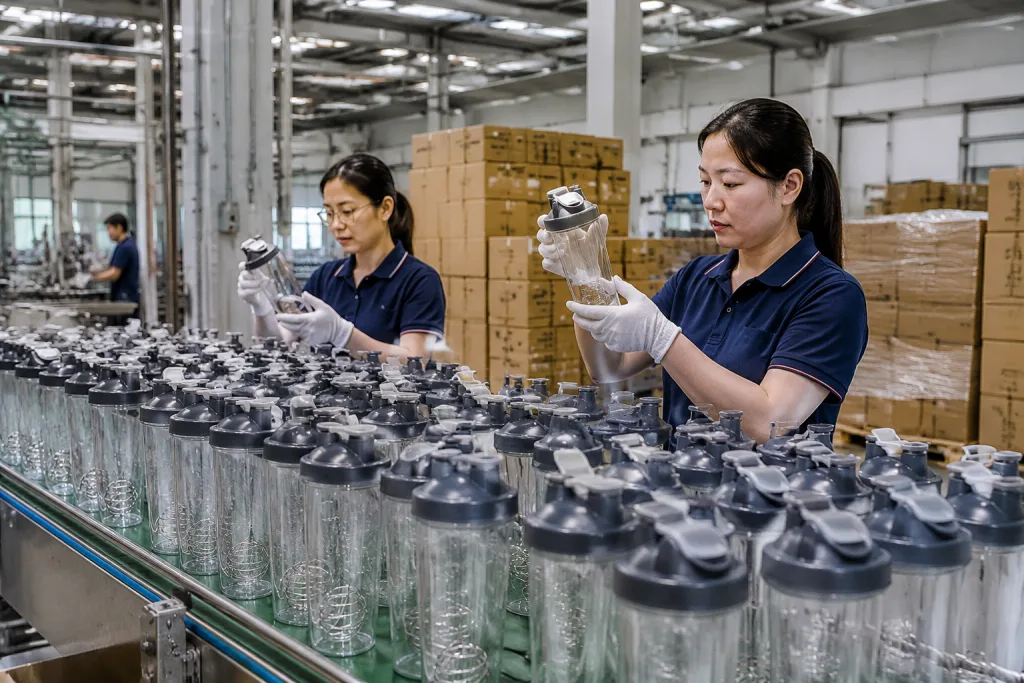
We build drinkware in Hangzhou, Zhejiang, and we see the same pattern in China and Europe. A buyer sends artwork first, then flags wall thickness, cap torque, or carton cost after QC pulled the sample at 2.2 mm. That is the wrong question to ask. Bulk sourcing needs a spec-first comparison, not a catalog browse. If you are sourcing a custom gym water bottle or a custom logo shaker bottle, start with the use case, then choose the build that fits it. We run into the same PO typo a lot: someone writes 500 pcs when the MOQ is 5,000, and the math does not work.
Start With the Use Case
Do not start with “custom shaker bottle” as a blank product ask. Start with who uses it and where it gets handed over. A trainer at the front desk wants a lighter, lower-cost bulk gym water bottle. A supplement brand selling through retail needs a stiffer body, a cap that closes with a clean snap, and print that stays sharp. A distributor loading pallets cares about carton efficiency, leak rate, and reorders that do not drift. Different jobs. Different spec.
We sort shaker bottles by three real use cases: promo giveaway, retail resale, and club merch. Promo orders can run on simpler PP bodies and one-color print; we shipped a 3,000 pcs run that passed because the buyer only needed shelf-ready giveaways. Retail needs stronger packaging and tighter cosmetics, and QC pulled the sample when the collar line was 1 mm off. Club merch wants a custom made shaker bottle with local branding, but the order still has to clear a realistic MOQ. Skip the use case and the math does not work. On our line in Hangzhou, we ask about capacity, closure type, lid color, print method, and whether you want powder mixer balls or a fixed mesh insert before we quote.
| Use case | Best-fit build | Typical MOQ | FOB China |
|---|---|---|---|
| Promo giveaway | PP, 500-700 ml, single print | 3,000 pcs | USD 0.75-1.10 |
| Retail resale | PP or Tritan, better packaging | 5,000 pcs | USD 1.10-2.20 |
| Club merch | Custom color, logo, accessory set | 5,000 pcs | USD 1.20-2.60 |
Compare Body Materials Honestly
Material choice decides half the deal. For a bulk shaker bottle, PP stays the default because it is cheap, light, and the line can run it fast. Tritan costs more, but the bottle comes off clear and moves better on shelf. Stainless steel shows up less in protein shaking; the weight jumps, and wash time stretches. None of them wins on paper.
Here is the straight read: if you need a bulk fitness water bottle for a chain promo, PP is the cleanest math. If you need a customizable fitness water bottle that sits beside retail SKUs without looking low-end, Tritan is the better sell. If you are building a premium distributor fitness water bottle program, stainless can work, but only when the price band supports it. We had a buyer flag a PO that said “food grade PP” with no resin code; QC pulled the sample and the smell test failed. This is the wrong question to ask if the spec is thin. Ask for resin spec, wall thickness, and odor control. A 1.0 mm wall in PP holds shape better than a body that feels cheap at first squeeze.
- PP: lower cost, lighter, good for 10,000-piece promo runs and fast molding on the injection machine.
- Tritan: clearer, cleaner presentation, better for retail shelves and gift sets.
- Stainless: premium feel, higher unit cost, more weight, and slower cleaning at the packing table.
Lids, Mixers, and Leak Risk
The lid is where cheap shaker bottles fail. The body can pass a quick visual check and still leak if the thread fit is sloppy or the flip cap sits 1 mm off-center. For a custom gym water bottle, I take a plain lid with a clean seal over a fancy body shape every time. We ran one batch where the cap survived 80 open-close cycles and started failing at 120; the buyer flagged it, and the returns math did not work. If you are buying bulk shaker bottle units for a gym chain, test the cap for 200-300 open-close cycles before you sign off on production.
Mixing hardware matters too. A wire ball is simple and cheap, and it works best for straight protein powder. A mesh insert blends better, but it adds one more part and makes cleaning slower. Fixed internal grids sell well in some markets, though they trap residue if the geometry is wrong. That is the wrong question to ask if you start with decoration. For a custom logo shaker bottle, keep the print away from the grip zone and the gasket seat. We usually spec food-grade silicone seals, then check closure torque on the line and run a random water-leak test under AQL 2.5 for major defects. QC pulled the sample with a 0.3 mm gap at the cap lip once; that is the kind of detail that turns into a complaint later.
Do not pay for decoration before you pay for the lid. A bottle that leaks once is a returned product, not a branded asset.
Read the Spec Table Properly
A shaker bottle order gets priced from the spec table, not from a shiny sample on the desk. We run the line off capacity, dimensions, weight, wall thickness, closure style, print area, carton loading, and certification status. Leave one field blank and the quote turns fuzzy fast. For distributor fitness water bottle programs, carton count is where margin slips. A bottle that loads 48 pcs per carton instead of 36 changes landed cost in a way you can see on the freight invoice.
Use this as the working comparison. QC pulled the sample with a 0.2 mm caliper on the bench, and the buyer still tried to compare a 560 ml PP cup against a 720 ml Tritan piece. Different job, different cost. That is the wrong question to ask.
| Spec | Promo PP | Retail Tritan | Premium Stainless |
|---|---|---|---|
| Capacity | 500-600 ml | 650-750 ml | 600-750 ml |
| Wall thickness | 0.8-1.0 mm | 1.0-1.2 mm | 0.4-0.6 mm inner/outer |
| MOQ | 3,000 pcs | 5,000 pcs | 3,000 pcs |
| Lead time | 25-30 days | 30-35 days | 35-45 days |
| Typical FOB | USD 0.75-1.10 | USD 1.10-2.20 | USD 2.80-5.50 |
If the spec sheet is vague, the quote is vague too. We have seen this go sideways on a PO typo for 500 pcs versus 5,000 pcs, and the carton plan was off before production even started. The math does not work when the buyer skips that check.
Branding and Print Methods
Your branding choice has to fit the body material and the target price. A custom shaker bottle with a one-color silkscreen logo works on 5,000-unit runs, and the shelf looks clean when the art stays simple. Laser engraving only makes sense on metal bodies; we run it on 304 stainless, and the mark still passes after 200 wash cycles. Full-wrap graphics can look strong, but the setup fee is higher, and the result depends on the print method and the mold shape. We check that on the line before film approval.
If you are sourcing a customizable shaker bottle for a fitness chain, keep the logo readable from 1.5 meters away. Buyers push back on that, then send artwork with five lines of copy on the sidewall, and it turns muddy once the bottle is filled. This is the wrong question to ask. A custom fitness water bottle for a gym desk needs logo clarity first. For China-made orders, confirm color tolerance, logo placement, and whether you need a second print on the cap or a paper insert. QC pulled the sample at 10.2 mm off-center once, and the buyer flagged it before mass production. We have also seen a PO typo on Pantone 186 C turn into a three-day delay. In Zhejiang factories, a clean AI file and a real Pantone code save more time than a week of back-and-forth.
- Silkscreen: best for 1-2 solid colors on flat or gently curved panels.
- Pad print: useful on curved caps, small logos, and tight 18 mm print zones.
- Laser: for metal only, durable and clean.
Compliance and Testing Checklist
For Europe and North America, compliance sits in the buying spec, not on the side. We ask for food-contact declarations, REACH files for the parts that touch the mix chamber, and a migration report before the line starts. If the bottle is going to retail, we check carton labels, batch codes, and the paper trail too. A PO typo on the label file can burn 7 days.
On our side, we run incoming inspection, in-process checks, and final random inspection to AQL 2.5 for major defects and AQL 4.0 for minor defects. That is normal export work. If you need an FDA-related document set for the U.S. market or ASTM-referenced material data, raise it before we open the mold. We also check drop-test targets, seal integrity, and barcode readability with a handheld scanner. The buyer flagged a weak barcode once, and the carton sat in warehouse for 12 days.
A factory at 600,000 units per month can still miss your spec if the checklist is loose. Capacity does not control the job. QC pulled the sample on a 500 ml shaker bottle run last month and found a 1.2 mm cap gap. The math does not work if you skip that kind of check.
Order Size, Lead Time, and Freight
Shaker bottle in bulk pricing drops with volume, but only up to a point. The real break sits around 3,000 to 10,000 pieces, where mold amortization, screen print setup, and carton packing start to move the number. For a standard PP custom sports water bottle, a 3,000-piece order may land only 0.08-0.15 USD per unit below a 5,000-piece run if the spec is plain. Once the bottle has a two-color logo or a different lid insert, the gap opens because we spread the artwork and mold tweaks across more pieces. We’ve had buyers push for 1,000-piece pricing on a 3,000-piece spec. The math doesn’t work, and the line shows it. A 450 g lid with a new gasket slot is not a small change.
Plan the schedule with factory timing, not wishful dates: 5-7 days for sampling, 2-3 days for sample approval if the buyer replies on time, 15-20 days for production on a simple mold, and 7-12 days for export packing and booking. QC pulled the sample and caught a 1.2 mm cap mismatch before it hit packing, which saved a rework loop. For the U.S. or Europe, ocean freight stays the better call once you are moving pallet volume. Air only makes sense for a launch test or a stockout fix. A distributor sports water bottle order should also be carton-optimized for warehouse handling: standard master cartons, clear outer labels, and FNSKU or SKU stickers placed where the 3PL scanner reads them on the first pass. We ship this kind of job every week, and a 58 x 38 x 40 cm carton spec is easier to live with than a loose guess.
For buyers in Zhejiang and elsewhere in China, speed matters only when the second order repeats the first one. We had a PO last quarter with a typo on the carton count, 480 instead of 408, and the buyer flagged it before loading. That is the wrong question to ask if you only chase a fast quote. A quick price that cannot be repeated on the next run is not a procurement answer. We run the same check on every reorder: lid color, logo position, carton count. Simple. A 3000-piece reorder with the wrong sticker count can burn a day on the dock, and we’ve seen that go sideways. That is what keeps freight from turning into a mess.
Which Build Fits Your Channel
Strip out the marketing copy and the answer gets plain fast. For gym giveaways and event packs, a light PP bulk gym water bottle is enough. For e-commerce or retail shelves, a Tritan bulk sports water bottle prints cleaner on camera and reads better on shelf. For premium programs, a stainless custom made shaker bottle can hold a higher ticket, but the extra weight pushes freight up fast. We ran a 12-day vs 18-day freight check on one 500 ml line, and the math does not care about branding.
Start with the channel. QC pulled the sample on the bench with a caliper, and the buyer flagged a 2 mm lid mismatch before we shipped. The bottle shape comes second. This is the wrong question to ask if you begin with looks.
- Gym chain desk sales: customizable gym water bottle with tight leak control and simple branding.
- Supplements and retail bundles: customized shaker bottle with cleaner packaging and sharper print.
- Distributor programs: distributor fitness water bottle or distributor shaker bottle lines with stable carton counts and reorders the line can repeat.
If you are buying from Zhejiang or another supplier in China, the cleanest program is the one that matches the channel, not the one that looks best in a sample photo. The bottle has to move through your sales floor, your warehouse, and your customer’s hand without turning into a return. We have seen that go sideways on a PO with one wrong digit in the carton count. The line remembers those mistakes.
Get a bulk shaker spec and FOB quote
Send your target capacity, logo file, and carton count. We will price the right shaker bottle in bulk for your channel, not a vague sample.
Frequently asked questions
What is the usual MOQ for shaker bottle in bulk orders?
For a standard PP shaker bottle in bulk, MOQ is usually 3,000 pieces. If you want Tritan, custom color matching, or special packaging, 5,000 pieces is more realistic. For stainless versions, 3,000 pieces is common because the tooling and assembly are more involved. In Zhejiang and other China factories, MOQ also depends on print colors and whether you need a unique cap or insert. If you are starting a new SKU, ask for a split order between plain stock and branded stock so you can test demand before you commit to 10,000 units.
How much does a custom shaker bottle cost FOB China?
A simple PP custom shaker bottle usually lands around USD 0.75-1.10 FOB China at 3,000 pieces. Tritan models often run USD 1.10-2.20 depending on wall thickness, lid design, and print coverage. Stainless models are typically USD 2.80-5.50. These numbers move with resin price, accessory count, and packing spec. If you want retail cartons, barcode labels, and a custom insert card, add roughly USD 0.08-0.20 per set. For a real comparison, ask the factory to quote the same bottle with the same carton count and the same logo method.
What certifications should I ask for?
At minimum, ask for food-contact declarations, REACH-related material compliance where applicable, and a migration test report if the bottle will be sold in Europe. For the U.S. market, many buyers request FDA-related material documentation and general food-safe resin statements. If you sell through retailers, ask for batch coding, carton marks, and an inspection plan based on AQL 2.5 for major defects. A serious China supplier should also provide process control records, especially for seal fit, print alignment, and leak testing. Do not assume a sample on a desk means the batch is compliant.
Can I get a custom logo shaker bottle with fast lead time?
Yes, if the design is simple. A standard custom logo shaker bottle can usually be produced in 25-35 days after sample approval. A plain-color PP version can be faster, sometimes 20-30 days, while more complex Tritan or stainless builds need 35-45 days. If your logo has more than two colors or you want special packaging, add time. The quickest path is to keep the mold standard, limit the artwork to one or two print areas, and lock the carton spec early. In Zhejiang factories, delays are usually caused by late artwork changes, not production itself.
What should I inspect in a sample before placing the bulk order?
Check lid closure feel, leak resistance, wall thickness, odor, print sharpness, and how the bottle behaves after a few cycles in warm water. Shake it with 200-300 ml of water and a mixing ball, then invert it for 60 seconds. Measure whether the cap opens too easily, whether the gasket sits evenly, and whether the body flexes under grip pressure. For a custom sports water bottle or custom gym water bottle, also check carton fit and shelf presentation. If the sample feels fine but the cap seam is weak, do not approve production. That problem only gets more expensive at scale.