Key Takeaways
- Basic bulk shaker bottle pricing starts around USD 0.78-1.25 FOB China at 3,000 pcs; custom decoration adds 5-15%.
- Most custom gym bottle projects need 7-15 days for tooling samples and 20-35 days for production after approval.
- A practical MOQ for a custom logo shaker bottle is often 3,000-5,000 pcs, but stock-cap decoration can start at 500-1,000 pcs.
- For Europe and North America, check REACH, LFGB, FDA-contact claims, and carton drop-test packaging before you place a large PO.
If you buy direct from a shaker bottle factory, do not price every quote the same. It never is. A 24 oz PP shaker with a basic flip cap and one-color print sits around USD 0.78 to 1.25 FOB China at 3,000 pieces, while a two-piece premium build with a stainless spring ball, silicone seal, and custom mold details can move past USD 1.60. On our line, the mold fee and decoration method set the gap. The buyer flagged a PO once: same bottle, same size, different cap. The math does not work.
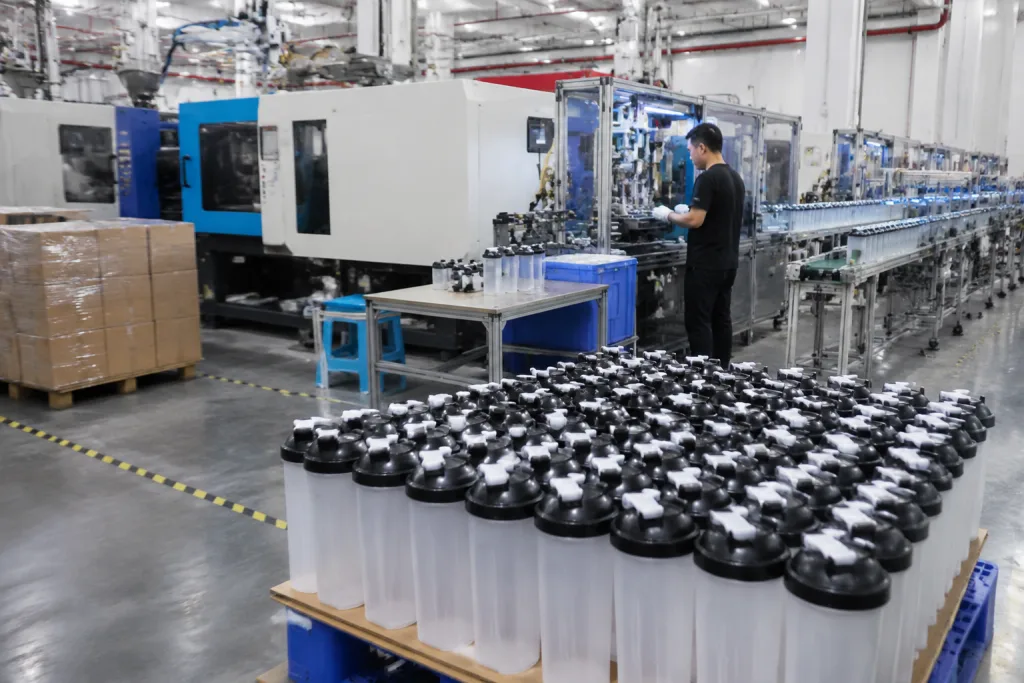
For fitness brands and gym chains, the real job is not chasing the lowest number. It is finding a Zhejiang supplier that holds spec, ships on time, and keeps carton damage low enough for retail and distributor channels. We run 400,000 units/month, but that means nothing if the MOQ starts at 10,000 and your launch needs 2,000 custom shaker bottle units in 35 days. QC pulled a sample with a 1.2 mm lid gap last spring, and that cost us a week. Build the buy around cost drivers, MOQ tiers, and the calendar your channel can live with.
What drives shaker bottle cost
Price starts with the parts that move it. The bottle body is usually PP or Tritan, the cap assembly may be PP, ABS, or TPE overmold, and the mixer can be a spring ball, mesh disc, or plastic whisk. A plain 28 oz PP body with a screw cap and flip lid is cheap because the mold is simple and the resin bill stays low. Add a Tritan body, a separate leakproof gasket, and a stainless mixing ball, and the quote jumps. We run that comparison every week on the line.
Decoration is the next cost bucket. Single-color silk screen is still the cheapest print method for a bulk fitness water bottle, often adding USD 0.08-0.18 per unit. Laser engraving looks clean on stainless parts, but on plastic it is the wrong tool. Wrap print, gradient print, and multi-location branding cost more because setup eats time, color matching needs extra checks, and scrap risk goes up. Packaging matters too. A plain polybag is one thing; a printed color box with barcode labeling, FNSKU application, and carton master label work is another. One buyer sent a PO with 480 cartons written as 84, and QC pulled the sample again before we shipped. Ask for the same Incoterm, same packaging, and same artwork count before you compare quotes.
Typical FOB China cost bands:
- Basic PP bulk shaker bottle: USD 0.68-1.05 at 3,000 pcs
- Tritan custom shaker bottle: USD 1.05-1.85 at 3,000 pcs
- Premium leakproof custom made shaker bottle: USD 1.45-2.40 at 5,000 pcs
In Zhejiang, factories with in-house molding and printing usually quote faster because they do not wait on outside decorators. That does not make them cheaper by default. It does make the cost structure clearer. We run 24 cavity caps here, and the math does not work the same once you split the process across three shops.
MOQ tiers that make sense
MOQ is where buyers lose days. A distributor fitness water bottle program does not need the same volume as a 40-store gym chain rollout, so one sales number is the wrong question. On a ready mold with only print changes, 500-1,000 pcs is normal. New color, new lid, and custom logo shaker bottle packaging? 3,000 pcs is the floor we quote without hand-waving. New mold? Plan on 8,000-10,000 pcs plus tooling fees. QC pulled a sample on one run because the cap skirt was 0.8 mm off, and that is why low-MOQ promises fall apart.
The useful way to think about MOQ is by project type:
- 500-1,000 pcs: stock bottle, custom print, standard carton marks
- 3,000 pcs: custom color, logo, mixed packaging, one production line run
- 5,000-8,000 pcs: custom lid parts, PMS color matching, retailer-ready packaging
- 10,000+ pcs: full custom mold or highly specialized custom sports water bottle
For buyers in North America and Europe, the MOQ should match launch risk. A bulk gym water bottle for a 20-location chain can start at 3,000 pcs if every store takes the same SKU. A distributor shaker bottle order often needs 5,000 pcs because you need buffer stock for resellers and reorders. We saw this go sideways on a 12,000-unit PO where the buyer flagged a typo on the carton mark, and we had to reprint 600 outer boxes. Ask for MOQ by component, not just finished product. A custom cap MOQ is where the math usually breaks.
Materials and compliance details
For Europe and North America, material choice is not a branding call. It hits cost, odor, drop life, and the compliance file. PP is the cheapest option for a customized gym water bottle, but it feels lighter in hand and the shell shows stress marks sooner; we see that at the line after a 1.2 m drop test. Tritan gives better clarity and a cleaner retail position, which is why buyers push for it on a customizable fitness water bottle. Stainless-steel mixer balls are common. They add 18 to 26 g per bottle and push carton cost up. If you want a more premium custom sports water bottle, a Tritan body with silicone sealing ships better in transit and holds up in use.
Compliance needs to go into the PO. For EU-bound orders, ask for REACH documents and, where relevant, LFGB food-contact support. For the US, ask for an FDA food-contact statement and the test reports behind it. If the bottle has a printed coating or rubberized grip, confirm the ink and coating system too; QC pulled one sample last month and the buyer flagged a 0.3 mm coating mismatch. A cheap quote gets expensive fast if the lab report fails and you have to reprint 8,000 units. That math does not work. For distributor gym water bottle programs, carton compression and drop performance matter as much as the bottle itself. We run 6-corner carton tests here, and a cap can crack in transit while the bottle body still passes a basic function check.
When you check a supplier in China, ask for recent third-party reports, not a generic certification PDF. A real factory will state the resin grade, the gasket material, and the test scope without hesitation. A vague answer usually means the factory is buying through traders and losing control of production. We ran into a PO typo last quarter where "Tritan" came through as "Triatn" and it took two days to clear; that kind of mistake shows who actually reads the job sheet. Zhejiang factories with in-house QA usually keep cleaner traceability than a loose sourcing chain, and you see it when a reorder on batch four matches the first run.
Decoration choices that change margin
Most buyers stare at bottle shape and miss the decoration math. That is the mistake. On the line, a logo call can move margin more than the resin grade because setup time, plate wear, and MOQ move together. Silk screen is still the workhorse for a bulk fitness water bottle. We run it on a 300 mm jig, reset is quick, and it stays stable across reorder cycles. Pad print fits curved caps or a recessed panel. Heat transfer and full wrap print look stronger for retail, but they add setup. We have seen them add USD 0.12-0.35 a unit, depending on color count and print area.
If you want a custom made shaker bottle for a gym chain, pick decoration by channel, not by taste. This is the wrong question to ask: “Which one looks best?” A distributor sports water bottle needs branding that survives handling, not a photo sample that only passes under soft light. QC pulled the sample on a 500 ml run and the buyer flagged a laser mark on the lid as too faint for store shelves. One-color logo on a matte body is the cheapest route, but a two-color print on a clear Tritan body can lift shelf value for a small cost jump. The math works only if the order can absorb the setup, and 3,000 pieces is a different game from 12,000.
Packaging decoration takes margin too. Custom belly bands, printed cartons, retail hang tabs, and barcode labels all add labor at packing, not just print cost. For direct ship to Amazon or a 3PL, the carton spec needs FNSKU placement and case pack logic before we start the line. We had one PO with a typo on the barcode line, and that turned into 2 days of relabeling with the zebra printer. A good factory asks for this early, with the carton artwork and pack count locked. A weak one waits until the last week and then charges rework. We ship these cases every week; the mistake is always the same.
Best fits by buyer type
If you are a fitness brand, start with a custom shaker bottle that keeps decoration tight and packaging in the mid-range. We run this choice a lot. The math is simple: you need retail margin, and the factory has to hold color at 90%+ consistency. A Tritan body, a leakproof cap, and one-color print usually get there without drama. QC pulled a sample last week with a 1.2 mm print shift, and the buyer flagged it fast. For launch SKUs, keep the part count down. Every extra gasket or insert adds assembly time and more failure points on the line.
If you are a gym chain, the buying logic changes. A bulk gym water bottle or customizable gym water bottle is usually a service item or membership gift, so unit cost and replenishment matter more than shelf life. A plain PP body with custom print works when bottles move fast and do not sit around as merchandise. We have seen this go sideways when a buyer tried to sell the same bottle in a pro shop. Then you need a more durable custom sports water bottle, better carton protection, and you pay for it. This is the wrong question to ask: cheapest unit price alone does not win if the pack gets crushed in transit.
For distributors, the key is reorderability. You need a distributor fitness water bottle or distributor shaker bottle that can be repeated without tooling surprises. Ask the factory what happens on order two. Can they hold the same PMS color? Can they keep the same carton configuration? Can they still hit the same lead time after they switch to another customer’s run? We once caught a PO typo on a 5,000 pcs reorder, and the carton mark was wrong by one digit; that kind of miss costs a week. Those are the questions that separate a one-time shipment from a real supply relationship.
Use case shortcuts:
- Launch retail brand: Tritan custom shaker bottle, 3,000 pcs minimum
- Gym chain giveaway: PP bulk sports water bottle, 1,000-3,000 pcs
- Distributor channel: custom logo shaker bottle, repeatable carton spec
- Premium merch: custom made shaker bottle with upgraded cap and box
How to audit the factory
Factory-direct only works if the plant is a real plant. In China, that still gets messy. Ask for the address, the machine list, monthly output, and who owns molding, printing, and packing. A proper shaker bottle factory direct supplier should know its line output without checking three people. If the site says 400,000 to 600,000 units/month and the QC manager still cannot explain leak checks, that is not a strength. We’ve seen that one go sideways. On one audit, the buyer flagged a PO typo that swapped 28 mm for 82 mm, and the plant had already booked the wrong cap mold.
Walk the audit in plain terms. Ask for incoming material inspection, in-process checks, the final AQL standard, and the carton drop-test procedure. AQL 2.5 for major defects and 4.0 for minor defects is common in consumer drinkware, but you still need hard definitions for leaks, print flaws, and cap alignment. Ask whether the factory follows ISO 9001, and whether it has BSCI or a similar social compliance record if your retail channel needs it. Then ask for photos of the exact line used for your bulk shaker bottle, not a trade-show album from 2023. QC pulled the sample on our side and found a 1.2 mm gap at the spout; that is the sort of miss that shows up after the shipment leaves, and that is the wrong time.
If the supplier cannot state a reorder lead time or explain how it holds color within the same batch, keep walking. Zhejiang has plenty of capable plants, but capacity alone does not buy discipline. This is the wrong question to ask: "Can you make it?" Ask how they run sampling, inspection, and document control. We ship with a lot number on every carton for a reason. A factory that treats those steps as admin work will cost you time later. On the line, we track color with a Pantone card and a 0.5 mm gauge, because a buyer who wants "close enough" usually comes back with a claim.
A simple buying sequence
Buy the first order as a factory check, not a patience test. Start with one clean spec sheet: capacity, material, cap style, decoration method, carton count, target market. For a custom fitness water bottle or customizable sports water bottle, lock the bottle dimensions first, then sort art and packaging. That order keeps the job from drifting into revisions. A good supplier in Hangzhou or anywhere in Zhejiang should quote from one sheet and one sample reference, not from a loose email chain with three versions of the same PO. We had a buyer flag a PO typo on the cap color once, and the line stopped for half a day while we waited for a clean file.
Then run the quote against three numbers only: landed unit cost, time to ship, defect risk. A distributor gym water bottle order that saves USD 0.06 per unit but adds 14 days and a higher leakage rate is the wrong deal. Ask for pre-production samples, then approval photos of the first 20-50 units from the line. QC pulled the sample and checked the cap torque at 18-22 kgfcm before bulk ran. During production, require in-process leak checks and carton samples before loading. If the order goes to Amazon or a 3PL, put FNSKU, case pack, and master carton labels in the production note. We run a 0.8 mm print check on the sleeve for this step; the buyer wanted to skip it, and that math does not work.
That process looks plain. Good. The best factory-direct deals in China are the ones that hold spec, ship on schedule, and repeat the order without eating your margin on rework. We see 12 days vs 18 days all the time when buyers skip the sample sign-off and then chase changes after the line is running. Give the factory one clear gate and one clear yes.
Get a factory quote built around your volume
Send your target MOQ, bottle size, and market. We can price a custom shaker bottle project with realistic lead time and packaging options.
Frequently asked questions
What is a realistic MOQ for a custom shaker bottle order?
For a stock mold with custom print, 500-1,000 pcs is realistic. For a true custom shaker bottle with color changes and packaging work, 3,000 pcs is the safer floor. If you need a new cap or any tooling, expect 8,000-10,000 pcs plus mold cost. A serious factory in Zhejiang should tell you whether the MOQ is driven by the body, lid, or printing line. That detail matters more than a single headline number.
How much should I budget per unit factory direct?
For FOB China pricing, a basic PP bulk shaker bottle often sits around USD 0.68-1.05 at 3,000 pcs. A Tritan custom gym bottle is usually USD 1.05-1.85. If you want stronger packaging, leakproof parts, or a premium custom logo shaker bottle finish, budget USD 1.45-2.40. These are factory-direct ranges, not landed costs, so you still need freight, duty, and local fulfillment added on top.
How long does production usually take?
For logo-only orders, sample approval usually takes 5-10 days and bulk production 20-25 days. For a custom color or more complex custom sports water bottle, plan on 7-15 days for sampling and 25-35 days for production. Tooling adds another 20-35 days before the first sample. If you are shipping to Europe or North America, add ocean freight time on top, which can be 18-40 days depending on destination.
Which compliance documents should I ask for?
For Europe, ask for REACH and, where relevant, LFGB food-contact support. For the US market, ask for FDA food-contact statements and third-party test reports. If your bulk fitness water bottle uses printed coatings, soft-touch grips, or multi-material caps, ask for those materials specifically. A generic certificate is not enough. You want the exact resin, ink, and gasket system that matches your production lot.
Can I order custom bottles for Amazon or 3PL fulfillment?
Yes, but tell the factory before production starts. For Amazon, you may need FNSKU labels, carton marks, and case-pack quantities defined up front. A custom gym water bottle heading to a 3PL should also have master carton dimensions confirmed, because freight charges can swing on a few millimeters. A good factory can print and apply barcode labels in-house, which saves time and avoids relabeling at origin.