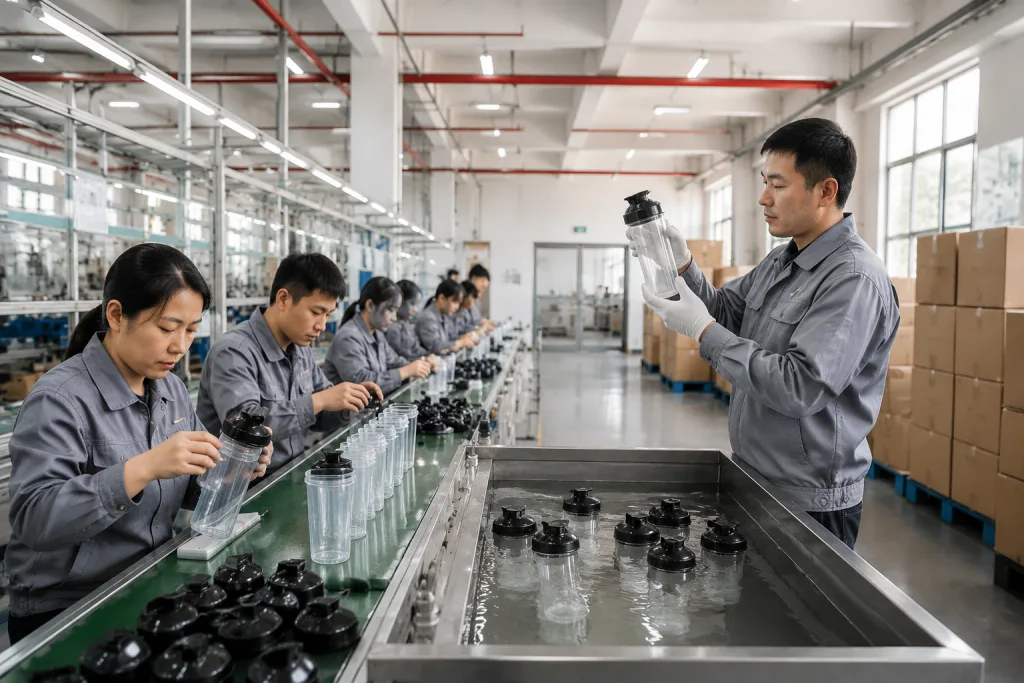
Key Takeaways
- Tritan (BPA-free) bodies cost 25-40% more than PP but reduce warranty claims by 60%.
- Standard MOQ for a custom shaker bottle is 3,000 units; lower runs incurur 15-20% setup surcharges.
- A 304 stainless steel mixing ball should weigh 25g minimum; lighter balls rust or deform.
- Lead time from Zhejiang to US ports averages 35 days FOB; factor in 7 days for custom mold printing.
- Silkscreen printing is viable for 1-2 colors; 3+ colors or full-wrap requires UV printing at +$0.25/bottle.
You are looking at a sheet with 20 SKUs and one ugly question: why does one custom shaker bottle land at $1.80 and another at $3.50. On paper, they look the same. Both are 28oz, both have black lids, both say BPA-free. On the line, that is where the split starts. For shaker bottle distributors feeding gym chains or retail programs, wall thickness, resin grade, and cap fit decide whether the bottle sells as a premium item or gets treated like a cheap promo. We run these jobs every week in Zhejiang, and the buyer flagged it fast when a 1.2 mm bottle and a 1.5 mm bottle were quoted as if they were twins.
This guide covers the procurement questions we hear from fitness brands and distributor gym water bottle buyers every day. No fluff. We focus on the numbers that move your landed cost: the real MOQ for custom logo shaker bottle runs, the gap between a $0.12 mixer ball and a $0.35 one, and the order setup that clears REACH without paying for material you do not need. QC pulled the sample on a 500-set lot last month and caught a lid wobble at the first drop test. That is the detail to watch.
What Material Grade Do You Actually Need?
Most distributor fitness water bottle RFQs start with “BPA-free plastic.” That is where the trouble starts. For the bottle body, we run three resins on the line: Polypropylene (PP), Tritan (copolyester), or Polyethylene (PE). For a bulk shaker bottle going to budget gyms, PP is the default pick. It keeps the unit price down, takes color well in the mold, and survives carton crush better than soft plastic. QC pulled a sample after 48 hours in the dishwasher tester, and the odor showed up fast. That is the kind of miss that gets buried in a quote.
Tritan is the better call for a premium custom sports water bottle. It comes out clear, takes a hard hit without cracking, and handles temperatures up to 100°C without leaching. If the buyer is a high-end fitness brand or a supplement company bundling bottles with protein powder, Tritan is the grade they should ask for. The math is plain: expect about $0.40 to $0.60 more per unit than PP. We had one buyer flag a PO that only said “plastic,” and we sent it back to the quote desk because that wording often points to recycled PP, which can fail REACH compliance tests for phthalates. PE shows up more on lid parts than bottle bodies; on shaker shells, it is too soft for the job.
How Does the Mixing Mechanism Affect Price?
The mixing part moves the price fast on a custom shaker bottle. We cut there first if the spec sheet is loose. A proper 304 stainless whisk ball should hit 25g to 30g on our scale; if a supplier quotes under 20g, QC pulled the sample and the wire bent after a short tumble test. That is the wrong place to save. A good ball runs about $0.35, while a thin one sits near $0.12, and the math does not work once the buyer starts asking about rust claims and returns.
Stationary mesh grids have taken more orders because they do not rattle in transit. They get molded into the cup, so there is no loose part to lose in packing, but the inside needs a harder wash and the buyer flagged that on a 12,000 pcs PO last month. The mold cost usually goes up by about $0.20, yet assembly drops by 10 seconds per unit on the line. At 50,000 units, that gap shows up. Plastic mixing cones are a bad bet; they do not break powder well and static leaves residue on the wall, which is exactly the complaint we hear when the bottle comes back from testing.
What is the Real MOQ for Custom Logo Shaker Bottle Projects?
Factory listings often show "MOQ: 500 pieces," but that number only holds for stock colors with a plain sticker label. For a custom logo shaker bottle with a Pantone-matched body and a printed logo, the real MOQ sits at 3,000 to 5,000 units per color. We run the line this way for a reason. An injection machine needs a purge and a color change, and a 500-piece order still burns 4 hours of setup for a 1-hour run. The math does not work.
If you are a distributor buying sports water bottles for a test market and need smaller runs, expect a small-run surcharge. We usually quote a flat $150-$200 color setup fee plus a 15-20% premium on unit price. One buyer flagged a PO typo on an 800-piece shaker order, but the real problem was deeper: the price had been built on a 5,000-piece model. For orders under 1,000 units, laser engraving on a stock bottle is the cleaner route, since there is no mold fee, but you are still limited to stock body colors like clear, black, or grey. Silkscreen printing sits in the middle at about 1,000 units, and it works for 1-2 color logos. QC pulled the sample at 0.8 mm off-center once, and that job went sideways fast.
Can You Print Complex Designs on Curved Surfaces?
Printing is where custom shaker bottle schedules slip. We lost 3 to 5 days on artwork sign-off alone, and that was with a clean AI file. Most bottles are tapered, so silkscreen hits a wall fast. It still wins on bulk jobs because the ink cost sits around $0.05-$0.10 per pass, and the print holds up in daily use. The catch is the gripper edge, a blank band where the clamp bites. If your buyer wants a full-wrap print down to the bottom seam, silkscreen will not do it. Last quarter we had a PO marked “full bleed” on a 750 ml bottle, and QC pulled the sample right away.
For a customizable sports water bottle that needs full-color wrap graphics, we run UV printing or heat transfer. UV is the cleaner call for fine logos and smooth gradients. It prints direct from file, so there are no screens to make, which matters when the buyer changes team names on 12 SKUs in one order. The math does not work the same way, though: UV adds about $0.25 to $0.45 per unit, and the surface can wear sooner than silkscreen if the bottle rides around in a gym bag every day. Ask for a cross-hatch adhesion test before mass production. We have seen this go sideways on the wrong resin, especially when the buyer flagged a matte body but the sample came in glossy.
What Quality Control Checks Prevent Returns?
For distributor shaker bottle imports, the first return drivers are lid leaks and odor. AQL 2.5 is fine for general defects, but leak checks need AQL 1.0. That is the right number. On our line, QC caught a 2 mm silicone seal ring twist after a rushed press-fit, and the bottle only showed it once we shook it with 30 g of powder. The eye misses that. The buyer flagged it later.
Build a drop test into the QC sheet. A custom sports water bottle should survive a 1.2-meter drop onto concrete without the lid cracking or the body splitting, and we log that with a calibrated tape measure, not a guess. Ask for an odor test on the cap too. This is the wrong question to skip. Caps often use a different resin blend than the body, and a low-grade recycled cap will smell off even if the Tritan body passes. For print, demand at least 10 dishwasher cycles on samples so you can see whether the logo fades and the lid warps. We have seen PP lids go soft after heat, then returns start.
How Should You Structure Payment and Lead Times?
For a custom shaker bottle order, we run FOB terms at 30% deposit and 70% balance after inspection closes. 100% upfront is a bad deal. The deposit covers resin, caps, and color masterbatch, and it locks the raw material price before the line starts. On a 5,000-piece sports water bottle order, lead time usually lands at 25-30 days after the deposit clears: 7 days for material prep, 15 days for molding and printing, then 5-8 days for assembly and packing. We had one PO typo turn “5000” into “500,” and that pushed the booking off by 2 days. This is where buyers get caught.
If the order ships to North America, add 20-30 days for sea freight. The buyer flagged this twice because they looked only at production time and missed the queue ahead of it. A Zhejiang factory running 300,000 units a month can still be booked 2 weeks out. For a rush custom fitness water bottle launch, the math does not work without a 10% rush fee. Ask for a written production schedule with the molding start date, not just the ETD. QC pulled the sample, checked cap torque with a 1.5 N·m gauge, and that schedule kept one buyer out of demurrage at Ningbo. We ship on numbers, not hopes.
Checklist for Your First Production Run
Before you release a bulk gym water bottle PO, run this checklist. One missing line on a spec sheet has turned into 12 days of back-and-forth here. The math does not work on a first run.
- Material Spec Sheet: Lock the resin code first, PP or Tritan, and ask for the BPA-free paper trail. We run the batch against REACH or FDA reports for that exact lot, not a generic file from last quarter. The buyer once wrote “food grade plastic” on the PO, and that wording burns time at the desk.
- Mixer Weight: Write it as 304 Stainless Steel, 25g min. Do not leave it as “mixing ball.” QC pulled the sample once and the buyer flagged a 21g piece that looked fine by eye but failed the contract. We weigh these on a 0.1g scale.
- Volume Tolerance: Standard tolerance sits at ±5%. For a 28oz bottle, that gives you 26.6oz to 29.4oz, which is fine for a low-cost line. If you want premium positioning, push it to ±3% and put it in the PO. This is the wrong question to ask after tooling starts.
- Logo File Format: Send vector artwork in AI or EPS. JPEG files print soft edges on silkscreen, and we had to rework a screen frame at 0.3 mm off because the buyer sent a compressed file with no clean outline. The art file decides whether the line runs clean.
- Packing Method: Standard pack is 1pc/polybag, 50pcs/carton. Ask for separator cards between layers if the bottle finish is glossy. One pallet we shipped came back with scuffs because the buyer tried to save 0.8 kg per carton. That saving was fake.
- Gold Sample: Keep one gold sample at the factory and one in your office. That is the reference when the buyer says the lid shade looks off, and it settles disputes faster than a long email chain. We label ours with the mold number and date.
Run this list before the line starts. We ship faster when the details are clear, and the first production run stays on spec instead of turning into a correction job. QC will tell you the same thing after the first carton check.
Ready to Source Your Next Shaker Bottle Line?
Send us your specifications or request a quote. We provide transparent pricing and production timelines for distributors of all sizes.
Frequently asked questions
Can I mix different bottle colors in one container order?
Yes, but it depends on the total quantity. For a custom shaker bottle order, factories usually allow 2-3 color variations per container if the total order exceeds 10,000 units. Below that, you may face a 'color change fee' of $50-$100 per switch because the molding machine must be purged. Always clarify if the MOQ is per color or for the total order. Some flexible manufacturers in Zhejiang allow color mixing within a single 3,000-unit order if you use stock colors rather than custom Pantone matches.
What is the difference between FOB and CIF pricing for distributors?
FOB (Free on Board) means you pay for the goods and the factory covers transport to the port of origin (e.g., Ningbo). You handle ocean freight and insurance. CIF (Cost, Insurance, and Freight) includes shipping to your destination port. For a bulk shaker bottle order, FOB is generally preferred because it gives you control over the freight forwarder and usually results in lower total costs. CIF prices often include a markup on the freight. Use FOB if you have a reliable logistics partner; use CIF only if you are a new distributor sports water bottle buyer without established shipping lanes.
How do I ensure the bottle is truly leak-proof?
Specify a 'negative pressure test' during production. This involves filling the bottle with water, inverting it, and applying pressure to check for seepage around the lid seal. For a custom gym water bottle, the most common leak point is the interface between the lid and the spout cap. Ensure the spout has a solid 'click' sound when closed. Request samples with the actual production mold, not 3D printed prototypes, as 3D prints often have different tolerances than injection-molded parts.
Are sustainable or recycled materials available for shaker bottles?
Yes, but they increase costs significantly. rPET (recycled PET) and PCR (Post-Consumer Recycled) PP are available options for a customizable shaker bottle. Expect a price increase of 20-30% compared to virgin materials. The visual quality of PCR PP can be slightly grey or speckled, which may not suit premium branding. For a sustainable custom sports water bottle, consider Tritan Renew, which is a chemically recycled material that maintains clarity. Always ask for the 'recycled content percentage certificate' to verify marketing claims.
What is the typical lifespan of a custom shaker bottle?
A high-quality custom made shaker bottle made of Tritan or heavy-gauge PP should last 2-3 years with daily use. The failure point is usually the lid mechanism or the seal. Silicone seals degrade over time, especially if exposed to bleach or high heat. For bulk fitness water bottle orders intended for heavy gym use, advise your clients to replace the bottle or seal every 12 months. Offering replacement seals as a spare part can be a value-add for premium fitness brands.