Key Takeaways
- Typical MOQ for a custom shaker bottle is 1,000 to 3,000 pcs, with sample lead time of 5 to 7 days
- A practical bulk sports water bottle price often starts around USD 1.35 to USD 2.80 FOB Zhejiang depending on material and print
- For export buyers, REACH-compliant plastic, BSCI audit status, and AQL 2.5 inspection are the basics, not extras
- A 700 ml or 750 ml format is the safest bet for gym chains; it moves better than odd sizes and packs efficiently
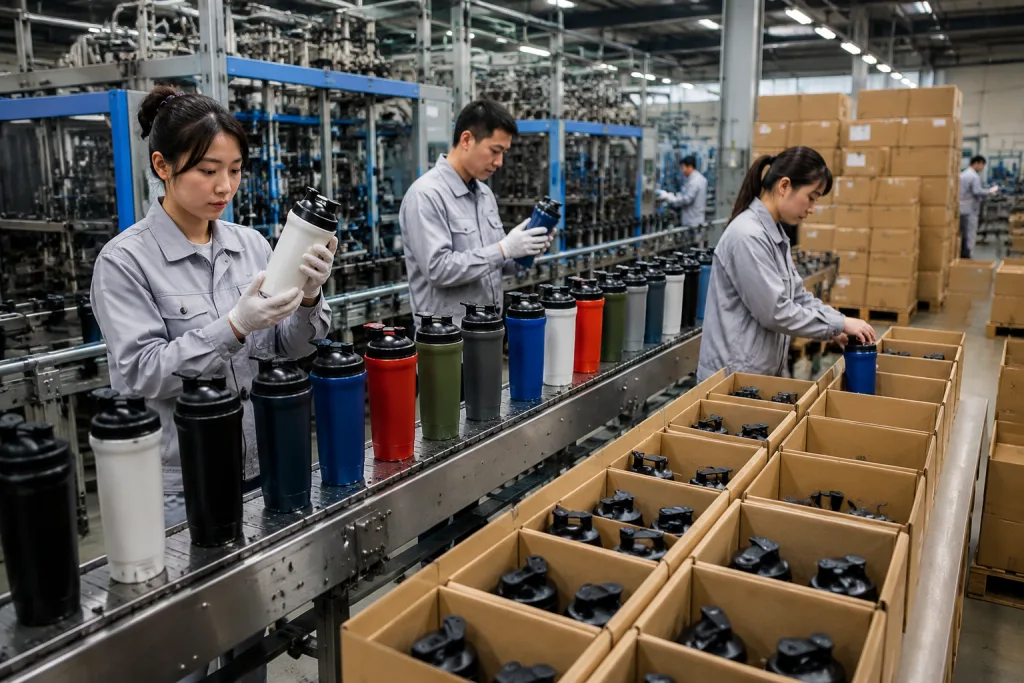
If you run a shaker bottle distributor, you know the pain points already: buyers want a low price, a clean logo, and zero leaks, then push for replenishment on a tighter clock than a normal drinkware program. That setup breaks sourcing plans fast. We saw it on the line last month. A 28 mm lid thread looked fine by hand, then QC pulled the sample after a 24-hour shake test and found a slow drip at the cap seam. A shaker bottle is not a plastic cup with a cap. It needs lid fit, a mixing insert that seats straight, color control within range, and packaging that survives cross-border freight without crushing at 15 kg per carton.
We build and export drinkware from Zhejiang, China, and the pattern stays the same every week: distributors who ship well start with use case. A gym chain buys different from a supplement brand, and that split changes the order from the first quote. Are you buying a bulk shaker bottle for promotion, or a custom logo shaker bottle for repeat retail orders? That is the right question. Everything downstream moves with it: MOQ, material, print method, and carton count. The math does not work any other way. Our factory runs about 120,000 units per month, and our standard lead time sits at 25 to 35 days after sample approval; one buyer typed “5000 pcs” on a PO but left the color code blank, and that order sat for two days while we confirmed the spec at the mixing station.
What Buyers Actually Need
Custom means use first. Print comes later. A shaker bottle on a gym floor gets slammed into a bag, dropped on rubber mats, and washed after class. A retail bottle sits on a shelf, so the lid feel, barcode space, and carton print carry more weight. Same bottle? No. Different spec.
For bulk fitness water bottle programs, we split the brief into three lanes: promotional, retail, and membership gifting. That keeps the quote clean. We ran one job where the buyer pushed for one bottle across all three, then flagged the carton cost after it jumped 18%. The math does not work. Promotional orders can run a simpler body and one-color logo. Retail orders need tighter surface control and better packaging. Membership gifts usually need a bigger print area and a lower landed cost. We ship this kind of split every week. MOQ changes the answer.
- Promotional: price first, 500 ml to 600 ml, one-color print
- Retail: lid quality, carton presentation, consistent surface finish
- Membership: speed, stackability, carton density
In Zhejiang and across China, the better factories ask these questions before they quote. QC pulled the sample and checked the lid gap at 0.8 mm, which tells you more than a glossy brochure. A supplier that cannot say whether a custom sports water bottle is built for gyms or retail shelves is handing you a price list. That is the wrong question to ask.
Choose The Right Bottle Build
The build decides whether you get repeat orders or a warehouse of complaints. For a custom made shaker bottle, the main body is usually PP, Tritan, or PET on lower-cost runs. PP is the workhorse. It is the cheapest in most quotes, handles heat reasonably well, and keeps unit cost down. Tritan costs more, but it gives better clarity and a cleaner shelf look. For a distributor fitness water bottle line, that premium look matters when the buyer sells through clubs or specialty retail. We run those samples on the line with a 0.05 mm feeler gauge at the cap seat, and a bad fit shows up fast.
Wall thickness matters more than first-time buyers expect. A common PP shaker wall is around 1.0 mm to 1.2 mm. Go thinner and the bottle feels flimsy in hand. Go too thick and cost and cycle time climb. Lid threads matter just as much. A sloppy thread spec creates leaks, and a leaking shaker is dead on arrival. The buyer flagged it on a 500-piece pilot once after QC pulled the sample and found a wet carton. For a bulk shaker bottle, ask for a pre-production sample with the exact cap, seal ring, and mixing insert you want in production. The math doesn't work any other way.
Useful build questions
- Is the bottle intended for manual washing or dishwasher use?
- Do you need a wire whisk ball, a fixed mixing grid, or no insert at all?
- Should the body be clear, frosted, or opaque?
- Is your target a bulk gym water bottle at entry price or a premium retail item?
If your customer wants a customizable shaker bottle for a chain rollout, keep the design conservative. Fancy shapes raise tooling risk and make palletizing worse. A square shoulder that looks clever in CAD can snag on the carton partition. Simple geometry ships better, and we have seen the fancy version go sideways after one typo on the PO turned 12 days of packing into 18 days of rework.
Print And Branding That Hold Up
Most custom sports water bottle jobs fail at decoration, not molding. Easy to miss. The PDF looks clean, then the bottle comes off the line with a curved shoulder, frost finish, and a wet palm on it. A custom logo shaker bottle has to start with the print method. On one 600 ml shaker run, the buyer sent artwork for a flat panel and asked for wraparound coverage. Wrong ask.
For a bulk gym water bottle, silkscreen is the practical call for 1 or 2 colors on a flat panel. Laser engraving only makes sense on the right substrate, and on standard shaker plastics it usually looks weak. If you need a customized fitness water bottle with tighter branding and better color control, pad print or heat transfer is the better route, depending on the material. We run one print method per SKU. Mixing methods adds cost and QC headaches, and the math does not work on a 5,000 pcs order. Last week, the caliper showed a 0.8 mm shoulder curve that would have pushed the logo off center on the second pass.
Ask for a print tolerance sample, not just a digital proof. QC pulled a 2-color sample last month, and a 1.5 mm shift was enough for the buyer to flag it as sloppy at retail distance.
For a distributor shaker bottle or distributors gym water bottle program, clean logo placement matters more than busy graphics. You want the brand readable from 2 meters away. That is the whole point. I would push back hard on overdesigned art here. We have seen that go sideways when the buyer approves a screen file that looks good on a laptop and useless on the bottle. The PO said "full coverage" once, then the buyer flagged the 18 mm logo height as too crowded after QC checked the mockup.
MOQ, Pricing, And Lead Time
Buyers need to lock this down early. A distributor sports water bottle order has three price lines: bottle price, decoration price, and packaging price. If a factory throws out one lump sum, you cannot compare the offer. For standard PP shaker bottles in 500 ml to 750 ml sizes, a realistic FOB Zhejiang range is often USD 1.35 to USD 2.80 per piece at 1,000 to 3,000 pcs, depending on mold status, color, and print. We run this split every day on the line, and a 2-color print job usually adds a separate setup charge. One bad quote we saw came in with packaging buried in the unit price; the buyer flagged it, and the numbers were useless.
MOQ is usually 1,000 pcs for a basic custom shaker bottle with existing tooling, and 3,000 pcs or more if you need a new color match or a special lid. If you want a truly custom made shaker bottle with new tooling, expect tool cost and a fresh start-up cycle. That is the wrong question to ask. Lead time is usually 25 to 35 days after sample approval for repeat production, and 35 to 45 days if the order needs extra packaging development. QC pulled the sample on a 0.3 mm lid gap once, and the buyer stopped the order before we shipped.
- Sample lead time: 5 to 7 days
- Production lead time: 25 to 35 days
- MOQ: 1,000 to 3,000 pcs
- Shipping term: usually FOB Ningbo or FOB Shanghai, depending on booking
If a supplier promises a low MOQ and fast delivery without asking about art, material, or packaging, they are quoting a generic stock item, not a bulk sports water bottle program. We saw that go sideways on a PO with a lid color typo, and the math does not work. A proper quote needs the artwork file, the material spec, and the carton count, or you are pricing blind. On a real run, the carton count can move freight by 12% on a 20GP, so this is where clean data saves time.
Testing And Compliance Checklist
You do not need a 40-page compliance pack. You do need the basics locked down. For Europe and North America, we check food-contact suitability, odor, migration, and carton consistency on the line before a sports water bottle ships. REACH is a common baseline for plastic parts going into the EU, and if the bottle is going into broader retail, we ask for material declarations plus ASTM or ISO test reports where they fit the resin and the market.
For procurement, the internal checklist stays plain. Good. Fancy slides do not stop complaints. We run AQL 2.5 on export drinkware, and QC pulled the sample when a buyer flagged a lid that failed torque at 1.8 N.m instead of 2.2 N.m. Check carton drop resistance, lid torque, and leak testing. If you are buying a bulk fitness water bottle for a chain rollout, ask for the carton loading plan up front, down to pieces per master carton and pallet.
- Food-contact declaration for resin and color masterbatch
- Leak test on 100% of first article samples
- AQL 2.5 for major and minor defects
- REACH-related substance screening for EU-bound orders
- Barcode and carton mark verification for retail distribution
We see fitness water bottle programs go sideways when the buyer approves the print and skips the carton spec. This is the wrong question to ask. The carton is part of the product, and one wrong PO typo on carton count can turn a clean shipment into a warehouse mess.
Packaging For Retail And Chain Use
Packaging has to match the channel. A gym chain ordering a custom gym water bottle for member gifts does not need the same packout as a distributor feeding Amazon or a retail shelf. We saw one buyer push back on a plain polybag after QC pulled the sample at the line; the bottle rolled in transit and the barcode scuffed. Retail needs a printed box, barcode, and hang tab. That saves rework at receiving and cuts return noise.
For chain programs, we usually run a compact carton with 12 or 24 pcs per master carton, based on bottle size. Simple math. It keeps pallet count steady and makes receiving faster at the DC. For a customizable fitness water bottle sold through marketplace channels, the outer box needs to protect the finish and leave a clean FNSKU label area. If the buyer wants a premium look, a plain insert card does the job better than a full-color sleeve, and the margin holds. We have seen the sleeve option go sideways when the buyer flagged a 1.5 mm print shift.
Ask the supplier for carton dimensions before production lock. A 2 cm change in carton width can move freight cost on a full container, and the math does not work in your favor. In Hangzhou, the better factories ship net weight, gross weight, carton count, and pallet height on the first drawing, usually after they check the 5 kg drop test spec and confirm the PO typo is not on the packing mark.
What To Ask Before Ordering
If you only ask for price, you get a quote built to win on paper and lose on the line. A shaker bottle distributor checklist has to cover product, packaging, compliance, and replenishment. We have seen PO reviews go sideways because the buyer skipped wall thickness, then QC pulled the sample and found a 0.6 mm swing. You are buying repeatability. That is what gets remembered.
Ask these questions before PO
- What is the exact material grade and wall thickness?
- Is the lid already tooled, or does it need a new mold?
- Can you provide a 5- to 7-day sample with the exact print method?
- What is the AQL target for final inspection?
- Can you meet a 25- to 35-day production window after approval?
- Which carton count best fits my market, 12, 24, or 36 pcs?
For a distributor shaker bottle program, I would ask for one more thing: a short failure-mode note from the factory. This is the wrong question to skip. If the supplier cannot tell you where leaks, ink rub, or cracked lids usually start, they are not giving export support, they are sending a price sheet. On our side, we run leak tests with a vacuum jig and drop-check lids at 1.2 m before shipment.
When a customer wants a custom fitness water bottle or customized gym water bottle line, the order has to be set up for scale from day one. Keep the SKU count low, keep the artwork locked, and use carton specs the warehouse can repeat. A buyer once flagged a PO typo on carton count, 24 pcs changed to 42 pcs, and that kind of mistake burns time fast. Build it as a distributor program, not a one-off buy.
Request a shaker bottle quote with real specs
Send material, size, logo method, and target market. We will quote MOQ, FOB price, and lead time without hiding the tradeoffs.
Frequently asked questions
What MOQ should I expect for a custom shaker bottle order?
For existing tooling and standard colors, MOQ is usually 1,000 pcs. If you want a special Pantone color, premium packaging, or a new lid design, 3,000 pcs is more realistic. New molds push the first order higher because you are paying for tooling and trial runs. For a shaker bottle distributor, the smart move is to keep the first SKU simple, then expand after sell-through. Sample lead time is usually 5 to 7 days, and full production is often 25 to 35 days after sample approval.
What is a fair FOB China price for bulk shaker bottles?
For a standard PP bulk shaker bottle, a common FOB Zhejiang range is USD 1.35 to USD 2.80 per piece at 1,000 to 3,000 pcs. Lower prices usually mean a simpler lid, thinner wall, or basic one-color print. Tritan, frosted finishes, and printed boxes add cost fast. Ask the supplier to separate bottle, print, and packaging costs so you can compare offers properly. If they only quote one lump sum, you cannot judge whether the price is real or just a placeholder.
Which material is better for a custom gym water bottle?
PP is the usual workhorse because it is economical and performs well for everyday gym use. Tritan is better when your customer wants a clearer, more premium look and is willing to pay more. For a custom gym water bottle sold through fitness brands or gym chains, PP handles the budget side well, while Tritan helps at retail. The right choice depends on whether the order is a giveaway, a membership gift, or a shelf product. Wall thickness around 1.0 mm to 1.2 mm is common for PP bottles.
How do I check quality before shipping?
Start with a pre-production sample using the exact lid, seal, and print. Then check leak performance, cap torque, logo registration, odor, and carton drop resistance. For export orders, AQL 2.5 is a normal inspection target for appearance and function. If you are selling in the EU, ask for REACH-related material declarations. For North America, make sure the packaging and barcode format match your channel requirements. A good supplier in China should give you a clear inspection report, not only photos.
Can I use custom shaker bottles for Amazon or gym chain replenishment?
Yes, but the packaging has to match the channel. For Amazon, you may need FNSKU labels, stronger carton protection, and a unit package that survives small-parcel handling. For gym chain replenishment, carton density and fast reordering matter more than retail theatrics. A bulk sports water bottle program works best when the SKU is simple, the artwork is locked, and the carton spec is stable. That keeps replenishment predictable and reduces the chance of damage, labeling issues, or mismatched inventory.