Key Takeaways
- Tritan plastic costs 15-20% more than PP but eliminates odor retention, critical for brand retention.
- Wire whisk balls cost $0.08/unit extra but double mixing efficiency compared to static plastic grids.
- Single-layer LDPE bottles suit cold mixers only; double-wall insulation adds 40% to tooling costs.
- MOQ for custom mold shakers starts at 3,000-5,000 units; stock molds lower this to 1,000 units.
You are adding a private-label shaker to the line. Fine. The market is crowded, and the gap between a bottle that gets reorders and one that leaks in a gym bag comes down to the spec sheet, not a pretty rendering. Sourcing a shaker bottle customized for your brand is not just picking a shape from a catalog; it means locking wall thickness, lid fit, and gasket material before the first sample runs. We had a 0.4 mm wall spec fail a drop check once, and the buyer flagged it fast.
This guide breaks the buying process into four calls we make on the factory floor: material grade, mixing mechanism, decoration method, and QC cost. We run these checks every week in Hangzhou, and QC pulled the sample because a 600 ml cap sat 2 mm off-center on the torque gauge. Whether you are a distributor shaker bottle buyer pushing volume or a boutique fitness brand ordering a premium line, the math does not work if you skip those trade-offs before contract sign-off. We ship a lot of samples like this, and the same typo on a PO keeps showing up: 650 ml written as 600 ml.
Decision 1: Selecting Your Polymer Grade
The first call on a custom shaker bottle is the polymer grade. Most bulk shaker bottle runs go to Polypropylene (PP) or Tritan (copolyester). PP stays the default for the bulk gym water bottle line because the resin is cheaper, the mold runs clean, and the cup still takes a drop on a concrete floor. We ship a lot of it. The catch is simple: it stays semi-opaque and can hold a whey smell if the buyer leaves it wet overnight. Tritan gives a clear finish close to glass, with better stain and odor resistance, so we send retail-facing custom fitness water bottle programs there.
For a distributor sports water bottle order, the real call is Eastman Tritan™ or a generic Tritan-like copolyester. Generic material can cut resin cost by about 10%, but the buyer flagged it on the spec sheet the first time we tried it for a chain account. That is the wrong question to ask if the program needs retail signoff. On our Zhejiang line, QC pulls the resin lot code before production and keeps Tritan and PP in separate bins, and that is how your customized sports water bottle stays within REACH and FDA targets.
Material Cost Comparison
- PP (Polypropylene): $0.45 - $0.65 / unit (FOB). Best for promo runs where the MOQ stays low and the buyer wants the cheapest bottle that still survives a drop test.
- Tritan: $0.75 - $1.10 / unit (FOB). Best for retail-ready customized gym water bottle programs that need clear walls and clean shelf appeal.
- Recycled PP (rPP): Adds 15-20% cost premium. We see it used when a distributor needs a sustainability story and can accept a slightly rougher surface finish.
Wall thickness matters just as much. A standard bulk sports water bottle usually runs at 0.8mm wall. Push it to 1.0mm and the bottle feels firmer in hand, but resin use jumps by nearly 25%, and the math does not work for every order. We had one PO typo list 1.2mm by mistake, and the sample came out like a brick. So the question is not “thicker or thinner” in the abstract. It is whether the extra grams per bottle pay back in selling price.
Decision 2: Mixing Mechanisms and Lid Engineering
A shaker bottle customized for protein powder does not behave like a standard hydration bottle. The mixing part drives the complaint rate. We run three setups for custom made shaker bottle orders: a stainless steel wire whisk ball, a plastic mixing grid built into the lid, and a bottom motorized agitator. The last one stays out of most bulk quotes. Battery cost blows up the math, and a 2,000 pcs PO turns ugly fast.
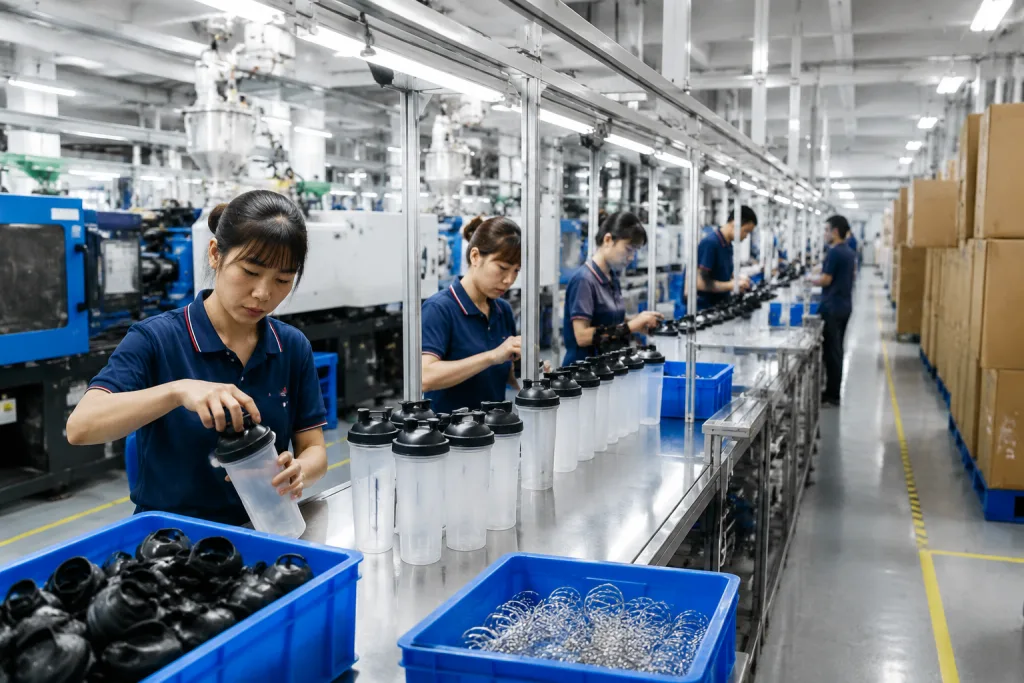
The stainless steel whisk ball is still the cleanest answer. It throws a stronger vortex and breaks powder clumps fast. On our line, one 304 stainless ball adds about $0.08 to $0.12 per unit. QC pulled the sample after the buyer flagged chunky shakes in round one. For a bulk fitness water bottle program aimed at casual gym users, the plastic mixing grid saves cost and stays with the lid, so nobody loses it in a locker room. It is harder to wash. It also struggles with thick mixes.
Pro Tip: Build a real lock into the flip cap. A plain spring cap can pop open when the bottle hits the floor. We saw leakage complaints drop 30% after switching to a reinforced latch, and the 1.2 m drop test made the point in one run.
For a custom logo shaker bottle, check the lid thread tolerance before you approve the sample. We measure that fit with a thread gauge, not eyeballs. Wide-mouth lids with an opening diameter > 55mm fill faster, clean easier, and distributors like that because it cuts return noise. The tradeoff is more resin in the mold. Standard 28mm or 38mm neck finishes are cheaper, and that is where buyers push for savings, then complain the scoop will not fit. We've seen that go sideways more than once.
Decision 3: Decoration Method vs. Durability
Your logo method decides how long the branding stays on the bottle. For a customizable shaker bottle, we normally quote silk screening, heat transfer labeling, and shrink sleeves. Each one behaves differently on a custom sports water bottle line, and the wrong pick shows up fast at QC.
Silk screening is the low-cost choice for bulk shaker bottle runs. We push ink through a mesh stencil on the line. One or two spot colors hold up well, but if the bottle flexes, the print can start to crack after a few washes. Heat transfer labeling (HTL) gives full-color graphics with clean wraps, so it fits a customizable fitness water bottle program that needs photo-style artwork. It handles dishwashing better than silk print, but it wants a smooth cylindrical body; last month the buyer flagged a slight shoulder curve, and the sample stopped at the dock.
Shrink sleeves give 360-degree coverage and cover mold parting lines, so a customized shaker bottle looks cleaner on shelf. That is why distributors use them for private label jobs. The catch is cost. Sleeve film and heat tunnel time both add up, and the math does not work on a tight MOQ. We ran one 28 g sleeve job where the tunnel slowed the packing table by 12 minutes per carton.
- Silk Screen: Best for 1-2 spot colors. Cost: ~$0.03 per color per position.
- Heat Transfer: Best for gradients and full color. Cost: ~$0.10 - $0.15 per label.
- Laser Engraving: Permanent, no ink. Best for premium metal or Tritan customizable sports water bottle lines. Cost: ~$0.05 per unit.
We tell distributors sports water bottle partners to run adhesion tape tests, ASTM D3359, on sample units before mass production. QC pulled the sample once and the tape lifted at the edge after 5 strips, which is the sort of result that saves a 20,000-piece headache later.
Decision 4: Stock Molds vs. Custom Tooling
Tooling sets the bill. If you are launching a new custom made shaker bottle, you pick a stock mold (OEM) or open a new mold (ODM). Stock molds sit on the rack in the factory. We run the line with your Pantone code and logo, then ship. That route fits most bulk gym water bottle orders because it skips the $15,000 - $40,000 tooling spend and cuts about 30 days off lead time; on one PO, the buyer flagged a 2 mm cap height typo before steel was even cut.
A custom mold gives you control over grip radius, capacity marks, and base shape. Good move if the brand needs a silhouette people spot from 5 meters away. For a random launch, the math doesn't work. Custom tooling for a customized fitness water bottle means waiting on the 3D drawing, the aluminum prototype, and the T1 (first shot) samples, and QC pulled the sample twice when wall thickness missed spec by 0.3 mm.
In Zhejiang, mold care gets ignored until the parts start flashing. A P20 or 718 steel mold can run 500,000 cycles. A low-grade mold may start slipping after 100,000 units, then you get flash and size drift. We've seen this go sideways on a distributors fitness water bottle project when the buyer pushed for the cheapest steel. Ask for the mold steel grade and the warranty period, or you pay for the mistake later.
MOQ Implications
Stock mold custom shaker bottle orders usually start at 1,000 - 3,000 units. Custom molds usually need 10,000 units per order so the tooling cost gets spread out. If your MOQ stays low, the unit price climbs because the line time and setup are still there. One 7 kg carton sample looked fine, but the factory quoted a higher piece price after we checked the changeover time on the injection machine.
Quality Control and Compliance Standards
Send out a full 40HQ of bulk sports water bottle stock, then get it held at customs or bounced at delivery, and the margin is gone. We have paid that bill. QC has to go past a quick look. For a shaker bottle customized order, we lock AQL before the line starts. Major defects sit at AQL 2.5, minor defects at AQL 4.0. That is the baseline. The math does not work any other way.
For North America and Europe, compliance is not a side note. Your customized sports water bottle needs FDA compliance for food contact, or LFGB for Germany. Retail buyers also ask for BSCI when the factory file goes in for approval, and we keep those papers ready before the PO lands. One order came through with a batch code typo on the draft spec sheet, and the buyer flagged it before we ran the first carton. Small issue. Big delay.
For custom gym water bottle runs, we test the bottle inverted for 24 hours, drop it from 1.2 meters onto concrete, and run microwave checks when the claim says BPA-free. QC pulled one sample last month with a cap torque of 0.8 N·m, and it failed the leak bench on the first round. Cutting inspection by $0.02 per unit is the wrong question to ask for distributor gym water bottle programs. We ship less scrap when we test hard up front.
Logistics: FOB vs. DDP Pricing Models
The first question is simple: who books the freight. Most bulk fitness water bottle quotes out of China are FOB. We load at Ningbo or Shanghai, clear export, then hand the cartons to your forwarder. You cover ocean freight, insurance, customs clearance, and the last mile. You also control the carrier and sailing date. We check that on the packing table every week with a tape measure and a carton scale.
DDP (Delivered Duty Paid) puts the whole move on the supplier, right to your warehouse door. It works for a 200-piece trial or a first import, because the buyer does not want to deal with customs codes and duty bills on day one. For a distributor shaker bottle order at 10,000 units, the math does not work. The freight markup bites, and we've seen it go sideways when the buyer flagged the landed-cost breakdown after the PO was signed. A pallet jack and a customs entry sheet settle that fast.
Carton size matters. A standard 28oz custom shaker bottle usually ships 50 units per carton, and a 2 mm change in the insert can shift pallet count more than people expect. QC pulled the sample last month and flagged one carton at 8.6 kg gross, which looked fine until the forwarder priced the extra cubic meter. Ask for the packing list with carton dimensions, gross weight, and pallet count, then your forwarder can quote LCL or FCL on real numbers. Do not guess here.
Scheduling Your Production Run
Lead times in Zhejiang change with the season. For a custom logo shaker bottle, we run 25-35 days after sample approval and deposit receipt. From August through November, the line fills up with Christmas and Q1 orders, and that window often slips to 45-60 days. One buyer pushed for a 20-day ship date; the math does not work. We tell them to plan a bulk shaker bottle order 4 months ahead, or they end up chasing cartons and booking space late.
Production starts with resin drying, then injection molding, assembly, decoration, and packing. On a 500 ml run, QC pulled the sample at silk screening because the second color needed 12 minutes of drying before the next pass. That delay held up customizable sports water bottle orders on the line. Rush that step and you get smudging. Simple. The dryer does not care about your launch date.
Give your "must-arrive-by" date first. We run the schedule backward from there, then set the deposit and artwork approval deadlines. If the proof sits on a desk too long, the buyer flagged it and we moved the slot to another PO, which pushed a customized gym water bottle shipment by 6 days. A typo on the PO, like the wrong ship-to postcode, does the same damage. This is the wrong question to ask: "Can you make it faster?" The real question is whether the dates line up with the press, the carton count, and the truck booking.
Start Your Custom Shaker Bottle Project Today
Send us your specifications. Receive a detailed quote, digital mockups, and material options within 24 hours.
Frequently asked questions
What is the minimum order quantity for a custom shaker bottle?
For stock molds, the MOQ is typically 1,000 to 3,000 units depending on the complexity of the logo. For a fully custom mold design, the MOQ usually starts at 10,000 units to justify the tooling investment. We can sometimes accommodate 500 units for pilot runs, but the unit price will be significantly higher due to setup costs.
Can I get a sample before placing a bulk order?
Yes. We provide existing samples for quality checking at the cost of shipping. For a custom logo shaker bottle, we create a pre-production sample (PPS) after receiving the mold deposit. This sample ensures the print size, color match, and placement are correct before we run the full bulk order.
How long does shipping take from China to the US or Europe?
Ocean freight takes approximately 25-35 days to the US West Coast, 35-45 days to the US East Coast, and 30-40 days to Europe (Rotterdam/Hamburg). Air freight is faster (5-7 days) but costs 4-5 times more, usually reserved for urgent small batches of customized shaker bottles.
Are the shaker bottles BPA-free?
All our Tritan and PP materials are certified BPA-free and food-grade. We provide FDA and LFGB test reports for every shipment. If you require specific migration testing for the EU market, we can arrange third-party lab testing through SGS or Intertek before shipment.
Can I mix different colors in one order?
Yes, but this affects production efficiency. We allow color mixing within an order (e.g., 1,000 black and 1,000 white bottles), but the MOQ per color usually needs to be at least 500 units to justify the machine cleaning time between color changes.