Key Takeaways
- Most shaker bottle custom made orders start at 3,000-5,000 units with a 20-35 day lead time after sample approval
- A usable spec sheet should lock capacity, material, lid type, logo method, and carton count before quotation
- For China sourcing, ask for REACH, food-contact declarations, and AQL 2.5 inspection terms on the PO
- A real bulk shaker bottle price spread is usually USD 1.20-3.20 per unit depending on material and print
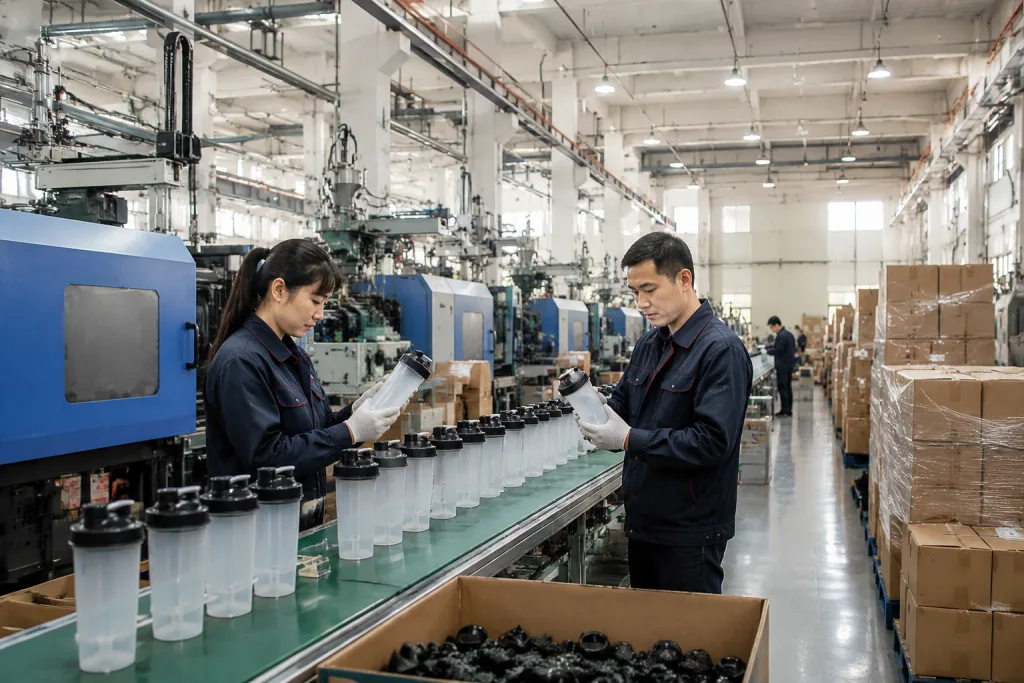
Most buyers we work with in Hangzhou make the same mistake: they lock the logo before the container spec. The goods land, and the lid leaks, the mixer ball rusts, or the silk-screen looks perfect on the PDF but washes off after cycle three. We move 50,000+ units monthly. The suppliers who survive in this game don't lead with branding. They lead with material grade, closure tolerance, and a workflow that holds up when you jump from a 500-unit sample run to a 50,000-unit contract.
Treat custom shaker bottle sourcing as a manufacturing contract, not a design project. A solid PO needs line items: bottle body material (Tritan vs. PP), lid style, mixer ball spec (304 stainless), print method, and carton dimensions. One client skipped defining the carton spec last year—paid for 20% more volumetric weight than needed. Cost them $1,200 in wasted air freight. The details below are built to prevent that second round of sampling and the margin erosion that follows.
Start With the Use Case
Don’t start with price. Start with the job. A shaker bottle custom made for protein shakes needs a different spec than a custom sports water bottle that lives on a treadmill floor, or a bulk fitness water bottle headed to retail. Closure load, wall thickness, and cleaning cycle all change the build. For gym chains, we run a 600-700 ml PP or Tritan body, a screw lid with a positive seal, and a detachable mixing ball. For distributor programs, shelf appeal and landed cost usually matter more than hand feel. We’ve seen that trade-off go sideways when the buyer chased “better looking” and ignored the cap torque test at 0.45 N.m.
Write the use case into the RFQ in plain terms: daily shake mixing, cold water refills, or promotional resale. Then state whether the bottle must fit cup holders, dishwasher cycles, or freezer use. A 0.8-1.0 mm wall thickness is standard for entry-level PP, while Tritan bodies usually sit around 1.2-1.5 mm depending on geometry. QC pulled the sample once and the buyer flagged a 1.1 mm neck that warped after hot wash at 80°C. That is the wrong question to ask: “Can you make it cheaper?” Ask whether the line can hold the spec for the way the bottle will be used. A PO typo on one job said “dish washer safe,” and the factory had to recheck the print proof before we shipped.
- Typical capacity: 500 ml, 600 ml, 750 ml
- Common MOQ in Zhejiang: 3,000 units per SKU
- Factory lead time: 25-35 days after sample sign-off
Build a Clean RFQ
Your RFQ should read like a purchase spec, not a mood board. A shaker bottle quote only works when we can price the same bottle twice and your buyer can lay 3 factory offers side by side on one sheet. Put in capacity, material, lid style, color, logo area, print method, packaging, and target market. QC pulled a 600 ml sample on the line, then the buyer flagged a 2 mm lid gap because the PO just said "sports bottle." If you need a custom logo shaker bottle for EU retail, spell out REACH and say whether you want carton barcodes or FNSKU labels for Amazon. For North America, tell us if you want retail hang tags or bulk-packed cartons. We ship both. The cost sheet moves fast.
Good RFQs include dimensions, not just volume. A 600 ml bottle can be tall and slim or short and wide, and that changes mold cost, carton loading, and shelf impact. Ask for FOB Ningbo or FOB Shanghai if you want a clean comparison across China suppliers; Zhejiang factories read both. Put the sample charge in the RFQ too, and ask if it comes off the first bulk order. We usually see USD 30-80 per sample set, with express freight billed separately. A buyer once sent "30pcs" on the PO, then called asking why we opened a tool fee. The math does not work.
Use line-item language in the RFQ:
- Body material: PP, Tritan, or stainless steel accent parts
- Lid: screw top, flip top, or lock-top closure
- Mixing system: mesh insert, whisk ball, or fixed agitator
- Logo: silkscreen, pad print, or laser engraving
- Pack-out: polybag, paper sleeve, retail box, master carton
Choose Materials Without Guessing
Material choice is where margin gets made or burned. For a bulk shaker bottle built for gym use, PP usually lands around USD 1.20-1.80 per unit at 3,000 pieces, depending on mold setup and print. Tritan pushes that into the USD 1.80-3.20 range. We ran both on the line last quarter, and the buyer flagged the PP sample as "too basic" for retail shelves. Fair call. For a shaker bottle custom made for weekly reuse, Tritan earns its keep. For a giveaway bottle tied to memberships, PP usually wins. The math does not lie.
Do not ignore closure hardware. A weak lid kills the bottle fast. Ask what gasket they run, how many thread turns the cap takes, and whether the lid is one-piece or two-piece. A 4-point locking cap can stop accidental openings, but it adds assembly time and cost. QC pulled the sample at 18 mm lid height because the seal groove was shallow by 0.3 mm. We have seen that go sideways in cold freight. In Zhejiang, better factories will show material certificates, but I still ask for REACH, LFGB where needed, and a food-contact declaration. The buyer who skips that step usually pays twice.
Do not buy by logo area alone. Buy by resin grade, seal design, and the cleaning behavior your users will actually live with.
Sample the Real Build
Sampling is not paperwork. It is the cheapest way to catch a bad geometry, a weak hinge, or a print that will fail after the first cartoning. For a custom made shaker bottle, ask for a pre-production sample, not a stock unit with the logo slapped on. We have seen that go sideways. The sample has to match the resin, color, print, and closure you signed off on. For a custom shaker bottle run, we also ask for the exact mix insert and the final carton spec if the route is rough; a 2 mm carton gap can crush corners on the line.
Check four points on the sample: seal integrity, logo registration, lid feel, and odor after washing. If a bottle still smells like molding oil after one hot rinse, that is a production issue, not a carton issue. QC pulled the sample on a torque meter and found a loose hinge at 0.8 N·m once; the buyer flagged it before we shipped 5,000 pcs. Test one piece with warm water and one with protein powder so you can see whether the whisk ball or mesh breaks up clumps. This is the wrong question to ask if you only want a pretty sample. For a customizable sports water bottle going to a distributor program, ask for two samples: one for fit and finish, one for drop and leakage testing. Sample approval needs to be written, dated, and matched to the approved photo set. A PO typo on the lid code can turn into a pointless dispute later.
Sample lead time in China is usually 5-10 days for stocked components and 10-15 days if we need a new color match. That is the real clock. A Pantone re-match can add 3 days, and the math does not lie. On one job, the swatch drawer and the injection machine both waited on the same color chip, and the schedule slipped from 12 days to 18 days.
Price the PO Line by Line
A clean PO keeps invoice language from drifting. We saw a buyer lose a 20,000 pcs run because the PO said only “shaker bottles, custom print,” then the packing team loaded the wrong insert. Break it into line items. The factory needs that level of detail. For a custom sports water bottle program, list the body, lid, insert, print, packing, and carton specs as separate lines. That is the difference between a clean re-order and a week of back-and-forth.
Here is what should be on the PO:
- Item 1: 600 ml PP shaker bottle body, matte finish, 1 color
- Item 2: screw lid with gasket, black
- Item 3: mixing whisk ball or mesh insert
- Item 4: one-color silkscreen logo, 1 position
- Item 5: individual polybag and barcode label
- Item 6: master carton, 24 pcs/carton, export mark
For a bulk shaker bottle order in Zhejiang, FOB usually lands at USD 1.35-2.95, depending on material, print, and packing. We run this through the line with a simple cost sheet, and the math gets ugly fast if the buyer tries to bundle everything into one price. Ask whether tooling is included. Custom color caps and new molds can add USD 300-1,500 for small changes, and full tooling is a different bill. QC pulled the sample with a 0.5 mm wall check once, and the buyer flagged the quote because sample credit, payment terms, and AQL standard were never written down. Without that, the “same price” is not the same product.
Lock Quality Before Bulk
Lock quality before bulk starts. Once the first complaint lands, you are already late. For a bulk sports water bottle run, we split checks into incoming material control, in-process checks, and final inspection. AQL 2.5 covers major defects, but the buyer has to spell out major in plain terms: leakage, cracked lid, missing logo, deformed thread. Minor defects can mean faint print shift or small cosmetic marks if the bottle still works. Put it on paper and attach it to the PO. We saw this go sideways on one 5,000-piece shaker order when the cap color on the PO did not match the sample sheet, and the carton pack caught it at the end.
If you are sourcing from China, ask for production photos at the first 500 pieces and again at packing. That is basic. A decent plant in Zhejiang can run that on the line without drama. Ask for batch traceability if the order will sit in a distributor warehouse or move into retail channels. For a customized fitness water bottle going into gym chains, carton compression and drop-test specs matter more than most buyers think. A 1.0 m drop test, 3 faces, will show a weak lid fast. QC pulled the sample on one run and the hinge cracked on the second drop. Skip that check and the math does not work.
If the bottles go into the EU, confirm REACH compliance on the finished product. If they go into North America, ask for food-contact documentation and any ASTM test references the factory can support. One buyer flagged a PO typo where the material line said "304 stianless" instead of 304 stainless, and that kind of slip slows file review. We keep a ruler on the desk for cap fit and neck finish, and 0.3 mm is enough to start a claim. That is the wrong question to ask if someone says "it should be fine."
Plan Packaging and Freight
Packaging decides whether your order lands as a finished item or loose plastic rattling in a carton. For a distributor gym water bottle run, bulk pack works. For retail, we usually quote a paper sleeve, hangtag, or printed box. Each choice changes carton size, freight cube, and breakage risk. A 24-piece master carton is common for a 600 ml bottle, but the count moves with body shape and cap set. On one shaker bottle custom made order, the buyer pushed for a retail look, then backed off after we showed the parcel test from a 400 mm drop. The film cracked at the corner. They changed their mind fast. This is the wrong question to ask if the goal is landed cost.
Ask for both EXW and FOB, or the math does not work. We run that comparison on every order sheet. In Zhejiang, a bottle that is 10 mm wider can change pallet count and container fill enough to move the landed cost by a clean margin. QC pulled the sample and the sleeve rubbed the cap on one corner, so we changed the inner tray before the line went full speed. If you ship into Amazon, get FNSKU application and master carton labels done in the factory, not in a warehouse later. One PO typo on a barcode can burn 7 days, and we have seen that go sideways.
Place Repeat Orders Right
The first order should make the second one faster. Not harder. We keep mold settings, artwork files, and pack-out notes on the line, so the next shaker bottle custom made run starts with hard data, not guesswork. Keep one live spec sheet with the approved color chip, logo Pantone, closure type, and carton data. QC pulled the sample against it last week with a caliper. That is how a distributor fitness water bottle line stays steady across seasons and regions.
For repeat POs, ask the factory to confirm resin, labor, and carton changes before you release payment. A 0.08/kg resin move looks small on paper, but on 300,000 units a month from Zhejiang, the math changes fast. We had a buyer flag a PO that said “same as last time” and the carton height mark was off by 8 mm, so the whole batch needed relabeling. Clean process matters. RFQ, sample, approval, bulk PO, then reorder against the signed spec. That is how a customizable gym water bottle program stays profitable after launch.
Request a shaker bottle quote with real specs
Send your capacity, material, logo method, packing, and target market. We will quote the bottle you actually need, not a vague placeholder.
Frequently asked questions
What MOQ should I expect for a shaker bottle custom made order?
For a standard shaker bottle custom made program, MOQ is usually 3,000 units per SKU in Zhejiang, sometimes 5,000 if you want a new color or custom cap. If the bottle uses stocked molds and a single-color print, some factories can start lower, around 1,000-2,000 units, but unit price will rise. For a custom logo shaker bottle with retail packing, budget around 20-35 days after sample approval. If you need multiple colors, mixed lids, or a custom insert, expect a longer lead time and a higher setup charge.
What is a realistic factory price for bulk shaker bottle sourcing?
For a bulk shaker bottle from China, a realistic FOB range is USD 1.20-1.80 for PP and USD 1.80-3.20 for Tritan, depending on capacity, print, and packaging. A simple bulk gym water bottle with one-color silkscreen and polybag is cheaper than a retail-ready custom sports water bottle with box, hangtag, and barcode label. Tooling, custom color caps, and extra mixing inserts can add separate charges. Always ask the supplier to break out sample fees, print fees, and carton costs so you can see the true landed cost.
How do I check whether the shaker bottle will leak?
Ask the factory for a leak test on the actual sample, not just a stock unit. A proper check means filling the bottle, closing the lid, and inverting it for at least 24 hours at room temperature, then repeating after a warm-water wash. If the cap uses a gasket, confirm the gasket material and fit. For a custom shaker bottle or customized sports water bottle, ask for drop testing too, because a lid that seals on the bench can still fail after impact. In final inspection, leakage should be treated as a major defect under your AQL terms.
What documents should I request from a China supplier?
For drinkware made in China, ask for a food-contact declaration, material specification, and a compliance statement for your market. For Europe, REACH is usually expected; for some channels, LFGB or other food-contact evidence may be requested. If you are a distributor shaker bottle buyer, also ask for ISO 9001, BSCI if social compliance matters to your retail partners, and a written AQL inspection plan. If you are importing into Amazon, request carton labels, barcode placement, and FNSKU handling before bulk production starts.
Can I customize packaging for gym chains and distributors?
Yes, and you usually should. A custom fitness water bottle program for gym chains often uses a simple polybag or paper sleeve to control cost, while a distributor sports water bottle order may need a printed retail box, barcode, and insert card. Packaging changes carton count, freight cube, and retail perception. If you want a customizable shaker bottle for a launch, tell the factory your target retail channel early. For Amazon or DTC, confirm FNSKU placement and carton marks before production, not after goods are boxed.