Key Takeaways
- A practical kids bottle program usually starts at 3,000 units per color with 30-45 days lead time from a Zhejiang factory
- Most field failures come from 5 issues: leaks, cap torque, print wear, odor, and child-handling damage
- For school use, PP, Tritan, and 304 stainless each solve different problems; spec by use case, not by trend
- AQL 2.5 for critical defects and 4.0 for major defects is a realistic starting point for bulk school water bottle QC
The bad surprises do not show up on the first sample. They show up at carton 473: a cap leaks after three dishwasher cycles, a straw kinks when a seven-year-old bites it, a print flakes because the ink missed the base resin. That is the wrong question to ask at a school water bottle manufacturer. The spec has to survive lunchrooms, backpacks, and export shipping.
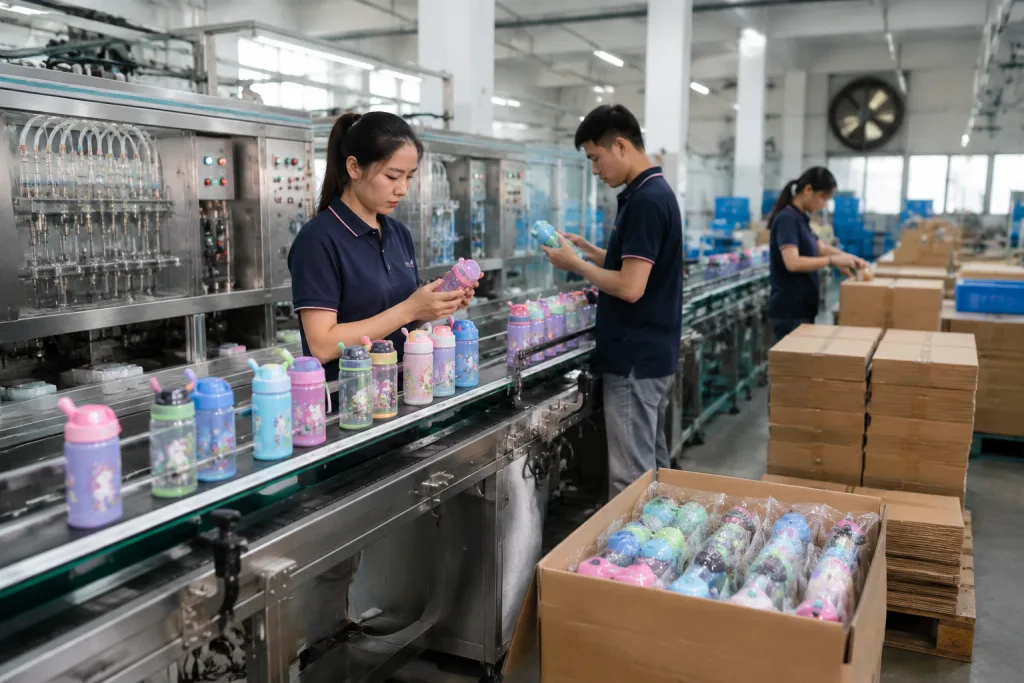
At our Zhejiang factory, we run kids drinkware for school programs, distributors, and private-label importers. MOQ is 3,000 units per color, and lead time is 30-45 days after sample approval. QC pulled the sample, checked lid torque with a torque meter, and found a 0.4 mm gap before mass production. Fixed before the line ran. The job is not to make the bottle look friendly. The job is to make it fail less often. Lock the lid stack-up. Pick the right polymer. Confirm the print method. Write the inspection points before start-up. We have seen this go sideways when a buyer signs off too early. Then the returns start.
Where Kids Bottles Usually Fail
The first thing to get straight is simple: a children water bottle does not fail like an adult tumbler. It gets dropped on tile, left open in a school bag, chewed at the spout, then shoved through a wash cycle by someone who never read the care card. We saw one cap crack after a 1.2-meter drop test on the line because the hinge was too thin at 0.8 mm. That kind of miss shows up fast. Leaks usually start at cap alignment and gasket compression. Odor usually comes from bad resin choice or contamination during molding. Print failure comes from the wrong decoration process, especially on low-cost custom children water bottle runs where price beats wear life.
If you are buying from children water bottle manufacturers in China, ask for a failure-mode map before you talk about colors. This is the wrong question to ask first. We break it into four buckets: seal integrity, mechanical abuse, hygiene, and graphic retention. A bulk children water bottle order should be checked for inverted leakage, 1.2-meter drop impact, dishwasher or hot-water exposure if claimed, and torque retention after repeated opening. QC pulled the sample on a 50-piece lot last month and found one gasket seated 0.3 mm off-center; the buyer flagged it, and he was right. For a school water bottle manufacturer, these checks are not extras. They are what keeps the bottle alive through one term.
- Leak risk: cap-to-neck tolerance, gasket compression, vent design
- Break risk: hinge stress, strap anchor strength, wall thickness
- Odor risk: resin quality, masterbatch contamination, packing smell
- Print risk: abrasion, UV fade, dishwasher wear
In practice, a custom school water bottle should be built around the ugliest use case, not the clean sample photo. We ship based on abuse, not wishful thinking. If the cap survives a backpack toss, a lunchroom drop, and a week of bad handling, the rest is easy.
Choose the Right Body Material
Material choice is where a lot of bulk kids bottle jobs go sideways. Buyers push price first, then QC pulls the sample and finds the bottle tips the scale, cracks in the drop test, or still smells like milk after wash-up. For school use, we run three clean options: PP for the lowest cost and lightest weight, Tritan for clear walls and better impact resistance, and 304 stainless for premium positioning and temperature retention. Each one has a tradeoff. If a supplier waves that away, the math does not work, and the classroom exposes it fast.
PP bottles are cheap and light. We ship them on children water bottle wholesale programs where the bottle is treated as a high-turn promo item and the target stays near USD 1.20-2.20 FOB depending on size and decoration. Tritan takes abuse better and looks cleaner, but the resin cost is higher, so a bulk school water bottle in Tritan often lands in the USD 2.60-4.20 FOB range. 304 stainless solves durability and odor complaints, but the unit weight climbs fast, so it fits schools and distributors who want a 2-year custom kids water bottle instead of the lowest landed cost. We had one buyer flag a 280 g spec last spring; the sample felt solid, but the school rejected it because first graders carried it in a 300 mm backpack pocket.
What to specify
- Wall thickness: 1.8-2.2 mm for PP or Tritan bodies
- Steel grade: 304 stainless, not generic steel wording
- Food-contact claims: REACH, FDA, LFGB as required by market
- Odor control: resin lot confirmation and pre-production smell check
If you are sourcing from a children water bottle supplier in Zhejiang, ask for the exact polymer grade and the test method, not just a sales description. The buyer once sent a PO with “Tranit” typed three times, and we still had to stop the line because the resin code did not match the sample card. China has enough factories to quote anything. The difference is whether they can prove it.
Caps, Straws, and Gasket Control
Most leak complaints start at the cap stack, not the bottle body. A child twists the lid at an angle, the gasket shifts, the straw sits off-center, and the backpack gets wet. We see it on the line. That is why cap design matters more than almost anything else in a custom kids bottle. Flip tops, screw caps, straw lids, and spout lids each do a different job, and each one has its own weak point. A school water bottle manufacturer that knows the job will not force one closure on every buyer.
For kindergarten and early primary grades, simple wins. A screw-cap or flip-top with fewer moving parts usually holds up better than a busy sport lid. For older children, a straw lid is often the better pick, but then you need gasket hardness, hinge cycle life, and cap torque in black and white. We normally target 3,000 open-close cycles for a school-going lid and run a leak test at 45 degrees and fully inverted. The math does not work any other way if you want a bulk kids water bottle program to survive transit and daily use.
Ask for the gasket material, the cap torque range, and the leak test angle in writing. If the supplier cannot give those numbers, the sample is not a real sample. It is a sales prop.
For children water bottle custom programs, check replacement parts before you place the PO. A lost straw cap should not kill the whole bottle. QC pulled a sample last month with a 28 mm cap and a missing spare straw bag, and the buyer flagged it right away. That is the difference between a distributor-friendly item and a headache.
Artwork That Survives School Use
Custom logo kids bottle jobs fail fast when the print looks clean on day one and ugly after 2 weeks. We saw it on a 1,200 pcs PO last quarter. The buyer flagged the logo after a tape-rub test, and the line had already packed half the cartons. The miss was basic. The buyer asked for a children water bottle promotional item, but nobody checked abrasion, surface energy, or sterilization exposure before artwork got locked. A shiny bottle and a pretty logo are not enough. The decoration method has to match the substrate and the way kids toss the bottle in a school bag.
For opaque PP or stainless bottles, silkscreen is usually the best-cost choice for bulk children water bottle runs, especially with one or two spot colors. We run 120 mesh on the screen table for most school orders, and that keeps edge bleed under control. Laser engraving holds up better on stainless, looks cleaner for premium school programs, and does not rub off. On transparent Tritan, pad print or UV print can work, but only if the ink system matches the resin and the supplier can show adhesion and rub-test results. If a children water bottle vendor says every logo method is fine on every material, that is the wrong question to ask. The resin decides. So does the heat cycle.
- Silkscreen: good for simple logos, lower cost, moderate durability
- Laser engraving: best for 304 stainless, permanent mark, higher perceived value
- UV print: useful for color graphics, but test abrasion carefully
For school districts, I would rather approve a smaller, cleaner custom school water bottle logo that stays intact than a large print that peels in a month. QC pulled the sample after 48 hours in the dishwasher cabinet, and the big graphic was already soft at the corners. We ship a lot of school bottles this way. One PO typo turned 300 pcs into 3,000 pcs once, and the buyer laughed less after we caught it on the proof. That is where a China-based factory earns its keep: by telling you what will last, not just what will sell on the first PO.
What School Buyers Should Test
Testing sounds dull until a pallet gets rejected at the school gate. Then it pays for itself. A real bulk school water bottle spec starts with incoming material checks and finished goods tests. We do not trust a nice-looking bottle alone. The line still has to survive daily use, packing, and export handling. If you work with children water bottle distributors or school district procurement teams, lock the acceptance criteria before the first 3,000 pcs run.
Ask for these checks at minimum: leak test, drop test, odor test, dishwasher or hot-fill test if claimed, print adhesion test, and carton compression. For export shipments, we also run carton drop and random case inspection so the outer box does not arrive crushed. AQL 2.5 for critical defects, 4.0 for major defects, and 6.5 for minor defects is a practical starting point. The buyer flagged a 1.2 mm wall once, and the math did not work. AQL is not a magic shield, but it gives you one language with your children water bottle factory.
If the program is for younger students, add a check for small parts and sharp edges. If the bottle has a straw, test the bite zone and straw wall thickness under load. QC pulled the sample with a caliper on a 0.8 mm straw wall, and that caught a weak point before shipment. For a custom made kids bottle, the engineering notes need the same detail as the artwork file. That is how you get repeatable output from a children water bottle manufacturer instead of a different bottle every production run.
MOQ, Price, and Lead Time Reality
Buyers ask for a custom children water bottle like it sits on a shelf. It does not. Once we change the mold, cap, or print layout, the numbers move fast. On our Zhejiang line, a standard kids bottle run starts at 3,000 units per color. New tooling starts at 5,000 to 10,000 units, and the lower end only works when the part is simple. For the first run, the math is tight.
FOB price comes down to material, decoration, and cap parts. A plain PP bottle may land around USD 1.20-2.20, Tritan around USD 2.60-4.20, and 304 stainless kids bottles often move into USD 4.50-8.50 or more. Add a spare straw, a two-color logo, or printed carton art, and the price climbs. We had one PO with a typo on the lid code, and the buyer flagged it before we shipped. Ask for line-by-line pricing. That is the right question.
Lead time matters more than unit price. A normal run is 30-45 days after sample approval and deposit, and ocean freight can add another 25-35 days before the goods clear a U.S. or European port. QC pulled the sample on a 500 ml bottle last month, and the cap torque was off by 1.5 mm on the first pull. We fixed it before mass production. If your back-to-school date is fixed, do not squeeze sampling. We've seen that go sideways, and then the buyer pays for rework or air freight.
Packaging for Warehouses and Schools
Packaging is where a lot of children water bottle wholesalers quietly cause damage. We have seen a bottle leave the line clean, then land with a dented base, a scuffed print, or one missing cap because the pack-out was set for speed, not export handling. School district buyers want cartons they can scan fast. Importers need pallet stacking that survives 12 days on a truck, not 18, plus retail or e-commerce rules that do not fall apart at the first transfer.
If you sell into Amazon or another marketplace, a children water bottle custom program needs FNSKU labels, polybag or carton rules, and barcode placement locked from day one. School runs may skip blister packs, but they still need the same carton count on every run, clear lot codes, and spare parts packed separately. QC pulled the sample on a 48-unit carton last month and found two lids rubbing the print. That is the wrong question to ask if the only goal is lowest pack cost. For a bulk children water bottle shipment, the outer carton should protect the finish, not just hold the count. We run insert trays or partitioned cartons for printed or coated bottles, especially when scuffing is already on the table. A 2 mm divider saves claims later.
- Carton count: keep it consistent, usually 24 or 48 units per master carton
- Lot coding: trace mold batch, resin lot, and production date
- Labeling: buyer SKU, carton count, origin, and handling marks
Good packaging is cheaper than claim processing. We have seen this go sideways after a PO typo changed the carton count from 24 to 42, and the buyer flagged it at the warehouse dock. The line had already boxed 310 cartons, so the fix cost a half day and a stack of angry emails. In Zhejiang and across China, the factories that pack for export are usually the ones that already paid for the lesson. The math does not work any other way.
How to Vet the Factory
Stop asking a children water bottle factory, “Can you do custom?” Every seller says yes. Ask for proof. Give me the monthly output for this category. Show the testing standards. Show how first article approval runs. Show the in-process check point. A real children water bottle manufacturer can walk you through the sample room, molding line, printing line, and final QC without thinking twice. QC pulled the sample at 14:30. That beats a brochure every time.
Check the audit file too. If your retailer or district asks for BSCI, the factory should show it. Same for REACH, FDA, or LFGB, depending on the market. Ask for one hard capacity number, not a nice story. In a Zhejiang plant we run, 80,000-150,000 units per month for this category is normal, but only if the line holds and the molds stay on spec. A buyer flagged a cap mold plan because the supplier had no backup when the straw vendor slipped by 7 days. The math does not work if they cannot explain the fallback.
For school programs and importer programs, I would rather work with a children water bottle manufacturer that says no to a bad spec than a children water bottle vendor that says yes to everything. We have seen this go sideways on a PO typo for a 450 ml bottle that was quoted as 540 ml. Good factories catch that at the drawing stage and push back before the first PO goes out.
Spec your school bottle before the PO
Send your size, lid type, and target price. We will turn it into a production-ready custom kids bottle spec with QC points and FOB options.
Frequently asked questions
What is a realistic MOQ for a custom kids water bottle order?
For most bulk kids water bottle programs, 3,000 units per color is a practical starting point if you use an existing mold. If you want new tooling, cap changes, or a special closure, 5,000-10,000 units is more realistic. The exact MOQ depends on decoration, packaging, and whether you need mixed SKUs. In Zhejiang, many factories can handle smaller trial orders, but unit cost usually jumps sharply below 2,000 pieces. For school district pilots, it is smarter to test one size and one lid first, then scale after use feedback.
Which material is best for school use: PP, Tritan, or stainless steel?
There is no universal winner. PP is the lightest and lowest cost, so it works for children water bottle wholesale promotions and tight budgets. Tritan is clearer and handles impact better, which is useful when you want a premium custom children water bottle without metal weight. 304 stainless is best for durability and odor resistance, but it costs more and weighs more. For younger grades, PP or Tritan often makes more sense. For higher-end school programs, stainless may be worth the extra USD 2-4 per unit.
How do I stop leak complaints after delivery?
Start with the cap design, not the bottle body. Specify gasket material, cap torque range, and a leak test at 45 degrees plus fully inverted. Ask the children water bottle factory for cycle testing, ideally 3,000 open-close cycles for the lid. Use AQL 2.5 for critical defects. Also check carton compression and drop handling, because a bottle that passes production can still leak after transit if the lid is distorted. If the supplier will not share these numbers, do not approve the sample yet.
What print method lasts longest on kids bottles?
On 304 stainless, laser engraving is the most durable and usually the cleanest for a custom logo kids bottle. For PP and some Tritan bottles, silkscreen is economical and holds up well for simple logos if the ink system is matched correctly. UV print can carry richer graphics, but it needs rubbing and adhesion tests. For a children water bottle promotional item, the cheapest print is not always the best. If the design has to survive dishwasher cycles or heavy abrasion, ask the supplier for rub-test results before release.
How long does production usually take in China?
For a standard custom school water bottle with approved artwork and no new tooling, 30-45 days is a normal production window after sample approval and deposit. Add another 25-35 days for ocean transit depending on destination and port congestion. If you need a new mold, expect the project to take longer because tooling, testing, and sample revisions are part of the schedule. A real children water bottle manufacturer in China should give you a dated process plan, not just a vague promise that it will be ready soon.