Key Takeaways
- A school water bottle factory should quote MOQ, lead time, and testing docs in the first reply, not after negotiation.
- For most school programs, 350 ml to 600 ml is the practical range; 500 ml is the safest default for bulk kids water bottle programs.
- Expect sample fees around USD 30 to 80 per design and bulk FOB pricing from about USD 1.20 to 3.80 depending on material and lid complexity.
- A serious China supplier should support REACH, LFGB where needed, and AQL 2.5 visual inspection for bulk children water bottle orders.
School buying is about abuse, not style. The bottle gets dropped out of a backpack, run through hot dishwashers, loses caps in week two, and still has to pass parent review. That is the job. Source from a school water bottle factory, and the work changes fast. You are choosing resin, lid fit, and the paperwork that clears Europe or North America without a late scramble.
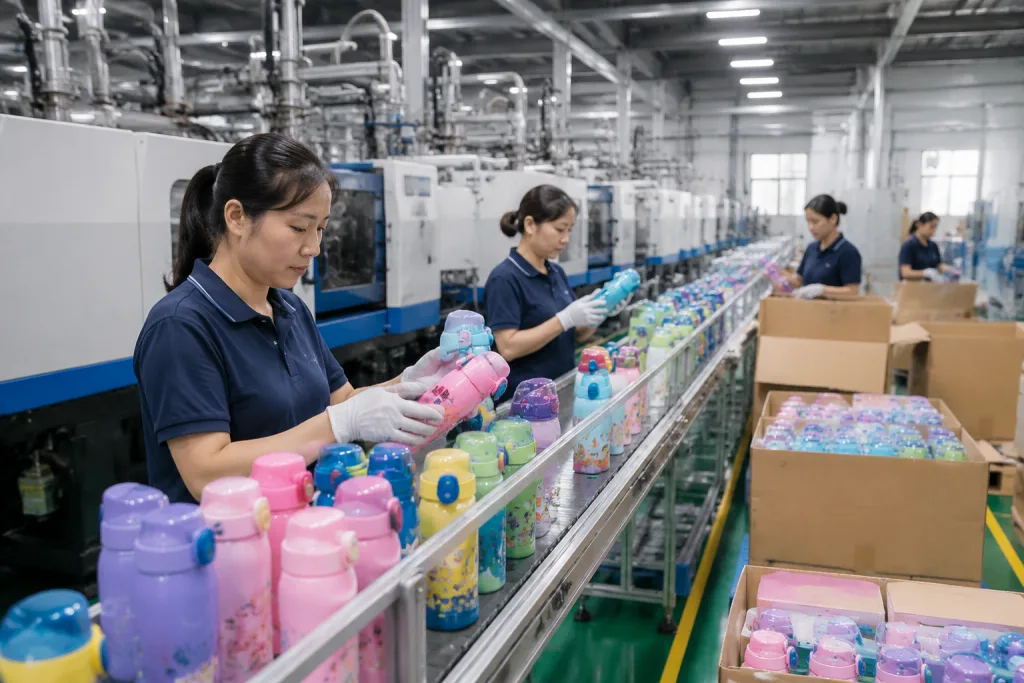
In Zhejiang and across China, the better lines treat kids bottles as production, not a side hustle. We run 500 ml Tritan bodies, 1.2 mm to 1.5 mm wall thickness, BPA-free lids, and 25 to 35 days lead time after sample approval. QC pulled the sample with a caliper on the bench, and a buyer once flagged a PO typo on the lid color code before the line started. For a school district buyer or a children water bottle distributor, that is the right question to ask: clean RFQ, clean sample, tight PO, and QC you can measure.
Start With the Use Case
Before you ask for price, pin down who uses the bottle and how hard the line will get hit. A primary-school order is not the same as a middle-school campus job, and a retail promo is another job again. Age band drives the size, cap style, and print method. We ran a push-button lid for a 7-year-old group; QC pulled the sample after the spring felt stiff in a 4-year-old hand. Start with the use case. Price comes later.
Put the use case in the RFQ like a procurement note, not brochure copy. Say whether you need a custom school water bottle for daily classroom use, a bulk school water bottle for district distribution, or a custom kids water bottle for resale. Add the age band, wash method, and whether the school wants names, class numbers, or a custom logo kids bottle. We ran two quotes last month: 420 ml PP at USD 1.05 FOB, and 500 ml Tritan at USD 2.40. The buyer flagged a PO typo on the carton mark, and the math did not work until we matched spec to job.
- Age band: 3-6, 7-10, or 11-14
- Capacity: 350 ml, 420 ml, 500 ml, or 600 ml
- Material: PP, Tritan, stainless steel, or glass for non-school use
- Decoration: one-color print, laser, wrap print, or molded logo
Write an RFQ That Gets Real Quotes
A school water bottle factory gives a clean quote only when the RFQ has hard inputs. “Need kids bottles for school” gets you a soft answer. We see that every week on the line. A proper RFQ should carry artwork, Pantone refs, target market, carton pack, test list, and the trade term you want, whether that is FOB Ningbo, FOB Shanghai, or DDP to your warehouse. If you buy from China, name the port and Incoterms in the first email. That saves a day of back-and-forth. For Europe or North America, spell out REACH and food-contact needs up front, because the resin and lid seal can change on that point. On one job, QC pulled the sample and found a 1.2 mm lid mismatch before we packed the first carton.
Good RFQs also give the quantity by line item. A children water bottle manufacturer will quote 3,000 units in one SKU differently from 12,000 units split across four colors. We ran that math in the ERP; the spread is not small. A clean RFQ for children water bottle wholesale should list the bottle body, lid, seal, print area, carton spec, and spare parts if you need them. Do not ask for “best price” without saying whether you want a basic PP bottle at 1,000 MOQ or a Tritan design with a silicone straw and a custom box. The buyer once wrote “blue-ish lid” on a PO, and the line had to stop the sample pull. The math does not work otherwise. Give the factory one spec set, and the first quote will be useful.
Practical rule: if the supplier cannot repeat your spec back in one paragraph, your RFQ was too thin.
Judge Samples Like a Buyer
Samples catch trouble fast. You are not approving a pretty bottle. You are checking cap torque, the leak line, straw stiffness, and whether the logo wipes off after a wet cloth test. For a custom children water bottle, we ask for two samples on new work: one with final print and one plain structure sample. That split saves arguments later. On the line, a clean sample usually takes 7 to 12 days with existing tooling, or 15 to 25 days if we need a new mold insert or a tight color match.
Judge the sample like three people will abuse it in one day: a janitor, a parent, and a 3rd grader. Heat is a real issue if the school uses hot-water cleaning. Drop impact matters when the bottle falls off a desk. Odor is another one; QC pulled the sample, left it closed overnight, and the buyer flagged a plastic smell in the morning. For a children water bottle custom project, we ask for these checks before sign-off:
- Leak test: invert for 30 minutes, then shake 20 times
- Cycle test: open and close the lid 100 times
- Print test: alcohol rub for 20 strokes
- Material check: food-contact declaration and REACH report if exported to Europe
Do not approve a sample because the blue is "close enough." That is the wrong question to ask. A 5% color shift might pass on a promo giveaway, but it fails fast on a district order where 800 bottles have to match the same classroom set. We had one PO with a typo on the Pantone code, and the buyer caught it before we ran the line. For bulk kids bottle sourcing, the sample is the physical contract.
Lock the PO Line Items
Once the sample is approved, the purchase order needs to read like a handoff sheet, not a wish list. We have seen trouble start when a buyer leaves cap color or logo position buried in email. Put it in the PO line items and attach the approved sample photos. If the PO only says “kids bottle, as per sample,” that is weak. If it says “500 ml Tritan body, matte blue, flip-top lid, silicone straw, one-color silk screen logo, 12,000 pcs, carton 50 pcs, spare seals 2%,” the line can build to it without guessing. On one job, a missing cap note cost us 2 days because the cap tray on the line was set for the wrong insert.
For a school water bottle factory, the PO should carry commercial terms and quality calls in one place. Put unit price, tooling fee, packing method, and inspection terms on the same page. We run AQL 2.5 for major defects and 4.0 for minor defects on appearance; one buyer also asked us to 100% check every lid with a 2N pull test before packing. Fine. The math does not work if the spec stays fuzzy. If you want a custom made kids bottle with multiple components, list spare parts as separate lines: seal, straw, cap insert, and gift box. We have seen that go sideways when a carton lands short by 200 seals and the buyer starts chasing credit notes.
Useful PO line items usually look like this:
- Item 1: Bottle body, material, capacity, color
- Item 2: Lid assembly, gasket, straw, lock mechanism
- Item 3: Decoration method, artwork file, placement
- Item 4: Outer carton, inner bag, barcode or FNSKU if retail-ready
- Item 5: Inspection standard, sample retention, replacement terms
That level of detail is not overkill. It is how a children water bottle supplier avoids a fight later over a missing seal or a logo that drifted 3 mm off center. The buyer flagged it after the first run, and QC pulled the sample right off the line. One typo on a PO can do the damage.
Check Factory Capability, Not Brochure Claims
You do not need a glossy deck. You need proof the kids water bottle factory can run your order at scale. Ask for the machine list, daily output per line, and what is done in-house. In Zhejiang, a factory that molds, prints, assembles, and packs under one roof will say so fast. If lids, printing, and cartons sit with three outside vendors, your risk goes up. We saw that on a 48,000-piece school PO last year when the buyer flagged a carton typo and the rework ate 6 days. For school programs, steady output beats a low sample quote. We run the line on a 12-hour shift, and the UV printer is either booked or it is not.
Ask one hard question: how many units per month can you ship of this SKU, not across the plant, but on this bottle? A decent line may run 150,000 to 300,000 units per month across drinkware, yet one SKU can still stall on tooling or pad-print speed. If you need children water bottle customized in multiple colors, ask how the line handles color changeover and whether the MOQ is per color or per order. We have seen a 2,000-piece order slow down because the buyer wanted four lid colors and the mixing room had only one extra hopper. Some children water bottle vendors can take 500 pcs per color on stock shapes; custom mold work may need 3,000 to 5,000 pcs minimum. The math does not work any other way. The wrong question is "can you do it?" The real question is "what does one SKU ship in a normal week?"
Ask for the compliance file, not a promise. For Europe, REACH and food-contact declarations are standard. For North America, the buyer may ask for ASTM-related test references or state-level food-contact support, depending on route to market. QC pulled the sample once and found a missing lot code on the test sheet, which is the kind of thing that turns into a delay at customs. A serious China supplier will hand over the file without dancing around it. If the answer is vague, move on. We keep the lot code on the carton side panel at 8 mm high, and that tiny detail saves a lot of back-and-forth.
Price the Real Economics
Unit price matters, but landed cost is what hits the budget. We ran a school order last quarter: the USD 1.45 quote looked clean on paper, then freight, cartons, retesting, and 3% spare replacement pushed it past the USD 1.65 FOB option. The math does not work any other way. Compare landed cost per sellable unit, not quote price. A bottle packed 40 pcs per carton can beat a cheaper quote if the line uses less inner packing and QC pulls fewer leak rejects.
For children water bottle wholesale offers, ask the supplier to break out these costs:
- Unit price by color and print count
- Tooling amortization, if a new mold is required
- Packaging upgrade, such as custom insert or retail box
- Testing cost, especially if you need third-party reports
- Spare parts and replacement rate allowance
For school district work, price the receiving side too. A custom children water bottle shipped in a barcode-ready carton or FNSKU label saves labor at the dock, and we saw a 12-minute unload drop to 7 minutes when the label was printed right the first time. A carton that nests well can cut volumetric freight by 8% to 15%. On a 20,000-unit run to North America or Europe, that is real money. The buyer flagged a PO typo once, one extra zero on the carton count, and we had to stop the line for a full count check with the tape measure. On this sort of job, the supplier who can read the receiving cost usually ships every week.
Run QC Before Shipment
Quality control is not a final checkbox. For kids drinkware, one bad batch hits your brand and the school buyer's trust at the same time. A children water bottle factory should run pre-production confirmation, in-line inspection, and final random inspection before loading. We ship photo reports at each step and keep one retained sample from the approved lot. QC pulled the sample on a 550ml order last month, and the buyer flagged a cap color mismatch before the line moved on. Good catch.
Run a simple QC stack: incoming material check, first article approval, in-process leak check, final pack check, and carton drop check. For most bulk children water bottle shipments, final inspection at AQL 2.5 for critical and major defects is normal. Critical defects cover leakage, odor, sharp edges, missing parts, and wrong material. Major defects cover print mismatch, wrong color, and cap misfit. If the order goes to a school district, add carton count accuracy and label verification. We have seen that slip turn into a receiving fight over 24 cartons versus 26, and the math does not work.
One more point buyers miss. A clean shipment is not only about defect rate. It is also about export paperwork. Match the commercial invoice, packing list, and test reports to the exact SKU and carton count. A typo on the PO, like 500 pcs written as 5,000 pcs, can hold a container even when the bottles pass leak testing. When you buy from a school water bottle factory in China, small document errors can slow customs for 12 days instead of 18 days if nobody checks them early. Good factories in Zhejiang build the paperwork into the workflow. They do not wait until the last day.
Send your RFQ to a real factory
Share your age range, target capacity, artwork, and annual volume. We can quote a school-ready custom kids bottle with clear MOQ, lead time, and test options.
Frequently asked questions
What MOQ should I expect for a custom kids water bottle order?
For stock shapes, a normal MOQ is 500 to 1,000 pcs per color. For a new mold or a fully custom school water bottle, expect 3,000 to 5,000 pcs, sometimes 10,000 pcs if the tooling is complex. A good children water bottle supplier should tell you whether MOQ is per SKU, per color, or per artwork. If they do not define it clearly, the quote is not useful for budgeting. For school district programs, ask for mixed-carton options if you need multiple colors without multiplying the MOQ too hard.
How long does sampling and bulk production take?
A typical sample takes 7 to 12 days for an existing mold and 15 to 25 days if you need a new mold insert, new cap, or custom logo kids bottle decoration. Bulk production usually runs 25 to 35 days after sample approval and deposit for standard items. If you need a children water bottle customized with complex packaging, add 5 to 7 days. Freight time is separate: about 20 to 35 days by sea to North America and 25 to 40 days to many EU ports, depending on routing.
Which material is best for school use?
For most school programs, Tritan or BPA-free PP is the practical choice. Tritan gives better clarity and impact resistance, while PP can bring the unit price down by 15% to 30%. For a bulk kids bottle, a 500 ml Tritan body with a simple flip-top is a strong default. Stainless steel works if insulation matters, but it adds cost and weight. Glass is rarely a smart choice for school use because breakage risk is too high. Ask your children water bottle factory for material declarations and food-contact test support before you approve anything.
What tests should I ask for before shipment?
Ask for leak testing, lid cycle testing, and material compliance documentation. For Europe, REACH and food-contact declarations are standard; if required by your market, ask for LFGB or equivalent food-contact support. For a custom children water bottle, also request a print rub test and a drop test on a sample lot. A practical QC request is AQL 2.5 for major defects, with critical defects at zero tolerance for leakage, sharp edges, or material mismatch. If the order is going to retail, ask for carton barcode verification and FNSKU labeling support.
How do I compare two factory quotes fairly?
Compare them on the same commercial basis: material, capacity, lid type, decoration, carton pack, incoterms, and test requirements. A USD 1.40 quote with extra freight damage and weak packaging may be worse than a USD 1.70 quote from a better children water bottle manufacturer. Put landed cost on paper, including samples, tooling, freight, and expected rejects. For school water bottle factory sourcing, also compare communication quality. A supplier that answers with exact specs, lead time, and defect controls usually saves time later, especially when your order has multiple PO line items.